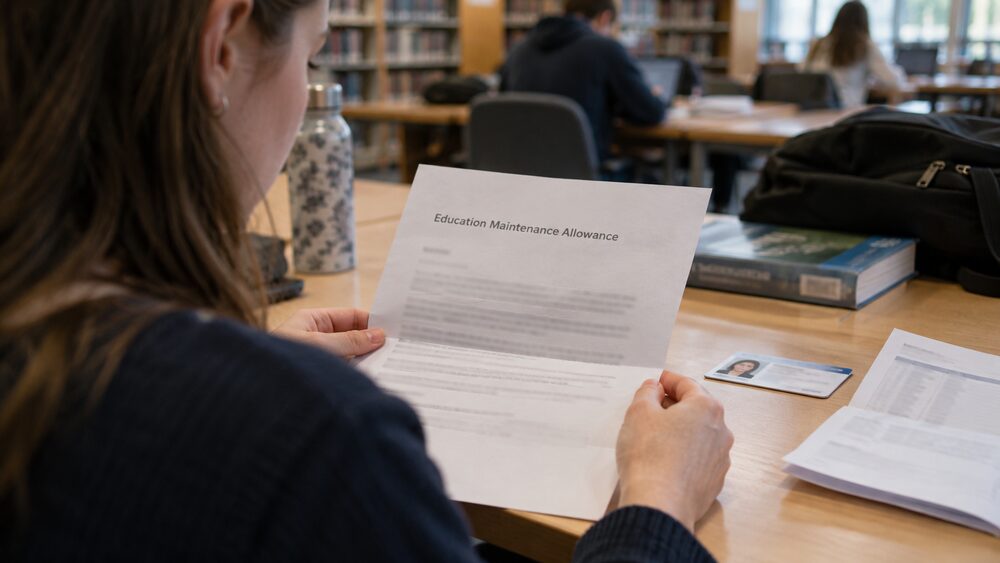
Young people aged 16 to 19 who stay on at school or college in Scotland, Wales or Northern Ireland may get the Education Maintenance Allowance, usually called EMA: a weekly, means-tested payment made to the student to help with the costs of continuing in education1. The scheme is closed in England, where schools and colleges instead hold bursary funds for 16 to 19 year olds who need help, including young people in care, care leavers and those claiming Universal Credit or disability benefits2.
The amounts differ by nation. In Wales EMA pays £40 a week, and in Scotland and Northern Ireland it pays £30 a week, in each case paid every two weeks into the student's own bank account during term time4. Entitlement depends on age, the level of the course and household income, and in Northern Ireland two bonus payments of £100 are available to students who meet targets set by their institution4.
What EMA is: money for staying in education after 16
EMA is a weekly means-tested allowance for 16 to 19 year olds enrolled in education, paid to encourage and support young people who stay on beyond compulsory school age6. The Welsh Government describes it as weekly £40 payments, paid every two weeks, made directly to eligible students to help with costs such as travel5. One Parents Families Scotland notes that young people aged 16 to 19 who stay in school or college may get it, and that it is paid every two weeks in arrears, during term time, into the young person's own bank account1.
The payment is a benefit in its own right rather than a grant made to a parent, which matters for how it is treated in the household. It is means-tested, so household income decides whether a young person qualifies, and it is paid only during term time, so it stops in the holidays2. In Scotland, mygov.scot confirms that a child aged 16 to 19 may get EMA7, and it is available there to students enrolled in school, college or home education6.
The scheme's territorial reach is the key thing to understand. It applies to people studying or permanently resident in Wales, Scotland and Northern Ireland, and it is closed in England2. A young person living in England therefore cannot get EMA even if they would qualify on income, though their school or college may have bursary funds available for 16 to 19 year olds in need of help3. This page sits alongside other guides on how money rules differ across the UK, starting with money in Scotland, Wales and Northern Ireland.
EMA amounts in Wales, Scotland and Northern Ireland
The weekly rate depends on which nation the student studies in. Turn2us sets out the current figures: £40 weekly in Wales, and £30 every two weeks in Scotland and Northern Ireland4. The Welsh Government confirms the £40 weekly figure for eligible students aged 16 to 18 continuing in school or college, paid every two weeks5.
| Nation | Weekly rate | How it is paid | Administrator |
|---|---|---|---|
| Wales | £40 a week4 | Every two weeks, term time1 | Student Finance Wales2 |
| Scotland | £30 a week4 | Every two weeks, term time1 | Local authority or college bursary office2 |
| Northern Ireland | £30 a week4 | Every two weeks, term time1 | Student Loans Company2 |
The administrators differ, and that decides where an application goes. In Wales EMA is administered by Student Finance Wales; in Scotland by the local authority or college bursary office; and in Northern Ireland by the Student Loans Company2. Some sources describe the Scottish and Northern Irish rate as £30 a week8, while others describe it as £30 every two weeks4; the Turn2us figure of £30 every two weeks is the more detailed of the two, and the Welsh £40 weekly rate is confirmed by the Welsh Government itself5.
On top of the weekly amount, Northern Ireland offers two bonus payments of £100, awarded to students who achieve goals set out by their educational institution4. These are described in more detail in the section on attendance and progress conditions below.
Who qualifies: age, course level and household income
Three things decide eligibility: the young person's age, the level of the course, and household income. The age rule is 16 to 19 years old across the three nations that still pay EMA2. In Scotland, EMA is available to students aged 16 to 19 enrolled in school, college or home education, and only for households earning under an income threshold6.
The income test works on the household income of the parents or guardians. One Parent Families Scotland gives the figures used for the assessment: a child may get EMA if household income is below £24,421, or below £26,884 if there is more than one child who qualifies1. The higher limit recognises that a family supporting two or more young people in education at the same time has more calls on the same income.
The course must be non-advanced education, which means the level of study below higher education: broadly GCSEs, A levels and their vocational equivalents rather than degrees2. In Scotland, further education for EMA purposes is SCQF level 6 including Standard Grades, National 5, Highers, Advanced National Certificates, SVQs up to level 3, Ordinary National Diplomas, Advanced Highers, and Modern Apprenticeships that do not form part of a contract of employment1. In Northern Ireland, the courses listed for EMA include GCSEs, A levels, NVQ or SVQ at level 1, 2 or 3, Pre U, BTEC National Diploma, National Certificate and First Diploma, Baccalaureate, and SCE higher grade or similar6.
A young person's own circumstances can also matter. A single parent who lives with their own parents, where those parents get benefits for them and their child, will get the Educational Maintenance Allowance rather than a bursary8. And where a young parent aged 16 to 20 is in further education, other help exists alongside EMA, such as the Care to Learn Scheme, which requires the applicant to be a parent aged 16 to 20 in further education6.
How to apply for EMA in each nation
The general rule is that the application for EMA is made in the country where the student is studying9. Applications are made on a form available from the young person's school, college or local council1, and application packs are likewise available from schools, colleges and the local council8. In Wales, the Welsh Government points students to checking eligibility and applying online, which it describes as taking minutes5.
Where the application goes depends on the nation, because the administrators differ. In Wales, Student Finance Wales runs the scheme; in Scotland, the local authority or college bursary office does; in Northern Ireland, the Student Loans Company administers it2. A student in Scotland or Wales who plans to study in England applies instead in the country where they normally live, which is covered in a later section3.
Once past EMA and into higher education, the application route changes. Students in Wales can apply for a Tuition Fee Loan to cover fees and a Maintenance Loan to help with living costs, along with a Welsh Government Learning Grant10. Applications for full-time undergraduate student finance for the 2026 to 2027 academic year are open through the student finance system10. From 1 January 2027, new courses and modules are funded through the Lifelong Learning Entitlement, which can include a Tuition Fee Loan, a Maintenance Loan, and extra funding such as a grant or allowance, for example for low income, disability or having children11. A student returning after a break of 12 months or more will find their previous application has been closed, and must either apply through the existing service for a course that started before 1 January 2027 or apply for Lifelong Learning Entitlement funding for a new course or module on or after that date11.
Attendance and progress conditions, and the Northern Ireland bonus payments
EMA is conditional. The payment is made only if the student regularly attends and works hard on the course4. That means a school or college can stop payments where attendance slips or effort falls away, so the allowance operates as a payment for continuing participation rather than an unconditional entitlement.
Northern Ireland adds a performance element on top. Two bonus payments of £100 are available there, awarded if the student continues to do well and meets the targets set by their teacher when they start4. Entitledto describes these as payments to students who achieve goals set out by their educational institution6. The targets are set at the start of the course, so a student knows from the beginning what they need to do to receive them.
The practical effect of the attendance condition is that payments follow the term-time calendar. EMA is paid every two weeks in arrears during term time1, so a student who is paid at the end of a fortnight is being paid for attendance already completed. Nothing is paid during the holidays, because the payment is tied to being on the course1.
EMA does not affect benefits or part-time earnings
Two reassurances come up repeatedly in the guidance, and both matter to families on low incomes. First, EMA is not affected by any money the student earns from part-time work4. A young person can work under 24 hours per week and still get the EMA1. Second, the EMA will not make any difference to any benefits the student's parents or guardians get4, and the young person's EMA, or income from working under 24 hours a week, will not reduce any benefits the parents receive1.
This works in both directions. The parents' benefits are not reduced because a child in the household receives EMA, and the child's EMA is not reduced because they have a Saturday job. The same guidance notes that EMA is paid fortnightly into the student's bank account during term time and does not affect entitlement to other benefits8.
For young people with disabilities or caring responsibilities, separate rules can apply at the same age. Students, whether full time or part time, can claim Employment and Support Allowance if they satisfy all the rules6, and in Scotland, Carer Support Payment can be available to students aged 16 to 19 studying part-time courses at any level, or full time for an advanced qualification such as an HNC, HND or a degree6. Disabled students in higher education can also get funding through Disabled Students' Allowances, which sit alongside rather than instead of the standard loans12.
Studying in England while living in Scotland or Wales
The rule that the application is made in the country where the student is studying9 has one important exception. If the student lives in Scotland or Wales and plans to study in England, the application for EMA is made in the country where they normally live3. Turn2us puts it plainly: a student in that position can get EMA, and the application is made in the country they normally live in3.
This matters because the England scheme itself is closed2. A Scottish or Welsh resident crossing the border to study does not lose entitlement by doing so; the entitlement follows residence, not the location of the college. The application is therefore made to the home nation's administrator: Student Finance Wales for a Welsh resident, or the local authority or college bursary office for a Scottish resident2.
The position is different for a young person who lives in England, whatever their course. The EMA scheme in England is closed, and the support that exists there is the 16 to 19 bursary funds held by schools and colleges, awarded to students aged 16 to 19 who need help, including those in care, care leavers, those claiming Universal Credit, and those receiving Universal Credit together with either Disability Living Allowance or Personal Independence Payment3.
After EMA: how new-style student loans are repaid
When a young person moves from further education to higher education, the funding changes from allowances to loans. New-style student loans apply to students starting their course from 1 September 1998 onwards13, and the loans that must be repaid include Tuition Fee Loans, Maintenance Loans for living costs, and postgraduate loans such as a Master's Loan or a Doctoral Loan14.
Repayment does not begin immediately. Repayments on a new-style student loan are not due until the April after graduation, and then only if income is over the income threshold15. The amount paid is 9% of the difference between actual income and the income threshold15, or 9% of income over the threshold on Plan 1, Plan 2, Plan 3 and Plan 4, and 6% of income over the threshold on a Postgraduate Loan plan16. Postgraduate Master's and Doctoral Loans follow the same principle: repayment starts when income is over the threshold amount17.
The threshold depends on where and when the course started. For students starting their course from September 1998 onwards, the income threshold is £33,795 per year15, which is also the figure given for Scotland20. For courses started in Wales on or after 1 September 2012, or in England between 1 September 2012 and 31 July 2023, the threshold is £29,385 per year, and for courses started in England on or after 1 August 2023 it is £25,000 per year19. Interest on the amount owed is linked to inflation and can go up and down, applied for as long as the loan lasts15.
Collection is through the tax system. Repayments are usually collected by HM Revenue and Customs through the employer, taken from wages before they are paid19, and self-employed borrowers repay through their self-assessment tax returns15. Anyone outside the UK tax system repays the Student Loans Company directly15, and the government expects borrowers leaving the UK to keep repaying unless they can give proof, for example a recent bank statement, that their overseas income is below the threshold14. In Northern Ireland, Student Finance NI pays Maintenance Loan money into the student's bank account in three instalments, one at the start of each term21, and the same termly pattern applies generally, with Maintenance Loans paid directly into the bank account at the start of each term after registering22.
Living-cost support is assessed on household income, though all eligible students can get a basic non-income assessed minimum amount of Maintenance Loan23. In Wales, the maximum maintenance support for 2026/27, combining grant and loan, is £15,720 for students living away from home in London and £12,590 for those living away from home outside London, and all students there receive a £1,020 annual non-means-tested maintenance grant12. Students aged 60 or over on the first day of the first academic year of a part-time course cannot apply for a Maintenance Loan, but can get a Tuition Fee Loan and Disabled Students' Allowance if eligible24. The government's student finance calculator works out what a particular student would receive22. One point to note for benefit entitlement: the majority of any Student Loan for Maintenance that a student is entitled to, even if they choose not to take it out, is counted as income for means-tested benefits25.
When a student loan is written off
Student loans are not open-ended debts: each plan has a write-off point after which anything still owed is cancelled. The rules differ by plan and by when the loan was taken out.
| Loan | Written off |
|---|---|
| Plan 2 | 30 years after repayments were due26 |
| Plan 5 | 40 years after repayments were due26 |
| Lifelong Learning Entitlement | 40 years after the April first due to repay27 |
| Plan 1, first loan before 2006/07 academic year | when you reach 6526 |
| Plan 1, first loan from 2006/07 academic year onwards | 25 years after repayment started26 |
| New-style loans (30-year rule) | 30 years after repayments were due15 |
The Plan 1 rules split at the 2005/06 academic year. If the first loan was taken out during or before the 2005/06 academic year, any remaining loan is written off when the borrower reaches 65; if it was taken out during or after the 2006/07 academic year, any loan not repaid is written off 25 years after repayment started26. The same split is described in Business Debtline's guidance, which adds that for borrowers starting between 1998 and 2012 the remaining loan is written off at 65 for the earlier group and 25 years after repayments began for the later group19. National Debtline gives a 30-year write-off for loans still owed after repayments became due15, and Plan 2 and Plan 5 loans are written off 30 and 40 years respectively after repayments were due26. For courses funded under the Lifelong Learning Entitlement from January 2027, loans are written off 40 years after the April the borrower is first due to repay27.
There is also an exceptional route: if a borrower can prove they are permanently unfit to work, the loan may be written off15. The practical meaning of a write-off date is that a loan which never gets fully repaid through income does not pass to family members or continue indefinitely; it ends at the plan's time limit, provided the borrower has kept up the income-linked arrangement rather than defaulting.
Old-style student loans: deferral, write-off and credit records
Before the income-contingent system began, the Student Loans Company issued fixed-term loans, introduced in 1990, which were replaced by the new-style income contingent system in 199820. Old-style student loans are for students who started their university course before 1 September 199813, and new-style loans apply from that date onwards13. Income contingent loans were introduced from 1998/99, and official statistics for Northern Ireland cover them from that year28.
Old-style loans work completely differently from new-style ones. They are repayable over five years, or seven years if the original course lasted more than three years, with repayments usually made by monthly direct debit unless deferred or in arrears16. They are registered under the Consumer Credit Act16 and regulated by the Consumer Credit Act 197420, which is why they behave like ordinary credit agreements rather than tax-linked loans. Many were later sold to three private sector companies: Erudio Student Loans, Honours Student Loans and Thesis Servicing20. Interest is calculated daily from the date the loan started and added to the account at the end of each month20.
Because repayment is a fixed monthly amount rather than a share of income, deferment exists for borrowers who cannot afford it. Deferment means postponing repayments for a period of 12 months19, and it stops the loan becoming due for payment for those 12 months13. Deferral lasts 12 months and interest is still added during that time16. The loan payment is automatically deferred each year if income is below the income threshold, and lower payments cannot be negotiated16. The deferment threshold is set at 85% of national average earnings20. For the rules in force from 1 September 2025 to 31 August 2026, a borrower whose gross income is £3,467.75 or less per month, equivalent to £41,613 per year, may be eligible to apply for deferment20. An earlier figure of £30,737 per year applied in 202416, which shows how the threshold moves with average earnings. Only the borrower's own income is taken into account, so no income details of a spouse, partner, parents or other relatives are needed20.
The write-off rules for old-style loans depend on age. A loan may be cancelled if the borrower was under 40 when the last agreement was made and reaches 50; if they were aged 40 when the last agreement was made and reach 60; or if the last agreement has been outstanding for 25 years, provided they have not defaulted20. Business Debtline gives the same 25-year cancellation for a last agreement outstanding that long without default19.
The credit-record consequences are the sharpest difference from new-style loans. Unless payments have been deferred or a repayment arrangement is being kept, after 28 days the account will be registered with a credit reference agency20. A new-style loan, by contrast, is collected through the tax system and does not operate as a Consumer Credit Act debt. Enforcement also differs by nation: in Scotland, if a borrower defaults on a fixed-term student loan, enforcement would be carried out in the Sheriff Court, in the same way as for any other Consumer Credit Act regulated loan agreement20. Borrowers struggling with either kind of loan can get free help from debt charities, covered in the site's guide to debt, and the rules on when debts become unenforceable over time are covered in the guide to debt law in Scotland and Northern Ireland.
Sources29 cited
- Educational Maintenance Allowance when a child turns 16 One Parent Families Scotland, 2026-02-02
- Education Maintenance Allowance (EMA) Scotland, Wales, Northern Ireland Turn2us, 2026-07-27
- Education Maintenance Allowance (EMA) England Turn2us, 2026-07-27
- How much does Education Maintenance Allowance (EMA) pay? Turn2us, 2026-07-27
- Get help with school costs Welsh Government, 2026
- Funding for learning entitledto, 2026-09-26
- Other benefits you might be able to get mygov.scot, 2022-11-14
- Help from the college One Parent Families Scotland, 2025-04-02
- How do I claim Education Maintenance Allowance (EMA)? Turn2us, 2026-07-27
- Full-time undergraduate student finance applications now open for 2026 to 2027 GOV.UK, 2026-03-23
- Apply for student finance: Lifelong Learning Entitlement GOV.UK, 2026-09-26
- Funding higher education for disabled students Disability Rights UK, 2026
- Statute barred debts (England and Wales) National Debtline, 2026-09-25
- Repaying your student loan GOV.UK, 2026-09-25
- Repaying student loans (Scotland) National Debtline, 2026-09-25
- Student loan debt StepChange, 2026-09-25
- Master's Loan GOV.UK, 2026-09-26
- Doctoral Loan GOV.UK, 2026-09-26
- Repaying student loans (England and Wales) Business Debtline, 2026-09-26
- Repaying student loans (Scotland) Business Debtline, 2026-09-26
- Student loans nidirect, 2026-06-04
- Student finance calculator GOV.UK, 2026-09-26
- Understanding student living costs GOV.UK, 2026-01-20
- Student finance: how you're assessed and paid 2026 to 2027 GOV.UK, 2026-03-23
- Benefits and higher education students nidirect, 2026-06-30
- Repaying student loans (England and Wales) National Debtline, 2026-09-25
- Student finance on or after 1 January 2027 GOV.UK, 2026-09-26
- Student loans in Northern Ireland 2025 to 2026 GOV.UK, 2026-06-18
- Statute barred debts (England and Wales) Business Debtline, 2026-09-26





 Citizens Advice ScotlandFree advice across Scotland
 Citizens AdviceFree advice on money, consumer and legal problems in England and Wales
 MoneyHelperFree, impartial money and pensions guidance, set up by government
 GOV.UKOfficial information on tax, benefits and government services