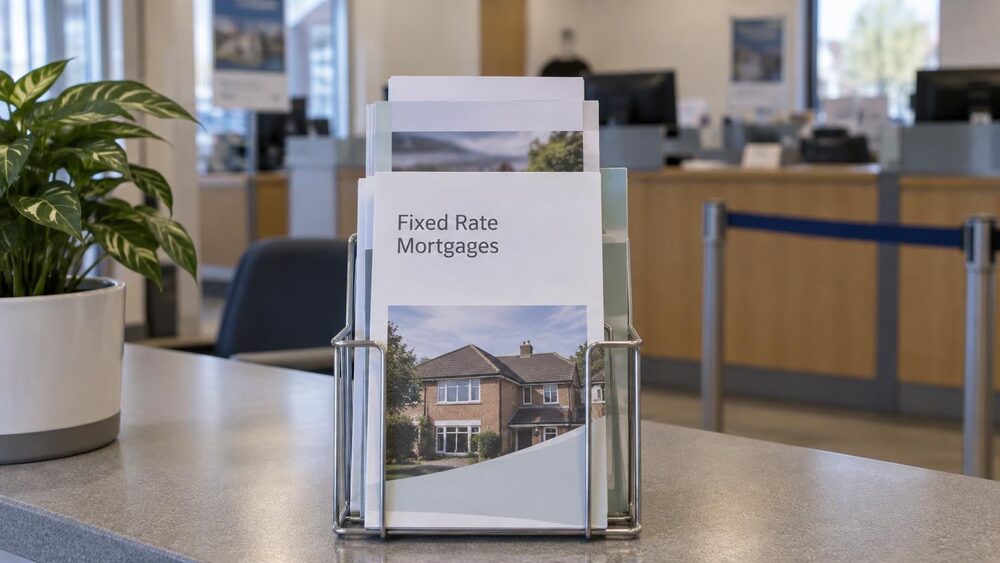
A fixed rate mortgage guarantees your interest rate for a set number of years, so the interest part of your payment cannot go up during that period no matter what happens in the wider market1. Most borrowers in the UK choose one: fixed-rate deals are one of the two broad categories of mortgage, alongside variable rates, and two-year and five-year fixes are the most common lengths1. The main advantage is simple: monthly repayments are fixed for the duration of the period, which helps with budgeting2.
The trade-offs are equally plain. A fixed deal usually carries an arrangement fee, often around £999 for a first-time buyer or home mover3. Most fixed-rate mortgages let you overpay only up to 10% of the balance each year before an early repayment charge applies3. And when the fix ends, you must remortgage to a new deal or you will be moved to your lender's standard variable rate, which is usually much more expensive1.
Fix lengths: usually two to five years, sometimes ten or more
Two-year and five-year fixes dominate the market. Borrowers most commonly take out one of these two lengths, although three, seven, ten and even fifteen year fixed terms are available1. Other guidance puts the usual range slightly differently, at between one and five years, though it can be for longer2, and some sources describe the typical choice as three or five years5. The consistent picture across all of them is that the fix itself is short relative to the mortgage behind it: the mortgage term, the full length over which the loan is repaid, is usually 25 to 30 years6.
The fixed period is a deal bolted onto that longer term, not the term itself. Your rate is set for an agreed period, often two or five years7, and at the end of it you choose a new deal or fall onto your lender's default rate. That is why the choice of length matters: a two-year fix gives you the chance to re-price often, but also means going through the remortgage process, and possibly paying fees, every two years. A five-year fix spreads those costs and gives longer certainty, at the price of being committed for longer if rates fall.
Longer fixes exist but are a smaller part of the market. Three, seven and ten year fixed terms are available alongside the common two and five year deals8. A ten-year fix suits someone who wants a decade of predictable payments and is confident they will not need to exit early, because the early repayment charge window is correspondingly long. The general rule is that the longer the guarantee, the more you give up in flexibility.
When rates rise or fall: what a fixed rate protects you from and what it does not
A fixed rate protects you from rises. Whatever happens to interest rates in the wider economy, your rate stays where it was set for the whole of the fixed period, and so does the interest element of your monthly payment1. The scale of what that can shield you from was shown in the period after Bank Rate rose sharply: one projection estimated the typical monthly repayment on a fixed-rate mortgage would rise from around £700 to around £1,100 on average as borrowers came off cheaper deals onto new, more expensive ones9. A fix does not stop that happening when the fix itself ends, but it does postpone the shock and make the date of it predictable.
What a fix does not do is let you benefit when rates fall. If the lender's standard rate falls below your fixed rate, you lose out10. This is the mirror image of the protection: the guarantee binds both sides. A borrower on a variable rate sees payments go up or down with the market11, while a borrower on a fix watches falls pass them by. Guidance on the market has noted that while rates were falling in the mid-2020s, they remained significantly higher than in the 2010s, which meant fixed-rate mortgages generally offered the better deal at that time12, but that judgement depends on the level of rates when you take the fix and can change.
It is worth being clear about what "fixed" fixes. It fixes the interest rate, not every part of your payment. On a repayment mortgage the payment is calculated from the rate and the balance, so a fixed rate does normally mean a steady payment, but other charges, such as buildings insurance or ground rent on a leasehold, are unaffected. And the guarantee lasts only for the fixed period: the standard variable rate you would move to afterwards tends to be significantly higher than the rates on other types of mortgage7, and much higher than an introductory rate on a new deal13.
There is also a regulatory angle that shows how the system treats fixes. Under the FCA's responsible lending rules, mortgage lenders must, in relevant cases, take into account the impact of likely future interest rate increases on affordability, unless a mortgage's interest rate is fixed for five years or more from the expected start of the term, or for the duration of the contract if it is shorter14. In other words, a fix of five years or longer is treated as removing the near-term rate risk that affordability assessments are designed to test.
Fees and charges on a fixed deal
The headline rate on a fixed deal is only part of its cost. Most fixed deals carry an arrangement fee, and for home movers or first-time buyers fees of around £999 are common3. Remortgagers are typically charged higher fees, with many close to £2,0003.
An analysis of leading fixed-rate deals in January 2026 found the averages shown below, along with a most common fee of £999 for a leading first-time buyer or home mover deal, rising to £1,999 for the most common fee on top remortgaging deals15.
| Borrower type | Two-year fix, average fee | Five-year fix, average fee |
|---|---|---|
| First-time buyer | £1,079 | £1,033 |
| Home mover | £1,185 | £1,236 |
| Remortgager | £1,673 | £1,349 |
The same analysis found fees can be as much as £3,999, but the majority of products had fees of £1,000 or less15. Percentage-based fees, where the fee is a proportion of the loan rather than a flat amount, are generally found on properties over £750,000 and are much more common with buy-to-let mortgages15.
Fee-free deals exist, but the fee is usually recovered through the rate. Choosing a fee-free deal typically costs roughly £15 extra per month, or £180 per year, across two and five-year fixed mortgages15. Whether a fee is worth paying therefore depends on the size of the loan: a flat fee spread over a large mortgage matters less than the rate, while on a small mortgage a high fee can outweigh a slightly lower rate.
It is usually possible to add upfront mortgage fees to the loan rather than paying them in cash16. The cost of that convenience is that the fee then sits in the mortgage balance and attracts interest, costing you far more overall17. In one first-time buyer example, adding the fee to the loan cost just over £316 extra over the course of a five-year fixed term15. The full guide to mortgage fees and charges covers the other costs of taking out a deal, including valuation and legal fees.
Early repayment charges and the 10% overpayment allowance
The main thing a borrower gives up in return for a fixed rate is freedom to leave. Most fixed-rate mortgages allow you to overpay up to 10% of the balance each year, either in regular overpayments or on an ad-hoc basis; overpaying more than that in a 12-month period may trigger an early repayment charge3. The same charges apply to repaying the mortgage in full or moving it to another lender during the fixed period.
Charges reduce the longer you have the deal, but can be as much as 5% of the mortgage balance in the first year18. A typical structure on a five-year fix, illustrated on a £200,000 mortgage, steps down each year3:
Individual lenders set their own structures, and the details vary. One building society's two-year fixed deal charges 2% of any excess overpayment above the 10% allowance in year one, falling to 1% in year two19. On ten-year fixes, competitive deals have been structured with a 3% charge in years three to five, falling to 1% in years six to ten20. The exact charge for a particular mortgage is set out in its mortgage illustration and offer, and the dedicated guide to early repayment charges covers how they work in full.
The 10% allowance is per year, not one-off, and it is usually measured on the balance at the start of each 12-month period. For a borrower who wants to pay a mortgage down faster, the allowance gives meaningful room: on a £200,000 mortgage, 10% is £20,000 a year of overpayments before any charge arises. The guide to overpaying your mortgage explains how allowances are applied and how to check yours.
Who can get a fixed rate mortgage and what affects the rate
Fixed-rate mortgages are the mainstream product: by 2017, fixed rate loans accounted for 92% of regulated mortgage lending21. Getting one is subject to the same affordability assessment as any mortgage, but a few factors particularly shape the deal you are offered.
Deposit and loan to value. Mortgages are available with just a 5% or 10% deposit, but a bigger deposit may get you a lower mortgage rate or a wider choice of deals22. You will usually need at least a 5% deposit, which means a 95% loan to value mortgage23, and guidance for applicants puts it the same way: a deposit of at least 5% of the property's value24. It is possible to get on the property ladder with a deposit of 5% of the purchase price and a mortgage covering the rest25. The lower your loan to value, the more deals open up and the cheaper they tend to be. The Mortgage Guarantee Scheme supports 95% lending.
Income and proof of earnings. Lenders check affordability, and how much you can borrow depends on income, outgoings and debts. The guide to how much you can borrow covers the rules. Self-employed applicants face extra requirements: to provide proof, you will need statements from an accountant and your tax return form SA302, plus supporting information such as bank statements and receipts26. Lenders differ on how many years they want to see, and some will accept two SA302 forms27. Lenders will usually require a deposit of at least 10% of the purchase price if you are self-employed28. The full guide to mortgages for self-employed people goes through this in detail.
Credit history and circumstances. Problems in your credit file narrow the choice of lenders rather than ruling out a mortgage altogether; the guide to getting a mortgage with bad credit explains what is available. Whether you apply direct or through a broker also affects which deals you see, since some lenders are broker-only.
The length of the fix itself. As above, the FCA's affordability rules treat a mortgage fixed for five years or more differently, because the near-term rate risk is removed14. This is one reason five-year fixes are widely offered and heavily marketed.
When the fixed period ends, you move to the standard variable rate
A fixed rate does not last for the life of the mortgage. You pay the same interest rate for an agreed number of years, before going back to the lender's standard variable rate (SVR) or, if you choose, remortgaging29. A standard variable rate mortgage is what you will be transferred onto when a fixed, tracker or discount deal comes to an end7. If you do nothing, you will usually be moved to an SVR11.
The cost of doing nothing is the reason this section matters. Standard variable rates tend to be significantly higher than the rates on other types of mortgage7, and the SVR is usually much more expensive than a new deal1. The scale of the flow of borrowers reaching this point is large: around 700,000 fixed-rate mortgages were set to reach the end of their deal rate in the second half of 2024 alone30.
The timing rules work in your favour. Under the Mortgage Charter, with effect from 10 July 2023, customers approaching the end of a fixed rate deal have the chance to lock in a deal up to six months ahead4. You can usually secure a new mortgage six months before your current one ends8. Two protections sit alongside that window: rates must be finalised two weeks before the new term starts, and six months is the maximum time lenders may offer for customers to sign up to a new deal under the Charter31. You can request a better like-for-like deal from your lender, if one is available, right up until the new term starts31. For borrowers coming to the end of a fixed period whose lender has signed the Charter, the new rate can be offered up to six months before the old one expires, and you can change your mind if rates go down32.
Your lender should make the first move: lenders will talk to you about a new deal about three to six months before the end of the one you have now11. But you do not have to wait for that letter. The options at this point are to remortgage to a new lender, do a product transfer with your existing one, or let the deal lapse onto the SVR, which is rarely the cheapest of the three. The narrow guide to what to do when your fixed rate ends works through the choice, and how far ahead you can lock in a new rate covers the timing rules in detail.
If payments become hard to manage
A fixed rate makes payments predictable, but it does not make them affordable if your income falls. If you are unable to keep up repayments on your mortgage, your home could be repossessed by your lender7. That is the serious end of the process, and it is not where it starts: lenders must follow pre-action rules before going to court, and the earlier you engage, the more options exist. The guides to mortgage arrears and what a lender must do before going to court set out the sequence.
The first step is to tell your lender. Free, independent help is available: debt advice charities such as National Debtline publish guides on mortgage arrears and on help with mortgage payments33, and a mortgage adviser can help restructure the borrowing itself, for example by extending the term.
Some homeowners can claim help with the interest. Support for Mortgage Interest is paid as a loan, and it comes with a condition: if no arrangement is made to pay future mortgage or secured loan payments, payments to your mortgage will stop, arrears can build up, and the lender could eventually take court action to evict you from your home35. The guide to Support for Mortgage Interest explains who qualifies and how the loan is repaid.
If a complaint about how your lender has treated you in difficulty is not resolved by the lender, the Financial Ombudsman Service can look at it, including complaints about financial difficulties with mortgages32. The guide to complaining to the Financial Ombudsman about your mortgage explains the process.
Sources35 cited
- Mortgage types explained Which?, 2026
- About mortgages Building Societies Association, 2023
- Fixed rate mortgages Which?, 2026
- Mortgage Charter HM Government, 2023
- Understanding interest charges StepChange Debt Charity, 2026
- Sorting out mortgage problems Housing Rights, 2026
- Standard variable rate mortgages Which?, 2026
- What to do if you need to remortgage Which?, 2026
- Projecting the effect of peak Bank Rate on mortgage holders NIESR, 2022
- Mortgage repayment options Shelter Cymru, 2026
- Mortgage term ending StepChange Debt Charity, 2026
- Discount mortgages Which?, 2026
- Porting a mortgage Which?, 2026
- Withdrawal of the FPC's affordability test recommendation Bank of England, 2022
- Are mortgage fees worth paying to secure the best rates? Which?, 2026
- 6 things to know about mortgage fees Which?, 2026
- Remortgaging to release equity and cash from your home Which?, 2026
- Should you remortgage to fund home improvements? Which?, 2021
- Credit Assist Extra 2 Year Fixed Rate Mortgage Cambridge Building Society, 2026
- Should you fix your mortgage rate for 10 years? Which?, 2019
- Trends in regulated mortgage lending 2007 to 2016 Finance and Leasing Association, 2017
- How to get a mortgage Building Societies Association, 2023
- Loan to value LTV calculator HomeOwners Alliance, 2026
- Applying for a mortgage Which?, 2026
- How much deposit do you need for a mortgage? Which?, 2026
- Applying for a mortgage Which?, 2026
- Mortgages for self-employed buyers Which?, 2025
- Self-employed mortgage squeeze: can you still get a deal? Which?, 2025
- Interest rates applied to mortgages Financial Ombudsman Service, 2026
- Household Finance Review 2024 Q2 UK Finance, 2024
- Mortgage Charter HM Government, 2023
- Financial difficulties with mortgages Financial Ombudsman Service, 2026
- Mortgage arrears National Debtline, 2026
- Help with mortgage payments Business Debtline, 2026
- How do I claim Support for Mortgage Interest loan? Turn2us, 2026






 MoneyHelperFree, impartial money and pensions guidance, set up by government
 StepChangeFree debt advice and solutions from a charity
 Financial Ombudsman ServiceFree, independent help when a complaint about a firm is not put right
 Citizens AdviceFree advice on money, consumer and legal problems in England and Wales
 ShelterFree housing advice from a charity