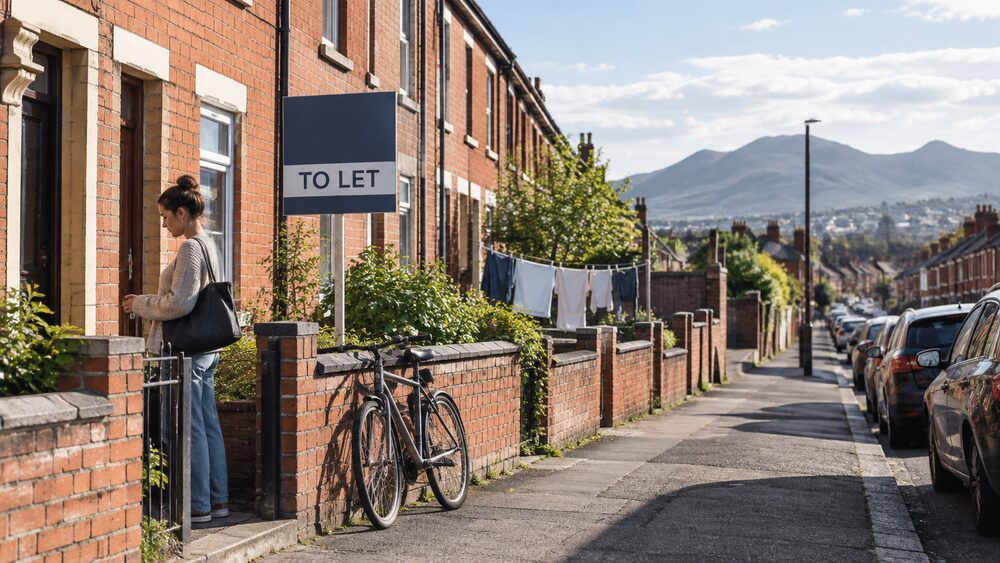
Buying a home in Northern Ireland works much as it does anywhere else in the UK: you borrow from a bank, building society or specialist lender, secured on the property, and repay it monthly over a term of years. The mortgage itself, and the rules lenders must follow, are set UK-wide. What differs in Northern Ireland is the market around the mortgage: house prices are lower than in most of the UK, some government schemes that exist in England, Scotland and Wales are not available, credit unions cannot lend for a house, and help with housing costs comes through different channels.
The numbers give a picture of the market. Official statistics for 2024/25 show 29% of households in Northern Ireland bought their home with a mortgage1, and Northern Ireland had the lowest median weekly mortgage payment in the UK, at £141, which was £43 per week lower than the UK figure2. Lending is more conservative than it once was: the average loan-to-income ratio for all mortgage sales in Northern Ireland was 3.0 times income in 2025, and mortgage activity in 2025 was around 42% lower than in 20063.
How mortgages work in Northern Ireland
A mortgage in Northern Ireland is the same product as elsewhere in the UK: a loan secured on your home, repaid monthly, with the property at risk if payments are not kept up. The Financial Conduct Authority regulates lenders and advisers UK-wide, and the process of applying, getting a mortgage in principle, having a valuation and completing works the same way. House price data for Northern Ireland comes from Land and Property Services, the local registry, alongside the Land Registry in England and Wales and Registers of Scotland8.
What is genuinely different is the local housing system. Northern Ireland has domestic rates rather than council tax, and help with those bills comes through Housing Benefit for rates, claimed through the Northern Ireland Housing Executive9. If you own your own home and qualify, you can claim Housing Benefit to help with the rates, but Housing Benefit does not cover a mortgage10. Support for the interest on a mortgage is a separate matter, and qualifying lenders for that purpose include deposit takers and insurers11. The practical point for a borrower is that owning in Northern Ireland brings rates bills alongside the mortgage, and the help available for those bills is separate from any help with the loan itself.
Who lends in Northern Ireland: banks, building societies and specialist lenders
Most UK-wide banks and building societies lend on Northern Ireland properties, and Belfast has its own banks. The market also has a professional infrastructure: mortgage brokerage is a large subsector in Northern Ireland, with some 40 companies employing around 715 people11. That means a borrower can go direct to a lender or use a broker, and the choice between the two works as it does anywhere in the UK, as covered in mortgage advice: brokers, advisers and applying direct.
Not every lender covers every part of the UK on the same terms. Some building societies issue separate mortgage conditions for different territories, for example one set of conditions for Scotland and another for England and Wales, and separate buy-to-let conditions again12. A lender's willingness to lend on a Northern Ireland property, and on what terms, is set out in its mortgage conditions and offer documents, and a broker can confirm which lenders are active in the local market at any time. Specialist lenders, including those serving the buy-to-let and self-build markets, also operate in Northern Ireland, and local banks publish their own mortgage ranges there, with representative examples covering first-time buyer, home mover, switcher and self-build products13.
Credit unions in Northern Ireland do not offer mortgages
This is the single biggest difference from the rest of the UK, and it catches people out. Credit unions in Northern Ireland cannot offer mortgages, current accounts or insurance, and cannot lend to other credit unions5. Credit unions in Great Britain can offer mortgages, and so can credit unions in the Republic of Ireland, but the Northern Ireland versions cannot5.
The reason is legal. Credit union law is largely devolved in Northern Ireland14, and the key legislation, including the Credit Unions (Northern Ireland) Order 1985, does not permit the financial services that credit unions elsewhere can provide. Credit unions in Northern Ireland are consequently prohibited from providing services such as hire purchase agreements, conditional sale agreements, insurance and loans to other credit unions5. They can take savings and lend to members, with interest capped at 1% per month on loans, and loans to corporate members are limited to 10% of the outstanding balances on all loans made by the credit union to members5.
The position has a history. A 2007 inquiry noted that Northern Ireland's credit unions received no governmental funding, and that recommendations made for credit unions elsewhere did not apply to those in Northern Ireland15. Anyone hoping to borrow for a home from a credit union in Northern Ireland will need to look instead at the mainstream options on this page, or at the Co-ownership scheme described below.
Fixed or tracker: which deal lengths are available
The deal types on offer in Northern Ireland are the same as across the UK. Borrowers most commonly take out two-year or five-year fixed-rate mortgages, although three, seven, ten and even fifteen year fixed terms are available in principle16. Tracker mortgages also have an introductory deal period, most commonly two years16.
Availability of the longer terms changes constantly, and in late 2026 it was thin. As of 23 September 2026, no lenders were offering 7-year fixed rate products17, no lenders were offering 15-year fixed rate products18, and no UK lenders were offering 10-year tracker products19. So while a fifteen-year fix exists as a concept, a borrower shopping at that moment would have found none on the market. The practical choice for most Northern Ireland borrowers is between a two-year and a five-year fix, or a short tracker, with the standard variable rate as the fallback once a deal ends.
How each type behaves matters more than its label. A fix gives certainty of payment for the deal period; a tracker follows the Bank Rate up and down. The trade-offs, including early repayment charges for leaving a deal early, are the same in Northern Ireland as elsewhere, and are covered in fixed vs tracker mortgage.
First-time buyers: low-deposit and 100% mortgages
First-time buyers in Northern Ireland borrowed at an average of 3.1 times income in 2025, slightly above the 3.0 average for all mortgage sales4. That local picture is what makes the market more accessible than in many regions, but raising a deposit is still the first hurdle, and the routes to a small deposit differ from England and Wales.
The government-backed Mortgage Guarantee Scheme, which supported 5% deposit lending, closed to new loans on 31 December 201620. The replacement options are:
- Co-ownership. The Northern Ireland Co-ownership scheme can help people who cannot afford to buy a home outright21. You buy a share of the property and rent the rest, in a structure similar to shared ownership elsewhere in the UK.
- Rent to Own. Rent to Own allows tenants to pay a fixed market rent for a three-year period, with the ability to buy their home any time after the first year22. The UK-wide Rent to Buy scheme works differently, and there is a different scheme in Northern Ireland23.
- Specialist 100% lending. In September 2026 the specialist lender Gable Mortgages launched five-year fixes at up to 100% loan to value, including a new-build rate at the same LTV24. True no-deposit mortgages are rare, and terms should be checked carefully.
- Lifetime ISA. Savings and the government bonus can go towards a first home costing £450,000 or less anywhere in the UK7, which comfortably covers the Northern Ireland median price.
Family-assisted mortgages: what is and is not available
Family-assisted mortgages, where a relative's savings or property help a borrower qualify, exist across the UK in several forms, and the dedicated guide to joint borrower sole proprietor and family-assisted mortgages covers how they work. The best-known version is the family springboard mortgage, where a helper's savings are held as security. As of 23 September 2026, no lenders were offering family springboard mortgage products25. That may change, but a family relying on that specific structure should check current availability before making plans.
Other family routes remain. A gifted deposit from a family member is accepted by most lenders and does not depend on a particular product existing. A Lifetime ISA can be combined with a partner's: if the person you are buying with has a Lifetime ISA, you can both use your savings and government bonus, provided you are both first-time buyers and meet all the conditions7. The Financial Ombudsman Service has also said that where a loan or credit card was used to make up a shortfall in a deposit for a Lifetime ISA house purchase, it may recommend a refund with interest26, which is relevant to families helping to assemble a deposit.
One scheme that does not reach Northern Ireland: there are no government-backed loans to help build homes in Scotland or Northern Ireland, so the Help to Build equity loan available in England and Wales has no equivalent there27.
Self-build and unencumbered property mortgages
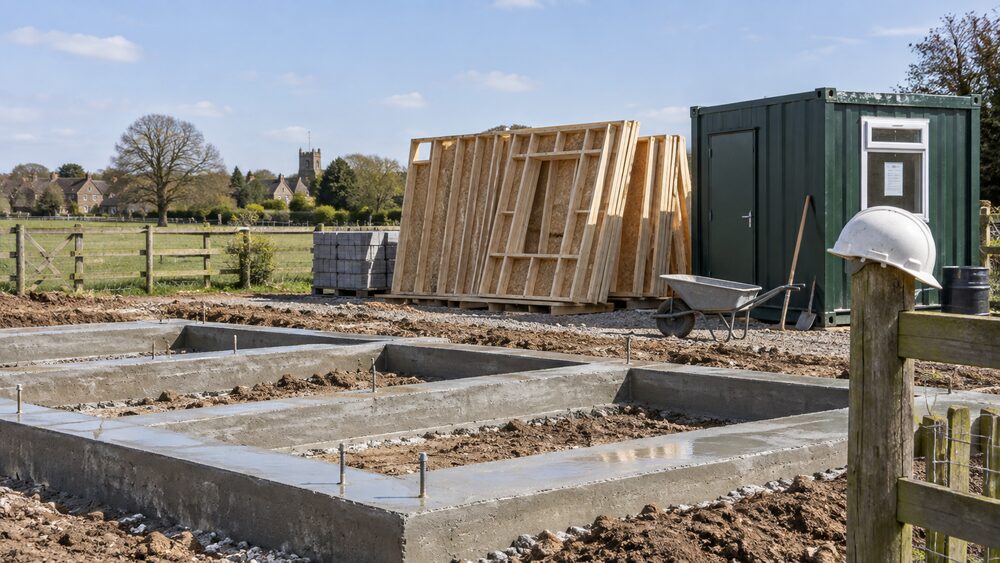
Self-build mortgages, where money is released in stages as the building work progresses, are available in Northern Ireland. Local banks publish representative examples covering self-build mortgages13, and the general guide to self-build and renovation mortgages explains how staged release works and what a lender will want to see. What is not available is the government equity loan: there are no government-backed loans to help build homes in Scotland or Northern Ireland27, so a self-builder in Northern Ireland must finance the whole project privately.
A different case is the unencumbered property: a home owned outright, with no mortgage on it. Borrowing against such a property is treated as a remortgage, and some building societies publish specific guidance on these cases, with one having published a guide to unencumbered mortgages in September 202628. The lender will still assess affordability and value the property, and the loan is secured on the home in the usual way, so the risks are those of any mortgage. The uses vary, from home improvements to helping family, and the options are the same as for any remortgage, including the possibility of borrowing more later.
Buy-to-let mortgages in Northern Ireland
Buy-to-let mortgages work in Northern Ireland as they do UK-wide: the loan is assessed on the expected rental income as well as the borrower's circumstances, the deposit is typically larger than for a home you live in, and the rules differ from residential lending. The full picture is in buy-to-let mortgages explained.
Lenders document their buy-to-let terms separately from residential ones. Newcastle Building Society, for example, issues buy-to-let mortgage conditions separately from its general mortgage conditions, and its residential conditions themselves vary by territory12. A landlord in Northern Ireland should check that a lender's conditions cover Northern Ireland properties before applying, since some lenders restrict lending by territory. Local factors also matter: rents data for Northern Ireland covers newly advertised lets8, drawn from advertised new rents from the Northern Ireland Housing Executive29, so the rental figures a lender uses for affordability may reflect the newest lets rather than the whole market. Landlords should also be aware that a Repair Grant in Northern Ireland is available to landlords, agents and tenants30, which can be relevant when a property needs work before it can be let.
Remortgaging and product transfers when your deal ends
Remortgaging means switching from one mortgage to another, either a new deal with your existing lender or a new mortgage with a different lender31. When a fixed rate ends, the loan moves to the lender's standard variable rate unless a new deal is arranged, and the two routes are a product transfer with the same lender or a full remortgage to a new one. The comparison between them, including the fees and checks involved, is covered in remortgage or product transfer.
Timing help comes from the Mortgage Charter. Customers approaching the end of a fixed rate deal will have the chance to lock in a deal up to six months ahead6, an arrangement in place since 10 July 202332. Individual lenders may set their own windows: Barclays has advised customers they can secure a new mortgage rate up to 90 days before their current deal ends33. Locking in early protects against rate rises while leaving time to shop around.
Where to get help with a mortgage in Northern Ireland
Free, impartial help exists at several points. MoneyHelper, the government-backed money guidance service, covers mortgages UK-wide, and the general guide to mortgage rules, your rights and protection sets out what a lender must do. For older homeowners, the Northern Ireland Pension Centre can help you apply for help with housing costs at the same time as your application for Pension Credit34. If payments become unaffordable, the steps in mortgage arrears and the court process in repossession in Northern Ireland apply locally.
Debt solutions are devolved in part. There is different guidance on insolvency and bankruptcy in Northern Ireland, provided by the Department for the Economy35. The eligibility limits differ too: a Debt Relief Order in Northern Ireland was amended in 2024 to raise the total value of property a debtor can own from £1,000 to £2,00036, which matters to someone with a home at stake. Some UK-wide support does not reach Northern Ireland at all: the Warm Home Discount Scheme is not available in Northern Ireland, where separate support is available37, so households should look to local schemes for energy help rather than assuming the GB position applies.
Complaints about a lender go first to the lender and then to the Financial Ombudsman Service, which covers the whole UK, as described in complaining to the Financial Ombudsman about your mortgage.
Sources37 cited
- Family Resources Survey: Northern Ireland report 2024/25 NISRA, 2026
- Family Resources Survey, financial year 2024 to 2025 Department for Work and Pensions, 2026
- Mortgage statistics UK: 2025 ONS, 2025
- Mortgage statistics UK: 2025 (PDF) ONS, 2025
- Credit union regulation and services in Northern Ireland Northern Ireland Assembly, 2025
- Mortgage Charter HM Government, 2026
- Withdrawing money from your Lifetime ISA HM Government, 2026
- Additional measures of housing affordability QMI ONS, 2025
- Housing Benefit rates Entitledto, 2026
- Can I get Housing Benefit in Northern Ireland? Turn2us, 2026
- Mortgage brokerage sector in Northern Ireland Northern Ireland Assembly, 2020
- Mortgage conditions Newcastle Building Society, 2026
- AIB (NI) mortgage representative examples AIB (NI), 2026
- Credit unions: research briefing House of Commons Library, 2026
- Inquiry into credit union regulation, services, funding and recommendations Northern Ireland Assembly, 2007
- Mortgage types explained Which?, 2026
- 7-year fixed rate mortgages Mortgage Professional America, 2026
- 15-year fixed rate mortgages Mortgage Professional America, 2026
- 10-year tracker mortgages Mortgage Professional America, 2026
- Help to Buy: Wales shared equity loan scheme quality report Welsh Government, 2024
- Low-cost home ownership schemes nidirect, 2026
- 7 first-time buyer schemes that are available now Which?, 2026
- Rent to Buy HM Government, 2026
- Mortgage rates edge closer to 6% as lenders continue to reprice Mortgage Strategy, 2026
- Family springboard mortgage rates Mortgage Professional America, 2026
- Lifetime ISA complaints Financial Ombudsman Service, 2026
- Apply for Help to Build: equity loan HM Government, 2026
- Unencumbered mortgages Suffolk Building Society, 2026
- Private rental affordability, England: 2022 ONS, 2023
- Housing grants: repair and adaptation Disability Rights UK, 2026
- Remortgage service HomeOwners Alliance, 2026
- Cost of living help with bills Business Debtline, 2026
- Barclays issues 90-day mortgage advice The Mirror, 2026
- Applying for Pension Credit in Northern Ireland nidirect, 2026
- Get help from the Insolvency Service HM Government, 2026
- Debt Relief Orders (Amendment) Regulations (Northern Ireland) 2024 legislation.gov.uk, 2024
- Continuing the Warm Home Discount Scheme: consultation HM Government, 2025




 MoneyHelperFree, impartial money and pensions guidance, set up by government
 StepChangeFree debt advice and solutions from a charity
 Financial Ombudsman ServiceFree, independent help when a complaint about a firm is not put right
 Citizens AdviceFree advice on money, consumer and legal problems in England and Wales
 ShelterFree housing advice from a charity