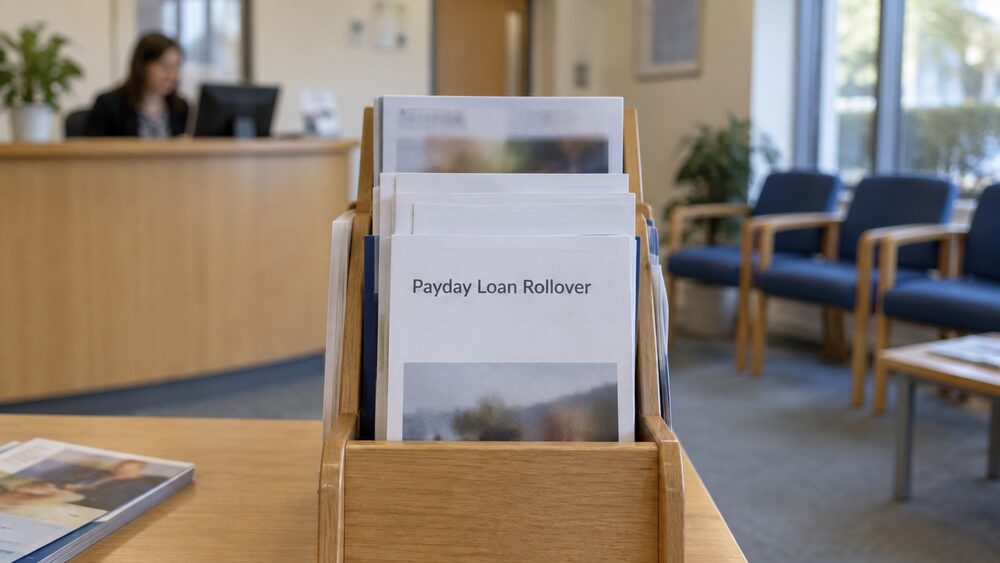
A payday lender can only roll over a loan twice. That is the rule the Financial Conduct Authority set for high-cost short-term credit, and it has been in force since 2014. A rollover, also called an extension or a deferral, is when the loan is not repaid on the original date and is carried forward to your next payday instead1.
Two other limits sit alongside it. The total you repay can never be more than double the original amount you borrowed, and a lender can only make two attempts to take money from your bank account, unless you agree a rollover1. Together these rules are meant to stop the pattern that used to define payday lending: a small loan that is rolled over again and again until the charges dwarf the sum borrowed.
If you are already at the limit and cannot repay, the practical steps are to stop further payments, ask for affordable repayment terms, and get free advice. Payday loans are a type of cash loan, normally paid into your bank account, intended to be repaid when you next receive your wages or benefits4.
What rolling over a payday loan means
A rollover lets the company take money you owe this month out of your account next month3. You normally pay any interest due so far to trigger it, and in the next loan period you may be charged interest on the original loan amount as well as a rollover fee1. The loan is not cleared; it is moved.
Payday loans are short-term by design. They are intended to be repaid when you next receive wages or benefits, and the original model was a loan of only a few weeks7. Common practice has shifted, and payday loans are now often available for longer repayment periods, up to three months, repayable in instalments8. That matters for rollovers, because a loan already spread over three months is being extended from a different starting point than a one-month loan.
Before lending, a lender must check that you can afford to repay the payday loan, and it must make clear how much it would cost you in total to repay, tell you how and when to pay back, and check your finances or personal circumstances4. Those duties apply again when a loan is rolled over or the amount of credit is increased: a lender must check your creditworthiness before it gives you a loan, rolls over a loan or increases the amount of credit2.
Why the FCA capped rollovers
The two-rollover limit came out of a review of a market that had got out of control. The FCA's own consultation in October 2013 was blunt about the aim: "We want to stop payday loans spiralling endlessly by capping the number of times they can be rolled over to two."10 The proposal was confirmed in February 2014, when the regulator said its proposal to limit rollovers to two had not changed, and that loans can only be rolled over twice and borrowers must be informed about sources of debt advice before a loan is refinanced11.
The evidence behind it was stark. Office of Fair Trading inspectors found examples of customers having 12 or more consecutive rollovers12. Payplan had seen cases where clients had "an excess of 20 payday loans"13. The FCA later noted that one in three payday loans were repaid late or not at all, equating to over 3 million loans a year14.
The rules that took effect from 2014 and 2015 included strengthened affordability checks, compulsory signposting to debt advice and limiting how many times a loan could be rolled over15. Stronger guidance on affordability checks and financial health warnings came with them15. The cap was never just about the number of rollovers: it was one part of a package designed to stop a loan being used as a long-term debt.
What happens when you reach the rollover limit
Once a loan has been rolled over twice, the lender should not refinance it again as normal business. The FCA's Consumer Credit sourcebook states that a firm must not refinance the agreement more than twice, unless it is exercising forbearance6. Forbearance means the lender is deliberately giving you leeway because you are in difficulty, not simply extending the loan on the same terms.
If a firm does refinance an agreement, it must send out an information sheet with specific warnings about borrowing more money and working out whether the agreement is affordable6. When a lender rolls over a loan, it also has to give you an information sheet telling you where you can get free debt advice16.
The cost cap is the backstop. The amount you pay cannot be more than double your original loan, and the borrower will never pay back more than twice the original amount borrowed1. So a loan of any size can cost at most twice the original amount in total, whatever happens with interest, fees and rollovers. If a lender's charges would push you past that, the cap applies.
There is also a limit on how the money is collected. Payday lenders can only make two attempts to take money from your bank account, unless you agree a rollover3. Where a customer is in financial difficulties, a firm must not request payment on a continuous payment authority more than twice on the same agreement once it has already been refused17. A continuous payment authority is the permission you give a lender to take money from your account, and it can be cancelled.
Can a lender offer a third rollover?
A third rollover is not something a lender should be offering as ordinary practice. The rule is that a firm must not refinance the agreement more than twice, unless it is exercising forbearance6. If a lender contacts you offering to roll the loan over a third time, that is worth questioning, and it is a legitimate subject for a complaint.
If you are offered a third rollover, or you are simply unable to pay, the first step is to talk to the lender and ask what forbearance it can offer. The second is to put your request in writing. You can write or email the payday loan creditor and your bank to withdraw permission for further payments8. Your bank should give you a refund, including any interest or charges added, if a payment is taken after consent is withdrawn8.
Complaints about payday loans are common and often succeed. The Financial Ombudsman Service received 17,256 complaints about payday loans in 2017/2018, and found in around six in ten cases that people had not been treated fairly by their lender19. In the first quarter of 2026/27 it opened 210 complaints about short term lending (payday loans)20. In the last quarter of 2024/25, 25% of short term lending complaints were upheld21.
Rollovers themselves are a small share of what people complain about. In a sample of 353 payday loan complaints, rollovers were the main feature in 1% (5) of cases and featured somewhere in 5% (17)14. Poor administration was the main feature in 14% (49) and an allegation of fraud in 16% (57)14. Two-thirds (64%) of the sampled cases featured more than one strand to the complaint14.
Is extending a payday loan the same as rolling it over?
Yes. Rollover, extension and deferral are different words for the same thing: the loan is carried forward rather than repaid. Lenders use all three, and the rules treat them as one1.
The distinction that does matter is between a rollover and a new loan. A rollover extends the existing agreement. A new loan is a fresh agreement with its own affordability check, its own cost and its own place in your credit file. Debt advice services are clear on the second: do not take out more debt to repay a payday loan3.
It is also worth separating a payday loan from other short-term credit that looks similar. Buy now pay later deferred payment credit usually lets you pay back over 12 months, with common options of 3 or 4 months, often called pay in 3 or pay in 422. That is a different product with different rules, and the payday rollover limit does not apply to it.
Does rolling over a payday loan affect my credit file?
A rollover is not automatically recorded as a missed payment, but the underlying risk is. If you miss a payment to your payday loan it will be recorded on your credit reference file23. A debt can only default once, but afterwards creditors can take further action to collect it24.
Repeated rollovers matter in a different way. They are evidence about whether the loan was affordable when it was made, and affordability is the ground on which most payday loan complaints succeed. Many payday loan companies have had to refund or write off debts because of irresponsible lending25. If a lender rolled your loan over repeatedly without properly checking you could repay, that history can support a complaint.
Where to get help if you cannot repay a payday loan
Free, impartial help exists and it does not cost anything. A debt advice service will look at your whole financial situation rather than just the payday loan, and it can negotiate with lenders on your behalf.
The options a debt adviser may discuss include paying reduced and affordable payments, offering a lump sum, asking the lender to write off the debt, applying for a debt relief order, or applying for bankruptcy26. If you cannot afford your monthly payments, it may be possible to get interest and charges frozen, and in some cases to have debts reduced or written off27. A payment plan or funding you can apply for to pay off your debt may also be available28.
In Scotland, there is a separate route called Time to Pay, where a court can change the amount you have to pay each month, how long the loan will last and, in some cases, the interest rate29. You can only ask the court for Time to Pay once for the same debt, and if you do not keep to the agreement you cannot apply for another one29.
If a lender has treated you unfairly, complain to it first. It must acknowledge your complaint within five days of receiving it and has eight weeks to respond or sort the problem out30. If you are not satisfied, or eight weeks pass, you can escalate to the Financial Ombudsman Service, which is free and covers complaints about payday loans and the affordability of the lending6. The ombudsman's casework shows how far these can run: one case involved a borrower who had complained to the lender about the 50 loans he had taken out with them, having started with one payday loan five years earlier32.
"I started with one payday loan five years ago"
If you are struggling with several debts, including payday loans, a debt charity can help you work out which to clear first and how to deal with the lenders. The important thing is to act before the next rollover date, because the options are wider before a payment is missed than after.
Sources32 cited
- Payday loan calculator StepChange, 2026-09-25
- Payday loans nidirect, 2026-02-25
- Dealing with payday loan debt StepChange, 2026-09-25
- Payday loans Business Debtline, 2026-09-26
- Payday loans Financial Ombudsman Service, 2022-12-23
- Payday loans (England and Wales) Business Debtline, 2026-09-26
- Payday loan debt StepChange, 2026-09-25
- Payday, guarantor and doorstep loans Advice NI, 2026-09-26
- Check if a financial service has followed the rules Citizens Advice, 2026-09-25
- Payday lending consultation Financial Ombudsman Service, 2013-10
- Payday lending report Financial Ombudsman Service, 2014-02
- Tackling the high-cost credit problem Responsible Finance, 2013-09
- Home credit market inquiry Business, Innovation and Skills Committee, 2012-03-07
- Payday lending report Financial Ombudsman Service, 2026-09-27
- Payday loans: industry changes StepChange, 2015
- Payday loans Citizens Advice, 2021-03-01
- Buy now pay later (England and Wales) Business Debtline, 2026-09-26
- Loans nidirect, 2025-09-30
- Full review 2018 Financial Ombudsman Service, 2018-05-30
- Quarterly complaints data Q1 2026/27 Financial Ombudsman Service, 2026
- Quarterly complaints data Q4 2024/25 Financial Ombudsman Service, 2024
- Buy now pay later StepChange, 2026-09-25
- Payday loans (England and Wales) National Debtline, 2026-09-25
- Default notices and missed payments StepChange, 2026-09-25
- Irresponsible lending and affordability checks StepChange, 2026-09-25
- What if I have a debt I cannot pay Mental Health and Money Advice, 2018-10-19
- What is the debt avalanche method National Debtline, 2026-09-25
- Water bills Scope, 2026-08-05
- Time to Pay debt mygov.scot, 2024-04-05
- Payday loans: making a complaint Citizens Advice, 2020-12-21
- Consumer credit complaints Financial Ombudsman Service, 2026-09-25
- Payday loan five years ago now cost everything Financial Ombudsman Service, 2026-09-27


 MoneyHelperFree, impartial money and pensions guidance, set up by government
 StepChangeFree debt advice and solutions from a charity
 National DebtlineFree debt advice by phone, webchat and online
 Financial Ombudsman ServiceFree, independent help when a complaint about a firm is not put right
 Citizens AdviceFree advice on money, consumer and legal problems in England and Wales