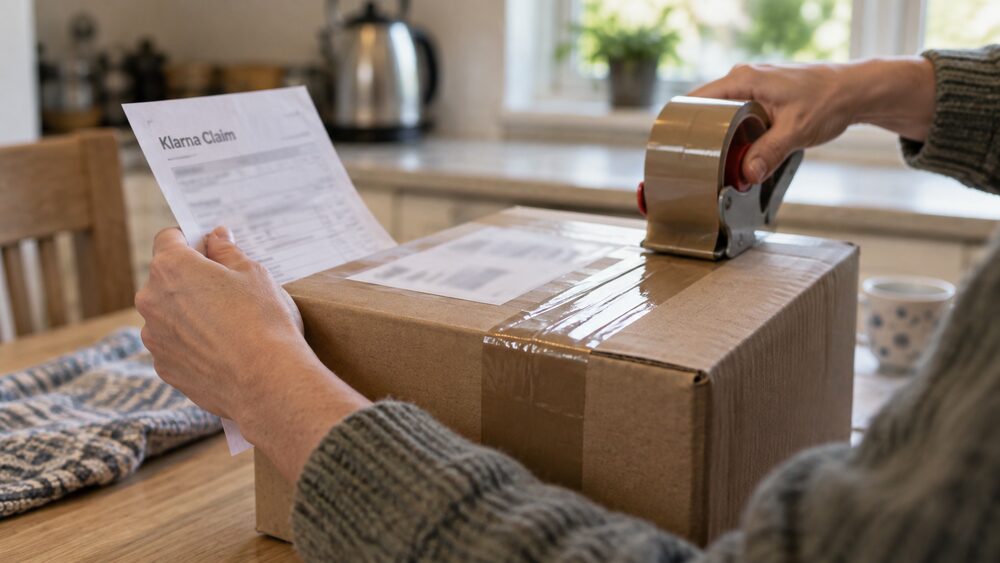
There is no single scheme called Klarna buyer protection. What covers a Klarna purchase depends on which Klarna product you used. Chargeback protection applies to purchases made using the Klarna card, and Klarna's regulated products, Klarna Financing and the Klarna Credit Card, sit under ordinary credit rules1. Pay-in-three and pay-later purchases are unregulated buy now pay later, so what stands behind them is consumer law and the retailer's own returns policy.
That is changing. Buy now pay later products such as Clearpay, Klarna and Laybuy will be covered by Section 75 once they become fully regulated by the Financial Conduct Authority at some point in 20262. The FCA's own consumer page confirms that deferred payment credit agreements carry Section 75 of the Consumer Credit Act, the same protection you would have if you used a credit card3. The date to watch is 15 July 2026, when the new rules take effect4.
Until then, the practical answer is that a Klarna pay-in-three purchase is not a credit card purchase. Section 75 does not apply to it, and using a third-party payment system such as Klarna can even break the chain that gives you Section 75 cover on a credit card you already hold5.
What Klarna buyer protection actually covers
Klarna runs more than one kind of product, and the protection follows the product rather than the brand. Klarna and PayPal both offer regulated lending products and unregulated buy now pay later products side by side8. In the UK, Klarna provides regulated credit through Klarna Financing and the Klarna Credit Card1. Those are credit agreements, and credit agreements bring credit protections with them.
The Klarna card is the clearest case. Chargeback protection applies to purchases made using the Klarna card1. Chargeback is the card scheme process that lets a card issuer reverse a payment when goods do not arrive or are not as described. It is not the same as Section 75, and it is not a legal right in the way Section 75 is, but it is the route a Klarna cardholder would use.
Klarna also sells membership tiers that bundle insurance, including global travel insurance on the Premium tier and comprehensive travel, rental-car and cancel-for-any-reason insurance on the Max tier1. Those are insurance products with their own terms, not buyer protection for shopping.
For pay-in-three and pay-later, there is no Klarna refund scheme standing behind the purchase. The FCA's consumer guidance is explicit that buy now pay later purchases are not covered by Section 75 protection in the way credit card purchases are1. What a shopper has instead is the retailer's obligations under consumer law, plus whatever the retailer's own returns policy offers on top.
Which Klarna purchases count as eligible
Eligibility turns on whether the agreement is regulated credit or unregulated buy now pay later. Klarna Financing and the Klarna Credit Card are regulated credit1. Pay-in-three and pay-later are not, at least until the new regime begins.
From 15 July 2026, buy now pay later agreements will carry rights under section 75 of the Consumer Credit Act, making it easier to obtain refunds for issues such as faulty goods9. Independent guidance puts it plainly: you will have the same Section 75 protections that you have with a purchase on a credit card4. The FCA's consumer page already describes deferred payment credit agreements as carrying Section 75, so a refund can be sought from the lender if something goes wrong with what you bought3.
The law that will underpin this is the Consumer Credit Act, and independent guidance describes buy now pay later as now having similar protections to credit cards, which are covered under that Act10. The protections are not in force yet, so a shopper deciding today should treat pay-in-three as unprotected by Section 75 and plan accordingly.
There is a second eligibility question that catches people out. Section 75 does not apply to charge cards or debit cards6. It also does not cover cases where goods or services are paid for through a third party such as a travel comparison website, PayPal or Amazon Marketplace rather than directly with a credit card11. And where a second card has been issued to someone who is not the debtor, that person lacks Section 75 protection unless they were acting as agent for the debtor12.
Fraud prevention built into Klarna payments
Klarna's own account security is the first layer. Klarna was authorised to act as an electronic money institution in July 2025, and that authorisation is what lets customers hold a Klarna balance, a digital wallet that stores e-money, allows funds to be added or withdrawn, and earns cashback on certain Klarna purchases1. Because Klarna is regulated as an electronic money institution, customers can take complaints about their Klarna balance or debit card functionality to the Financial Ombudsman Service1.
That is a meaningful protection, and it is narrower than it sounds. It covers the account and the card, not the shopping. A dispute about whether a pair of trainers arrived is a dispute about the purchase, and the ombudsman route for that depends on the underlying agreement being regulated.
Klarna has also tightened how its credit is presented. It introduced new wording for retailers to use at the checkout, which it says will make it absolutely clear that buy now pay later options are credit products with consequences for missed payments, and it updated its terms with the help of consumer group Fairer Finance to ensure they are clear, simple and easy to understand13. The FCA separately secured changes to potentially unfair and unclear terms in the contracts of four buy now pay later firms: Clearpay, Klarna, Laybuy and Openpay14.
Those changes matter to a reader because unclear terms are what make a dispute hard to win. A Which? investigation into buy now pay later schemes found 23 online retailers that did not include Klarna's exact risk wording on their sites13.
No cancellation right on regulated deferred payment agreements
This is the part most people get wrong. Cancelling the purchase and cancelling the credit are two different acts, and the second one is harder.
For a regulated deferred payment credit agreement covered by section 66A of the Consumer Credit Act, there is no right to cancel under the FCA's cancellation rule7. The FCA's guidance confirms the same point: no right to cancel under CONC 11.1.1R for a regulated deferred payment credit agreement to which section 66A applies16. The rule took effect on 15 July 2026.
That sits alongside a wider pattern in credit law. A consumer has no right to cancel a home finance transaction concluded with a firm, though there may be a right to cancel a distance contract with an intermediary for their services17. Agreements that cannot be cancelled by the debtor under the Consumer Credit Act, the Timeshare Act 1992 or the Financial Services (Distance Marketing) Regulations 2004 must carry a statement saying so18.
What a shopper does have is the ordinary right to change their mind on an online order. You do not waive your right to cancel a contract within the cooling-off period even if you ask for the service to start straight away19. The right to cancel ceases for sealed goods unsuitable for return for health protection or hygiene reasons, and for sealed audio, video recordings or computer software once unsealed after delivery20. Under older rules for contracts concluded away from business premises, the cooling-off period was 7 days following the making of the contract21.
The practical consequence: returning the goods and unwinding the credit are separate steps, and the second may not be available at all on a regulated deferred payment agreement.
Where Klarna buyer protection does not apply
Several gaps are worth knowing before you buy.
- Buy now pay later and Section 75. Not covered today, as they would be when using a credit card1.
- Debit and charge cards. Section 75 does not apply to either6.
- Third-party payment routes. Section 75 may not cover goods or services paid for via a third party such as a travel comparison website, PayPal or Amazon Marketplace rather than directly with a credit card11.
- Second cardholders. A second credit card holder who is not the debtor lacks Section 75 protection unless acting as agent for the debtor12.
- Fake payment pages. Where a scammer used PayPal branding, PayPal is not part of the transaction and you cannot claim through PayPal Buyer Protection15.
- Delivery to a different address. Sellers who post to an address other than the account holder's registered one, or hand over in person, fall outside seller protection22.
There is also a warning about where people put their money while waiting for a better deal. Unregulated savings schemes do not provide the same protections as regulated savings accounts23. And on the fraud side, the Payment Systems Regulator has been consulting on whether consumer protection in interbank payments is adequate, or whether more needs to be done so that consumers and businesses are confident they will not be disproportionately harmed when something goes wrong24.
How to raise a problem with a Klarna purchase
Start with the retailer. Consumer law protects your rights when you buy goods, services or digital content remotely or in person25, and the retailer is the party you bought from. If you paid for delivery and requested the item be delivered by a certain date or time and it arrives late, that is a breach of contract and you have the right to cancel your order and get a full refund26. The same applies in Northern Ireland4.
If the retailer will not resolve it, the next step depends on the product.
- Klarna balance or debit card. Complaints about the balance or card functionality can go to the Financial Ombudsman Service, because Klarna is authorised as an electronic money institution1.
- Buy now pay later purchase. Klarna users cannot complain to the independent Financial Ombudsman Service, because buy now pay later firms are not yet regulated by the FCA13. Klarna has introduced an internal complaints adjudicator as an interim step until its customers can access the ombudsman1.
- A lender complaint. If you wish to make a complaint about your lender, raise it formally with them first27.
- Northern Ireland. Consumerline is an online service to make a complaint against a trader, report a fraud or ask about consumer rights; you give details of what happened and when, the trader's contact details, and whether you have contacted the trader and if they replied28. The Consumer Council also takes complaints online, by phone or by email25.
Keep evidence. Getting evidence to prove your claim is a standard part of a consumer dispute, and it is what a complaint turns on when the facts are contested29.
How Klarna compares with Section 75 on a credit card
Section 75 makes your credit card provider jointly liable with the retailer if something goes wrong, meaning you can claim a refund if you get faulty goods or your item never arrives, and it applies even if you only put part of the cost on the card5. The range is purchases over £100 and up to £30,0006.
Klarna's pay-in-three does not work that way. It is a short-term credit arrangement with no joint liability sitting behind it, and the FCA's consumer guidance confirms buy now pay later purchases are not covered by Section 751. Debit cards offer chargeback protection on all purchases, but not Section 7532.
| Feature | Credit card (Section 75) | Klarna pay-in-three | Klarna card |
|---|---|---|---|
| Joint liability with retailer | Yes, over £100 and up to £30,0006 | No1 | No, but chargeback applies1 |
| Covers debit or charge cards | No6 | Not applicable | Not applicable |
| Ombudsman route | Yes | Not currently13 | Yes, for balance and card issues1 |
| Cancellation right on the credit | Governed by credit rules | No right to cancel on a regulated deferred payment agreement7 | Governed by credit rules |
The comparison is not a recommendation. It sets out what each route does and does not do, so a shopper can weigh the risk of a large purchase against the protection attached to the way they pay.
Who provides buy now pay later in the UK
Buy now pay later is offered through many providers including Klarna, Clearpay, PayPal and Amazon30. Klarna and PayPal both run regulated lending products and unregulated buy now pay later products8. PayPal's own buyer protection covers eligible purchases made online using the PayPal debit card or credit card, bank account or PayPal balance, and does not cover in-store purchases33. PayPal also has a buyer protection scheme if an item is not delivered or not as described32.
Klarna's UK operation spans several products: pay-in-three and pay-later, Klarna Financing, the Klarna Credit Card, the Klarna balance digital wallet, and membership tiers that bundle insurance1. Klarna Pay Now was rolled out to the majority of UK retailers in 2022, allowing customers to pay immediately and in full wherever Klarna is available13.
The market is moving toward regulation. The FCA has secured changes to potentially unfair and unclear terms in the contracts of Clearpay, Klarna, Laybuy and Openpay14, and the new buy now pay later regime takes effect on 15 July 20264. For a reader, the practical point is that the provider name on the checkout does not tell you what protection you have. The product type does.
Sources33 cited
- Klarna launches debit card: how does it work? Which?, 2025-10-30
- New rules for buy now pay later schemes to protect shoppers from 2026 Which?, 2026
- Buy now pay later Financial Conduct Authority, 2026-02-11
- Shopping safely online Consumer Council, 2026
- Should I get a credit card? Which?, 2026-09-18
- Remedies and redress: an overview of your key consumer rights Anglesey Council Trading Standards, 2025-10
- CONC 11.1 Cancellation Financial Conduct Authority Handbook, 2026-07-15
- Buy now pay later impact assessment legislation.gov.uk, 2025-05-19
- Buy now pay later explanatory memorandum legislation.gov.uk, 2025
- Buy now pay later StepChange, 2026-09-25
- Cancellations and refunds: helping consumers with rights and routes to refunds Financial Conduct Authority, 2020-10
- Financial Ombudsman Service response to HM Treasury consultation on reforming the Consumer Credit Act 1974 Financial Ombudsman Service, 2023-03-17
- Klarna overhauls buy now pay later service: what you need to know Which?, 2021-10-19
- FCA requires changes to unfair and unclear BNPL contracts Finance and Leasing Association, 2022-02-15
- How to get your money back after a scam Which?, 2026-09-27
- CONC 11 Financial Conduct Authority Handbook, 2026-07-15
- MCOB 4 Financial Conduct Authority Handbook, 2010-06-30
- Financial Services (Distance Marketing) Regulations 2004 legislation.gov.uk, 2004-06-05
- Can I cancel an online order? Which?, 2025-07-30
- The Consumer Contracts (Information, Cancellation and Additional Charges) Regulations 2013 legislation.gov.uk, 2013-12-11
- The Consumer Protection (Cancellation of Contracts Concluded away from Business Premises) Regulations 1987 legislation.gov.uk, 1987-12-07
- How to get your money back after a scam Which?, 2026-09-26
- APP scams policy statement Payment Systems Regulator, 2023-12
- CP21/4 Consumer protection in interbank payments: call for views Payment Systems Regulator, 2026-09-26
- Complaints about electricity, oil and gas Consumer Council, 2026
- Online shopping and parcel delivery rights Consumer Council, 2026
- How to make a consumer complaint Finance and Leasing Association, 2026-09-25
- Contact Consumerline to make a complaint or ask advice nidirect, 2026-09-16
- Getting evidence to prove your claim Anglesey Council Trading Standards, 2025-10
- Buy now pay later Business Debtline, 2026-09-25
- Priority and non-priority debts One Parent Families Scotland, 2026-01-22
- Shop safely online MoneyHelper, 2026-09-25
- PayPal launches debit and credit card with up to 1.5% cashback Which?, 2025-11-22

 MoneyHelperFree, impartial money and pensions guidance, set up by government
 StepChangeFree debt advice and solutions from a charity
 National DebtlineFree debt advice by phone, webchat and online
 Financial Ombudsman ServiceFree, independent help when a complaint about a firm is not put right
 Citizens AdviceFree advice on money, consumer and legal problems in England and Wales