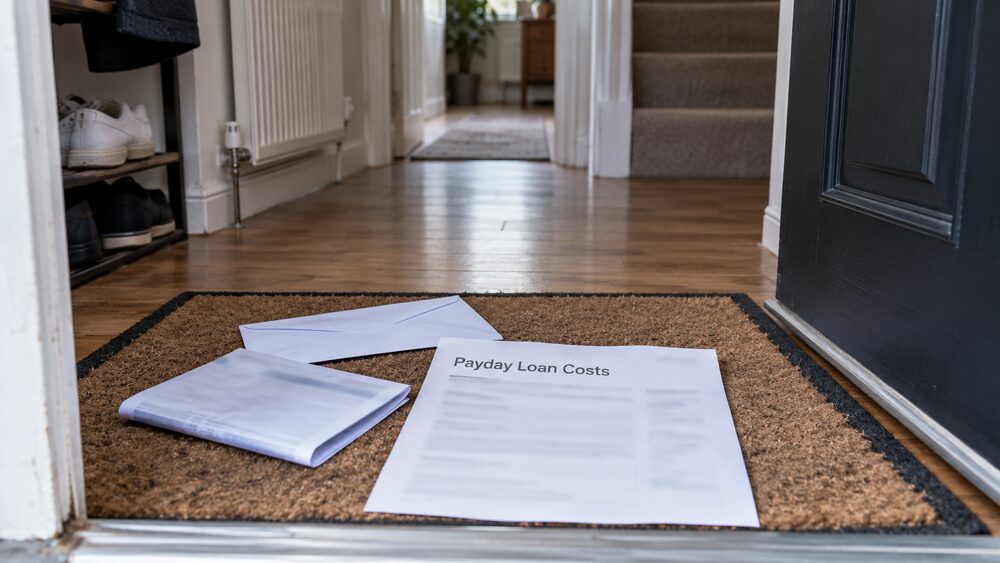
A payday loan is a short-term, high interest, unsecured loan that you get in return for your pay cheque or proof of your income1. You borrow a relatively small amount, typically £50 to £1,000, and repay it in one payment on or shortly after your next payday2. Because the interest is high and the term is short, the rules that govern these loans work differently from those for a personal loan or a credit card.
A payday loan is a short-term, high interest, unsecured loan that you get in return for your pay cheque or proof of your income1. You borrow a relatively small amount, typically £50 to £1,000, and repay it in one payment on or shortly after your next payday2. Because the interest is high and the term is short, the rules that govern these loans work differently from those for a personal loan or a credit card.
The payday loan cost cap is the set of limits on what a lender can charge you. There are three: interest and fees together cannot exceed 0.8% per day of the amount borrowed, default fees are capped at £15, and there is a total cost cap of 100%, which means you never have to pay back more than twice the amount you borrowed1. The rules came into force on 2 January 20153.
The cap applies to high-cost short-term credit, the regulatory category payday loans fall into. It does not apply to every kind of borrowing, and it does not stop a payday loan being an expensive way to borrow. The sections below set out each limit, how rollovers are restricted, what a lender must check and tell you before it lends, and where the cap stops.
You never repay more than double what you borrowed
The total cost cap is the simplest of the three limits to understand. Borrowers should never have to pay back more in fees and interest than the original amount borrowed3. Put another way, the amount you pay cannot be more than double your original loan6. If you borrow £300, the most you can repay in total is £600, and that figure includes interest, fees and charges4.
That ceiling matters because it is a cap on the whole cost of the loan, not just the headline interest rate. A lender cannot add an arrangement fee, a late fee and a servicing charge on top of interest and take the total above the cap. The cap was introduced alongside the daily limit and the default fee limit as a package, and the three work together: the daily rate limits how fast the cost builds up, the default fee limits what a missed payment adds, and the total cap limits where it all ends.
The cap does not make a payday loan cheap. Independent guidance is clear that a payday loan might help in the short term but can end up costing you much more in the long term7. The same warning applies to overdrafts used in the same way7. The cap limits the damage; it does not change the underlying cost of borrowing at a high rate over a short period.
If you are already struggling with a payday loan, the advice is not to take out more debt to repay it5. Free help is available, and the Debt: a complete guide to help, solutions and your rights sets out the options.
The three limits: 0.8% a day, £15 default fee, 100% total
Each of the three limits does a different job, and a lender has to stay inside all of them at once.
| Limit | What it caps | The rule |
|---|---|---|
| Daily rate | Interest and fees | 0.8% per day of the amount borrowed, even when rolled over3 |
| Default fee | The charge for a missed payment | £151 |
| Total cost | Everything you repay | 100% of the amount borrowed, including interest, fees and charges4 |
The daily rate is the one most people notice first. Interest and fees must not exceed 0.8% per day of the amount borrowed, even when rolled over3. On a £100 loan repaid after 30 days, the most you would pay in interest is £248. On a £300 loan over 30 days, the daily cost would be £2.40, which is £72.00 in total6.
The default fee is the charge a lender can add if you do not pay back the loan on time. Default fees are capped at £15.001, and default charges must not exceed £153. A lender can also charge interest on the unpaid amount, but interest rates on unpaid balances and default charges must not go over the interest rates of the initial amount borrowed3. So a missed payment cannot be used to push the rate up.
The total cost cap then catches anything the first two limits miss. Because it includes interest, fees and charges, it is the backstop that decides the most you can ever repay4.
Rollovers and refinancing: the limit of two
A rollover is when a lender extends an existing payday loan instead of collecting it on the due date. The rules restrict how often that can happen. A payday loan cannot be extended, or rolled over, more than twice1. A payday lender can only roll over a loan twice6.
The limit exists because repeated rollovers are how payday loan costs used to spiral. The regulator's own consultation on the cap said the aim was to stop payday loans spiralling endlessly by capping the number of times they can be rolled over to two9. Each rollover adds another period of interest, so a loan that is extended again and again grows without the underlying debt falling.
There is a related protection on how a lender collects its money. Payday lenders can only make two attempts to take money from your bank account, unless you agree a rollover5. If you want to stop a lender taking payments, the How to stop a continuous payment authority page explains how.
If a loan has already been rolled over and the balance is not coming down, the How many times can a payday loan be rolled over? page goes into more detail, and What to do if you can't repay a loan sets out the options.
What lenders must tell you before you borrow
The cap limits what a lender can charge. Separate rules govern what a lender must do before it lends you anything.
A payday lender must check your credit worthiness before it gives you a loan, rolls over a loan or increases the amount of credit1. It must also satisfy itself that you can afford the repayments1. Independent guidance puts the same duty plainly: a lender must check that you can afford to repay the payday loan before it gives it to you10. Your lender should check you can afford the payments when you take out the loan11.
Before you borrow, a payday loan company must make it clear how much it would cost you in total to repay a loan, tell you how and when to pay back your loan, and check your finances or personal circumstances12. Those duties are about making sure the cost is visible before you commit, rather than only appearing once you have missed a payment.
The affordability check is not a formality. If a lender did not carry out a proper check and the loan was unaffordable, that can be the basis of a complaint. The Complaining about an unaffordable loan page covers how that works, and Loan affordability checks: what lenders must check explains what a lender is required to look at.
What happens if you miss a payment
Missing a payment on a payday loan triggers the default fee limit, but it also has consequences beyond the fee itself.
If you do not make the payment due by the agreed time and date, most payday lenders will charge you a late or missed payment fee6. That fee is capped at £151. Some lenders will then charge interest on the original loan amount plus the late payment fee, but this is capped at 0.8% per day6. The rate on unpaid balances and default charges must not go over the rate on the initial amount borrowed3.
The cost is not the only effect. Missing payments can lead to extra charges and can negatively impact your credit score, and make it harder to get credit in the future13. You owe the outstanding balance, and added interest, extra fees and charges can follow11. Banks will also charge a fee to cover payments where there is not enough money in your account6.
If a payday loan has been mis-sold or an unaffordable loan has left you out of pocket, a complaint can include the interest the payday loan company added to your loan amount, charges added if you could not repay the loan on time, and an extra 8% interest if you take your complaint to the Financial Ombudsman Service14. The Complaining about a lender or finance company page sets out the process.
Which lenders the cap does not cover
The payday loan cap applies to high-cost short-term credit. It is not a general cap on the cost of borrowing, and several kinds of lender sit outside it.
Community development finance institutions and credit unions are not payday lenders, so the payday cap is not the rule that governs them. Credit union lending is subject to a separate limit: the rate of the total charge for credit must not exceed 42.6 per cent for credit union lenders15. That is a different cap, calculated differently, and it applies to a different kind of loan. The Credit union loans and Community lenders (CDFIs) and affordable credit pages explain how those work.
Doorstep loans are a type of high-cost, short-term credit16, but they are not payday loans and the payday cap is not the rule that applies to them. Buy now pay later is also outside the payday cap; lenders need to check whether you can afford to repay before you take out an agreement17, and the Buy now pay later explained: how it works, late fees and your rights page covers the rules that do apply.
The cap also does not cover the cost of a loan from a friend or family member, a bank overdraft, or a credit card. Those have their own rules. If you are comparing what is available, Cheaper alternatives to a payday loan sets out the options side by side.
Why payday loan adverts carry a risk warning
Firms offering high-cost short-term credit must include prominent risk warnings on all financial promotions18. The warning is a condition of advertising, not a voluntary label.
The warning reflects what the product is. A payday loan might help in the short term, but it can end up costing you much more in the long term7. The same caution applies to overdrafts used to bridge a gap to payday7. The advert has to carry that message because the cost of the loan is not always obvious from the headline figure.
There is a separate warning to watch for that has nothing to do with the cap. If you are asked to pay a fee in advance for a loan, that is a warning sign of loan fee fraud19. A legitimate lender does not ask for an upfront fee before lending. The Is a lender asking for an upfront fee a scam page explains how to check.
Where to get help
If a payday loan is causing difficulty, free and impartial help is available. The Debt: a complete guide to help, solutions and your rights section covers the full range of options, and What to do if you can't repay a loan deals specifically with a loan you cannot keep up with.
If you think a lender has broken the rules, you can complain to the lender first and then take the complaint to the Financial Ombudsman Service if you are not satisfied. The Complaining about a lender or finance company page explains the steps and the time limits.
For the wider picture on how these loans work and what else is available, the Payday lending and high-cost short-term credit page is the starting point, and Loans: a complete guide covers the full range of borrowing options.
Sources19 cited
- Payday loans nidirect, 2026-02-25
- Payday loans Financial Ombudsman Service, 2022-12-23
- Payday loans (England and Wales) National Debtline, 2026-09-25
- Filling the gap: can banks step into the gap left by payday loans? Citizens Advice, 2015-01
- Dealing with payday loan debt StepChange, 2026-09-25
- Payday loan calculator StepChange, 2026-09-25
- Making money last until payday StepChange, 2026-09-25
- What's the best way to borrow money at Christmas? Which?, 2023-12-10
- Consultation paper on the payday lending cap Financial Ombudsman Service, 2013-10
- PERG 4.4 Financial Conduct Authority, 2016-03-21
- Payday loan debt StepChange, 2026-09-25
- Check if a financial service has followed the rules Citizens Advice, 2026-09-25
- Same day loan debt StepChange, 2026-09-25
- Payday loans (England and Wales) Business Debtline, 2026-09-26
- The Consumer Credit (Regulated Activities) Order 2001, article 61A legislation.gov.uk, 2026
- Doorstep loan debt StepChange, 2026-09-25
- Buy now pay later Financial Conduct Authority, 2026-07-15
- I've been charged hidden fees on a payday loan, can I get a refund? Which?, 2026-08-20
- Finding who I owe money to StepChange, 2026-09-25










 MoneyHelperFree, impartial money and pensions guidance, set up by government
 StepChangeFree debt advice and solutions from a charity
 National DebtlineFree debt advice by phone, webchat and online
 Financial Ombudsman ServiceFree, independent help when a complaint about a firm is not put right
 Citizens AdviceFree advice on money, consumer and legal problems in England and Wales