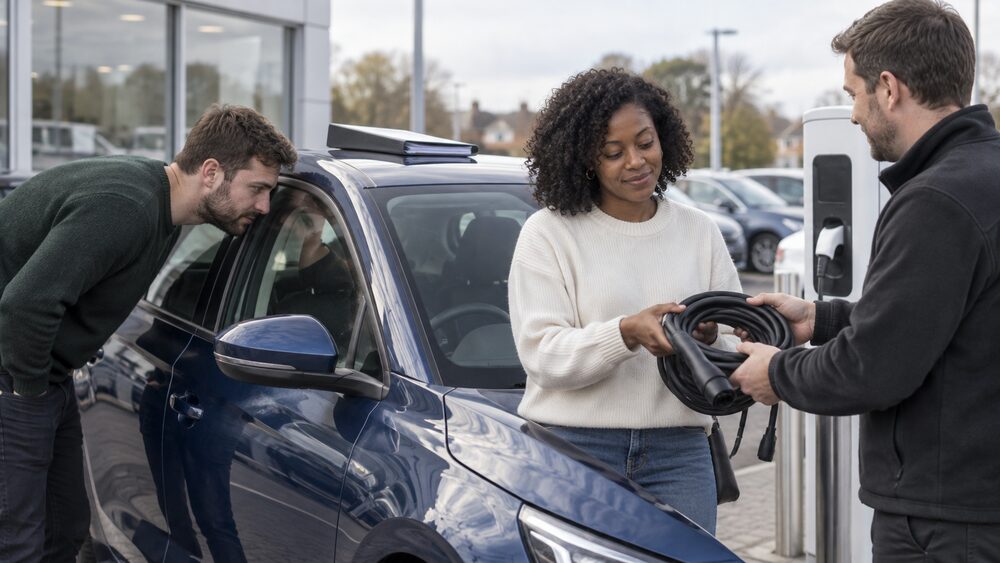
If you are buying a new electric car, the government's Electric Car Grant takes up to £3,750 off the price, or up to £1,500 on some models. The discount is applied automatically at the dealership, so there is no claim form and no extra paperwork for the buyer1. It comes off the price of the car rather than being paid to you, which means it also reduces the amount you need to borrow if you are using car finance.
If you are buying a new electric car, the government's Electric Car Grant takes up to £3,750 off the price, or up to £1,500 on some models. The discount is applied automatically at the dealership, so there is no claim form and no extra paperwork for the buyer1. It comes off the price of the car rather than being paid to you, which means it also reduces the amount you need to borrow if you are using car finance.
The scheme is worth £650 million in total and the money is allocated on a first-come, first-served basis, so it can run out2. All cars must have a recommended retail price below £37,000 to qualify3. The size of the discount depends on which band the car falls into, and the band is set by the car's carbon emission score.
Financing an electric car works in the same way as financing a conventional car4. The grant sits alongside whatever finance arrangement you choose, whether that is hire purchase, personal contract purchase or a personal loan, and it reduces the price that is being financed.
Electric Car Grant: up to £3,750 off a new electric car
The grant gives a discount on the price of a new electric car that meets the government's requirements. The highest grant, available for new cars with the lowest carbon emission scores, is £3,7501. The second level of grant is £1,5005. The discount is applied at the point of sale, so the price you agree with the dealer is already reduced.
The scheme was announced by the Department for Transport as a £650 million programme to help with the shift to zero-emission vehicles2. That funding pot is finite, and it is allocated on a first-come, first-served basis2. In practice this means the grant is available while the money lasts, and there is no guarantee it will still be there when you come to order.
The grant applies to new cars only. Only vehicles that have been approved by the government are eligible6. If you are looking at a used electric car, the grant does not apply, and the price you pay is the price you agree with the seller.
Band 1 or band 2: £3,750 or £1,500 off
The grant is split into two bands based on how environmentally friendly the car is. The most environmentally friendly cars, in band 1, receive up to £3,750 discount3. Cars in band 2 receive up to £1,500 discount3. The band is determined by the car's carbon emission score, so a car with lower emissions qualifies for the higher discount.
| Band | Discount | Which cars |
|---|---|---|
| Band 1 | Up to £3,750 | The most environmentally friendly cars, with the lowest carbon emission scores3 |
| Band 2 | Up to £1,500 | Cars with higher carbon emission scores3 |
The difference between the bands is £2,250, which is the gap between the £3,750 available on band 1 cars and the £1,500 available on band 2 cars5. That difference can matter when you are comparing two models that look similarly priced, because the grant reduces the amount you actually pay and therefore the amount you need to finance.
The dealer should be able to tell you which band a particular model falls into. The government publishes the list of approved vehicles, and only cars on that list are eligible6.
Which cars qualify: price below £37,000
To qualify for the grant, all cars must have a recommended retail price below £37,0003. That is the list price before any discount, not the price you negotiate. If the car's RRP is £37,000 or more, it does not qualify, even if you agree a lower price with the dealer.
The price limit applies alongside the band rules. A car needs both to be on the approved list and to have an RRP below £37,0003. The grant is also limited to new cars, so a used vehicle does not qualify regardless of its price.
The £37,000 threshold sits above the average price of many new electric cars, but it does exclude larger models and higher trims. If you are choosing between two versions of the same car, the cheaper trim may qualify while the more expensive one does not, simply because of where the list price falls.
How the grant is claimed at the dealership
The grant is applied automatically at the dealership, so there is no extra paperwork for the buyer1. You do not need to apply to the government, fill in a form or wait for a payment. The dealer handles the discount and it comes off the price of the car.
This is different from some other grant schemes, where the applicant has to apply and may need a survey or assessment before the money is released7. With the Electric Car Grant, the process is handled at the point of sale.
Because the funding is first-come, first-served, it is worth asking the dealer to confirm the grant is still available before you commit2. If the money has been used up, the discount will not be applied and the price will be higher than you expected.
A £650 million fund, paid first-come, first-served
The scheme is backed by £650 million announced by the Department for Transport2. That is the total pot, and it is allocated on a first-come, first-served basis2. Once the money is committed, the grant is no longer available on new orders.
This structure means timing matters. If you are planning to buy a new electric car and the grant is a significant part of your budget, ordering sooner rather than later reduces the risk of the funding running out. There is no waiting list and no guarantee of availability.
The first-come, first-served rule also means the grant is not means-tested. It does not depend on your income or circumstances, only on whether the car qualifies and whether the funding is still available when you order.
Financing an electric car works like any other car finance
Financing the purchase of an electric car or hybrid is the same as that of a conventional car4. The grant reduces the price, and the finance agreement is arranged on the discounted amount. You can use hire purchase, personal contract purchase or a personal loan, and the lender's criteria and terms apply in the usual way.
The initial upfront purchase price of an electric vehicle tends to be higher than its petrol or diesel equivalent6. The grant narrows that gap, but it does not remove it. If you are comparing an electric car with a petrol or diesel model, the grant is one factor among several, including the cost of charging, servicing and insurance.
Some lenders offer finance products aimed specifically at electric and hybrid vehicles. One credit union offers a Green Car Loan that applies to new or used electric or hybrid vehicles only8. That is a lending decision by the provider, not a government scheme, and the terms are set by the lender.
| Finance option | How it works | What the grant changes |
|---|---|---|
| Hire purchase | You pay instalments and own the car at the end | Reduces the amount financed4 |
| Personal contract purchase | Lower monthly payments, with a balloon payment or return at the end | Reduces the amount financed4 |
| Personal loan | You borrow the money and buy the car outright | Reduces the amount you need to borrow4 |
Paying a PCP car finance agreement will be considered when lenders assess your affordability for a mortgage9. That applies to electric cars in the same way as any other car finance.
What protects you, and where it stops
The grant itself is a government discount, not a financial product, so it does not carry the protections that apply to credit agreements. The finance agreement you use to buy the car does. If you are mis-sold a financial product, you can complain to the provider and, if unresolved, to the Financial Ombudsman Service10.
If you are buying on finance, the Consumer Credit Act gives you rights over the agreement, and the FCA's rules on motor finance commission also apply11.
The grant is not means-tested and does not depend on your credit score. However, the finance you use to buy the car does. Lenders assess affordability, and your credit file will be checked. Experian scores range from 721 to 880 for Fair and 961 to 999 for Excellent on the old scale, or 1,121 to 1,250 on the new scale12.
If you need help with a vehicle or with borrowing
Some grant schemes exist for people who need help with the cost of a vehicle because of disability. The Motability Foundation offers grants towards advance payments for cars, wheelchair accessible vehicles, and adaptations for drivers and passengers14. These are separate from the Electric Car Grant and have their own eligibility rules.
The Accessible Vehicles and Equipment scheme allows people who get the enhanced rate of the mobility part to use some or all of it to lease a new car, scooter or powered wheelchair15. Payments under that scheme totalled £567 million as of 31 July 202616.
If you are struggling with borrowing, free and impartial help is available. MoneyHelper offers guidance on debt and borrowing, and debt advice charities can help if you are worried about repayments. The Financial Ombudsman Service can look at complaints about finance agreements if you and the lender cannot agree10.
Sources16 cited
- Buying an electric car Bank of Scotland, 2026-09-27
- Car leasing Halifax, 2025-07-15
- Electric vehicles Lloyds Bank, 2026-09-27
- Electric and hybrid car finance Stellantis Financial Services, 2026-09-26
- Electric vehicles Halifax, 2026-09-27
- Electric vehicles Consumer Council, 2026
- Energy grants mygov.scot, 2026-02-04
- Best Start Grant statistics Social Security Scotland, 2025-05
- What is PCP car finance? HSBC, 2026
- I think I've been mis-sold a financial product Which?, 2026-08-18
- Consumer credit sourcebook FCA, 2026-03-31
- How to check your credit score for free Which?, 2025-10-24
- New Experian credit score shake up Which?, 2025-11-03
- Offer terms DF Capital, 2026-02
- Budget 2025 overview GOV.UK, 2026
- Driving lessons grant Motability Foundation, 2026-09-26









 MoneyHelperFree, impartial money and pensions guidance, set up by government
 StepChangeFree debt advice and solutions from a charity
 National DebtlineFree debt advice by phone, webchat and online
 Financial Ombudsman ServiceFree, independent help when a complaint about a firm is not put right
 Citizens AdviceFree advice on money, consumer and legal problems in England and Wales