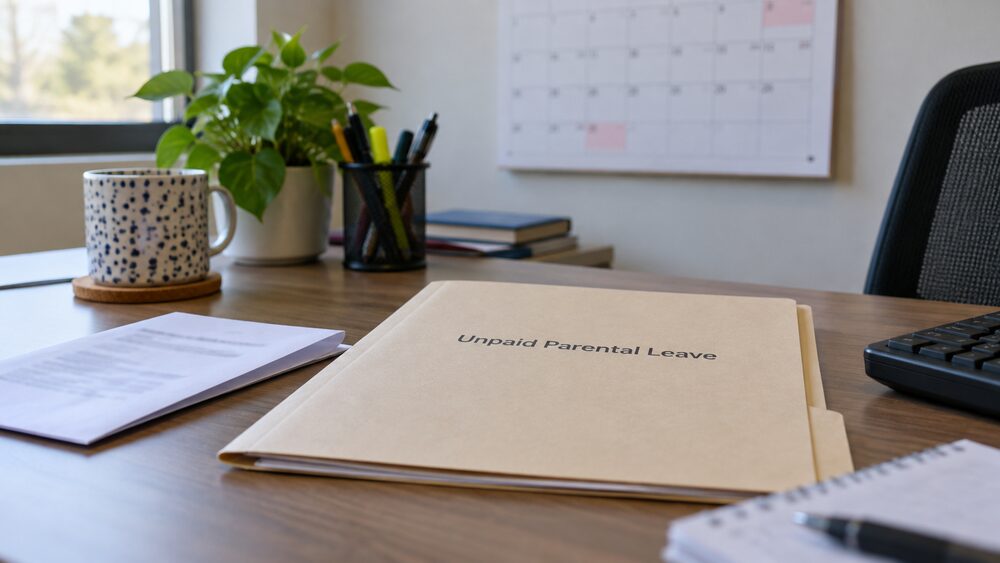
Unpaid parental leave is a statutory right that lets each parent take up to 18 weeks off work to look after a child, per parent, per child, up until the child's 18th birthday1. It is usually unpaid, and it is a different right from shared parental leave, maternity leave and paternity leave2.
Unpaid parental leave is a statutory right that lets each parent take up to 18 weeks off work to look after a child, per parent, per child, up until the child's 18th birthday1. It is usually unpaid, and it is a different right from shared parental leave, maternity leave and paternity leave2.
The rules changed on 6 April 2026. Before that date you needed to have worked for your employer for one year to qualify. From 6 April 2026 that requirement was removed and parental leave became a day one right3. You still need to be an employee with parental responsibility for a child under 18.
How much you can take in one go is limited. Parental leave can normally only be taken in blocks of a week, up to four weeks a year, though your employer may be more flexible3. You must give at least 21 days' notice to take it3.
Unpaid parental leave: up to 18 weeks per parent, per child
The entitlement is 18 weeks for each parent and for each child, and it does not have to be used in one stretch. It runs alongside the child's childhood rather than being tied to the first year, so it can be drawn on at any point up to the child's 18th birthday1.
Because it is per parent and per child, two parents each have their own 18 weeks for the same child, and a parent with more than one child has a separate 18 weeks for each of them1. The entitlement does not reset if you change employer: what carries over is how much of the 18 weeks you have already used for that child.
There is a separate, smaller right that sits alongside shared parental leave. You can take up to four weeks' parental leave at the end of your shared parental leave without affecting your right to return to your job8. That is a distinct protection, not an extra 18 weeks.
Parental leave is not the only unpaid family leave. Fathers or partners can take up to 52 weeks of unpaid bereaved partner's paternity leave if the mother or primary adopter dies, taken within 52 weeks of the child's birth or adoption placement4. From 6 April 2026 that entitlement begins for fathers and partners3.
Who qualifies now that it is a day one right
The change on 6 April 2026 removed the one year service requirement, so parental leave is now available from the first day of a new job3. Before that date, you needed to have worked for your employer for one year to qualify9.
To use the right you need to be an employee and to have parental responsibility for a child under 18. The entitlement is per parent, per child, so it applies to mothers and fathers, and to same sex partners and civil partners who have parental responsibility4.
It is worth separating parental leave from the other family leave rights, because the qualifying conditions differ:
- Paternity leave: up to two weeks' paid leave for fathers or the mother's partner, where the qualifying conditions are met1.
- Shared parental leave: up to 50 weeks of leave and up to 37 weeks of pay, shared between parents during the baby's first year10.
- Bereaved partner's paternity leave: up to 52 weeks of unpaid leave where the mother or primary adopter dies4.
- Statutory Parental Bereavement Pay: payable for a maximum of two weeks, consecutively or as separate weeks, and it must end within 56 weeks of the child's death or stillbirth11.
Shared parental leave is not open to single parents, who cannot qualify for it2. Self-employed parents are also outside it: a self-employed mother claiming Maternity Allowance is not entitled to shared parental leave or Statutory Shared Parental Pay, and self-employed fathers and partners cannot take them either12. Employees and workers, including agency workers, casual workers and freelance staff paid through PAYE with tax and National Insurance deducted at source, can qualify for Statutory Shared Parental Pay2.
How much you can take each year and in what blocks
The annual limit is normally four weeks, taken in blocks of a week, and the total across the child's childhood cannot exceed 18 weeks3. Your employer can agree to be more flexible than the weekly block rule, but is not obliged to3.
The block rule is where parental leave differs most sharply from shared parental leave. Shared parental leave and Statutory Shared Parental Pay must be taken in blocks of one week2. You have the right to take shared parental leave in three separate blocks, though your employer can agree to more8. You can also book up to three separate blocks of shared parental leave even if you are not sharing the leave with your partner13.
Paternity leave has its own shape: you can take either one week or two consecutive weeks, but not odd days11. If you are at work during a week, your employer cannot pay you Statutory Paternity Pay for that week11.
There is also a limit on how much you can work during shared parental leave without ending it. You can work for your employer for up to 20 shared-parental-leave-in-touch days during your shared parental leave, per parent taking it2.
Giving notice: at least 21 days
You must give at least 21 days' notice to take parental leave3. Notice should set out the dates you want, and an employer that cannot accommodate them can postpone the leave to another agreed time rather than refuse it outright.
The notice rules for the other family leave rights are longer, and mixing them up is a common source of disputes:
| Leave type | Notice required |
|---|---|
| Parental leave | at least 21 days3 |
| Shared parental leave | at least eight weeks before the first period2 |
| Changes to shared parental leave dates | at least eight weeks before the start of any leave13 |
| Ending maternity leave early (curtailment notice) | at least eight weeks2 |
| Paternity leave on adoption | within seven days of the match, or within 28 days of the child entering the UK, and at least 28 days before starting pay14 |
If you are moving from maternity leave into shared parental leave, the curtailment notice is the step that creates the shared leave: you must give at least eight weeks' notice to end your maternity leave at a future date, specified in your notice2.
Shared parental leave and pay must be taken within a year of the birth if you returned to work early and want to take more leave3. From April 2026, fathers and partners can take shared parental leave at any time up to 52 weeks from the birth, before or after paternity leave2.
Unpaid leave and your money
Parental leave is usually unpaid, so the household budget has to absorb the weeks without pay2. What happens to your pension depends on the type of unpaid leave and your contract.
For unpaid maternity leave, your employer still has to make pension contributions in the first 26 weeks of your leave, and afterwards only if it is in your contract15. More generally, if you are not getting paid during maternity leave, your employer does not have to make pension contributions unless your contract provides for it, though you may be able to make contributions yourself16. If you take 52 weeks of Statutory Maternity Leave, the last 13 weeks are unpaid17.
National Insurance is the other thing to watch. If you take unpaid maternity leave you can get class 3 NI credits if you are claiming Child Benefit; those credits count for pension purposes but not for contribution-based benefits such as Employment and Support Allowance18.
Where money is tight, there is help outside the workplace. Universal Credit may help with paying for childcare20. If you have unreimbursed work expenses, speaking to your work coach may allow you to offset these against your Universal Credit payment21.
If you have unreimbursed work expenses, speaking to your work coach may let you offset these against your Universal Credit payment21. Child maintenance is paid when one of the parents does not live with the child, and paying parents through the Child Maintenance Service are charged a fee even if they miss a payment14.
Where unpaid parental leave can go wrong
The main risks are practical rather than legal. Because the leave is unpaid, the weeks you take reduce household income, and the pension position is weaker than during paid leave: employer contributions are guaranteed for the first 26 weeks of unpaid maternity leave and after that only if your contract says so15.
The second risk is notice. Turning up expecting to start parental leave without the 21 days' notice, or assuming the eight week shared parental leave notice applies to parental leave, can mean the leave is postponed3. An employer can postpone parental leave where the business would be disrupted, but the leave still has to be taken at another agreed time.
The third is the interaction with other leave. Shared parental leave and pay must be taken within a year of the birth if you returned to work early and want more leave3. If you are resigning, check your contract or maternity policy for any repayment clause: you can only be asked to repay occupational maternity pay if it was agreed before your leave or is stated in your employer's maternity policy, and any return period is usually three to six months19.
If you are pregnant or on maternity leave and facing redundancy, or you are having a baby and want to see how the pay and benefits fit together, the Having a Baby: Pay, Benefits and Costs guide covers the wider picture, and Shared Parental Leave and Pay sets out the paid alternative in detail.
Sources21 cited
- Rights for parents with more than one job Maternity Action, 2026-02
- Shared parental leave and pay Maternity Action, 2026-04
- Childbirth injuries: rights at work and benefits for new mothers Maternity Action, 2026-04-06
- Pregnant at work Maternity Action, 2026-03
- Redundancy during pregnancy and maternity leave Maternity Action, 2026-03
- Premature births: rights to maternity leave and pay Maternity Action, 2026-02
- Pregnant during maternity leave Maternity Action, 2026-03
- Shared parental leave and pay nidirect, 2026-04-03
- Continuing to breastfeed when you return to work Maternity Action, 2026-03
- Maternity leave and pay for parents of twins and triplets Twins Trust, 2026-06-16
- Statutory Parental Bereavement Pay nidirect, 2026-07-07
- Maternity and parental rights for self-employed parents Maternity Action, 2026-02
- How do I make a claim Turn2us, 2026-05-14
- Adoption leave and pay rights for parents Maternity Action, 2026-02
- How your situation affects your workplace pension nidirect, 2025-09-11
- Workplace pensions: changes in personal circumstances nidirect, 2025-09-11
- Time off work when pregnant or just had a baby One Parent Families Scotland, 2026-04-06
- Maternity pay questions Maternity Action, 2026-03
- Resigning from your job during pregnancy and maternity leave Maternity Action, 2026-03
- Universal Credit mygov.scot, 2026-04-01
- How to claim Universal Credit when working Mental Health and Money Advice, 2025-09-04




 MoneyHelperFree, impartial money and pensions guidance, set up by government
 Citizens AdviceFree advice on money, consumer and legal problems in England and Wales
 Turn2usFree benefits calculator and grants search from a charity
 GOV.UKOfficial information on tax, benefits and government services