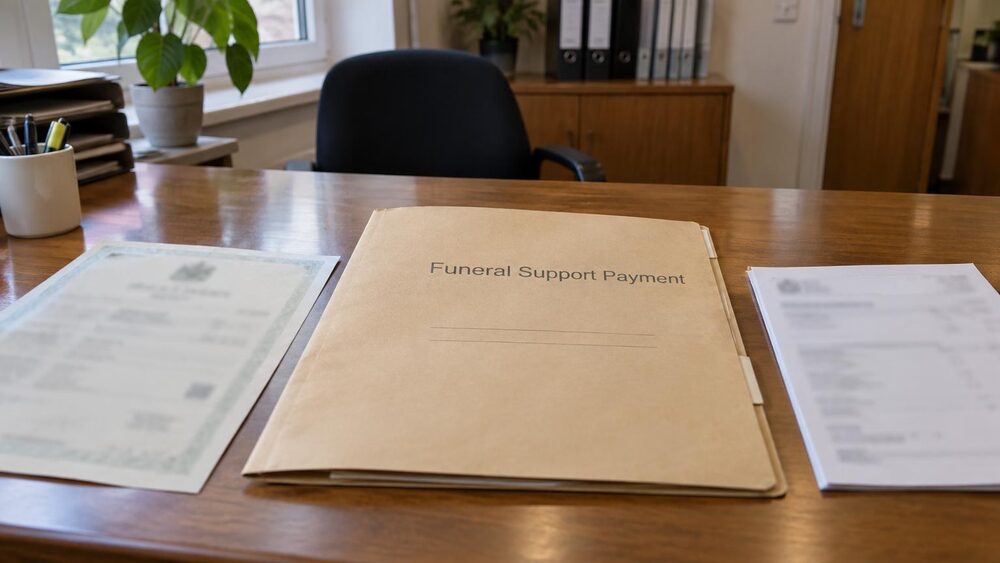
The Funeral Expenses Payment is a government grant from the Department for Work and Pensions towards the cost of a funeral in England, Wales and Northern Ireland. It covers the cost of a simple burial or cremation, plus up to £1,000 for other expenses such as funeral director's fees and the coffin1. It is not a loan and the person who claims does not repay it, but it is means tested and the estate may have to repay it later.
The Funeral Expenses Payment is a government grant from the Department for Work and Pensions towards the cost of a funeral in England, Wales and Northern Ireland. It covers the cost of a simple burial or cremation, plus up to £1,000 for other expenses such as funeral director's fees and the coffin1. It is not a loan and the person who claims does not repay it, but it is means tested and the estate may have to repay it later.
The payment is aimed at people on a low income who are receiving certain benefits and who have taken responsibility for arranging and paying for the funeral. You must apply within six months of the funeral, and the DWP aims to process claims within 13 working days, though in practice it can take longer2. Scotland runs its own version, the Funeral Support Payment, through Social Security Scotland3.
The most important thing to understand before you start is that this payment rarely covers a whole funeral. The average funeral payment covers less than half of the average cost of a simple funeral2, so most families face a shortfall and need to find the rest from the estate, from family, or from other sources.
What a Funeral Expenses Payment covers: burial or cremation fees plus up to £1,000
The payment is built from two parts. The first is the reasonable cost of a simple burial or cremation1. The second is a fixed ceiling of up to £1,000 towards other funeral expenses, generally those covered under funeral director's fees, or the costs of a DIY funeral such as the coffin2. Age UK describes the same £1,000 as covering things like the coffin and flowers6.
Beyond those two parts, the payment can meet several specific costs. These include doctors' fees in Northern Ireland, death certificates needed to release money belonging to the person who died, and one return journey to arrange or attend the funeral, not including the cost of a funeral car2. In some circumstances it also covers transport costs if the person who died needs to be moved over 50 miles2. In Scotland, the Funeral Support Payment covers the cost of one return journey either to arrange the funeral or to attend it7.
What the payment does not do is fund the funeral a family might choose. It is tied to a simple burial or cremation, so a more elaborate service, a headstone, or additional cars are not what the grant is for. That is the main reason a shortfall appears: the grant meets a basic funeral, and the average funeral payment covers less than half of the average cost of a simple funeral2. In Scotland, the full amount is unlikely to cover even the cost of a simple funeral, so a shortfall is likely8.
Who qualifies: benefits, responsibility for the funeral and residence
Eligibility rests on three things: the benefit you receive, whether you have accepted responsibility for the funeral costs, and where you live. The rules are set out in legislation and are more complex than most benefit claims, because they look at the family around the person who died as well as the person applying9.
On benefits, the responsible person or their partner must have an award of one of a set list at the date of claim. That list includes income support, state pension credit, income-based jobseeker's allowance, working tax credit where the disability element or severe disability element is included, child tax credit which includes an individual element or a disability element, housing benefit, income-related employment and support allowance, universal credit, or owner-occupier loan payments treated as entitlement to a specified benefit10. The Northern Ireland regulations list the same core benefits, including income support, state pension credit, income-based jobseeker's allowance, housing benefit, income-related employment and support allowance and universal credit11.
On responsibility, the person applying must have accepted responsibility for meeting the funeral costs. The official guidance treats it as usually reasonable for the nearest relative of the person who died to accept that responsibility, and a nearest relative could be a partner, child, parent or sibling12. If neither the applicant nor their partner is receiving any benefits, or has claimed one, they will not be eligible12.
On residence, the Funeral Expenses Payment covers England, Wales and Northern Ireland. Scotland has its own benefit, the Funeral Support Payment, which has replaced the UK Government's Funeral Expenses Payment for residents in Scotland3. You can apply for it if you live in Scotland and you, or your partner, are receiving a qualifying benefit13.
How family members' circumstances affect a claim
This is where many claims fail, and it is the part most people do not expect. The payment is not assessed on the applicant alone. It also looks at whether other relatives who were close to the person who died are on a qualifying benefit.
Any close relatives, such as adult brothers and sisters including half and step siblings, who were at least as close to the deceased as the person applying must also be on a qualifying benefit2. On top of that, immediate family members, meaning a parent or adult child of the deceased, who do not fall into certain categories must also be on a qualifying benefit, no matter who applies2. Marie Curie puts the practical effect plainly: if the person who died had a close relative who is not getting one of the qualifying benefits or is in work, you may not be able to get a payment14.
The result is that a claim can be refused because of a relative's circumstances rather than the applicant's. Quaker Social Action notes that if there is a relative of the person who died who does not receive a qualifying benefit, the application could be rejected15. This is a rule about the family as a whole, not a judgement about need, and it is the single most common reason a claim that looks eligible on paper does not succeed.
There is a separate route worth knowing about if the family circumstances block a claim. Work-related charities may help, and applications may be based on the work history of the applicant, the deceased, or a partner or close family member helping with the funeral bill16. That is a different kind of help from a different source, and it does not depend on the benefit rules.
Money from the estate is usually paid back first
If the person who died had money, it can usually be used to help pay for the funeral first17. Funeral expenses can be paid from the deceased person's estate and are often the highest priority except for some secured debts such as mortgages18. The first priority for any money left by the deceased person is to help pay towards the cost of their funeral, ahead of rent, utilities and other bills19. The only exception is where they left secured loans such as a mortgage, in which case these must be paid first19.
That priority matters for the grant, because the DWP can recover what it paid. The person making the claim does not need to pay it back, but if the deceased person left sufficient assets, such as money or property, in their estate, the DWP is entitled to recover the payment from there and will usually attempt to do so13. Age UK puts it in terms of what you receive: if you get any money from the estate of the person who has died, your Funeral Expenses Payment will usually be deducted from it1.
In Scotland the treatment is the same in effect. A Funeral Support Payment is treated as a funeral cost, and if the person who died had money or assets in their estate, it may need to be repaid from the estate20. Because it is a grant, the claimant does not have to repay it, but it can be recovered from the estate of the person who died, before any inheritance is paid out21. If the person who died had assets, once these become available they may need to be used to repay any Funeral Support Payments before any inheritance is paid12.
How to claim within six months of the funeral
The deadline is the same across the UK and it is strict: apply within six months of the funeral4. In England and Wales you must claim within six months of the funeral even if you are waiting to receive a qualifying benefit22. Scope states the same rule: you must apply within 6 months of the funeral23. In Scotland, applications can be made for up to six months after the date of the funeral24.
Scotland adds a short extra window in one situation. A claim can be made within six months from the date of the funeral, or within 20 working days after the end of the six month period with a backdated qualifying benefit award relating to at least one day in that period25. Turn2us states the basic rule for Scotland as within six months after the funeral26.
For England, Wales and Northern Ireland, the route is a claim form. You can download a claim form on GOV.UK and apply by post, or call the Bereavement Service helpline on 0800 731 0469 to make a claim1. The phone numbers differ by nation. In England and Wales, you could call the DWP Bereavement Service on 0800 151 201213. In Northern Ireland you can contact the Bereavement Service on 0800 085 246313. Both routes involve the same phone number, so the number is the reliable starting point.
In Scotland, claims go to Social Security Scotland rather than the DWP, and applications can be made by phone12. The Funeral Support Payment has replaced the UK Government's Funeral Expenses Payment for residents in Scotland3.
If your claim is refused: reconsideration and appeal
A refusal is not always the end of the process, and there are two separate systems depending on where you live.
In England, Wales and Northern Ireland, the first step is a mandatory reconsideration. You cannot usually ask a tribunal to look at a decision until you have gone through the mandatory reconsideration process27. The same two stage structure applies to other DWP hardship decisions: if you are refused a recoverable hardship payment, you can appeal against the decision, but you must first apply for a mandatory reconsideration28. So the sequence is a reconsideration request to the DWP, and only then, if the decision stands, an appeal to a tribunal.
In Scotland, the language is different but the idea is similar. If you disagree with the decision made on your Funeral Support Payment claim, for example because of incorrect information, you can ask for it to be looked at again, known as requesting a re-determination or appeal29.
It helps to know the likely reason for a refusal before you challenge it, because the grounds shape what you can argue. The most common is the family circumstances rule: if there is a relative of the person who died who does not receive a qualifying benefit, your application could be rejected15. Another is the benefit test itself: if the client or their partner are not in receipt of any benefits, or have not claimed, they will not be eligible12. A third is where the funeral was arranged and paid for by the hospital, in which case the client will not be eligible unless they can show that they still incurred costs30.
If the payment is refused and the family cannot meet the cost, other routes exist. A public health funeral is arranged by the local authority when no one can pay, and work-related charities may help based on a work history16. Free and impartial help with benefits and funeral costs is available from MoneyHelper and from charities such as Age UK and Turn2us, and bereavement support is available separately from the money questions.
If the person who died had a pre-paid funeral plan
A funeral can be paid for in several ways: from a financial scheme the person had, such as a pre-paid funeral plan or an insurance policy; by you, or other family members or friends; or with money from the person's estate, such as savings they had17. Where a plan or policy already covers the funeral, there is little or nothing left for the Funeral Expenses Payment to meet.
Pre-paid funeral plans are products that allow you to pre-arrange and pre-pay for your funeral with a provider, generally for a fixed cost. They are sold by third-party intermediaries or directly by providers, and paid for by a one off premium or in instalments31. If the person who died held one, the plan is the first source of payment, and the grant only comes into play for costs the plan does not cover.
There is also a rule against paying twice. No funeral payment is to be made if such a payment has already been made in respect of any funeral expenses arising from the death of the same person, except where the decision has been revised and the revised award together with the amount already paid does not exceed the amount of any funeral payment which may be awarded10. The Northern Ireland regulations say the same in slightly different words: no funeral payment is to be made if such a payment has already been made in respect of funeral expenses arising from the death of the same person, save where the original award has been revised and the total does not exceed the maximum11. The two documents disagree on the exact wording of the exception, but both bar a second payment for the same funeral.
Life insurance is a separate matter. Life insurance payouts can be used to help cover funeral costs, although a lump sum paid out upon death does not have to be used in this way19. That means a payout is not automatically deducted, but it is money available to the family.
Extra help for the funeral of a child or a stillborn baby
If you are paying for the funeral of a child under 18 or a stillborn child, you may be able to get extra help32. In Northern Ireland, the Child Funeral Fund is there to help families with the cost of a funeral following the death of a child under 18 or a still birth after 24 weeks33.
In Scotland, a client applying for the funeral of a stillborn child will qualify for Funeral Support Payment if they meet the eligibility criteria and have incurred costs for the funeral30. That is a specific rule for stillbirth, and it sits alongside the general eligibility conditions rather than replacing them.
Parents in this situation may also have rights to time off and pay, which are separate from the funeral payment and are covered in the guidance on neonatal care leave and pay and on having a baby. The funeral payment itself is not taxable: Turn2us lists it as not taxable32, and in Scotland a Funeral Expenses Payment from the Department for Work and Pensions counts as government support already paid12.
Where to get help
The Funeral Expenses Payment sits inside a wider set of arrangements for paying for a funeral, and it is worth seeing it alongside them rather than on its own. The main alternatives are paying from the estate, using a pre-paid funeral plan or insurance, or family members contributing. Each has different consequences: estate money is used first and the grant can be recovered from it, a plan pays what it was bought to cover, and family contributions are not recovered.
Free and impartial help is available. MoneyHelper provides guidance on benefits and funeral costs, and charities including Age UK, Turn2us and Quaker Social Action publish detailed guidance on eligibility and on challenging a decision. Bereavement support is separate from the money questions and is available from specialist services.
If you are dealing with the wider administration of an estate at the same time, the pages on what to do when someone dies, paying for a funeral and pre-paid funeral plans cover the surrounding steps. In Scotland, the Funeral Support Payment has its own rules and its own application route.
Sources33 cited
- Help with urgent or one-off expenses Age UK, 2026-08-26
- Funeral expenses Quaker Social Action, 2026
- Funeral Support Payment Social Security Scotland, 2026-09-26
- Things to do after a death Independent Age, 2026-09-26
- Government support Quaker Social Action, 2026
- What to do when someone dies Age UK, 2026-02-16
- Funeral travel costs Social Security Scotland, 2026-09-26
- FAQs: funeral support Quaker Social Action, 2026
- Social Fund Funeral Payments House of Commons Library, 2026-07-08
- The Social Fund (Funeral Expenses) Regulations 2005 legislation.gov.uk, 2005-11-02
- The Social Fund (Funeral Expenses) Regulations (Northern Ireland) 2005 legislation.gov.uk, 2005-11-14
- Telephone application Social Security Scotland, 2026-09-26
- Help when someone dies mygov.scot, 2022-05-13
- Help with funeral costs Marie Curie, 2024-03-31
- Funeral expenses Quaker Social Action, 2026
- Grants from work-related charities Quaker Social Action, 2026
- Funeral costs mygov.scot, 2026-09-07
- FAQs: the estate Quaker Social Action, 2026
- Money of the deceased Quaker Social Action, 2026
- Recovery of funeral costs from a person's estate Social Security Scotland, 2026-09-26
- Funeral Support Payment Contact, 2026-04-28
- Miscarriage, stillbirth and neonatal death: rights to time off and pay Maternity Action, 2026-03
- Financial support when someone dies Scope, 2026-04-01
- Bereaved Parents Day Social Security Scotland, 2026-07-03
- Eligibility for Funeral Support Payment Social Security Scotland, 2026-09-26
- How do I claim a Funeral Support Payment in Scotland? Turn2us, 2026-09-26
- How do I challenge a Funeral Expenses Payment decision? Turn2us, 2026-07-30
- Challenging a hardship payment decision Turn2us, 2026-08-12
- How do I challenge a Funeral Support Payment decision? Turn2us, 2025-12-23
- Stillbirth and infant death guidance Social Security Scotland, 2026-09-26
- Funeral plans FSCS, 2026-09-25
- Funeral Expenses Payment Turn2us, 2026-09-26
- More financial help if you get Universal Credit nidirect, 2025-12-02

 MoneyHelperFree, impartial money and pensions guidance, set up by government
 Citizens AdviceFree advice on money, consumer and legal problems in England and Wales
 Turn2usFree benefits calculator and grants search from a charity
 GOV.UKOfficial information on tax, benefits and government services