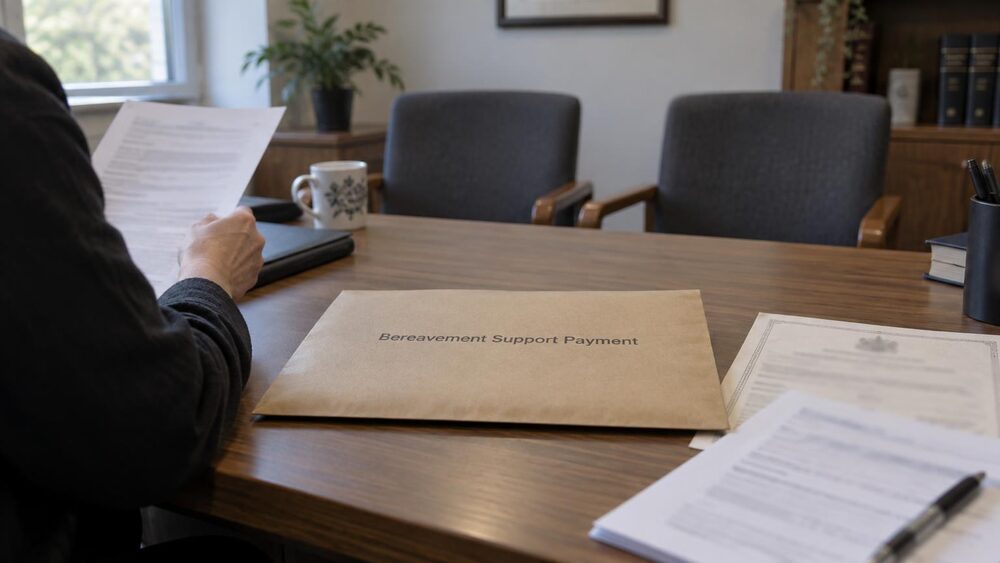
When someone dies, the help most people need falls into two kinds: someone to talk to, and someone to sort out the practical and money side. Both are available free in the UK. For emotional support, Samaritans runs a confidential 24-hour listening service on 116 1231, and Cruse Bereavement Care runs a freephone national helpline on 0808 808 1677 staffed by trained bereavement volunteers2. For the money side, the DWP Bereavement Service cancels the person's benefits and State Pension and checks what help you may be entitled to3.
None of these services charges the person who calls. The emotional support lines exist for anyone affected by a death, whatever their relationship to the person who died. The government lines exist for specific jobs: reporting the death to the benefits and tax systems, claiming Bereavement Support Payment, or applying for help with funeral costs. This page sets out what each free service offers, how to reach it, and where its limits are, so you can pick the right one first time.
What free bereavement support covers
Free bereavement support in the UK covers three broad things. The first is emotional support: a trained person to listen, at any hour, without judging and without charging. Samaritans provides a 24-hour helpline for confidential emotional support4, and describes itself as a confidential 24-hour listening service5. You can call it free, 24 hours a day, on 116 1236, and other organisations point people to that same number for free help7. The Department for Work and Pensions itself directs people affected by scams to Samaritans on 116 1238, which shows how central it is as a first port of call.
The second is bereavement counselling: structured, ongoing support with grief, from organisations that specialise in loss. Cruse Bereavement Care offers specialist phone, email and face to face support for children and adults who are dealing with loss9, and the charity has resources and information on its website for people who want to read rather than talk10. Child Bereavement UK runs a helpline on 0800 02 888 40 for families facing the death of a child or supporting a bereaved child11.
The third is practical and money help: working out what to do about benefits, pensions, tax, debts and funeral costs. Here the free services include government helplines, such as the DWP Bereavement Service and HM Revenue and Customs' Bereavement Helpline3, and charity advice lines. The Bereavement Advice Centre can be contacted on 0800 634 94 9410. Many advice services now offer appointments by telephone, email or videocall as well as, or instead of, face to face meetings12, so support does not depend on being able to travel.
Cruse Bereavement Care: free phone, email and face-to-face support
Cruse Bereavement Care is the national charity most often named as the place to go for grief support. It offers specialist phone, email and face to face support for children and adults who are dealing with loss9, which makes it one of the few free services where you can move beyond a single phone call to ongoing support in the way that suits you. Its freephone national helpline, 0808 808 1677, is staffed by trained bereavement volunteers2.
The helpline is a starting point rather than the whole service. Volunteers can listen, explain what support is available and help you find the right next step, whether that is one-to-one support, a group, or simply information. Because Cruse also offers email support9, it is an option for people who find talking about a death too difficult at first, or who want to write things down in their own time. The charity also publishes resources and information on its website10, which can help you prepare for a call or understand what you are feeling before you speak to anyone.
In Scotland, Cruse Bereavement Care Scotland runs its own helpline on 0845 600 222711. Note that this is an 0845 number rather than a freephone one, so calls may cost more than calls to the national 0808 line, depending on your phone package. If cost matters, the freephone national line remains the free route from anywhere in the UK.
Cruse support is free at the point of use and is open to adults and children9. You do not need a referral from a doctor and you do not need to be a relative of the person who died. For many people it sits between Samaritans, which is there for immediate emotional support at any hour, and the government helplines, which deal with the paperwork and payments.
Samaritans: free 24-hour emotional support on 116 123
Samaritans is the service to call when you need to talk to someone immediately, whatever the hour. It runs a 24-hour helpline on 116 123 for confidential emotional support4, and describes the service as a confidential 24-hour listening service5. You can call free, 24 hours a day, on 116 1236, and it is widely signposted by other organisations as the place for free help7. Government guidance also gives the Samaritans telephone number, 116 123, as a contact for people affected by upsetting events such as online scams8.
Two things distinguish Samaritans from the other services on this page. The first is availability: it is there at night, at weekends and on public holidays, when almost everything else is closed. The second is scope: it is not a bereavement specialist service and does not only take calls about death. The volunteers listen to whatever is weighing on you, which matters because grief often arrives tangled with other things, such as money worries, loneliness or thoughts you find hard to share with family.
The support is confidential, and you do not have to be suicidal or in crisis to call, a point worth stating because some people assume the service is only for emergencies. You also do not have to give your name or talk about the person who died in any detail. What Samaritans does not do is give advice on benefits, debts or funeral costs, or provide ongoing counselling. For structured grief support, Cruse Bereavement Care is the free service that offers that9. For the practical aftermath of a death, the government and charity advice lines in the later sections of this page are the right places.
Support when a child dies or a child is bereaved
The death of a child, or a child's grief at losing someone close, is a situation where specialist support matters. Child Bereavement UK runs a helpline on 0800 02 888 4011, supporting families when a child dies and also when a child is bereaved. Cruse Bereavement Care likewise provides support for children as well as adults, by phone, email and face to face9, so a grieving child or young person can be supported directly rather than only the adults around them.
There is also financial help aimed specifically at families with children. Bereavement Support Payment gives financial help to deal with the more immediate costs caused by the death of a spouse or civil partner15. The rules around children affect both who qualifies and how much is paid: you can qualify at the higher rate if you were pregnant when your partner died or you claim or are entitled to Child Benefit16. Historically the payment required the surviving partner to have been married to or in a civil partnership with the person who died17, but the law has changed and surviving cohabiting partners with children can now get it18. A cohabiting partner qualifies if they were entitled to Child Benefit when their partner died or were pregnant when their partner died16.
Where a child's death was caused by someone else's wrongful act, there is a separate legal provision: claims for bereavement damages can be granted to the spouse or civil partner of the deceased, or to the parents of the deceased if the child was under 1817. That is a matter for a solicitor rather than a helpline, but the charity lines above can provide emotional support alongside any legal process.
In Scotland, guidance on stillbirth and infant death signposts both Child Bereavement UK and Cruse Bereavement Care Scotland as sources of support11, so families there have the same specialist routes. If money is tight, help with funeral costs may be available if you are on a low income or your partner was claiming benefits19.
Marie Curie Support Line: help around end of life
The Marie Curie Support Line is a free service for anyone dealing with dying, death or bereavement, particularly where the death followed a terminal illness such as cancer. You can reach it on 0800 090 230913, and it is described as the free Marie Curie Support Line20. Like the other lines on this page, it costs nothing to call.
Where it differs from Samaritans and Cruse is in its focus on the end of life experience: the Support Line sits alongside Marie Curie's information on benefits, care and practical matters for people living with a terminal illness and their families. That means the people who answer are used to questions about what happens in the final weeks, what support exists, and what a family should expect, as well as to grief itself.
There is a limit worth knowing about in advance. Marie Curie states plainly:
"Our Support Line staff are not trained benefits advisers. We cannot provide information about your specific benefit claim."21
So the Support Line can talk through the emotional and practical side of terminal illness and bereavement, but for a question about a specific benefit claim, a benefits calculation or a claim that has gone wrong, you need the DWP Bereavement Service, HMRC or a benefits advice charity. The Support Line can still be the right first call, because it can point you towards the right kind of help even where it cannot give that help itself.
Practical help with what to do after a death
Alongside emotional support, a death triggers a set of practical jobs: telling government, banks and utility companies, stopping the person's benefits and pension, and dealing with the funeral. Several free services exist for exactly this.
The DWP Bereavement Service is the main government contact. You can call it on 0800 731 0469 if your benefits were affected by the death, or your council if it is an application for housing benefit14. Its purpose is broader than the name suggests: contact the Bereavement Service to cancel the person's benefits and entitlements, including their State Pension, and they will also check if you are eligible for help with funeral costs or other benefits3. A textphone option exists on 0800 731 046422. The service also helps relatives access any other benefits they may be entitled to because of the bereavement23.
For tax matters, HM Revenue and Customs asks people to call its Bereavement Helpline3. The Bereavement Advice Centre, contactable on 0800 634 94 94, offers practical guidance on the administrative aftermath of a death10. For funeral costs specifically, in England and Wales you can download an SF200 form or complete an application by phoning the DWP Bereavement Service Helpline on 0800 151 2012; in Northern Ireland you download the form online or contact the Bereavement Service on 0800 085 246314. In Scotland, the Funeral Support Payment helpline is open Monday to Friday, 8.00am to 5.00pm24.
Companies are also expected to treat bereaved customers fairly. Ofwat's Paying Fair guidelines for water companies set expectations that include clear and simple advice on company websites on how to report a death, an agreed timeframe for responding to bereavement enquiries and settling balances, a bereavement customer care team, a direct contact channel, standardised paperwork and support for first time household managers25. Similar expectations increasingly shape how banks and energy firms handle a death, so it is reasonable to ask a company what its bereavement process is.
Two further points are worth knowing. Where a person dies in NHS care and there are no relatives or friends willing or able to arrange a funeral, the NHS may arrange and pay for the funeral26. And where the person who died was a service person or veteran, there are specific bereavement benefits under the Armed Forces Compensation Scheme, and you may need to ask for a claim form if the death occurred after the individual had left service, if an eligible child is not living with the spouse or civil partner, or if there is no spouse, civil partner or surviving adult dependant27.
For the full sequence of money tasks after a death, see the checklist on what to do when someone dies, and for reporting the death to government in one go, Tell Us Once.
Which helpline fits your situation
With several free services, the practical question is which one to pick first. The choice depends on what you need at the moment: someone to listen, ongoing grief support, help with a child's grief, support around terminal illness, or the benefits and funeral cost side.
| Situation | Free service | Contact |
|---|---|---|
| Need to talk now, at any hour | Samaritans | 116 1236 |
| Ongoing grief support, by phone, email or in person | Cruse Bereavement Care | 0808 808 16772 |
| A child has died, or a child is bereaved | Child Bereavement UK | 0800 02 888 4011 |
| Death followed a terminal illness | Marie Curie Support Line | 0800 090 230913 |
| Benefits, State Pension, funeral cost help | DWP Bereavement Service | 0800 731 046914 |
| Tax matters after a death | HMRC Bereavement Helpline | via GOV.UK3 |
| General practical questions | Bereavement Advice Centre | 0800 634 94 9410 |
If your need is a claim rather than a conversation, it helps to have the right details ready. To apply for Bereavement Support Payment you need your National Insurance number, your bank or building society account details, the date your spouse or civil partner died, and your partner's National Insurance number30. You can apply for Bereavement Support Payment online, by telephone or by post31. In Northern Ireland, you can also apply online or download a claim form at NI Direct, or call the Bereavement Service on 0800 085 2463 or textphone 0808 100 219832.
If you are not sure which benefits you might be entitled to, an adviser can help: advice services offer appointments by telephone, email or videocall as well as, or instead of, face to face meetings12, and the DWP Bereavement Service itself checks what you may be eligible for3.
What these helplines cannot help with
Every service on this page has limits, and knowing them saves frustrating calls at a difficult time.
The clearest stated limit is Marie Curie's: Support Line staff are not trained benefits advisers and cannot provide information about your specific benefit claim21. For claim-specific questions, go to the DWP Bereavement Service14 or a benefits adviser. Government helplines have their own exclusions: the Insolvency Service, for example, states it cannot give legal or financial advice, information on specific insolvency cases, information or advice about other government departments, or information about redundancy payments33. Samaritans and Cruse provide emotional support, not money or legal advice.
On the money side, the help available has hard edges. Funeral Support Payment will not cover all of the costs of a funeral34, and it will not cover the cost of the first 49.7 miles (80km) of the journey to transport the body35. If you apply when you are not responsible for the funeral costs, you may be told you cannot get the payment36. Funeral Support Payments are treated as a funeral cost and may need to be repaid from the estate of the person who died if they had money or assets37; recovery applies where the person who died was aged 18 or over and had money or assets in their estate37, and the money is taken directly from the estate, not from the applicant38.
For Bereavement Support Payment, you cannot get it if you were no longer living with your partner or were living with someone else when your partner died18. Only one person can be entitled to bereavement support payment in respect of a death39. On the positive side, Bereavement Support Payment is not taxable40, and it will not be taken into account when determining eligibility for means tested benefits such as Universal Credit, Jobseeker's Allowance, Employment Support Allowance and Income Support41. It replaced the earlier bereavement allowance, widowed parent's allowance and bereavement payment42.
Finally, a helpline is not a substitute for specialist advice on an estate, a will or a dispute. For those, the free routes are the practical guides on registering a death, probate, debts after death and paying for a funeral, and, where money problems are piling up, the free debt help described in our guide to debt.
Sources42 cited
- Samaritans 24-hour helpline StepChange Debt Charity, 2026-04-13
- Cruse Bereavement Care freephone national helpline National Debtline, 2026-09-25
- Reporting a death without Tell Us Once GOV.UK, 2026-09-28
- Samaritans 24-hour emotional support helpline Advice NI, 2026-09-25
- Samaritans confidential 24-hour listening service Gingerbread, 2026
- Call Samaritans free 24 hours a day on 116 123 StepChange Debt Charity, 2026-09-25
- Free help from the Samaritans on 116 123 Turn2us, 2026-09-25
- Contact the Samaritans by telephone on 116 123 GOV.UK, 2022-10-28
- Cruse phone, email and face to face support StepChange Debt Charity, 2026-09-25
- Cruse Bereavement Care website resources Contact, 2025-10-27
- Child Bereavement UK and Cruse Scotland helplines Social Security Scotland, 2026-09-26
- Advice service appointment channels AdviceNow, 2024-03
- Marie Curie Support Line 0800 090 2309 Marie Curie, 2026-08-12
- DWP Bereavement Service and Funeral Expenses Payment contact numbers NI Direct, 2026
- Bereavement Support Payment purpose NI Direct, 2026-04-03
- Bereavement Support Payment and Child Benefit eligibility Scope, 2026-04-01
- Bereavement Support Payment and bereavement damages eligibility House of Commons Work and Pensions Committee, 2019-10-22
- Cohabiting partners and Bereavement Support Payment Turn2us, 2025-09-09
- Help with funeral costs on a low income mygov.scot, 2022-05-13
- The free Marie Curie Support Line Marie Curie, 2026-08-12
- Marie Curie Support Line staff are not benefits advisers Marie Curie, 2026-08-12
- Bereavement Service textphone number mygov.scot, 2022-10-19
- Bereavement Service helps relatives access other benefits NI Direct, 2026-09-01
- Funeral Support Payment helpline opening hours Turn2us, 2026-09-26
- Paying Fair guidelines on bereavement support for customers Ofwat, 2026-09-28
- NHS duty to arrange funerals where no relatives can House of Commons Library, 2018
- Armed Forces Compensation Scheme bereavement benefits claim forms GOV.UK, 2020-02-19
- Benefits and mental health Scope, 2025-08-19
- Universal Credit Marie Curie, 2026-08-12
- Information needed to apply for Bereavement Support Payment NI Direct, 2026-08-18
- Applying for Bereavement Support Payment and SMS safety NI Direct, 2026-06-24
- Applying for Bereavement Support Payment in Northern Ireland Macmillan Cancer Support, 2025-06-01
- What the Insolvency Service cannot help with GOV.UK, 2016-12-20
- Funeral Support Payment does not cover all funeral costs Social Security Scotland, 2026-09-26
- Funeral Support Payment travel cost exclusion Social Security Scotland, 2026-09-26
- Funeral Support Payment eligibility screening Social Security Scotland, 2026-09-26
- Funeral Support Payments treated as a funeral cost Social Security Scotland, 2026-09-26
- Recovery taken from the estate, not the applicant mygov.scot, 2022-04-01
- Only one person entitled to bereavement support payment legislation.gov.uk, 2023-02-08
- Bereavement Support Payment is not taxable House of Commons Work and Pensions Committee, 2019-10-22
- Bereavement Support Payment and means tested benefits UK Parliament written evidence, 2016-01
- Bereavement support payment replaces earlier benefits legislation.gov.uk, 2017-03-20

 MoneyHelperFree, impartial money and pensions guidance, set up by government
 Citizens AdviceFree advice on money, consumer and legal problems in England and Wales
 Turn2usFree benefits calculator and grants search from a charity
 GOV.UKOfficial information on tax, benefits and government services