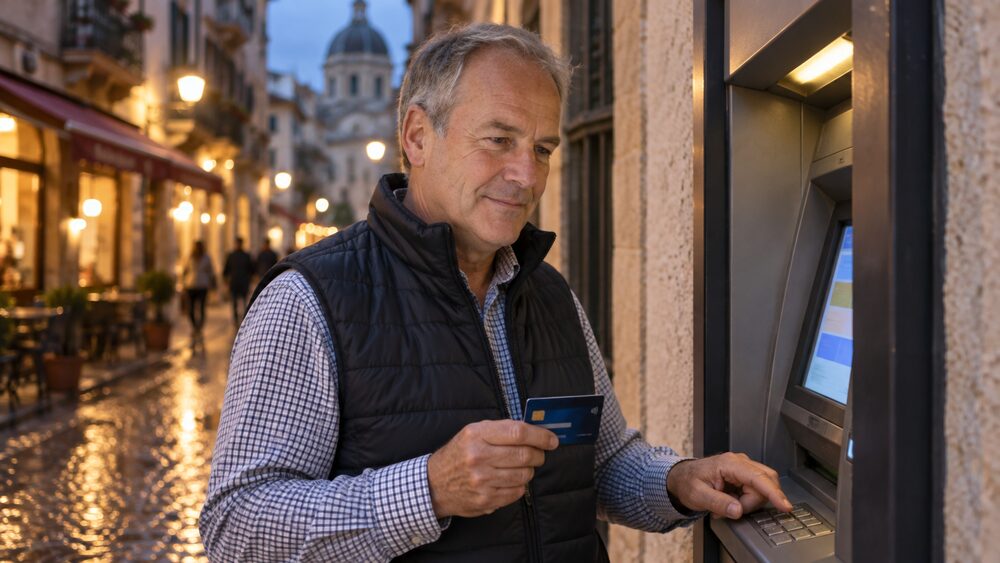
If you hold investments priced in another currency, or take cash out of an ATM abroad, a conversion charge usually applies. On investment platforms, foreign exchange fees on transactions up to £5,000 ranged from 0.45% to 1.5%1. On the card side, current accounts often add a foreign exchange fee of around 3% of the transaction amount, plus a spending or cash machine charge typically between £1 and £3 each time you use your card, except for euros in the EU2.
The charge is separate from the exchange rate itself. HSBC, for example, says international payments are made using the HSBC Exchange Rate, which includes a currency conversion charge3. That means the rate you see already has a cost built in, and any additional fee sits on top. Regulation requires the party offering a currency conversion service at an ATM, point of sale or by the payee to disclose all charges and the exchange rate to be used4.
What you pay depends on where the money is held and how it moves. An investment platform converting a share purchase is a different transaction from a debit card withdrawal at a foreign ATM, and the fee structures reflect that. This page sets out what each type of charge is, how the percentages add up, and where the rules protect you.
Foreign exchange fees: 0.45% to 1.5% on amounts up to £5,000
The headline range for investment platforms converting currency on international share and fund transactions is 0.45% to 1.5% on amounts up to £5,0001. That range covers the platforms surveyed, and the variation reflects different pricing models rather than different underlying costs.
Interactive Investor, for example, charges 0.75% on the first £50,000 and 0.25% above that on its Plus price plan7. Fidelity International charges 0.25% on the whole amount for transfers of US$200,000 or more8. These tiered structures mean the effective percentage falls as the amount rises, which matters if you are moving larger sums.
On the banking side, the picture is different. MoneyHelper says current accounts typically charge a spending or cash machine fee of between £1 and £3 each time you use your card abroad, except for euros in the EU, plus a foreign exchange fee often around 3% of the transaction amount2. TSB charges 1.5% of the amount withdrawn on ATM card cash withdrawals in foreign currency, with a minimum of £1.509. For debit card cash withdrawals in foreign currency, TSB charges 1.5% with a minimum of £2 and a maximum of £4.50, though this does not apply to Cash accounts9.
Credit cards add their own layer. Most credit cards add a foreign transaction fee of around 3% on non-sterling purchases and cash withdrawals5. Nationwide credit cards charge a cash advance fee of 2.5% of the amount, or £3, whichever is greater, when you use your card to withdraw cash in sterling or foreign currency, buy foreign currency, or pay for traveller's cheques10. The same 2.5% minimum £3 charge appears across the Select, Gold, Classic and Member credit cards11.
How the percentage fee adds up on different amounts
A percentage fee sounds small until you apply it to a real withdrawal. The structure of the fee matters as much as the rate. Many travel money cards charge a percentage on the transaction as well as a flat rate fee for each withdrawal or transaction16. That combination means small, frequent withdrawals cost proportionally more than one larger withdrawal, because the flat fee is charged each time.
Investment platforms work differently. They charge either a percentage annual fee, or a fixed amount each year17. On top of that, you might be charged each time you buy and sell a share, investment trust or exchange-traded fund, though fees for buying and selling traditional funds are less common1. Some platforms charge a fixed fee per trade, for example £5 to £1018.
For larger portfolios, platform fees tier down. NatWest charges 0.15% on investments up to £1m, 0.10% above £1m up to £5m, and 0.05% over £5m19. These are annual platform charges rather than conversion fees, but they affect the total cost of holding international investments.
Where the currency conversion charge applies
The conversion charge applies wherever a currency has to be changed. That includes buying or selling international shares and funds on an investment platform1, withdrawing cash from a foreign ATM20, and making card payments in a currency other than sterling21.
Santander International says there will be a charge applied for international payments and receipts22. Bank of Ireland UK charges 2.75% of the amount withdrawn as a non-sterling transaction fee on cash withdrawals in any foreign currency from its personal current account23. Its Clear Account also applies charges for using your card to make transactions in a foreign currency21.
Credit cards layer the charges. Citizens Advice says that if you withdraw cash on your credit card abroad you may be charged a foreign transaction fee on top of the usual cash advance fee24. Halifax says that in addition to any service provider charges, a foreign currency transaction and purchase fee might apply to cash withdrawals at an ATM or branch outside the UK25. Nationwide says some of its cards include a fee when you make a payment or take out money in a foreign currency26, and that you may have to pay fees for cash withdrawals or for making debit card payments in a foreign currency27.
The Post Office explains the structure clearly: if you withdraw cash at a foreign ATM, you will be charged a non-sterling transaction fee for currency conversion plus a non-sterling cash fee, either as a flat fee or a percentage20. Barclays notes that some transaction fees might apply when spending abroad28.
"the party offering the currency conversion service to the payer must disclose to the payer all charges as well as the exchange rate to be used"
Receiving money in sterling or in another currency
Where the money lands matters as much as where it came from. Royal Bank says that for international payments, the recipient bank may charge fees29. That means a transfer can incur a charge at both ends, and the sending platform's fee is only part of the cost.
Santander International's Foreign Exchange service states that there will be a charge applied for international payments and receipts22. SWIFT payments, used for international transfers, usually have a fee charged by your bank30.
For accounts held in a foreign currency, the position can be simpler. Santander International's Gold Account does not charge for cash withdrawals from ATMs in the same currency as the account, though foreign banks may levy a charge31. That means if you hold a euro account and withdraw euros, the conversion charge does not arise, though the foreign bank operating the ATM may still charge you.
The Payment Accounts Regulations set a rule for basic accounts: where a credit institution provides a service to a consumer in a currency other than sterling, a fee may be charged, provided the fee is reasonable33. That gives some protection against disproportionate charges on basic accounts, though it does not cap them.
Can I avoid currency conversion when withdrawing abroad?
There are ways to reduce or remove the conversion charge, though each has conditions.
Holding an account in the currency you spend in is the most direct route. Santander International's Gold Account does not charge for cash withdrawals from ATMs in the same currency as the account31. If you hold a euro account and withdraw euros in the eurozone, no conversion is needed, though the foreign bank may still charge32.
Some cards offer allowances. Currensea allows ATM withdrawals free under a limit of £500 a month, after which a 2% fee applies34. The RBS Travel account applies a 2.75% fee to further withdrawals charged to the linked current account beyond the €/$1,000 allowance35. Currensea's Elite plan charges 0.00% up to £750 on foreign currency ATM withdrawals36.
Prepaid foreign currency cards vary. Some charge fees for withdrawing cash in the UK, and it may be cheaper to pay for purchases37. Checking the card's terms before withdrawing is the practical step.
Do fees differ for withdrawals over £5,000?
They can, because investment platforms often tier their foreign exchange charge by amount. Interactive Investor charges 0.75% on the first £50,000 and 0.25% above that on its Plus plan7. Fidelity International charges 0.25% on the whole amount for transfers of US$200,000 or more8. The effective rate therefore falls as the amount rises.
On the card side, the thresholds are lower. Currensea applies a 2% fee once monthly ATM withdrawals pass £50034. Vanquis Travel Credit Card charges up to 5%, or £3, whichever is higher, for cash withdrawals abroad or in the UK39. Nationwide credit cards charge 2.5% of the amount, or £3, whichever is greater10.
For larger sums, the difference between a percentage fee and a flat fee becomes significant. The tiering structure on investment platforms is designed to reduce the effective rate on larger transactions, but the starting rate still applies to the first slice.
Platform exit fees also matter when moving investments between providers. Some providers charge exit fees ranging from £15 to £30 per holding, though most providers charge nothing40. You might be charged if you transfer investments from one platform to another, but many platforms have scrapped these fees, while others will offer to cover switching fees as an incentive to join them1.
Does the fee apply when selling international shares or funds?
Yes. Transactions on international shares and funds incur foreign exchange fees, and these vary by platform1. The fee applies on both the buy and the sell side, because each transaction involves converting between sterling and the currency the investment is priced in.
You might be charged each time you buy and sell a share, investment trust or exchange-traded fund1. Investment trusts are treated by investment platforms in a similar way to shares, so you will likely have to pay one-off fees when you buy and sell trusts, even if fund trading is free41.
For balance transfers, some cards do not charge a balance transfer fee, but others charge up to 5% for each balance transfer42. That is a separate charge from currency conversion, but it illustrates how layered fees can be on a single account.
Who can I complain to if a platform's charges were wrong?
Start with the platform or bank's own complaints process. If you are not satisfied with the response, you can take the complaint to the Financial Ombudsman Service, which is free and independent. Resolver can help you raise a complaint about currency and foreign exchange issues, including funds transfers that were not completed43.
The rules on reimbursement for authorised push payment fraud do not cover international payments. The mandatory APP fraud reimbursement requirement does not currently apply to international payments, payments across other payment systems such as card payments, cryptocurrency transfers and CHAPS transactions, or "on us" payments where the fraudster uses an account provided by the victim's own payment service provider44. The exclusions also cover payments sent or received by credit unions, municipal banks and national savings banks, first-party fraud, gross negligence, payments before 7 October 2024, and claims more than 13 months after the last payment45.
That means a disputed international transfer follows a different route from a domestic scam claim. The Financial Ombudsman Service can consider complaints about charges, but the APP reimbursement scheme will not apply.
Sources45 cited
- How investment platforms work Which?, 2026-03-16
- How to open, switch or close your bank account MoneyHelper, 2026-09-25
- Setting up your finances abroad HSBC, 2026
- The Payment Accounts Regulations 2015, Part 6 legislation.gov.uk, 2026
- Should I get a credit card? Which?, 2026-09-18
- The UK's ATM network Payment Systems Regulator, 2026-09-26
- Buying US shares in a UK ISA Interactive Investor, 2026-09-26
- Transfer guidance Fidelity International, 2026-09-26
- Banking Charges Guide TSB, 2025-09
- Fees and charges Nationwide, 2026
- Select Credit Card rates and details Nationwide, 2026
- Gold credit card rates and details Nationwide, 2026
- Classic credit card rates and details Nationwide, 2026
- Credit card rates and details Nationwide, 2026
- Savings charges Halifax, 2026-09-27
- Travel money ABTA, 2026
- Are fund charges eating into your returns? Which?, 2026-04-06
- Understanding investment fees and costs Chip, 2026-07-22
- Investment fees NatWest, 2026-09-25
- Right travel card for spending abroad Post Office, 2026-04-07
- Clear Account Bank of Ireland UK, 2026-09-25
- Foreign exchange Santander International, 2026-09-25
- PCA charges explained Bank of Ireland UK, 2026-01
- The costs and charges of credit cards Citizens Advice Scotland, 2026-09-25
- Credit vs debit cards Halifax, 2026-09-27
- Compare EEA currency conversion charges Nationwide, 2026
- Living and working abroad Nationwide, 2026
- Payment methods Barclays, 2026
- Ways to pay Royal Bank of Scotland, 2026-09-25
- Bank accounts for young people Santander International, 2026-09-25
- Current account for expats Santander International, 2026-09-25
- Current account for international expats Santander International, 2026-09-25
- The Payment Accounts Regulations 2015, Part 4 legislation.gov.uk, 2015
- Spending abroad: the 4 dos and 5 don'ts Which?, 2024-07-26
- Travel account Royal Bank of Scotland, 2026-09-26
- Terms and conditions 2024 Currensea, 2026
- I can't get my money out of my prepaid foreign currency card Which?, 2021-10-08
- N26 withdraws from the UK: what does it mean for your money Which?, 2020-02-15
- Travel credit card Vanquis, 2026-09-07
- Stocks and shares ISA transfers Which?, 2026-09-25
- Investment trusts explained Which?, 2025-05-14
- 8 things you need to know about balance transfer credit cards Which?, 2023-02-06
- Currencies, foreign exchange and funds transfer complaints Resolver, 2026-09-26
- New rules for bank transfer fraud reimbursement from 2024 Which?, 2023-06-07
- What to do if your bank won't refund you after a scam Which?, 2026-05-12




 MoneyHelperFree, impartial money and pensions guidance, set up by government
 FSCSProtects your money if a bank, insurer or investment firm fails
 Financial Ombudsman ServiceFree, independent help when a complaint about a firm is not put right
 FCA Warning ListCheck whether a firm is authorised before you deal with it
 Citizens AdviceFree advice on money, consumer and legal problems in England and Wales