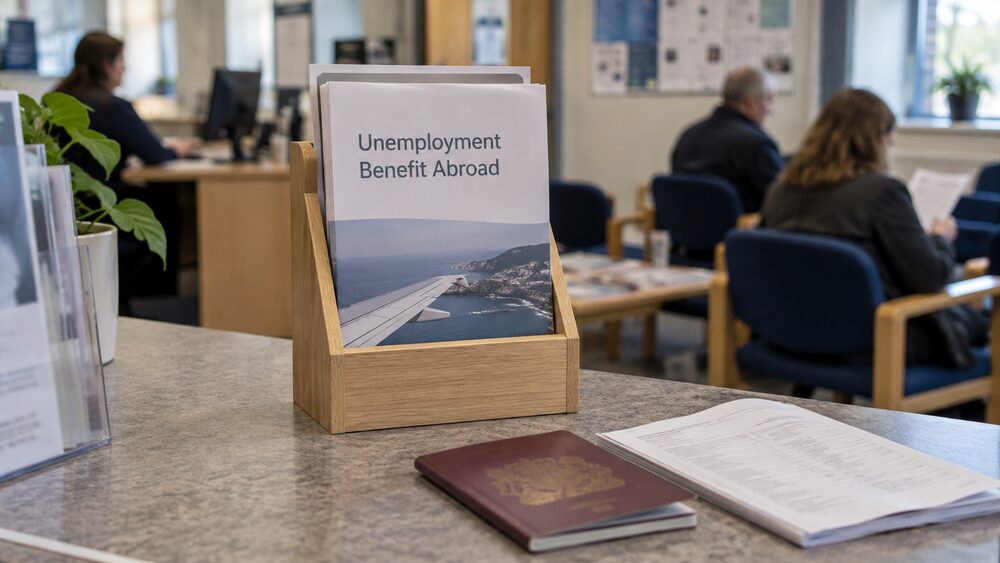
A PDU1 is a certificate that records the work and National Insurance contributions you built up in the UK, so that a benefit office in another country can take that record into account when you claim unemployment benefit there. The official guidance is clear about what it is for: you use it to apply for a PDU1 certificate "to support an unemployment benefit claim" in the EU, Norway, Iceland, Switzerland or Liechtenstein1. It is not a benefit in itself, and it does not pay anything: it is evidence, carried from one country's system to another.
The reason it exists is that unemployment benefits everywhere are built on contributions. A country will normally only pay if you have paid into its own system for long enough. When you have paid in the UK instead, the PDU1 lets the office abroad count those UK periods, so a person who worked in Britain for years is not treated as someone who has never worked at all. The claim is still decided under the rules of the country where you make it, including its residence and work tests, but the UK record is part of the calculation.
This page explains who needs a PDU1, what it records, what information to gather before applying, how the application works, and what the certificate can and cannot do once you have it.
What a PDU1 is for: unemployment benefit in the EU, Norway, Iceland, Switzerland and Liechtenstein
The PDU1 certificate exists for one main situation: you have worked in the UK, you have moved to another country in Europe, and you need to claim unemployment benefit there. The official guidance lists the countries where the certificate supports a claim as the EU, Norway, Iceland, Switzerland and Liechtenstein1. These are the same countries that appear throughout the UK's social security rules for people with cross-border lives. Child Benefit guidance, for example, draws its eligibility lines around the EU, Switzerland, Norway, Iceland and Liechtenstein5, and the State Pension guidance for people abroad lists a European Economic Area country, Switzerland, Norway, Iceland or Liechtenstein as places where claims can be made through the local pension authority6.
The practical point is simple. Unemployment benefit systems look at your contribution history. If that history is in the UK, the office abroad cannot see it on its own records. The PDU1 is the document that carries it across. Without it, a claim may be refused or reduced on the basis that you have not paid enough into the local system, even though you have years of UK work behind you.
The certificate is issued by the UK side, from your UK records, before or while you make your claim abroad. It is one of a family of documents the UK issues for cross-border social security: the same guidance page that covers the PDU1 also covers getting a National Insurance contributions statement1, and there are parallel processes for other benefits, such as the IPC BR1 form used to claim the State Pension from abroad6.
Who might need a PDU1
The people who need a PDU1 are those whose UK work is their main or only contribution record and who are now claiming unemployment benefit in one of the countries listed above. That covers several common situations:
- People who have left the UK to look for work abroad. You give your address abroad when you apply, and your UK address only if you still have one2.
- People who worked in the UK for a period and returned to their home country in the EU, Norway, Iceland, Switzerland or Liechtenstein. The UK record can be added to the record built at home.
- People who moved within these countries during their working life. The certificate is part of how periods worked in different countries are brought together.
- Students and younger workers. If you worked in the UK as a student, the same record applies. Note that if you work abroad for a foreign employer you will not normally pay National Insurance in the UK, but may have to pay foreign contributions7, so the timing of your UK work matters.
The certificate is not needed by people claiming unemployment benefit in the UK itself, and it is not relevant for countries outside the EU, Norway, Iceland, Switzerland and Liechtenstein, unless a separate social security agreement applies. The State Pension guidance, for instance, recognises a wider list that includes countries with a social security agreement with the UK6, but the PDU1 itself is tied to the European countries named in the guidance1.
If you are planning a move rather than making a claim now, it is worth gathering your UK paperwork before you go. Payslips and P60s are the documents you will need for your own records8, and your employer's PAYE number, found on payslips, P60s, P45s and P11Ds, is the kind of detail that identifies your UK employment history9.
Countries where a PDU1 can support your claim
The guidance names the countries directly: the certificate supports an unemployment benefit claim in the EU, Norway, Iceland, Switzerland and Liechtenstein1. Because the EU is a group of member states rather than a single country, the practical list is long, and the exact claim rules differ from one country to another even though the certificate itself is the same document.
What the countries on the list have in common is that the UK's social security arrangements treat them as a single area for these purposes. The same grouping appears in other benefit rules. Child Benefit can be paid for a child living in an EU country, Norway, Iceland or Liechtenstein, or Switzerland, where the claimant has settled or pre-settled status under the EU Settlement Scheme or is covered by the conditions in the UK's agreements with those countries5. Funeral Support Payment in Scotland can be available where the funeral took place in a member state of the EU, Iceland, Liechtenstein, Norway or Switzerland and the client or their partner has settled or pre-settled status under the EU Settlement Scheme10. The State Pension can be claimed through the local pension authority if you live in a European Economic Area country, Switzerland, Norway, Iceland or Liechtenstein, or a country with a social security agreement with the UK6.
The benefit of this common area is that your UK record is not lost when you cross a border within it. The limit is that each country still runs its own unemployment benefit scheme, with its own conditions, rates and waiting periods. The PDU1 opens the door; the office abroad decides what is behind it.
What the PDU1 records about your UK work
The certificate is built from your UK National Insurance record, which is why your National Insurance number is the single most important piece of information in the application2. The record behind the certificate is the same record that drives your UK benefits and State Pension: it is held against your NI number and reflects the contributions credited to you from work and, in some cases, from benefits.
Your NI number appears on documents you are likely to have kept:
- on your P603
- on letters about your tax, pension or benefits3
- in the National Insurance section of your personal tax account3
A wage or pension slip can also carry it: the documents accepted to verify identity for Universal Credit include a wage or pension slip that shows the payee name and National Insurance number, dated within the last 6 months11. The same number is asked for across government applications, from Pension Credit12 to student finance13 to claiming a tax refund by post14, which is a sign of how central it is to your UK record.
The UK record that feeds the certificate can include periods when you were claiming certain benefits as well as periods when you were working, because some benefits carry National Insurance credits. It is worth keeping the supporting paperwork: payslips and your P60 are the records you will need if anything has to be checked or corrected8, and your employer's PAYE number, found on payslips, P60s, P45s and P11Ds, identifies each employer on the record9.
Information to have ready before you apply
The application asks for a short list of personal details. To apply, you will need2:
- your full name
- your date of birth
- your National Insurance number
- your address in the UK, if applicable
- your address abroad, if applicable
The "if applicable" matters. People who have left the UK for good may no longer have a UK address, and the form allows for that. Equally, someone applying before a move may not yet have an address abroad.
Before you start, it is worth locating your National Insurance number if you do not know it by heart. It is on your P60, on letters about your tax, pension or benefits, and in the National Insurance section of your personal tax account3. Other government services ask for the same thing and offer the same advice: Student Finance England tells applicants to have their National Insurance number, passport and bank details to hand before they start13, and the student finance application service asks for National Insurance number and passport details at the start15. The lesson from all of them is the same: find the number first, then begin.
If your UK record includes employment, having your payslips and P60 to hand can help you answer questions about your work history8, and your employer's PAYE number, if you need to identify an employer, is on payslips, P60s, P45s and P11Ds9. If you have had a tax coding notice, checking that your income and any taxable company benefits were listed correctly at the time16 reduces the chance of a discrepancy in the record later.
If you claimed Jobseeker's Allowance or Universal Credit
Periods on certain UK benefits can form part of the record that the certificate reflects, so it helps to have the details of any recent claims to hand. The two benefits most associated with unemployment in the UK are Universal Credit and New Style Jobseeker's Allowance.
New Style Jobseeker's Allowance is a contribution-based benefit: it is based on your National Insurance record rather than your income, which makes it the closest UK equivalent to the unemployment benefits the PDU1 supports abroad. If you get New Style Jobseeker's Allowance and Universal Credit at the same time, the JSA payment is deducted from the Universal Credit payment17. Universal Credit itself is a household benefit with conditions attached to it: in Northern Ireland, statistics to 30 November 2025 show 35,110 claimants in the 'searching for work' conditionality regime, representing 13% of the caseload18.
A few points are worth knowing if your recent history includes these benefits:
- Re-claiming Universal Credit after a gap. The regulations allow a new claim without a full repeat of some steps where the claimant was previously entitled to an award of Universal Credit whose last day fell within the 6 months preceding the date on which the claim is made, and during that 6 months the claimant has continued to meet the basic conditions and was not excluded from entitlement19. This 6-month window is a UK rule, not a rule about the PDU1, but it shows how recent claim periods are treated as continuous in some circumstances.
- Other benefits reduce Universal Credit. Payments for benefits including New Style Jobseeker's Allowance, New Style Employment and Support Allowance, Incapacity Benefit, Carer's Allowance, Maternity Allowance and the State Pension are deducted from Universal Credit20.
- Advances are loans. A Budgeting Advance generally requires you to have been getting Universal Credit, Employment and Support Allowance or Pension Credit for six months or more, unless you need the money to help you start a new job or keep an existing job21, and the equivalent help while waiting for a first Universal Credit payment requires similar qualifying periods22.
- Health-related claims use their own forms. If your Universal Credit claim involved a health condition or disability, your medical professional may have completed an SR1 form23, and a DS1500 form or SR1 form is accepted as evidence in the Scottish system where a BASRiS form would otherwise be used24.
None of this changes how you apply for a PDU1, but claim dates, reference numbers and award letters are the kind of detail that can be requested when your UK record is being reviewed, so keeping them is sensible.
Signing in to apply for a PDU1
The PDU1 is applied for through an online government service, and to apply online you need to sign in to use the service4. This is the same pattern as other government online applications: the non-resident landlord form NRL1, for example, states plainly that to apply online, you'll need to sign in to use this service4.
Signing in matters because the certificate is drawn from your personal UK records. The sign-in step is what ties the application to your National Insurance record, so the details you give are checked against what the UK already holds about you rather than being taken purely on trust.
A few practical points about government online forms of this kind, drawn from how comparable services work:
- Some online forms cannot save your progress partway through. The P53Z form, for instance, is filled in online and you cannot save your progress25, and the same is true of the P50Z(DB) claim26 and the voluntary Class 3 contributions form for periods abroad, which instructs you to fill in the form online, print the completed form, sign the declaration and post it2. Gather your information before you start rather than during.
- Where a form cannot be completed online, there is normally a paper route. The P50Z(DB) claim can be printed and posted to HMRC using the postal address shown on the form27, and the Maternity Allowance MA1 form is downloaded and sent to the address on the form28.
- Accessible formats are often available on request. For the NRL1 form, you can email HMRC to ask for the form in a more accessible format, or in Welsh4.
Applying without a UK postcode: your National Insurance number
Many people applying for a PDU1 no longer live in the UK, and the application is built to allow for that. The list of information needed includes your address in the UK "if applicable" and your address abroad "if applicable"2, so neither is compulsory.
If you have no UK postcode, you say so rather than inventing one. Other benefit services handle the same situation explicitly: the Funeral Support Payment telephone application instructs that if the client does not have a postcode, you select 'No postcode'29. The principle is the same here: the form accommodates people whose only address is abroad.
What the application does need, in every case, is your National Insurance number2. It is the key that identifies your UK record from anywhere in the world. If you do not know it, it is on your P60, on letters about your tax, pension or benefits, or in the National Insurance section of your personal tax account3. If you have kept payslips or a P60, keep hold of them: they are the records you will need if anything has to be checked8.
There is a related point worth knowing for people who spend time abroad. You do not need to pay National Insurance or get a number if you have either a certificate or document that proves you pay social security contributions in the EU, Iceland, Liechtenstein, Norway or Switzerland, or a certificate from a country that has a social security agreement with the UK2. That reflects the same cross-border principle the PDU1 relies on: within this group of countries, you are normally covered by one country's system at a time, and documents like the PDU1 are how the systems talk to each other.
Using the PDU1 with the benefit office abroad
Once the certificate is issued, it goes to the benefit office in the country where you are claiming. The sequence looks like this:
The certificate carries your UK record to the benefit office abroad, which then decides under its own rules.
The office abroad uses the certificate as evidence of your UK periods when it applies its own rules on qualifying contributions. The decision, the rate and the conditions you must meet while claiming are all matters for that country. The UK's role ends with issuing an accurate certificate.
A few related points about benefits and cross-border life are worth knowing:
- The UK can pay some benefits abroad. While abroad, you may be able to claim your UK State Pension30, and you may be able to claim UK Child Benefit if you live abroad30.
- Benefits paid abroad are often frozen. Although these benefits are payable anywhere abroad, they're not normally increased when pension rates go up in the UK31.
- Some benefits need notice before you leave. Industrial Injuries Disablement Benefits can be paid abroad, but you must inform the office which deals with your claim before you leave the UK31.
- Paying voluntary National Insurance abroad protects your record. Paying National Insurance while abroad protects your State Pension and entitlement to other benefits and allowances30. The voluntary Class 3 route for periods abroad has its own application form, filled in online, printed, signed and posted2.
- Foreign benefits have their own UK tax treatment. UK legislation applies to benefits payable under the law of a country or territory outside the United Kingdom that are substantially similar in character to specified UK benefits and payable to a person resident in the United Kingdom32.
- Help with working abroad is available. If you want to work in another country, contact their UK-based embassy for more information33.
What a PDU1 cannot do
The PDU1 is evidence, not entitlement. The clearest limit is the one in the guidance itself: the certificate is there "to support an unemployment benefit claim"1. Supporting a claim is not the same as winning one. The benefit office abroad decides whether you qualify, under that country's own rules on residence, availability for work and contribution levels. A person can hold a valid PDU1 showing years of UK work and still be refused, because the local conditions are not met.
The certificate also does not move UK benefits abroad. It does not let you keep claiming Universal Credit or Jobseeker's Allowance from another country; those are UK benefits with their own rules about presence and residence. The documents that do carry UK entitlements abroad are separate: the State Pension has its own claim route from abroad, through the IPC BR1 form or the local pension authority in the countries listed6, and some benefits are simply payable anywhere abroad, though normally without the UK's uprating31.
Nor does the PDU1 cover countries outside its list. The guidance ties it to the EU, Norway, Iceland, Switzerland and Liechtenstein1. For countries with a separate social security agreement with the UK, different documents and rules apply, as the State Pension guidance's wider list shows6.
Finally, the certificate is only as good as the record behind it. If your UK record has gaps, because of work that was never recorded or details that were wrong, the PDU1 will reflect the gaps. Checking your record, keeping your P60 and payslips8, and correcting errors through the normal UK channels are what protect the record the certificate relies on. For the wider picture of National Insurance when you leave the UK, see National Insurance after you move abroad, and for what else changes financially when you relocate, see money abroad: travelling, living and moving overseas.
Sources33 cited
- Get a PDU1 certificate or a National Insurance contributions statement GOV.UK, 2014-06-02
- Apply to pay voluntary Class 3 National Insurance contributions for periods abroad GOV.UK, 2026-07-14
- Pension Age Disability Payment reviews: sending documents mygov.scot, 2026-09-26
- Apply as an individual to receive UK rental income without UK tax deducted GOV.UK, 2024-09-05
- Child Benefit if your child comes to the UK GOV.UK, 2026-09-27
- State Pension abroad: easy read GOV.UK, 2026
- Working while you study: paying tax nidirect, 2025-09-10
- Repaying your student loan GOV.UK, 2026-09-25
- Report that your employer is not complying with their workplace pension duties The Pensions Regulator, 2026-09-26
- Funeral Support Payment: eligibility Social Security Scotland, 2026-09-26
- Documents to verify your identity for Universal Credit GOV.UK, 2026-06-09
- Applying for Pension Credit nidirect, 2026-07-06
- Full-time undergraduate student finance applications open for 2026 to 2027 GOV.UK, 2026-03-23
- Claim an income tax refund by post GOV.UK, 2014-08-15
- SLC opens application service for 2026 to 2027 academic year GOV.UK, 2026-03-23
- Common letters: P2 Tax Coding Notice HMRC, 2026-09-28
- New Style Jobseeker's Allowance nidirect, 2026-09-10
- Universal Credit publication, November 2025 NISRA, 2025-11-30
- The Universal Credit Regulations 2013, as amended legislation.gov.uk, 2025-04-06
- What will affect your Universal Credit payments nidirect, 2026-06-30
- Universal Credit advance payments nidirect, 2026-05-20
- Help while waiting for your Universal Credit payment nidirect, 2026-06-30
- Universal Credit if you have a health condition or disability nidirect, 2026-08-25
- Child Disability Payment statistics to 30 June 2026 Social Security Scotland, 2026-08
- Form P53Z HMRC, 2025-04
- Claim back income tax on a pension death benefit lump sum (P53Z(DB)) GOV.UK, 2024-02-21
- Claim back income tax on a pension death benefit lump sum payment if you've stopped working (P50Z(DB)) GOV.UK, 2024-02-29
- Maternity Allowance form MA1 notes nidirect, 2026-06-29
- Funeral Support Payment: telephone application Social Security Scotland, 2026-09-26
- Moving, living or retiring abroad GOV.UK, 2025-08-20
- Guidance on social security abroad (NI38) GOV.UK, 2026-07-07
- Income Tax (Earnings and Pensions) Act 2003, Part 10 legislation.gov.uk, 2026
- Moving or retiring abroad GOV.UK, 2026-09-26






 MoneyHelperFree, impartial money and pensions guidance, set up by government
 FSCSProtects your money if a bank, insurer or investment firm fails
 Financial Ombudsman ServiceFree, independent help when a complaint about a firm is not put right
 FCA Warning ListCheck whether a firm is authorised before you deal with it
 Citizens AdviceFree advice on money, consumer and legal problems in England and Wales