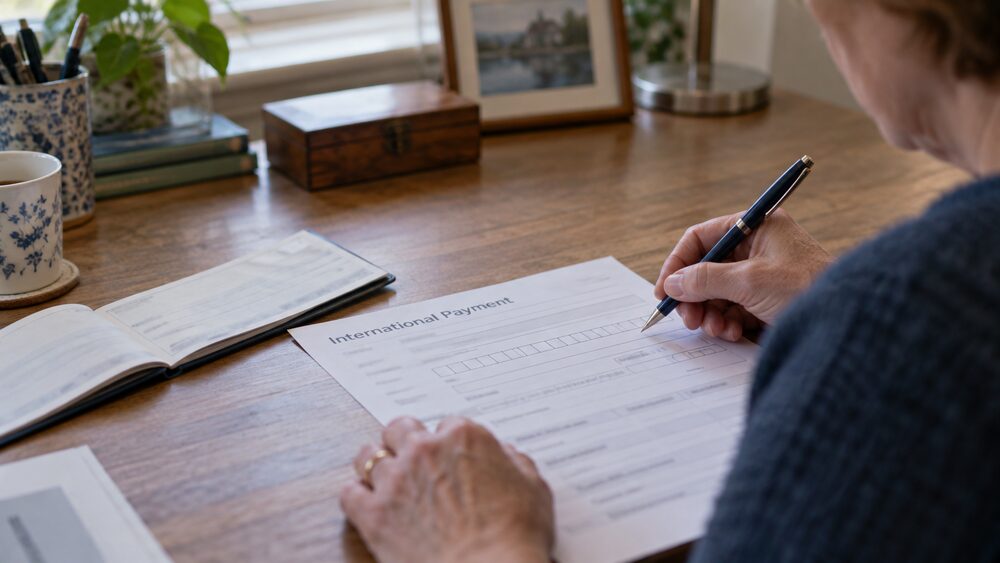
IBAN stands for International Bank Account Number. It is an internationally agreed code made up of up to 34 letters and numbers that helps banks process transfers around the world1. Alongside it sits the SWIFT code, also called a BIC, a shorter code of 8 to 11 characters that identifies the bank itself rather than the account2. Anyone who wants to transfer money internationally usually needs both2.
If you are paying someone abroad from a UK account, you will generally need the recipient's IBAN and their BIC or SWIFT code3. If someone abroad is paying you, they need the same things about your account: your IBAN, and often your bank's BIC as well4. Neither code costs anything to obtain, and both are printed on statements or shown in banking apps, so there is no reason ever to pay a third party to "find" one for you.
This page explains what each code is, how a UK IBAN is built from your existing account details, which countries use IBANs, what else a bank may ask for when you send money abroad, how SEPA euro payments work, and what can go wrong when a code is mistyped. For the costs of sending money abroad and the services available, see money transfers.
What an IBAN is: up to 34 letters and numbers
An IBAN is a standard way of writing a bank account so that a bank in one country can read an account in another without guessing. It can contain up to 34 characters in both letters and digits2. The code includes a country code, and a bank and account number in a standard format, which helps to reduce errors in international payments8.
The length varies by country because each country's domestic account details are a different length to begin with. Barclays, describing the IBANs used for SEPA payments, says the code is a mixture of letters and numbers and is 15 to 33 characters long7. The UK version, at 22 characters, sits in the middle of that range. Whatever the length, the point of the format is the same: a receiving bank can check the structure before the money moves, rather than discovering a problem afterwards.
An IBAN identifies both the bank and the specific account9. That is what makes it different from a SWIFT code, which stops at the bank. When you give someone abroad your IBAN, you are giving them everything they need to route a payment to your exact account; the SWIFT code they may also ask for simply tells the sending system which bank to hand the payment to on the way.
A UK IBAN is your sort code and account number in an international wrapper
A UK IBAN is built by embedding the existing sort code and account number inside a standardised format, alongside a country code and check digits6. Nothing about your account changes when it is written as an IBAN: it is the same account, expressed in a way banks abroad can read.
The structure is fixed. It starts with GB for the United Kingdom, then two check digits that a computer uses to catch keying errors, then a four letter bank code, then your sort code and account number exactly as they appear on your card and statements. Revenue Scotland, which asks taxpayers to pay Land and Buildings Transaction Tax by bank transfer, publishes the IBAN GB93NWBK60708010019456 and the SWIFT code NWBKGB2L for its BACS, CHAPS and Faster Payments account10, and repeats the same IBAN on its main payment page11. That real example shows the pattern in practice: GB, the check digits 93, the bank code NWBK, then the sort code and account number of the receiving account.
Because the IBAN is only a wrapper, you cannot invent one from a sort code and account number by guesswork: the check digits are calculated, and a mistyped version will usually fail the receiving bank's checks. Your bank generates the IBAN for you, and it appears on statements and in online banking. first direct customers find their IBAN and BIC on a statement, just below the account summary12. Starling customers can see their SWIFT code alongside their IBAN in the app, by selecting the top right hand menu, then Account details, then International2.
SWIFT and BIC codes: 8 or 11 characters that identify the bank
A BIC, sometimes referred to as a SWIFT code, is a unique set of characters, either 8 or 11 numbers and letters5. The two names mean the same thing: BIC stands for Business Identifier Code, and SWIFT is the network that carries the messages between banks. Gov.uk, explaining what details are needed to receive a State Pension into an overseas account, lists an IBAN and a BIC, previously Bank Identifier Code, as the standard identifiers13.
The code has an internal structure. OFX describes the bank code element as 4 letters identifying the bank8, with the remaining characters identifying the country, the location and, in the 11 character version, the specific branch. An 8 character code points to the bank's head office; an 11 character code narrows it to a branch.
| Element | What it contains |
|---|---|
| Bank code | 4 letters identifying the bank8 |
| Country code | identifies the bank's country |
| Location code | identifies the city or office |
| Branch code (11 character codes only) | identifies the specific branch |
A BIC is a number that identifies your bank, and it is needed if you want to send or receive money from outside the UK; HSBC customers can find it on their bank statement14. AIB (NI) confirms the same format for its customers: BIC codes consist of either 8 or 11 alphanumeric characters15. Because the BIC identifies the bank rather than the account, it is often published openly: a bank's BIC appears on its website, on statements and in the payment details of any organisation that receives money into it, as Revenue Scotland's published NWBKGB2L shows10.
Do all countries use IBANs?
Not every country uses IBANs. Some countries do not use them, so you might have to use an account number along with a SWIFT/BIC code2. IBANs are standard across many countries, mostly in Europe and parts of the Middle East9. Some countries, such as those within the European Union, use IBAN, BIC and SWIFT codes16.
In practice this means the details you need depend on where the recipient's account is held:
- IBAN countries: you will normally be asked for the recipient's IBAN, and often their bank's BIC as well4.
- Non IBAN countries: you may instead need a local account number plus a SWIFT/BIC code2, and in some cases a clearing code as well17.
- The United States and some other corridors: a wire transfer typically requires a SWIFT/BIC code and a local account number, with no IBAN involved at all9.
The safest approach is to ask the recipient to obtain the exact requirements from their bank, or to check what your own bank's payment form asks for once you have selected the destination country. Sending a payment with the wrong type of details for that country is one of the common reasons international transfers are delayed or returned.
Details you need to send money abroad
When you send money outside the UK, you will generally need the IBAN and BIC or SWIFT code of the person you are sending money to3. That is the minimum, but banks may ask for more depending on the destination. Al Rayan Bank tells customers they will need the beneficiary name, IBAN, and SWIFT/BIC code18. first direct says that if you are sending money outside the UK, you will also need the payee's BIC/SWIFT or IBAN19.
For payments to the rest of the world, Halifax lists a longer set of requirements: the recipient's IBAN, the name and address of the recipient's bank, a clearing code, and the reason for your payment17. The "reason for payment" is not bureaucracy for its own sake: banks are required to check what international payments are for, and payments that are flagged for missing information can be held.
A useful checklist before you start:
- The recipient's full name, exactly as it appears on their account.
- The recipient's IBAN, or their local account number if their country does not use IBANs2.
- The recipient's bank SWIFT/BIC code18.
- The name and address of the recipient's bank, and a clearing code for some destinations17.
- The reason for your payment17.
When the payment is coming the other way, someone paying your UK account from abroad needs your account's IBAN number instead of your usual account number, and you can find your IBAN on your bank statements20. Handelsbanken, explaining what it needs for incoming SWIFT payments, makes the same point: give the sender the IBAN, not the domestic account number20.
SEPA: the standard route for euro payments
SEPA stands for Single Euro Payments Area and was launched by the European Union (EU) as a standardised way of making electronic euro payments4. It covers all 27 EU countries plus associated territories, and 3 European Economic Area countries: Iceland, Norway and Liechtenstein21. The UK takes part for euro payments, so a UK account can send and receive SEPA payments in euros.
A SEPA payment is not the same as a SWIFT payment, though both can move money across borders. SEPA is designed for euros within the SEPA area, and it is generally the cheaper and simpler route when the recipient's account is in that area and the currency is the euro. SWIFT payments cover the rest of the world and other currencies.
To make a SEPA payment, Handelsbanken needs to know the payee's full name (or company name) and address, their IBAN or account number, and the name and address of the payee's bank including their bank's SWIFT/BIC code22. HSBC says you will need the recipient's IBAN and often the Bank Identifier Code as well4. You might need to authenticate the payment with a PIN, one time password (OTP) or your Secure Key4.
Speed is one of SEPA's selling points. Most payments arrive within one working day7. AIB says its SEPA Standard option normally arrives a minimum of the same working day or maximum no later than one working day, subject to the cut off time23. AIB also notes SEPA payments are available on its mobile app to SEPA reachable countries within the European Economic Area23.
SEPA cut-off times: when a payment goes the same day
The "same working day" part of that promise depends on when you submit the payment. Every bank sets a cut-off time, and a payment keyed after it is processed on the next business day. Coutts states the cut-off time for a SEPA payment is 14:00 (GMT/BST) and the payment will arrive the next business day24. Its help pages repeat the same 14:00 cut-off for payments keyed online25, and for SEPA payments generally26.
Cut-off times differ between banks and between channels. Metro Bank says payments submitted by 2pm in store and via its call centre will be processed the same day, and that payments usually arrive within 1 to 2 working days27. Santander says money arrives the next working day subject to cut-off times28. The practical rule is simple: if a payment must land by a particular day, submit it in the morning and ask your bank what its own cut-off is, because the times quoted here are each bank's own and not an industry standard.
Wire transfers compared with domestic transfers
A wire transfer is an electronic movement of money directly between banks or financial institutions, processed individually rather than in a batch with other transactions9. That single word, individually, is what separates it from the domestic payments most people make every day. A UK Faster Payments or BACS transfer moves through domestic systems that handle payments in bulk; a wire transfer is handled as one transaction, on its own.
Because wire transfers are processed individually, they are often available faster than a standard bank transfer, but typically with a higher fee9. They are frequently used for international transfers, particularly for larger or more time sensitive amounts9. Wire transfers have historically carried a flat fee that is often higher than other transfer methods9, and funds have historically been associated with same day or next day availability once received, though actual timing still depends on the specific banks and countries involved9.
The details a wire transfer needs depend on the destination. A wire to a bank account in the United Kingdom typically requires the recipient's IBAN and the bank's sort code, while a wire to many other corridors instead requires a SWIFT/BIC code and a local account number, with no IBAN involved at all9.
| Domestic UK transfer | International wire transfer | |
|---|---|---|
| Processing | batched with other payments | processed individually9 |
| Typical details | sort code and account number | IBAN and sort code for the UK, or SWIFT/BIC and local account number elsewhere9 |
| Speed | usually near instant (Faster Payments) | historically same day or next day availability, depending on banks and countries9 |
| Fees | usually free from UK current accounts | historically a flat fee often higher than other methods9 |
Transfer speed is an estimate depending on payment and delivery method, transaction review, and system availability9. Fees vary by amount, destination, and delivery method, and are subject to change9, so a quote given today may not hold next month.
Fees on international payments and SEPA transfers
There is usually a fee for cross border payments29. StepChange, the debt charity, makes this point in its guidance on dealing with UK debts from abroad: sending money to an IBAN usually costs something, and anyone budgeting for regular payments from overseas needs to allow for it29.
What a fee buys, and how it is charged, varies. Wire transfers have historically carried a flat fee that is often higher than other transfer methods9, while SEPA payments within the euro area are typically cheaper, which is one reason to choose SEPA when the recipient's account is in a SEPA country and the currency is the euro. Fees vary by amount, destination, and delivery method, and are subject to change9. Some banks also apply an exchange rate margin, the difference between the market rate and the rate they give you, which is a cost even when no explicit fee is quoted. The money transfers guide covers the full range of services and their costs, and buying currency explains exchange rates and commission.
Two things are worth checking with your own bank before a large or recurring payment. First, whether the fee is charged to you or deducted from the amount the recipient receives, because a payment that arrives short can cause problems if the recipient is expecting an exact sum, for example to settle a bill. Second, whether the receiving bank charges its own fee for incoming international payments, which is common in some countries.
When an IBAN is wrong, and where to get help
If you get an IBAN wrong, your bank might send your money to the wrong destination, or it may charge you for an invalid payment1. Both outcomes are bad, and neither is automatically reversible. A payment that goes to the wrong account has to be traced and recalled, which can take weeks and is not always successful, particularly once the recipient's bank has credited the account.
The check digits at the front of an IBAN catch many typing errors automatically, which is why the format exists. But they only catch errors in the structure. An IBAN being in the right format is not a guarantee that it exists, or that it is the right IBAN for a particular account1. A payment sent to a valid IBAN belonging to the wrong person will pass every structural check on its way.
That leaves three practical protections:
- Check the IBAN with the recipient directly, ideally by having them read it from their own statement or banking app rather than from an email, which could itself be fraudulent1.
- Send a small test payment first for large transfers, and confirm it arrived before sending the rest.
- Beware of changed details. If a supplier, solicitor or anyone else emails you to say their account details have changed, verify it by phone on a number you already hold, not one in the email. Payment redirection is one of the most common frauds affecting international transfers; the scams and fraud guide covers it in full.
If a payment goes missing, contact your bank as soon as possible and ask it to trace and recall the funds. If you are unhappy with how the bank handles the matter, you can complain to the bank and then to the Financial Ombudsman Service. If the underlying problem is debt, StepChange offers free advice on dealing with UK debts from abroad, including how payments can be made29. For the wider picture on your rights when things go wrong with a financial firm, see consumer protection.
Sources29 cited
- What is an IBAN Wise, 2026
- Guide to IBAN, SWIFT and BIC Starling Bank, 2026
- What is an IBAN, a BIC and a SWIFT code HSBC, 2026
- What is SEPA HSBC, 2026
- How to send money abroad Royal Bank of Scotland, 2026
- Sort code Remitly, 2026
- Send and receive money online to 130 plus countries Barclays, 2026
- SWIFT codes OFX, 2026
- Wire transfer Remitly, 2026
- How to pay a penalty Revenue Scotland, 2024
- How to pay LBTT Revenue Scotland, 2024
- BIC and IBAN first direct, 2026
- State pension if you retire abroad GOV.UK, 2026
- Banking terms HSBC, 2026
- International payments FAQs AIB (NI), 2026
- What is an account number and sort code HSBC, 2026
- Send money guide Halifax, 2026
- Payments, direct debits and account details Al Rayan Bank, 2026
- Payments and transfers first direct, 2026
- SWIFT payments Handelsbanken, 2026
- SEPA glossary Coutts, 2026
- SEPA payments Handelsbanken, 2026
- International SEPA payments explained AIB, 2026
- Coutts online international payments Coutts, 2026
- What is the difference between a SEPA and a SWIFT payment when keyed online Coutts, 2026
- International payments Coutts, 2026
- International payments, personal accounts Metro Bank, 2026
- Making international payments Santander, 2026
- Dealing with UK debts abroad StepChange, 2026



 MoneyHelperFree, impartial money and pensions guidance, set up by government
 FSCSProtects your money if a bank, insurer or investment firm fails
 Financial Ombudsman ServiceFree, independent help when a complaint about a firm is not put right
 FCA Warning ListCheck whether a firm is authorised before you deal with it
 Citizens AdviceFree advice on money, consumer and legal problems in England and Wales