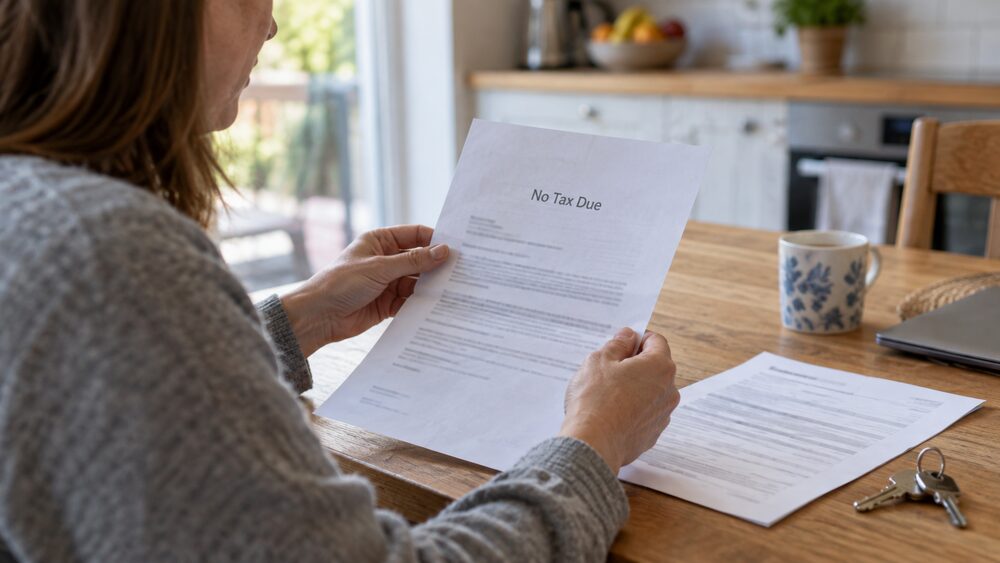
Some property transfers carry no Stamp Duty Land Tax at all. HMRC lists three situations where a transaction does not need a return: where no money or other type of payment changes hands, where property is left to you in a will, and where property is transferred because of divorce or the dissolution of a civil partnership1. Those are the clearest cases of an exempt transfer.
Some property transfers carry no Stamp Duty Land Tax at all. HMRC lists three situations where a transaction does not need a return: where no money or other type of payment changes hands, where property is left to you in a will, and where property is transferred because of divorce or the dissolution of a civil partnership1. Those are the clearest cases of an exempt transfer.
The trap is that "no tax to pay" and "no return to file" are different questions. For most land transactions a return is due within 14 days of the effective date of the transaction, even if you do not owe any tax2. Filing produces a Unique Transaction Reference Number and an online SDLT5 certificate, and the reference must be used when making any SDLT payment3.
HMRC does not routinely write to confirm that nothing is due. It does not acknowledge paper returns at all4. Where a form does trigger a reply, HMRC writes to confirm receipt and gives a date by which it would ask questions; no contact after that date means no questions5. A repayment being made is not the same as HMRC agreeing the refund was due6.
Transfers with no Stamp Duty to pay
Stamp Duty Land Tax applies in England and Northern Ireland only8. It is charged on a slice basis, so rates are graduated and more expensive properties face progressively higher rates8. The exemptions sit outside that structure entirely.
HMRC's list of transactions that do not need a return covers three situations: transactions where no money or other type of payment changes hands, property left to you in a will, and property transferred because of divorce or the dissolution of a civil partnership1. A gift of a property between living people falls into the first category, because nothing is paid for it.
There is a separate point about mobile homes. There is no stamp duty to pay when you buy a mobile home9. That is a different rule from the SDLT exemptions above and applies to that type of purchase specifically.
Where a transfer is exempt, the practical question becomes whether a return is still required. HMRC's position is that you may still need to send a return even if you are exempt from paying1. The exemption removes the tax, not necessarily the paperwork.
You usually still file a return, even when nothing is due
The general rule is that a return must be sent within 14 days of the effective date of the transaction, even if you do not owe any tax2. That deadline applies whether or not the transaction is one of the exempt categories.
How the return is filed depends on who is doing it. If you are not represented, you must use the SDLT1 paper return and send it to HMRC by post3. If a representative is filing on your behalf, they should do this online3. In most purchases the return is handled by the solicitor or conveyancer acting for you10.
There is a wider principle behind this that appears across the tax system: unless a return is withdrawn by HMRC, it must be submitted by the due date even if there is no income to report, and penalties for failing to file still apply11. HMRC will not send you a tax return or notify you to complete one if you are not registered8, so the obligation to know whether a return is needed sits with the taxpayer.
Inherited property: no Stamp Duty, but check Inheritance Tax
Property left to you in a will is on HMRC's list of transactions that do not need a return1. That removes the Stamp Duty question. Inheritance Tax is a separate matter and follows its own rules.
An estate is an excepted estate where the value is below the threshold, and in that case there is no longer any requirement to fill in an HMRC tax form12. Where the estate is not excepted, Inheritance Tax may be due. Property left to a spouse is exempt from Inheritance Tax13, and there is no Inheritance Tax to pay on estates left entirely to a spouse, civil partner or charity5.
Where Inheritance Tax is due, the estate's executor deals with it, and HMRC has a dedicated account for payment: the account name is HMRC Inheritance Tax4. Where a form is filed, HMRC writes to confirm receipt and gives a date by which any questions would be asked; no contact after that date means no questions5.
First-time buyer relief: up to £300,000 at 0%
First-time buyer relief is not an exemption from filing. It is a relief that reduces the tax to nil on part of the price, and it must be claimed.
The relief exempts the first £300,000 of the price from SDLT for a first-time buyer, provided the total purchase price does not exceed £500,0007. The legislation sets the rate at 0% on so much of the relevant consideration as does not exceed £300,00014. Any value between £300,000 and £500,000 is taxed at 5%, and above £500,000 the relief is not available at all7.
| Purchase price | Relief position |
|---|---|
| Up to £300,000 | 0% on the first £300,0007 |
| £300,000 to £500,000 | 0% on the first £300,000, 5% on the value between £300,000 and £500,0007 |
| Above £500,000 | Relief not available7 |
Where a purchase is made jointly, both applicants must be first-time buyers to be eligible for the relief15. If you are buying with a partner, you both need to be first-time buyers to qualify for any stamp duty exemptions16.
The relief does not apply in Scotland. It was introduced for England, Wales and Northern Ireland, and SDLT was devolved to Scotland on 1 April 20157. In Scotland the equivalent relief is claimed in the first LBTT return made in relation to the transaction, or in an amendment to that return17.
Deadlines: 14 days to file and pay
The return and the payment are both due within 14 days of the effective date of the transaction2. That is a short window, and it runs from completion rather than from exchange.
Late filing has a direct cost. HMRC charges a late filing penalty and interest if an SDLT return is not filed on time3. Interest is also charged on late payment once the payment date has passed18.
There is a longer window for one specific refund. Where the higher rates of SDLT were paid and the previous home took longer than three years to sell, a refund can still be applied for if the new home was bought on or after 1 January 2017, exceptional circumstances stopped the sale of the previous home, and the previous home has now been sold6. The application must be made within the period of 12 months beginning with the effective date of the transaction disposing of the major interest in the sold dwelling, or within a longer permitted period agreed by HMRC under exceptional circumstances7.
Where SDLT does not apply: Scotland and Wales
Stamp Duty Land Tax is not charged in Scotland or Wales1. It applies in England and Northern Ireland only8. Scotland has Land and Buildings Transaction Tax, and Wales has Land Transaction Tax, which replaced SDLT on residential and non-residential property and land interests from 1 April 20189.
The surcharge on additional properties does not apply to purchases of land or buildings in Scotland or Wales10. Where SDLT applies to a transaction it cannot be linked with any transaction where Land and Buildings Transaction Tax applies, even if it includes land in Scotland8.
This matters for anyone buying across a border or owning property in more than one nation. A purchase in England cannot be linked with a purchase in Scotland for SDLT purposes, so the two are assessed separately under their own rules.
Does HMRC give written confirmation that no Stamp Duty is due?
Not as a matter of course. HMRC does not tell you that it has received a paper return4. So a paper SDLT1 posted to HMRC may produce no reply at all, and the absence of a reply is not evidence that anything is wrong.
Where a form does generate a response, the pattern is set out in HMRC's guidance on the IHT100: HMRC writes to confirm receipt and gives a date by which any questions would be asked, and no contact after that date means no questions5. That is a confirmation of receipt and a closing date for queries, not a statement that no tax is due.
There is a further distinction that catches people out. Even after a repayment has been made, HMRC has not agreed that the refund is due6. If you receive a repayment where the amount you claimed was not due, you must pay it back along with any interest due6.
"This means that even after a repayment has been made, we have not agreed that the refund is due."
What the 11-character transaction reference is for
Filing online produces two outputs: a Unique Transaction Reference Number, known as a UTRN, and an online SDLT5 certificate3. The UTRN must be used when making the SDLT payment3. The SDLT5 certificate is the record that the return has been filed.
That certificate matters even when the tax bill is nil. It is the document that shows a return was made, which is what a buyer, a lender or a later purchaser may need to see. Where a solicitor or conveyancer files on your behalf, they will hold it.
If you are filing yourself and are not represented, the route is the SDLT1 paper return sent to HMRC by post3. That is the only paper route, and it is the one that produces no acknowledgement4.
Can I claim a refund if I paid when I did not need to?
Refunds are applied for either online or by writing to HMRC6. The application route is set out in HMRC's guidance on applying for a refund of Stamp Duty Land Tax.
The refund rules carry a sting. A repayment being made does not mean HMRC has agreed the refund was due, and if you receive a repayment where the amount you claimed was not due, you must pay it back along with any interest due6. So a refund that arrives is not a final determination.
For the higher rates specifically, the refund route has its own conditions and its own deadline, covered above. Where a refund is claimed and later found not to be due, the repayment plus interest is recoverable.
Where to get help
HMRC publishes the guidance on which transactions do not need a return, how to send a return, and how to apply for a refund1. Those are the primary sources for anyone checking their own position.
For free, independent help with a tax problem, TaxAid provides guidance on preparing for Self Assessment and on problems paying a tax debt11. Where a return has been filed late and a penalty has been charged, HMRC's own guidance on paying a Self Assessment penalty sets out the process19.
Where a purchase is being handled by a solicitor or conveyancer, they will normally deal with the return and hold the SDLT5 certificate20. If a conveyancer has failed to pay the tax, that is a separate problem with its own route, covered in what to do if your conveyancer fails to pay property tax.
Sources20 cited
- Stamp Duty Land Tax transactions that don't need a return GOV.UK, 2014-01-03
- Check if you need to send a Stamp Duty Land Tax return GOV.UK, 2026-06-26
- How to send a Stamp Duty Land Tax return GOV.UK, 2026-06-26
- Paying Inheritance Tax: bank or building society GOV.UK, 2026-09-28
- Tell HMRC that Inheritance Tax is due on a gift or trust (IHT100) GOV.UK, 2024-08-12
- Apply for a refund of Stamp Duty Land Tax GOV.UK, 2026-06-26
- Stamp Duty Land Tax relief for first-time buyers GOV.UK, 2026-03-25
- SDLT linked purchases or transfers GOV.UK, 2013-06-25
- Buying a mobile home Shelter Cymru
- Stamp Duty Land Tax Lloyds Bank, 2026-09-27
- Preparing for Self Assessment TaxAid, 2026-03-09
- Inheritance Tax reporting rules if the person died after 1 January 2022 nidirect, 2025-07-31
- Debts after death National Debtline, 2026-09-25
- Stamp Duty Land Tax relief for first-time buyers: legislation legislation.gov.uk, 2026
- Help to Buy: first-time buyer stamp duty relief Royal Bank of Scotland, 2026-09-25
- Buying your first home Furness Building Society, 2026-09-26
- LBTT first-time buyer relief Revenue Scotland, 2025-11-19
- Problems paying a tax debt TaxAid, 2026-07-17
- Pay a Self Assessment penalty GOV.UK, 2026-09-25
- First-time buyer Stamp Duty NatWest, 2026-09-25









 MoneyHelperFree, impartial money and pensions guidance, set up by government
 Citizens AdviceFree advice on money, consumer and legal problems in England and Wales
 ShelterFree housing advice from a charity
 GOV.UKOfficial information on tax, benefits and government services
 Financial Ombudsman ServiceFree, independent help when a complaint about a firm is not put right