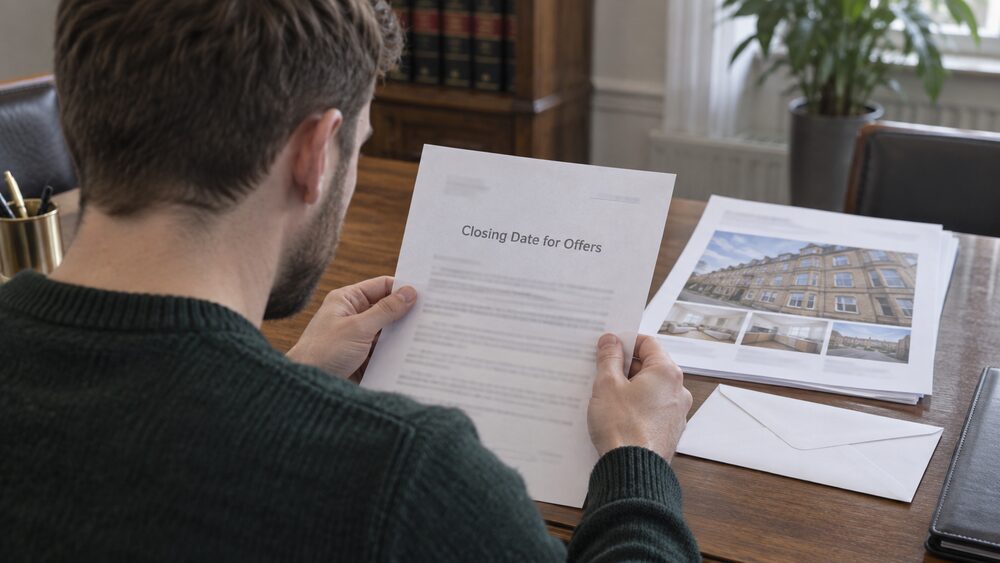
In Scotland, a closing date is a deadline for anyone who wants to make an offer on a property. Once it passes, the seller considers all the offers received and decides which one to accept. It is a sealed-bid process: you do not know what anyone else has offered, and you get one chance to put your best figure forward1.
In Scotland, a closing date is a deadline for anyone who wants to make an offer on a property. Once it passes, the seller considers all the offers received and decides which one to accept. It is a sealed-bid process: you do not know what anyone else has offered, and you get one chance to put your best figure forward1.
The system works this way because Scottish property is usually advertised as "offers over" or "offers around" a figure, rather than at a fixed asking price. Most existing homes are advertised as "offers over", which means buyers usually offer more than the listed amount2. When several people are interested, the seller's agent sets a closing date and invites sealed offers. The seller then accepts the most suitable one, often the highest bid3.
If you are buying in Scotland, the practical steps are: find a property, check its Home Report, tell your solicitor you are interested so they can note your interest formally, and wait to hear whether a closing date is set. If it is, your solicitor submits your offer in writing before the deadline. If it is not, you may be able to negotiate a price directly instead4.
A closing date is a deadline for all offers
A closing date is exactly what it sounds like: a fixed deadline by which anyone who wants to buy the property must submit their offer. The seller's estate agent sets it, usually giving interested parties a week or two to prepare. After the deadline passes, no further offers are considered, and the seller reviews what has come in1.
The purpose is to create a fair, transparent process when more than one person wants the same home. Rather than a series of escalating negotiations, everyone submits their best offer once, in writing, through their solicitor. The seller then chooses. This avoids the drawn-out bidding wars that can happen in England and Wales, where buyers sometimes increase their offers repeatedly over days or weeks.
A closing date is not the same as a fixed price. Some properties in Scotland are advertised at a fixed price, where the seller will consider or accept an offer of that amount2. In that case there is no closing date and no competition on price: you offer the fixed figure, or close to it, and the seller decides whether to accept. A closing date only arises when the property is advertised as offers over or offers around, and more than one buyer is interested.
The closing date itself is a deadline for offers, not a deadline for the sale. Once the seller has chosen an offer, the legal process continues: solicitors exchange letters to agree the conditions of the purchase, a process known as missives. The sale is finalised by signing a contract called the concluding missive1. Only at that point is the deal legally binding.
When a seller sets a closing date: noting interest
A closing date is not set automatically. It is triggered by competition, and competition is measured by notes of interest. If you are interested in a property but not ready to make an offer, your solicitor can submit a note of interest, which gives you a chance to make an offer before the property is sold1. The note tells the seller's agent that you are a serious potential buyer.
If a number of people note their interest, the seller will set a closing date for offers to be made4. Your solicitor is then told the date and time, and it is up to you to prepare your offer in time. If you have not noted interest, you may not be told that a closing date has been set, and you could miss your chance entirely.
Noting interest is not a commitment to buy. It does not oblige you to make an offer, and it does not give you any right to buy the property. It simply puts you on the list of interested parties so that you are notified if a closing date is set. There is no cost to noting interest beyond your solicitor's time.
If there is no closing date set, this could mean nobody else has noted their interest. Instead of making a formal offer, you might be able to negotiate a price with the seller directly4. In that situation the process is closer to the English system: you discuss a price, agree terms, and instruct your solicitor to formalise the offer.
Sealed offers and how the seller decides
When a closing date is set, all offers must be submitted in writing by your solicitor before the deadline. Only offers submitted via a solicitor will be considered5. You cannot email the estate agent directly or phone in a figure. The sealed nature of the process means you do not know what anyone else is offering, and they do not know what you are offering.
Once the deadline passes, the seller reviews all the offers. The seller will then accept the most suitable one, often the highest bid3. A seller might prefer a lower offer if it comes with fewer conditions, a quicker entry date, or a buyer whose mortgage is already approved and whose chain is shorter.
This is why the quality of your offer matters as much as the number. An offer that is conditional on a survey, for example, gives the seller less certainty than an unconditional one. You can make an offer conditional on the outcome of a survey2, but doing so may make your offer less attractive if the seller has other bidders who are prepared to proceed without that condition.
Most builders have a standard form of offer laying out conditions the buyer must agree to if they want to buy a newly built home7. If you are buying a new build, the developer's conditions are largely fixed, and the competition at a closing date is about price and timing rather than the terms of the offer.
Offering over the asking price at a closing date
In Scotland, sellers usually advertise properties as "offers around" or "offers over" a certain figure5. This is different from the English system, where a property is typically advertised at a specific asking price and buyers negotiate downwards. In Scotland, the advertised figure is a starting point, and buyers are expected to offer more.
Most properties are advertised as "offers over", meaning buyers usually offer more than the listed amount2. How much more depends on the property, the area, and how many other people are bidding. There is no published average for the premium paid at a closing date, and the figure varies widely from one property to the next.
The Scottish housing market saw 102,757 sales in the year to September 2025, the highest level since the series began8. The average price paid by first-time buyers in Scotland is around £157,500, compared with £245,000 in England9. These figures give a sense of the market overall, but they do not tell you what to offer on a specific property.
A solicitor will know recent sale prices for similar homes in the area and can help a buyer judge a figure that is competitive without being reckless. Offering too little risks losing the property; offering too much risks paying more than it is worth and potentially running into problems if the mortgage valuation comes in lower than the offer. At a closing date, sellers usually receive offers over the asking price4.
What happens if only one person is interested
If nobody else notes interest, the seller may not set a closing date at all. In that case you might be able to negotiate a price directly with the seller instead of making a formal sealed offer4. This can be an advantage: you have more room to negotiate, and you are not competing against unseen bids.
Some properties are advertised at a fixed price, where the seller will consider or accept an offer of that amount2. If the property is at a fixed price and nobody else is interested, you may be able to secure it at or near the advertised figure. If it is advertised as offers over and there is no competition, you may still need to offer above the listed amount, but the premium is likely to be smaller.
If you are the only interested party and you make an offer, the seller can still choose to reject it. They may hold out for a better price, or decide not to sell at all. A closing date is not the only way a seller can test the market; they can also simply wait.
If you are buying through a shared equity scheme such as the Open Market Shared Equity scheme, the rules work slightly differently. The Scottish Government's equity share is based on the valuation figure rather than the purchase price10. If you sell the home later, the Scottish Government gets a share of the money11. If you have a 70% share of your home and you decide to sell it, you will get 70% of the selling price and the Scottish Government gets the rest12. On the sale of your home, the equity percentage paid to the Scottish Government is based on the sale price of the property, regardless of whether the property has increased or decreased in value13.
Where to get help
If you are buying a home in Scotland and you are unsure about the closing date process, your solicitor is your first point of contact. They handle the note of interest, prepare your offer, and negotiate the missives on your behalf. You can find more about the legal side of buying in our guide to conveyancing.
For general guidance on buying a home in Scotland, including the Home Report and the offer process, see our guide to buying a home in Scotland. If you are making an offer and want to understand how it compares with the process elsewhere in the UK, our page on making an offer on a house explains the differences.
If you are struggling with mortgage arrears or worried about losing your home, free and impartial help is available. The Scottish Government's Home Owners' Support Fund provides help for homeowners at risk of losing their home14. You can also get free debt advice from National Debtline15 or from your local Citizens Advice bureau.
Sources15 cited
- Making an offer on a home in Scotland Shelter Scotland, 2024-07-25
- Finding properties Shelter Scotland, 2024-07-25
- Finding your first home TSB, 2026
- Making an offer on a home in Scotland mygov.scot, 2020-08-12
- How to buy a house Which?, 2026-05-29
- Making an offer on a house or flat Which?, 2026-05-29
- Buying a newly built home mygov.scot, 2020-08-12
- Scottish housing market review Q4 2025 Scottish Government, 2025
- Review of Land and Buildings Transaction Tax Scottish Government, 2026-03-25
- Open Market Shared Equity scheme buyer information Scottish Government, 2025-09-19
- Open Market Shared Equity scheme: how it works mygov.scot, 2026-03-17
- Open Market Shared Equity scheme: after buying mygov.scot, 2026-03-17
- Open Market Shared Equity scheme buyer information Scottish Government, 2025-04
- Help if you are at risk of losing your home Scottish Government, 2010-06-23
- Mortgage arrears National Debtline, 2026-09-25








 MoneyHelperFree, impartial money and pensions guidance, set up by government
 Citizens AdviceFree advice on money, consumer and legal problems in England and Wales
 ShelterFree housing advice from a charity
 GOV.UKOfficial information on tax, benefits and government services
 Financial Ombudsman ServiceFree, independent help when a complaint about a firm is not put right