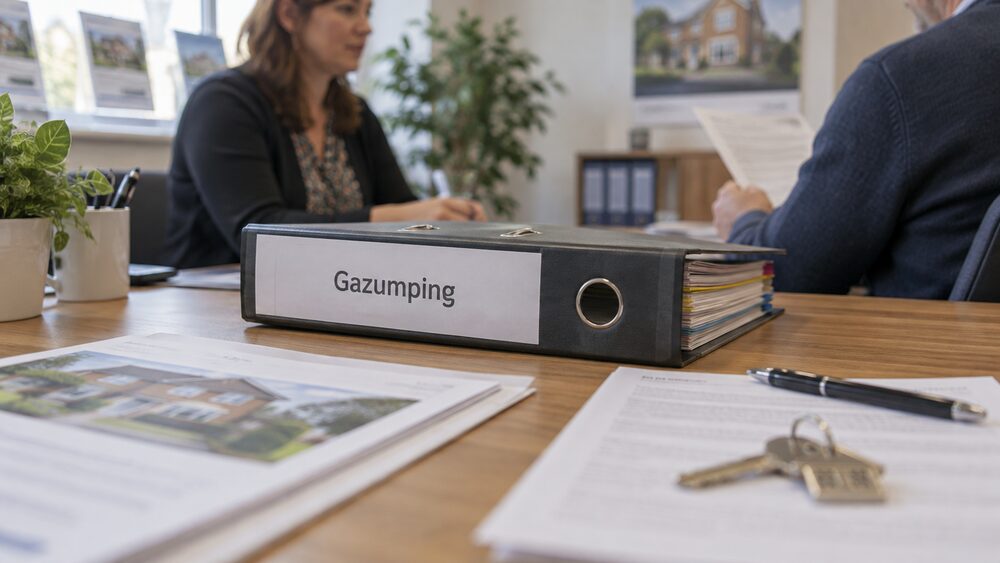
Gazumping is when a seller accepts a higher offer from another buyer after already agreeing a price with you. It is legal in the UK, and in England and Wales the agreement between you and the seller is not legally binding until you exchange contracts, so there is a window in which it can happen1. That window runs for as long as the property is listed as sold subject to contract, which can be weeks or months1.
Gazumping is when a seller accepts a higher offer from another buyer after already agreeing a price with you. It is legal in the UK, and in England and Wales the agreement between you and the seller is not legally binding until you exchange contracts, so there is a window in which it can happen1. That window runs for as long as the property is listed as sold subject to contract, which can be weeks or months1.
The practical answer to avoiding it is speed and commitment on both sides: have your mortgage decision in principle ready before you offer, get your application and your legal work moving the same week, ask for the listing to be taken off the market, and consider whether an exclusivity agreement is worth asking for. None of these makes gazumping impossible, because the seller can always change their mind before exchange.
What follows sets out why the risk exists in England and Wales, the steps that reduce it, what an exclusivity or lock-out agreement actually does, and what your position is if a higher offer arrives after yours has been accepted.
What gazumping is and why it can happen in England and Wales
In England and Wales, an offer is not legally binding until contracts are exchanged2. Until that moment there is no contract to breach, which is exactly why a seller can accept a better offer from someone else. The seller's own position is usually simple: they want the highest price they can get, and nothing in law stops them taking it.
The risk period is longer than most buyers expect. Gazumping can happen at any stage of the home-buying journey, while the house is listed as sold subject to contract1. That covers the weeks spent waiting for a mortgage offer, a survey, a valuation and the searches, which is precisely when a buyer has spent real money and has least leverage.
It is more common in competitive markets, where several buyers are chasing the same homes and a seller has a queue of people willing to pay more5. A higher offer from another buyer can happen at any point before the sale is complete6.
Scotland is different. There, a binding contract is in place when all the conditions of an offer have been accepted and the two sides have concluded the missives5. Because the deal hardens much earlier, the gap in which a seller can walk away is far smaller. If you are buying in Scotland, the Scottish process and the point at which an offer becomes binding are worth understanding before you bid.
Northern Ireland follows the English pattern: the exchange of contracts is the point where the sale is legally binding3.
Act quickly once your offer is accepted
The single biggest factor in your favour is being the buyer who can move fastest. A seller who has already spent weeks waiting for a buyer to sort out a mortgage is more likely to listen to a rival offer, so the aim is to remove every reason for delay.
Steps that may help include applying for an Agreement in Principle, submitting your mortgage application quickly, asking the seller to take the property off the market, lining up legal help as soon as you can, keeping in contact with your conveyancer, and arranging your surveys quickly1.
In practice that means:
- Get an Agreement in Principle before you make an offer, so the seller can see you are a serious, funded buyer.
- Instruct a conveyancer the day your offer is accepted, not the week after.
- Book the survey and valuation immediately, and chase the mortgage lender for the formal offer.
- Keep in regular contact with your conveyancer so nothing sits unanswered in a pile.
- Return every document and payment request the same day it arrives.
The costs of buying a house are worth understanding at this point, because the money you spend on a survey and legal work during this window is the money most at risk if the seller changes their mind. The conveyancing stage is where most of the delay, and most of the exposure, sits.
Ask for the property to be taken off the market
Once the seller accepts an offer, either verbally or in writing, their solicitor or estate agent cannot accept another one1. That is a meaningful protection, and it is worth asking for confirmation in writing that the property has been marked as sold subject to contract and is no longer being actively marketed.
What it does not do is bind the seller. The agent's instruction comes from the seller, and the seller can change their mind, raise the price or accept a different buyer. The rule stops the agent taking fresh offers on the seller's behalf; it does not stop the seller.
Two practical points follow. First, ask the agent directly whether the property is still being shown to other buyers, and get the answer in writing. Second, keep the pressure on your own side of the transaction, because a seller who is being chased by their agent for progress is a seller with less time to entertain alternatives.
If you are selling as well as buying, the same logic applies in reverse: your own buyer's position affects how attractive you look to the seller you are buying from. The guide to selling a house sets out how the two halves of a chain fit together.
Exclusivity and lock-out agreements: what they do and their limits
An exclusivity agreement, sometimes called a lock-out agreement, is a contract in which the seller agrees not to accept another offer for a set period, usually a number of weeks. It is the only real legal tool a buyer has against gazumping, and its limits matter as much as its benefits.
If such an agreement exists, and you are gazumped during this period, you will be able to sue the seller for breach of contract4. That is a genuine remedy, and it is more than you have without one. But it is a remedy after the event: it does not force the seller to sell to you, and it does not stop them accepting another offer. It gives you a claim, not the house.
There are practical obstacles too. Sellers have little incentive to sign one in a hot market, and many will refuse. The agreement has to be properly drafted by a solicitor, which costs money, and the period has to be long enough to cover the whole conveyancing process, which is hard to predict. A short lock-out that expires before you exchange leaves you exactly where you started.
What you can do if you are gazumped
If a higher offer has been accepted and the seller has moved on, the first thing to establish is whether you have any contractual footing at all. Without a signed exclusivity agreement, typically you cannot sue for gazumping, because in England and Wales the agreement between you and the seller is not legally bound until you exchange contracts1.
Your options then are practical rather than legal:
- Ask whether the sale is genuinely lost. Occasionally a rival offer falls through, and a seller who liked your position may come back. There is no obligation on them to do so.
- Decide whether to raise your offer. This is a commercial judgement, and it carries its own risk: you may be bidding against yourself, and your mortgage lender will value the property on its own terms, not on what you agree to pay.
- Walk away and keep your position ready. The Agreement in Principle, the conveyancer and the mortgage application you have already assembled can be pointed at another property quickly.
- Check what you have spent. Survey and legal fees are normally lost, because there was no binding contract to breach. If you had a lock-out agreement covering the period, you may be able to sue the seller for breach of contract4.
Where a sale falls through, the deposit position depends on whether contracts had been exchanged. Before exchange, there is no deposit to lose in the legal sense; after exchange, the buyer's deposit is at risk if they pull out.
If you believe an estate agent has behaved improperly, for example by continuing to solicit offers after an offer was accepted, there is a route for that. The complaints process for estate agents explains who to take it to.
Gazumping and gazundering: the mirror image
Gazundering is the reverse of gazumping: a buyer lowers their offer late in the process, usually shortly before exchange, when the seller is committed and has little room to manoeuvre. It is legal, and it generally occurs when property prices are going down4.
From a seller's point of view it is the same problem in a different direction. Though perfectly legal, it can create a difficult situation for the seller and risk scuppering the sale altogether5. A seller who has already committed to a purchase, packed boxes and paid for removals is in a weak position to refuse a last-minute reduction.
The two behaviours feed each other. A market in which gazumping is common is one where buyers feel they must move fast and sellers feel they can hold out for more; a market in which gazundering is common is one where buyers feel they can renegotiate at the last moment. Both are symptoms of the same gap: the period between an accepted offer and exchange, when nothing is legally settled.
For a buyer, the practical lesson is the same in both cases. The fewer loose ends you have, and the closer you are to exchange, the less room anyone has to reopen the price.
Where the protection stops
The protections available to a buyer in England and Wales are real but narrow, and it is worth being clear about where they end.
| Protection | What it does | Where it stops |
|---|---|---|
| Accepted offer | The seller's solicitor or estate agent cannot accept another offer once one is accepted1 | Does not bind the seller, who can change their mind |
| Exchange of contracts | Makes the sale legally binding and triggers the buyer's deposit2 | Comes after the whole risk period, not before |
| Exclusivity or lock-out agreement | Lets you sue the seller for breach of contract if gazumped during the period4 | Does not force a sale; needs drafting, costs money, and sellers often refuse |
| Scotland's missives | A binding contract once conditions are accepted and missives concluded5 | Does not apply in England, Wales or Northern Ireland |
There is no compensation scheme for a buyer who loses a property to a higher offer. The Financial Ombudsman Service and the Financial Services Compensation Scheme deal with regulated financial firms, not with sellers who change their mind. Legal aid is available in England and Wales for people facing eviction or repossession, through the Housing Loss Prevention Advice Service, but that is a different situation from a collapsed purchase8.
The honest summary is that gazumping cannot be prevented by any single step. What reduces the risk is being the buyer a seller wants to keep: funded, organised, fast, and close to exchange. What protects you if it happens anyway is a signed exclusivity agreement, and only that.
Sources8 cited
- What is gazumping and is it legal? Lloyds Bank, 2026-09-25
- Buying a home GOV.UK, 2026-09-26
- Buying a home: step by step guide nidirect, 2025-08-22
- Problems with buying and selling a home Citizens Advice, 2026-09-26
- Making an offer on a house or flat Which?, 2026-05-29
- Making an offer on a house Newcastle Building Society, 2026-09-26
- How to sell your house Which?, 2026-06-08
- Help from your council if you're homeless Independent Age, 2026-09-26








 MoneyHelperFree, impartial money and pensions guidance, set up by government
 Citizens AdviceFree advice on money, consumer and legal problems in England and Wales
 ShelterFree housing advice from a charity
 GOV.UKOfficial information on tax, benefits and government services
 Financial Ombudsman ServiceFree, independent help when a complaint about a firm is not put right