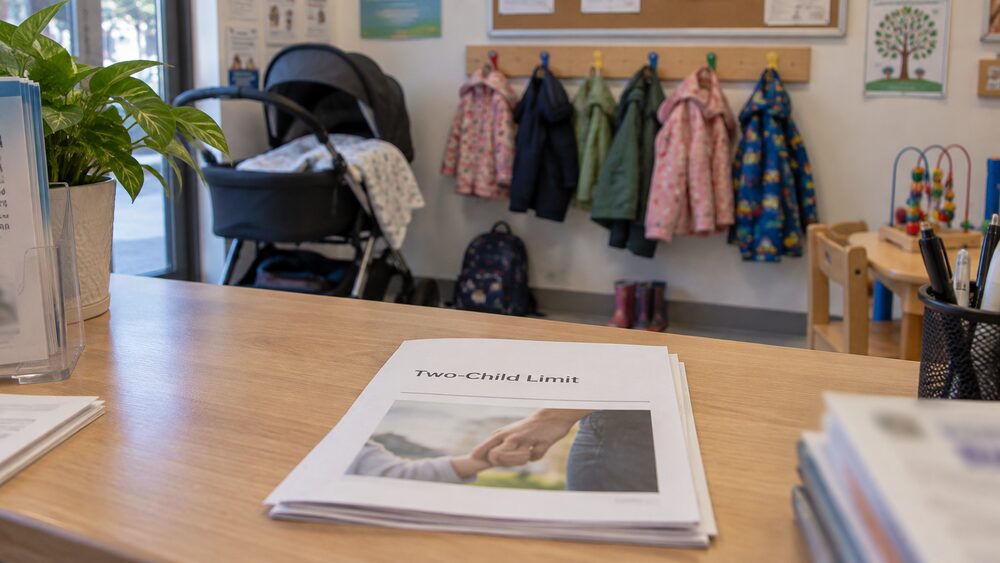
The two-child limit capped the child element of Universal Credit and Child Tax Credit at two children. It applied to children born on or after 6 April 2017, so a third or later child born from that date did not normally bring extra benefit, unless a specific exception applied or the child was born before the policy started1.
The two-child limit capped the child element of Universal Credit and Child Tax Credit at two children. It applied to children born on or after 6 April 2017, so a third or later child born from that date did not normally bring extra benefit, unless a specific exception applied or the child was born before the policy started1.
The limit has now ended. The UK government announced in November 2025 that it would remove the two-child limit from April 2026, and the change took effect for assessment periods starting on or after 6 April 20263. Families can now receive the child element of Universal Credit for all children regardless of family size5. The Universal Credit (Removal of Two Child Limit) Act 2026 removed the policy in Great Britain, with a separate section covering Northern Ireland1.
This page explains how the limit worked, the exceptions that let a child element be paid for a third or later child, which families it affected, and what the removal changes. It also covers the position in Northern Ireland, where the limit reached a larger share of households and where a supplementary payment has been discussed.
What the two-child limit was: support for no more than two children
The limit restricted the child element of Universal Credit to a maximum of two children or qualifying young people for whom a claimant was responsible6. It also applied to Child Tax Credit, which it replaced for most families. Support through both benefits was limited to two children from 6 April 20172.
The rule was narrow in what it touched. It applied only to the child element, the part of a claim that pays for children2. It did not reduce help with childcare costs, passported benefits such as free school meals, additional support for a disabled child, or Child Benefit2. You could still get a disabled child element or childcare element for a child even where the limit meant no child element was paid for them7.
Child Benefit sits outside the limit entirely. There is no limit to how many children can be claimed for, and the benefit is paid to one parent10. In Scotland, the Best Start Grant Pregnancy and Baby Payment also places no limit on the number of children supported11.
The legal basis was section 10(1A) of the Welfare Reform Act 2012, inserted by section 14 of the Welfare Reform and Work Act 20164. The policy was introduced in 2017, and households generally received support for no more than two children unless a specific exception applied to a third or subsequent child, or the child was born before the policy was introduced6.
Exceptions for a third or subsequent child
A child element could still be included for a third or later child born after 6 April 2017 where an exception applied2. The exceptions covered four broad situations: multiple births, adoptions, non-parental caring arrangements and non-consensual conception8.
In detail, the exemptions covered2:
- a second or subsequent child born in a multiple birth, but not the first child in a multiple birth
- children likely to have been conceived as a result of rape or coercion
- children living long term with family or friends, including formal and informal caring arrangements, where the child would otherwise likely be looked after by the local authority
- children who were adopted, unless adopted from abroad or where you or your partner were the parent or step-parent before the adoption
- where a child under 16 for whom you have responsibility becomes the parent of a child
The exceptions applied to children born after 6 April 2017 where two or more child elements were already being received2. Where an exception applied, the child element could be paid for that child in the normal way.
Which families the limit affected
The limit fell on families with three or more children, and it was not evenly spread. Single parent families were among those most affected12. Across the UK, an estimated 900,000 families, or around 3 million children, were affected, with at least 200,000 children pushed below the poverty line13.
The rule also applied to single people who joined together to form a new family if the new family unit would have three or more children2. That meant a couple who each brought children into a new household could find the child element capped even where neither had three children before.
The limit extended beyond Universal Credit. It applied to Housing Benefit for working age claimants, and that restriction was removed from 6 April 202614. The Housing Benefit change affected only working age claimants not entitled to Universal Credit, because those entitled to means-tested benefits are passported to the maximum eligible amount of Housing Benefit6. A separate change abolished the two-child limit in pension age Housing Benefit from May 202415.
If you already had two children and were claiming Universal Credit before 6 April 2017, you did not get extra money for a subsequent child born on or after that date16. Families were not paid an additional amount for more than two children unless the children were born before 6 April 2017 or an exception applied17.
The two-child limit is being lifted: what changes for families
The removal means families with three or more children receive an extra child element payment for each additional child18. The change took effect for assessment periods starting on or after 6 April 20264, and the two-child limit ended on 6 April 20263.
The Universal Credit (Removal of Two Child Limit) Act 2026 makes provision to remove the policy of paying for a maximum of two children in a household, subject to a limited number of exceptions, in Universal Credit4. Section 1 extends to England and Wales and applies to England, Wales and Scotland, and does not extend to Northern Ireland4. The Act also revoked regulation 24A, regulation 24B and Schedule 12 of the Universal Credit Regulations 2013, the provisions that had created the exceptions1.
The removal was announced in November 2025, with the government stating that from April 2026 it would be removing the two-child limit5. The change applies across the United Kingdom19. The Resolution Foundation described the position in April 2026 as the two child limit being lifted20.
The effect on incomes is a matter of scale. The Joseph Rowntree Foundation noted the increased social security income from scrapping the two-child limit as part of its work on household resilience21. The removal restores the child element going forward; it does not backdate payments for years when the limit applied.
Northern Ireland and calls for a supplementary payment
Northern Ireland has its own legislation for the limit and its removal. Section 2 of the Universal Credit (Removal of Two Child Limit) Act 2026 covers Northern Ireland only1, and amends Article 15 of the Welfare Reform (Northern Ireland) Order 2015 by omitting paragraph (1A), the two child limit22. Consequential amendments were made to Article 10 of the Welfare Reform and Work (Northern Ireland) Order 2016 and regulation 25(1) of the Universal Credit Regulations (Northern Ireland) 20161.
The limit reached a larger share of households in Northern Ireland. At August 2025, 13,780 households in Northern Ireland were affected by the two-child policy, containing 48,080 children9. Advice NI estimated the total impact of removal in Northern Ireland at approximately £75 million, with a knock-on impact on the Benefit Cap of approximately £7.5 million, based on the £2.5 billion UK figure and 3.0% Barnett consequentials6.
There have been calls for a supplementary payment to make up for money lost while the limit was in force. The Northern Ireland Assembly committee report on the legislative consent memorandum for the Universal Credit (Removal of Two Child Limit) Bill is part of that scrutiny23. The Welfare Supplementary Payments mitigation scheme, funded through the Department for the Economy budget, carries a cost of £10.1 million in 2028/299.
Where to get help
If you are unsure how the removal affects an existing claim, or you think a child element has been missed, free and impartial help is available. Advice NI provides guidance on the two-child limit and on benefit changes in Northern Ireland17. Turn2us publishes a benefit changes timetable covering 202618. Gingerbread covers Universal Credit and older benefits including tax credits25.
For a decision you think is wrong, the normal route is to ask for a mandatory reconsideration and then, if needed, appeal to a tribunal. The pages on challenging a decision and appealing to a tribunal set out how that works. If you are checking what you might be entitled to now, the checking entitlement page lists free calculators and advisers.
The child element is one part of a Universal Credit award. How it fits with the standard allowance and other elements is explained in how Universal Credit is worked out, and the main rules for claiming are in Universal Credit.
Sources26 cited
- Universal Credit (Removal of Two Child Limit) Act 2026 legislation.gov.uk, 2026
- Exemptions to the 2 child limit Entitledto, 2026-09-26
- Universal Credit if you have children GOV.UK, 2026-04-06
- Universal Credit (Removal of Two Child Limit) Act 2026, section 2 legislation.gov.uk, 2026
- Universal Credit (Removal of Two Child Limit) Act 2026, section 2 (enacted) legislation.gov.uk, 2026
- Draft Explanatory Memorandum, two-child limit Northern Ireland Assembly, 2026
- Children and dependants overview, Universal Credit Entitledto, 2026-09-26
- Low income poverty projections for children, FYE 2025 to FYE 2030 GOV.UK, 2025-11-26
- Legislative Consent Memorandum, Universal Credit (Removal of Two Child Limit) Bill Northern Ireland Assembly, 2026-01-19
- Benefits and entitlements to claim when you have a baby NCT, 2026-06-26
- Best Start Grant Scottish Government, 2026-09-26
- Single parents in crisis: a pre-budget briefing on the two-child benefit cap One Parent Families Scotland, 2025-01-31
- Policy briefing on welfare reform mitigations on a cliff edge Law Centre NI, 2018
- The Social Security (Restrictions on Amounts for Children and Qualifying Young Persons) Amendment Regulations 2026 legislation.gov.uk, 2026-04-06
- The Housing Benefit (Persons who have attained the qualifying age for state pension credit) Amendment Regulations 2024 legislation.gov.uk, 2024-05
- How much Universal Credit will I get? Shelter Cymru, 2026-08-25
- Two-child limit Advice NI, 2026
- Benefit changes timetable 2026 Turn2us, 2026
- Poverty impacts of social security changes at Budget 2025 GOV.UK, 2025-11
- Energy shocks, sugar rationing and bumper bills Resolution Foundation, 2026-04-02
- Weak income growth leaves people with little resilience to shocks Joseph Rowntree Foundation, 2026-04-15
- Universal Credit (Removal of Two Child Limit) Act 2026, section 2 (Northern Ireland) legislation.gov.uk, 2026
- Report on Legislative Consent Memorandum for the Universal Credit (Removal of Two Child Limit) Bill Northern Ireland Assembly, 2026-02-05
- Benefit changes Advice NI, 2026
- Universal Credit Gingerbread, 2026-04-16
- Older benefits and tax credits Gingerbread, 2025-10-16












 Turn2usFree benefits calculator and grants search from a charity
 Citizens AdviceFree advice on money, consumer and legal problems in England and Wales
 GOV.UKOfficial information on tax, benefits and government services
 MoneyHelperFree, impartial money and pensions guidance, set up by government