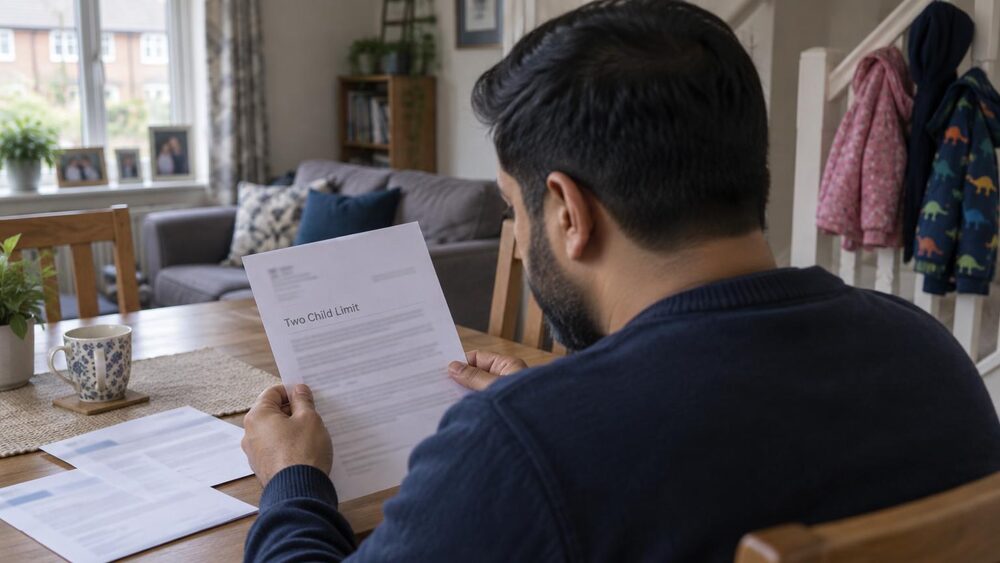
The Department for Work and Pensions has announced that the Universal Credit extra amount for children, known as the two-child limit, will end from April 2026. The change was set out in an update to official guidance on 4 December 2025, which stated that the limit "will end from April 2026" and "remains in place until then"1.
Under the current rules, the extra amount for children applies only to a claimant's first and second child unless an exception applies1. From April 2026, the limit is removed, meaning families with three or more children receive an extra child element for each additional child2. Maternity Action states that the two-child limit "will no longer apply to Universal Credit claims from monthly assessment periods beginning on or after 6 April 2026"3, and that this may mean households become newly entitled to Universal Credit, or to a higher amount, from assessment periods starting on or after that date4.
The guidance sets out the position on payment timing. Claimants will receive any increased payment from May or June onwards, depending on the dates of their monthly assessment period1. The rules on the benefit cap stay the same, and additional Universal Credit payments for each child count towards the cap, so an increase may be limited if total benefits go over the cap amounts for a household's circumstances1.
The extra amount for children is separate from other elements of Universal Credit. The standard allowance and extra elements are worked out according to a claimant's circumstances, and the two-child limit and its exceptions governed how many children the child element covered before this change. The guidance also covers children aged up to 16, where the extra amount is paid until the 31 August after their 16th birthday, and young people aged 16 to 19 in full-time non-advanced education or approved unpaid training1.
"The Universal Credit extra amount for children '2-child limit' will end from April 2026. It remains in place until then."
Why it matters for households
The change affects families claiming Universal Credit with three or more children, who have been receiving the child element for only their first two children unless an exception applied1. From April 2026, the extra amount applies to every child, and increased payments are expected from May or June onwards depending on assessment period dates1. Maternity Action notes that households may become newly entitled to Universal Credit, or to a higher amount, from assessment periods starting on or after 6 April 20264.
The benefit cap continues to apply, and the additional child payments count towards it, so some households may see the increase limited if their total benefits exceed the cap for their circumstances1. The guidance also states that foster carers cannot get the extra amount for a child they are fostering, including the disabled child extra amount, and that kinship carers of a non-looked after child will usually get the extra amount if the child normally lives with them1.
Separately, Turn2us reports that all legacy benefits will end on 31 March 2026, with no more payments made, and that Universal Credit will have fully replaced legacy benefits such as income-related ESA and Housing Benefit for working age people from April 20264. The same timetable lists a 3.8% rise in social security benefits and increases to Universal Credit standard allowance rates from April 20262.
What happens next
The two-child limit remains in place until April 20261. The guidance states that claimants will receive any increased payment from May or June onwards, depending on the dates of their monthly assessment period, and advises checking the Universal Credit statement to confirm payment1. Turn2us lists the removal of the two-child limit among changes to Universal Credit introduced from April 20262.
Sources4 cited
- Universal Credit if you have children - GOV.UK gov.uk
- Benefit Changes Timetable 2026 | Turn2us turn2us.org.uk
- Pregnant during maternity leave (expecting again) - Maternity Action maternityaction.org.uk
- Childbirth injuries - rights at work and benefits for new mothers - Maternity Action maternityaction.org.uk

 Turn2usFree benefits calculator and grants search from a charity
 Citizens AdviceFree advice on money, consumer and legal problems in England and Wales
 GOV.UKOfficial information on tax, benefits and government services
 MoneyHelperFree, impartial money and pensions guidance, set up by government