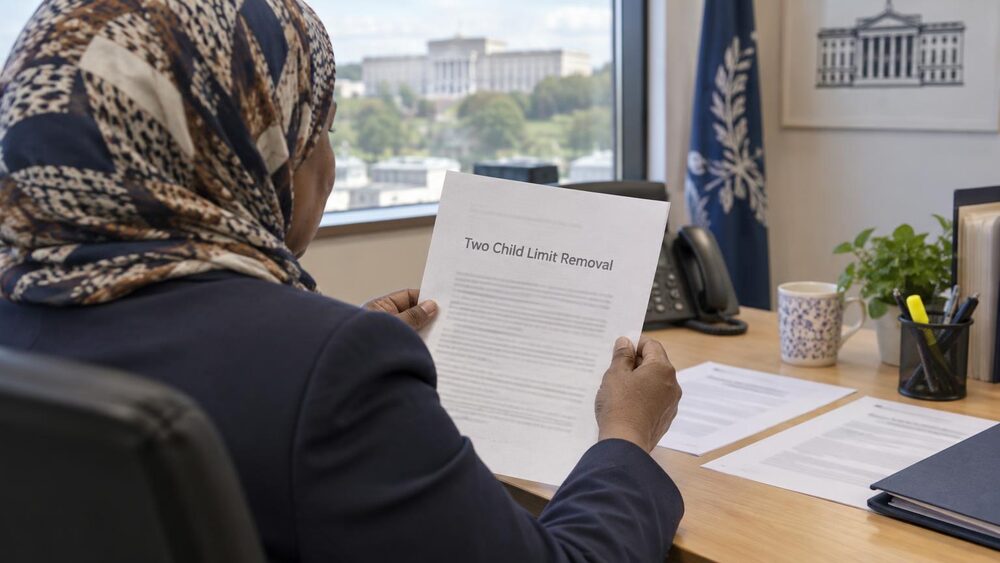
The Minister for Communities laid a legislative consent memorandum before the Northern Ireland Assembly on 19 January 2026, seeking agreement that provisions in the Universal Credit (Removal of Two Child Limit) Bill extend to Northern Ireland1. The memorandum was laid under Standing Order 42A(2)1. The Bill was introduced in the House of Commons on 8 January 20261.
The Chancellor of the Exchequer announced in her Autumn Statement on 26 November 2025 that the two-child limit in Universal Credit is being abolished from April 20261. Clause 3(4) of the Bill sets out the coming into operation date for clause 2 as 6 April 2026, and additional child elements can be included in the calculation of entitlement for assessment periods starting on or after that date1. For Great Britain, the Bill amends provisions in the Welfare Reform Act 2012, the Welfare Reform and Work Act 2016 and the Universal Credit Regulations 2013; for Northern Ireland it makes corresponding amendments to the Welfare Reform (Northern Ireland) Order 2015, the Welfare Reform and Work (Northern Ireland) Order 2016 and the Universal Credit Regulations (Northern Ireland) 20161.
The Northern Ireland provisions sit in clause 2. Subsection (1) removes the two-child limit, and the power to make exceptions to it, from Article 15 of the Welfare Reform (Northern Ireland) Order 2015; subsection (2) makes consequential amendments to Article 10 of the Welfare Reform and Work (Northern Ireland) Order 2016 and Regulation 25(1) of the Universal Credit Regulations (Northern Ireland) 2016; and subsection (3) notes the revocation of regulations 25A and 25B of, and Schedule 12 to, those Regulations1. Clause 3(7) provides a delegated power for the Department for Communities to make transitional or saving provision for clause 21.
The memorandum states that at August 2025, 13,780 households in Northern Ireland were impacted by the two-child policy, containing 48,080 children, of whom 17,600 were not eligible for the child element in Universal Credit1. Of those 13,780 households, 650 were affected by the Benefit Cap; following removal of the policy an additional 1,010 households are estimated to be impacted, bringing the total estimated impacted households to 1,6601. The memorandum sets out projected additional annually managed expenditure and departmental expenditure limit costs1:
| Year | Estimated additional AME cost | Estimated additional DEL cost |
|---|---|---|
| 26/27 | £59.6m | £9.4m |
| 27/28 | £63.5m | £9.7m |
| 28/29 | £66.4m | £10.1m |
| 29/30 | £69.3m | £10.5m |
The memorandum says the UK Government is not consulting on the measures in the Bill, and that given the timeline it will not be possible for the Department for Communities to conduct any specific consultation in Northern Ireland1. It states that equality screening of the provisions is currently underway in the Department1.
"The view of the Minister for Communities is that, in the interests of good government, the provisions of the Bill dealing with devolution matters should remain in the Bill."
Why it matters for households
The change concerns the two-child limit in Universal Credit, which restricts payment of the child element to two children or qualifying young people, subject to a limited number of exceptions1. If the Assembly agrees the extension, an amount would be included in the Universal Credit calculation for all children or qualifying young people in a household, for assessment periods starting on or after 6 April 20261. Households in Northern Ireland with three or more children would therefore be affected on the same operational date as those in Great Britain, which the memorandum describes as maintaining parity of timing and substance1. The memorandum notes that without agreement, a separate Assembly Bill would be needed, meaning people in Northern Ireland would not benefit at the same time as those in Great Britain, which it says could have an adverse financial impact on claimants there1.
The memorandum also records that removing the policy means more families will be affected by the Benefit Cap, and that the cost of the welfare mitigation scheme, which is funded through the Executive's departmental expenditure limit budget, will increase1. It states that additional funding for the mitigation scheme will require Executive consideration as part of the 2026-29/30 multi-year Budget Exercise1.
What happens next
The draft motion will be tabled by the Minister for Communities1. The memorandum states that Sir Stephen Timms MP, Minister for Social Security and Disability in the Department for Work and Pensions, has confirmed that formal consent will be required before the Bill reaches Royal Assent, which is likely to be mid to late March 20261. The Minister for Communities wrote to the Committee for Communities on 12 January 2026 to advise of the intention to seek a legislative consent motion1.
Sources1 cited
- 20260119_lcm_uc-2-child-limit-bill.pdf niassembly.gov.uk
 Turn2usFree benefits calculator and grants search from a charity
 Citizens AdviceFree advice on money, consumer and legal problems in England and Wales
 GOV.UKOfficial information on tax, benefits and government services
 MoneyHelperFree, impartial money and pensions guidance, set up by government