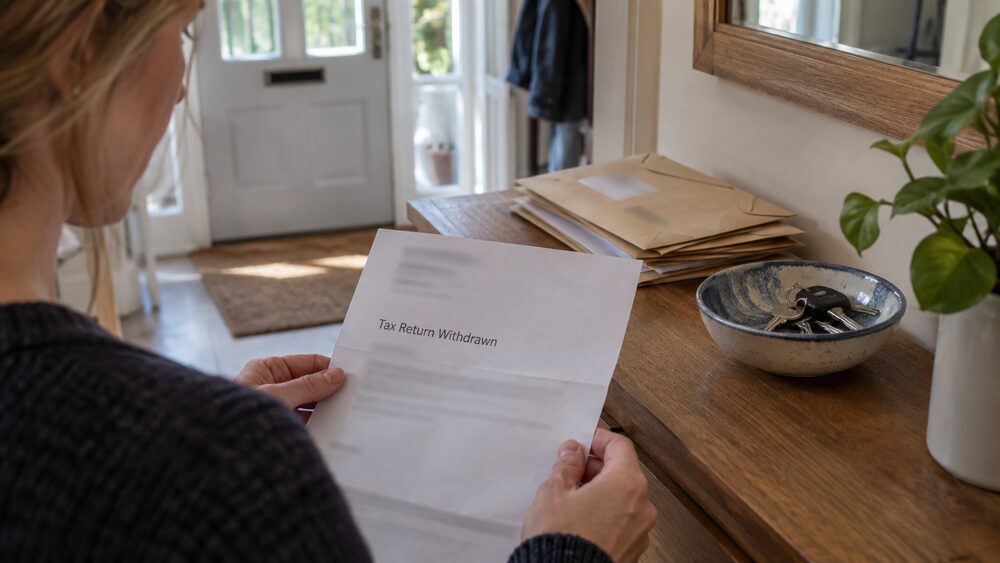
A tax return notice has to be answered. If HMRC has sent you one, you must submit the return by the due date even if there is no income to report, and the penalties for filing late still apply, unless HMRC withdraws the return1. People who no longer need to complete a tax return should tell HMRC as soon as possible rather than simply stopping2.
A tax return notice has to be answered. If HMRC has sent you one, you must submit the return by the due date even if there is no income to report, and the penalties for filing late still apply, unless HMRC withdraws the return1. People who no longer need to complete a tax return should tell HMRC as soon as possible rather than simply stopping2.
The reason is that HMRC will not send a tax return, or notify you to complete one, if you are not registered3. Once you are on the register, the notice keeps coming until someone takes it off. That is why the practical task is not "stop filing" but "ask HMRC to withdraw the notice", and then deal with any penalty that has already built up.
This page covers who can come off Self Assessment, how to ask, what happens to a return you have already been sent, and what replaces it if HMRC still needs tax from you.
A tax return notice must be answered until HMRC withdraws it
The starting point for anyone who has received a return they believe they do not need is that the notice stands. Unless the return is withdrawn by HMRC you will have to submit the return by the due date, even if there is no income to report, and penalties for failing to file by the due date will still apply1. Ignoring the letter is the one course of action that reliably produces a charge.
The £100 late filing penalty applies from at least one day late and is payable even if no tax is owed4. A separate source puts the same figure at £100, noting that you may have to pay it even if you have no tax to pay or the tax has already been paid7. The two agree, and the point they make together is that the penalty is triggered by the missing return, not by an unpaid bill.
There is a route out of a penalty that has already been charged. You can appeal against a penalty if you have a reasonable excuse4. Where a payment plan is agreed before the penalties would have been applied, HMRC will not add penalties to your debt, as long as you keep to the arrangement4. That is a different mechanism from withdrawal of the return, and it addresses the debt rather than the filing obligation.
If you are not registered, HMRC will not send you a tax return or notify you to complete one3. Registration is therefore the switch that starts the process, and it is worth checking whether you are actually on it before assuming a letter was sent in error. If you have already registered before, you do not need to register again3.
Who no longer needs to file: the Self Assessment criteria
Coming off Self Assessment means no longer meeting the criteria that put you on it. The clearest of those is self-employment income. You need to complete a Self Assessment tax return if you are self-employed and received a gross income of more than £1,000 in the tax year, including cash in hand5. The threshold is stated as more than £1,000 on income from self-employment8, and as £1,000 for self-employed income tax and National Insurance on profits9. The same £1,000 figure applies to income from buying and selling, providing services or other commercial activities: you only have to report this if your gross income before expenses is more than £1,0005.
Below that line, nothing needs to be done. The exemption is automatic and if your self-employed income is £1,000 or less, you do not need to tell HMRC or file a tax return6. This is the trading allowance, and it is the single most common reason a small trader can come off the register.
Other criteria pull people in rather than let them out. Self Assessment is needed if you get any income not taxed through PAYE, via Self Assessment or Making Tax Digital for Income Tax10. Having foreign income, such as savings or investment income or a foreign pension, is one of the criteria11. A total taxable income of more than £150,000 is another12. For people not already within Self Assessment, a gain of more than £10,000 together with other savings and investment income brings a reporting requirement13.
It is your responsibility to register for Self Assessment if you meet the criteria11. The mirror image is that it is your responsibility to tell HMRC when you stop meeting them.
Stopping self-employment or leaving the UK: one final return
Stopping does not usually mean stopping immediately. You complete a final self-assessment tax return to cover your last period of trading, done at the end of the tax year14. The final return is a real return, with the usual deadlines attached.
Those deadlines are 31 October following the end of the tax year if you send your return by post4, and the same 31 October date for postal returns, which is earlier than the online deadline12. Missing the final return brings the same £100 penalty as any other4.
Leaving the UK works in a similar way, in that a return is often still owed after you go. You usually have to send a Self Assessment tax return if you live abroad and you rent out property in the UK, you have taxable savings interest from UK banks or building societies, you have a pension outside the UK and you were UK resident in one of the 5 previous tax years, or you have any other untaxed UK income12. Non-residents can fill in a Self Assessment tax return and an SA109 form and send it by post, use commercial Self Assessment software that supports SA109 reporting, or get a tax professional to report UK income12.
Coming the other way, you may need to register for Self Assessment if you start working for yourself or have other income or gains from the UK or abroad, while employees with no other untaxed income need not register15. People with other UK income, for example a pension, savings interest or income from renting out a property, have to send a return16.
Asking HMRC to cancel a return you have already been sent
The request itself is straightforward: tell HMRC you no longer need to complete a tax return, and do it as soon as possible2. There is no form to fill in for the withdrawal itself in the material here; the action is a notification.
Two practical points shape how it goes. First, HMRC will not send you a paper return if you have filed a tax return online in the previous year19, so a missing paper return is not evidence that you are off the register. Second, if you are registered for Self Assessment and receive a Simple Assessment letter, you need to call HMRC on 0300 200 3300 to have the Simple Assessment withdrawn11. That number is the one given for sorting out a duplicate notice.
If a refund is due, it should arrive without a separate claim. Whether you submit your return on paper or online, HMRC should automatically send you any refund due once the return has been processed20. Overpaid tax should be shown on the tax calculation if you submit your return online20. If you have already made a pension withdrawal and reclaimed some tax earlier, you will usually need to wait until the end of the tax year to sort everything out through your return, and must still include the pension withdrawal and any claim in your tax return21.
Penalties and Simple Assessment after a return is cancelled
Cancelling a return does not cancel a penalty that has already been charged. The £100 late filing penalty applies from at least one day late and is payable even if no tax is owed4, and you can appeal against a penalty if you have a reasonable excuse4. Where a payment plan is agreed before the penalties would have been applied, HMRC will not add penalties to your debt, as long as you keep to the arrangement4.
Simple Assessment is the alternative HMRC uses when it can work out the bill itself. It is not the same as making a Self Assessment tax return22. You cannot request a Simple Assessment; HMRC decide if you are eligible on an annual basis depending on your income and tax liability11. Under Simple Assessment you do not have to fill in any forms, but you do need to let HMRC know if they have not included all your income in their calculation11. One of the situations that brings a Simple Assessment is needing to pay tax on your State Pension22.
If you are registered for Self Assessment, you will not receive a Simple Assessment, as your tax is handled differently10. That is why the two systems can collide when a registration is out of date, and why the withdrawal call matters.
Records, checks and what happens after your record closes
Closing a Self Assessment record does not close the file. When HMRC deals with tax returns, they use a process now, check later approach24. You need to keep records if you have to send HMRC a Self Assessment tax return25, and you will need those records to fill in your tax return correctly and to provide documents if HMRC checks your tax return25.
In practice this means the paperwork behind a final return should be kept even after the return is filed and the record closed. The obligation attaches to having had to send a return, not to being currently registered.
Where to get help
TaxAid provides free tax help to people on low incomes, and its guidance covers registration, Simple Assessment, refunds and problems with returns already submitted2. Independent Age publishes tax guidance aimed at older people26. Business Debtline covers income tax debt in England and Wales27. MoneyHelper and the tax charities are the usual first stops for anyone who has received a return they believe is wrong, and the appeal route for a penalty runs through HMRC first, with a reasonable excuse as the test4.
Sources27 cited
- Improved Self Assessment registration service launched GOV.UK, 2026-09-09
- How to register for Self Assessment TaxAid, 2025-10-06
- Pensions, Self Assessment and Simple Assessment TaxAid, 2026-03-09
- Pay a Self Assessment penalty GOV.UK, 2026-09-25
- Self-employment, buying and selling or providing services TaxAid, 2026-03-23
- Trading allowance TaxAid, 2025-01-24
- 8 ways to make filing your tax return easier Which?, 2026-01-25
- Working in retirement Which?, 2026-03-17
- Self Assessment tax Which?, 2026-04-06
- Tax return basics GOV.UK, 2026-08-05
- Simple Assessment TaxAid, 2026-01-20
- Tax on your UK income if you live abroad GOV.UK, 2026-09-26
- HS321 Gains on foreign life insurance policies GOV.UK, 2026-07-14
- Previously self-employed TaxAid, 2025-01-24
- Tax if you come to the UK GOV.UK, 2026-09-27
- Tax return GOV.UK, 2026-09-26
- Repaying your student loan GOV.UK, 2026-09-25
- Student finance calculator GOV.UK, 2026-09-26
- Preparing for Self Assessment TaxAid, 2026-03-10
- Tax refunds TaxAid, 2025-10-21
- How to claim a refund on pension tax TaxAid, 2025-09-26
- Understand Simple Assessment GOV.UK, 2026-09-25
- Check if a text message you've received from HMRC is genuine GOV.UK, 2026-09-18
- Enquiries and other problems with returns you have submitted TaxAid, 2025-09-26
- Keeping your pay and tax records GOV.UK, 2026-09-26
- Tax advice Independent Age, 2026-09-26
- Income tax debt (England and Wales) Business Debtline, 2026-09-26





 GOV.UKOfficial information on tax, benefits and government services
 MoneyHelperFree, impartial money and pensions guidance, set up by government
 Citizens AdviceFree advice on money, consumer and legal problems in England and Wales
 Turn2usFree benefits calculator and grants search from a charity
 Citizens Advice ScotlandFree advice across Scotland