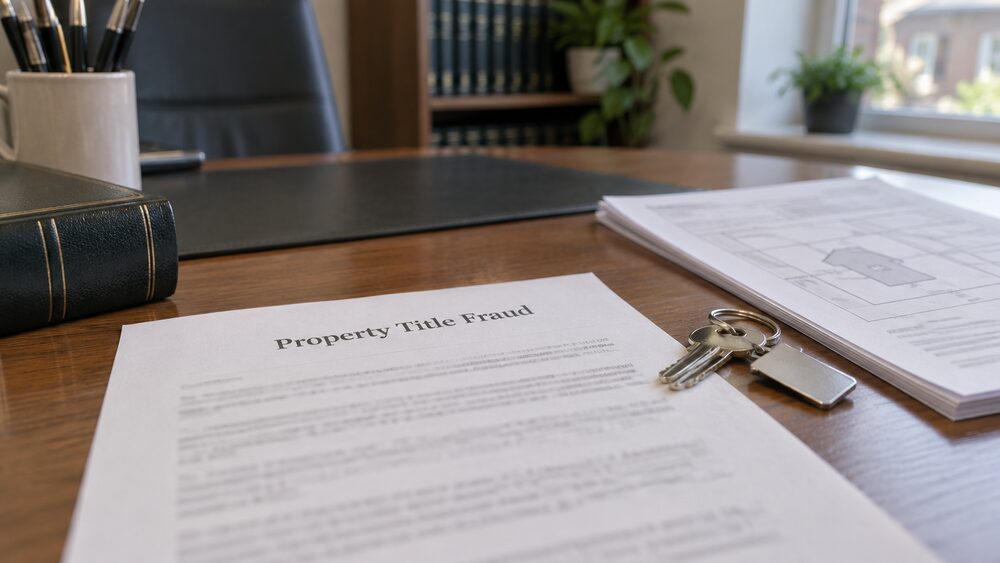
Property title fraud is when a fraudster pretends to be you and either sells or mortgages your property without your knowledge, most commonly to take the legal title for themselves1. It is a form of identity fraud, and it is a crime2. The fraudster steals the homeowner's identity, then transfers the title of the property into their own name illegally3.
Property title fraud is when a fraudster pretends to be you and either sells or mortgages your property without your knowledge, most commonly to take the legal title for themselves1. It is a form of identity fraud, and it is a crime2. The fraudster steals the homeowner's identity, then transfers the title of the property into their own name illegally3.
The reason it works is that a property transaction turns on documents and identity checks, not on the owner standing in the room. Scammers pose as genuine buyers to steal the personal details of the property owner, and those details are then enough to move a title3. Conveyancing scams, where criminals pose as solicitors to trick homebuyers into sending deposit or purchase money to their accounts, are a related problem and could cost you thousands and may even cause your home purchase to collapse4.
Fraud of this kind sits inside a much larger picture. You are more likely to fall victim to fraud or cyber offences than to any other crime5, and the priority frauds affecting the UK are investment fraud, romance fraud, courier fraud and payment division fraud6. Most victims report what happened to their bank or account provider rather than to the national reporting service Action Fraud or the police7, which is one reason the true scale of property title fraud is hard to see.
Property fraud: fraudsters pose as you to sell or mortgage your home
The mechanics are simple to describe and hard to spot. Identity fraud or theft is when somebody steals your personal details and pretends to be you11. In the property version, the fraudster uses those details to sell the home or to borrow against it, and the owner may not find out until a buyer, a lender or a court gets in touch.
Several tactics feed into it. Invoice and mandate fraud happens when criminals pose as your builder, solicitor, tradesperson or someone from a trusted organisation and give you new or amended bank account details12. Courier fraud involves criminals contacting you unexpectedly, often pretending to be from your bank, card provider, the police or a fraud team13. Scammers can mimic an official telephone number, which can trick you into thinking the caller is from a legitimate organisation such as a bank or utility company14. Each of these is a way of harvesting the personal details that a title fraud needs.
There is also a domestic route. A person may fraudulently apply to be added to your mortgage or the title deed, which is a pattern seen in economic abuse11. That is why the identity of everyone with an interest in the home matters, not just the registered owner.
Homes most at risk of title fraud
The clearest risk factor is that the owner is not living in the property. Empty homes, second homes and rented-out homes are the ones where nobody notices post going astray or strangers calling. Letting out your property without permission is a breach of your mortgage terms and conditions and could affect your mortgage and insurance15, so landlords who let quietly are also the ones least likely to have their lender watching the property.
Equity release is another area to understand. With equity release, it is not so much lenders as borrowers who may be at risk of fraud16. Anyone who has released money from their home and no longer lives there should treat the title as something to check.
Guarantor arrangements carry their own exposure. A guarantor loan can put the guarantor's house at risk of repossession17, and a guarantor mortgage usually involves someone offering their home or savings as security against your mortgage and agreeing to cover the payments if you default18. In the worst case, if the lender had to repossess and sell the property for less than the amount remaining on the mortgage, that family member could stand to lose their home18. None of this is title fraud, but it means more people have a stake in a title than the name on the deed suggests.
Fraud on loan accounts is not a small problem. Cifas recorded a 55% annual increase in fraud on loan accounts in 20132.
Warning signs that someone is using your property's title
Identity theft rarely announces itself. The signs are administrative and easy to dismiss. You apply for state benefits but are told you are already claiming19. Unusual payments or direct debits appear on your bank statements, important mail goes missing, recycling bins and rubbish bags are tampered with, bills arrive for things you have not bought, or new credit cards appear on your credit record19.
If there has been any fraud against you, for example if someone has used your identity, there may be a marker against your name, and you will be able to see this on your credit file20. That marker is worth checking for, because it is often the first visible trace.
Post is a useful signal in itself. Scam post tends to show bad spelling, a prize that is too good to be true, a general address such as a PO Box, a request to send money to claim a prize, and watermarks such as win, barcodes, seals or codes21. None of that is title fraud on its own, but a run of it arriving at a property you own and do not live in is worth acting on.
Protecting a home against title fraud
The single most useful step is to put a flag on your identity. Contact Cifas, the UK's Fraud Prevention Service, to apply for protective registration23. Protective registration places a warning flag against your name and other personal details on their National Fraud Database24. The same service is described by the Information Commissioner's Office as the route to take after identity theft25, and it is also the answer when fraudsters pretend to be you8.
There is a second, address-based option. For a fee, a fraud warning can be placed against your address and will be flagged up if someone applies using your address26. That is a different product from protective registration and is aimed at the property rather than the person.
If you are married to or in a civil partnership with the owner of the home, you can prevent a sale or remortgage by registering home rights via a notice at the Land Registry or a land charge on the Land Charges Register27. This matters where the non-owning partner would otherwise have no say.
Keep your paperwork in order as well. Keep receipts for anything of significant value, as this will act as a valuation and also as proof of purchase, along with photographs, serial or model numbers, a note of item ages, insurance documents in a safe place, and your broker or insurer's contact details to hand28.
Who to contact if you suspect property fraud
Report it, and report it to the right place. You can contact Report Fraud about fraud in England, Wales or Northern Ireland; if you live in Scotland or the fraud happened there, contact Police Scotland on 1019. Report Fraud can be reached on 0300 123 204010, and the same number is given for reporting a scam or getting more advice on scams and fraud29.
For the police themselves, report the fraudulent activity by calling 101, or 999 if you feel threatened or unsafe26. If you suspect you might already have been targeted by fraudsters, contact Action Fraud on 0300 123 204030.
Phishing is worth separating out. Forward the email to report@phishing.gov.uk, which the National Cyber Security Centre will investigate, and report it to Report Fraud at reportfraud.police.uk or on 0300 123 204031.
If the problem is a data breach rather than a completed fraud, the Information Commissioner's Office sets out the steps to take if you have been affected by a personal data breach32, and the same guidance applies if you have experienced a data breach23.
Can someone sell my house without me knowing?
It is possible, because a sale turns on identity and paperwork rather than on your presence. The fraudster steals the homeowner's identity and then transfers the title of the property to their name illegally3. Scammers pose as genuine buyers to steal the personal details of the property owner in the first place3.
There are legitimate routes by which a home can be sold without the owner living in it, which is why the paperwork matters. Under the First Homes scheme, you can ask your local council for permission to sell your property at the full market price to any buyer if you have tried unsuccessfully to sell your property as a First Home for 6 months or more, or if selling it as a First Home will cause you severe difficulties, such as bankruptcy33. If you have negative equity, you may need your lender's agreement to sell34.
Selling something you do not own outright is treated seriously elsewhere in the law, which shows how the principle works. It is a criminal offence to sell an item that has a bill of sale agreement attached to it without the lender's permission35, and selling a leased or rented item would be a criminal offence36.
How would I find out if my property had been mortgaged without my consent?
You can find out when the mortgage was taken out by asking the lender or finding out from the Registers of Scotland, and the date of the mortgage will also be written in the court summons37. In Scotland, that is the register to check; elsewhere, the lender is the direct route.
The wider signs are the identity theft signs: benefits refused because someone is already claiming, unusual payments or direct debits, missing post, tampered bins, bills for things you did not buy, and new credit cards on your credit record19. A fraud marker on your credit file is another trace20.
If a mortgage was arranged in your name, it is worth knowing what mis-selling looks like in this area, because the two can be confused. A mortgage may have been mis-sold if you were advised to borrow money without proving your income, also called self-certifying, or asked to overstate your income in order to borrow more38. That is a complaint about advice, not a fraud, and it goes down a different route.
Does a mortgage on my home protect it from title fraud?
No. A mortgage is a loan secured on the property, and it does not stop someone else claiming the title. It is worth being clear about which protections point where.
Mortgage indemnity insurance protects the lender, not you39. It protects them against loss if you borrow a high proportion of your property's value and cannot repay the mortgage40. A guarantor mortgage is a different arrangement again: it usually involves someone offering their home or savings as security against your mortgage and agreeing to cover the payments if you default18. Where savings are used, the money is held as security for your mortgage for a set number of years, or until the amount you owe falls below a certain percentage, such as 80%, of the property's value18.
None of these is a defence against a fraudster. The protections that do bear on fraud are the identity flag, the address warning, home rights registration and prompt reporting.
Can I get my property back if it has been sold fraudulently?
There is a route, and it runs through the court. The court may agree to allow you to return if you can show that the possession order was obtained through fraud, or that the correct legal process was not followed, or possibly if you can raise the money to pay off the mortgage debt soon after eviction by applying for an injunction to stop the sale41. Those are the grounds as set out in independent housing guidance, and they turn on evidence and speed.
That is why the paperwork matters so much. Receipts, photographs, serial numbers, insurance documents kept safely, and up-to-date cover with your insurer's contact details to hand all help when a claim or a dispute has to be proved28.
Get advice early rather than late. Free, impartial help is available from Citizens Advice, from Shelter and Shelter Cymru on housing matters, and from MoneyHelper on money questions. If a financial firm has treated you badly, the Financial Ombudsman Service can look at complaints about fraud and scams involving unauthorised payments and identity theft42.
Sources42 cited
- Fraud awareness Halifax Regional Building Society, 2026-04-21
- Debts not in my name StepChange, 2026-09-25
- Property scams: what are they and how to avoid them Which?, 2025-05-07
- Conveyancing scams Take Five, 2026-09-26
- Fraud and economic crime National Crime Agency, 2026-09-26
- Fraud research briefing UK Parliament POST, 2026-06-07
- Payday lending report Financial Ombudsman Service, 2026-09-27
- Credit Information Commissioner's Office, 2026-09-25
- What if you're a victim? Financial Services Compensation Scheme, 2026-01-07
- Lone pensioner allowance nidirect, 2026-07-31
- Economic abuse via a mortgage Surviving Economic Abuse, 2024-09
- Invoice and mandate fraud Take Five, 2026-09-26
- Courier fraud Take Five, 2026-09-26
- Phone scams Age UK, 2026-08-19
- Consent to let Cumberland Building Society, 2026
- Any risks? Equity Release Council, 2026-09-26
- Guarantor loan debts StepChange, 2026-09-25
- Guarantor mortgages Which?, 2026-04-02
- Protect your identity nidirect, 2025-10-28
- How lenders decide whether to give you credit Citizens Advice, 2026-09-25
- Postal scams Consumer Council, 2026
- Keep pension safe from scammers, warns Financial Ombudsman Service Financial Ombudsman Service, 2025-09-18
- What steps should I take if I have experienced a data breach? Information Commissioner's Office, 2026-09-25
- Rights to return to the home Shelter Cymru, 2026-08-13
- Identity theft Information Commissioner's Office, 2026-09-25
- Credit reference agencies Business Debtline, 2026-09-26
- Making a claim British Insurance Brokers' Association, 2026-09-26
- Online and text scams nidirect, 2026-07-27
- Investment scams Age UK, 2026-04-13
- TV licence scams Age UK, 2026-04-13
- Protect yourself Take Five, 2026-09-26
- What steps can I take if I've been affected by a personal data breach? Information Commissioner's Office, 2026-09-25
- Selling the property GOV.UK, 2026-09-28
- Selling voluntarily Shelter Cymru, 2026-08
- Selling assets to clear debt (England and Wales) Business Debtline, 2026-09-26
- Selling assets to clear debt (Scotland) Business Debtline, 2026-09-26
- Repossession by your landlord's mortgage lender Citizens Advice Scotland, 2026-09-25
- I think I've been mis-sold a financial product: what can I do? Which?, 2026-08-18
- Scams involving unauthorised payments and identity theft Financial Ombudsman Service, 2026-09-26
- AI scams Age UK, 2026-08-19
- Ordered to leave Shelter Cymru, 2026-08-28
- Guidance on HMCTS related suspicious phone calls, emails and text messages GOV.UK, 2026-09-17






 FCA Warning ListCheck whether a firm is authorised before you deal with it
 Financial Ombudsman ServiceFree, independent help when a complaint about a firm is not put right
 Citizens AdviceFree advice on money, consumer and legal problems in England and Wales
 MoneyHelperFree, impartial money and pensions guidance, set up by government