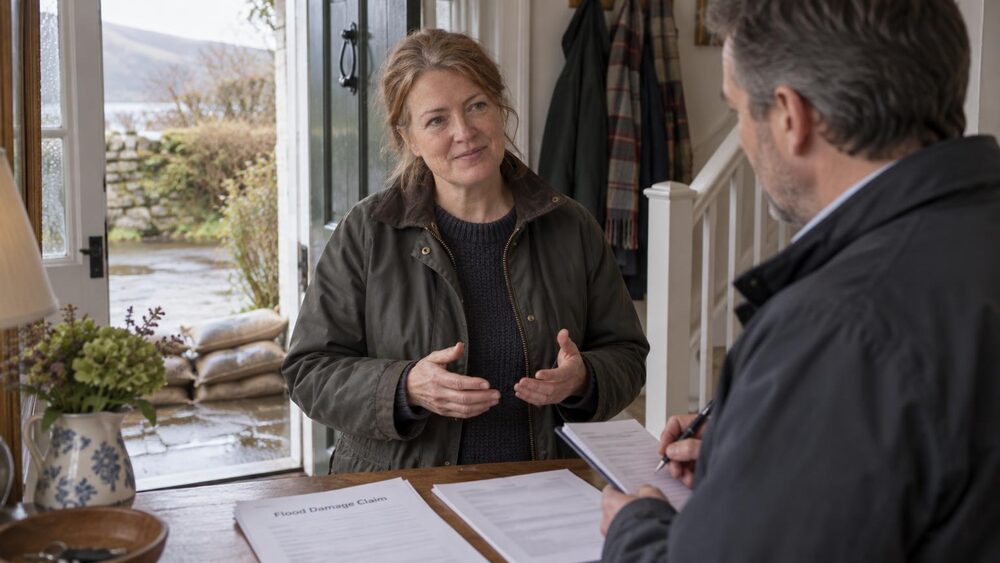
Storms Bert and Conall, which struck in November 2024, led to more than 680 properties in England being flooded, according to Which?1. The figure appears in a Which? article published on 20 November 2025 examining how home insurers handle storm and flood claims1.
Figures from the Financial Conduct Authority cited by Which? show that only 32% of storm-related claims made in 2024 resulted in a payout1. Which? said it scrutinised the terms and conditions of 133 policy documents from 67 insurers at the beginning of 2025 and found that 20% contained a storm definition it believes is potentially unfair1. Around half of those only cover damage caused by rain, hail or snow where high winds were involved, meaning a claim for damage caused by hail, snow or torrential rain could be rejected1.
Many insurers say they use the storm definition set out by the Association of British Insurers, which classifies a storm as violent weather including any of the following1:
| ABI storm criteria |
|---|
| Wind speeds with gusts of at least 55mph |
| Torrential rainfall at a rate of at least 25mm an hour |
| Snow to a depth of at least 30cm in 24 hours |
| Hail of such intensity that it causes damage to hard surfaces or breaks glass |
Which? also analysed 76 home insurance policies from 35 providers in summer 2025. It found that 83% of buildings policies include a definition for storms, but only 36% have one for floods1. It found that 74% of buildings policies will not cover groundwater flooding if it happens gradually as opposed to rapidly, and that only 1% of buildings policies will pay out for storm damage to fences, gates and hedges1.
In one case reported by Which?, a homeowner in Shipdham, Norfolk, was told he could not claim on his Post Office Gold Plus Buildings & Contents Policy after storm damage, because the wind speed in his area did not meet the insurer's storm criteria. Ageas, which underwrites the policy, said:
"Our definition of storm winds is strong winds over 55mph. From a review of the weather conditions [in Shipdham], the highest wind speed recorded on this date was 45mph, this being confirmed using Weathernet and a Met Office report."
In a separate case, the Financial Ombudsman Service upheld a complaint about how Home Protect, underwritten by Axa, handled a claim. Home Protect paid an initial £4,800 in May 2021, but the policyholders waited until July 2022 for a further £5,934, and Axa was ordered to pay £500 compensation1. The Financial Ombudsman Service says it saw a 7% year-on-year increase in complaints about buildings insurance in 2024-251.
Why it matters for households
For anyone whose home is damaged by a storm or flood, whether an insurer pays depends on how the policy defines a storm and a flood, and on measured weather conditions at the property. Where a policy sets a wind gust threshold, a claim can be refused even when damage has occurred, as the Shipdham case shows1. Where a policy has no written flood definition, some insurers apply their own definitions without stating them in the policy wording, while others default to industry-standard definitions1.
The scope of cover varies by policy. Groundwater flooding that happens gradually is excluded by 74% of buildings policies, and storm damage to fences, gates and hedges is covered by only 1%1. Items left outside, such as garden furniture and barbecues, may not be covered if they were not properly secured1. Damage resulting from general wear and tear, such as water entering through a poorly maintained roof, may also fall outside a standard policy1.
Where a claim is accepted, payout times vary. In a July 2025 Which? survey of members, of the 234 respondents whose claim was accepted or partially accepted, 18% waited fewer than two weeks for a payout and 22% waited between one and three months1.
Households that are unhappy with how a claim has been handled can complain to the insurer first and then take the case to the Financial Ombudsman Service, which is free to use1. The service told Which? that disputes about storm and flood claims include arguments over policy terms and conditions and over whether a flood occurred suddenly or was a gradual, long-term problem1. For homes at high flood risk, Flood Re is the government-backed scheme that sits behind home insurance policies; the sources do not state how many of the 680 flooded properties were covered by it.
What happens next
No further steps are set out in the source material. Which? reports that a major incident was declared in South Wales after Storm Claudia led to severe flooding, and that three named storms had hit Britain in autumn 20251.

 MoneyHelperFree, impartial money and pensions guidance, set up by government
 Financial Ombudsman ServiceFree, independent help when a complaint about a firm is not put right
 FSCSProtects your money if a bank, insurer or investment firm fails
 Citizens AdviceFree advice on money, consumer and legal problems in England and Wales
 GOV.UKOfficial information on tax, benefits and government services