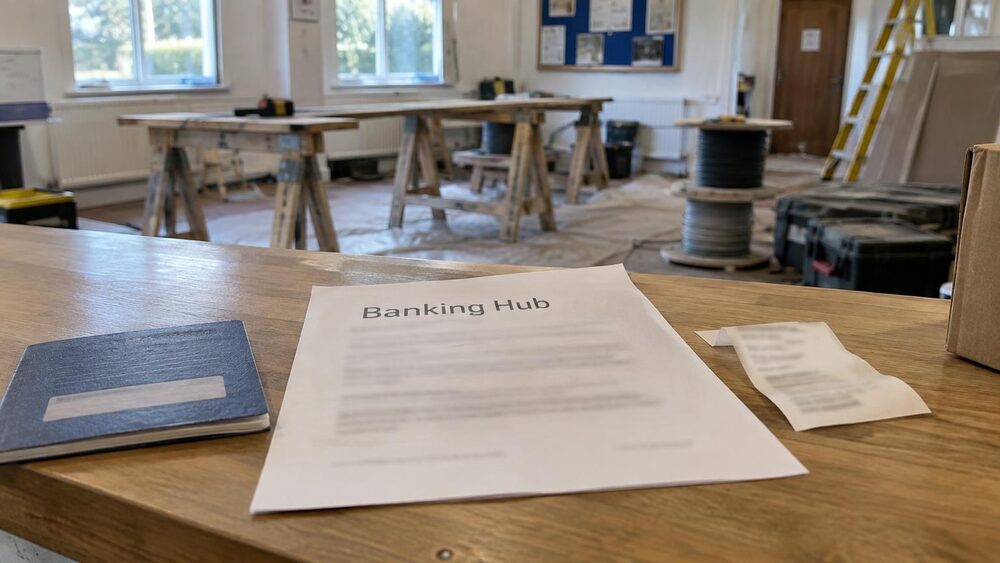
United Kingdom banks have committed to set up 350 banking hubs over the next five years, to provide face-to-face high street services following the closure of local branches1. The commitment is set out in a Northern Ireland Assembly research briefing paper published on 4 October 20241.
Banking hubs are shared premises where several banks and building societies provide counter services. In Northern Ireland, hubs are planned in Kilkeel, Newcastle, Comber, Warrenpoint and Portrush, though at the time of writing only the Kilkeel and Portrush hubs were operational1.
The commitment sits alongside new regulation of cash access. The Financial Services and Markets Act 2023 received Royal Assent on 29 June 2023 and gives the Financial Conduct Authority and the Bank of England powers to regulate retail cash access and wholesale cash distribution respectively1. The new FCA rules under the Act came into force on 18 September 20241. In August 2023 the Treasury published its Cash Access Policy Statement1.
"In 2024, United Kingdom banks have committed to set up 350 banking hubs over the next five years to provide face-to-face high street services following the closures of local branches."
The paper sets out the scale of branch and cash access change in Northern Ireland. Analysis by the Consumer Council for Northern Ireland, published in 2023, found that 166 electoral wards have two or more banking services within their boundaries, 187 have just one and 109 have no banking service at all1. The same analysis of bank closures from 2020 to early 2023 noted that 21% of consumers have seen their local bank close within the last three years1.
Northern Ireland has 16,000 cash access points of all types, below Scotland (50,000) and Wales (27,000)1. Two thirds of rural dwellers in the Antrim and Newtownabbey District Council area live more than one mile from free access to cash, and in all district council areas except Belfast City and Ards & North Down roughly half of rural residents are more than a mile from free cash access1.
| Measure | Figure |
|---|---|
| Banking hubs committed across the UK | 350 over five years1 |
| Northern Ireland wards with no banking service | 1091 |
| Northern Ireland wards with one banking service | 1871 |
| Northern Ireland wards with two or more banking services | 1661 |
| Cash access points, Northern Ireland | 16,0001 |
| Cash access points, Scotland | 50,0001 |
| Cash access points, Wales | 27,0001 |
Why it matters for households
The commitment covers the five years from 2024, so the hubs are expected to open gradually rather than at once1. For households in areas that have lost their last branch, a hub is a shared counter rather than a replacement branch of a named bank, and the paper notes that in Northern Ireland only two of the five planned hubs were operational at the time of writing1.
Cash use has fallen sharply: the Bank of England reported in December 2021 that transactional cash use dropped from over 50% of payments in 2010 to 17% in 20201. But reliance on cash is uneven. FCA research cited in the paper found that living in Northern Ireland makes an individual over twice as likely to rely on cash than a similar individual in England, and that not being in employment, being permanently sick or disabled, or being retired makes an individual 83% more likely to rely on cash than average1. The paper also notes that digital banking security features such as card readers and passwords can be difficult for older and disabled people1.
The paper states that credit unions, mutual and community banks all have the potential to maintain access to cash services across Northern Ireland1. It does not report a full UK-wide list of hub locations or opening dates.
What happens next
The FCA rules under the Financial Services and Markets Act 2023 took effect on 18 September 20241. The paper does not set out a timetable for individual hub openings beyond the five-year commitment, and no further dates for the Northern Ireland hubs have been reported1.
More on banks and building societies.

 FSCSProtects your money if a bank, insurer or investment firm fails
 Financial Ombudsman ServiceFree, independent help when a complaint about a firm is not put right
 MoneyHelperFree, impartial money and pensions guidance, set up by government
 Citizens AdviceFree advice on money, consumer and legal problems in England and Wales