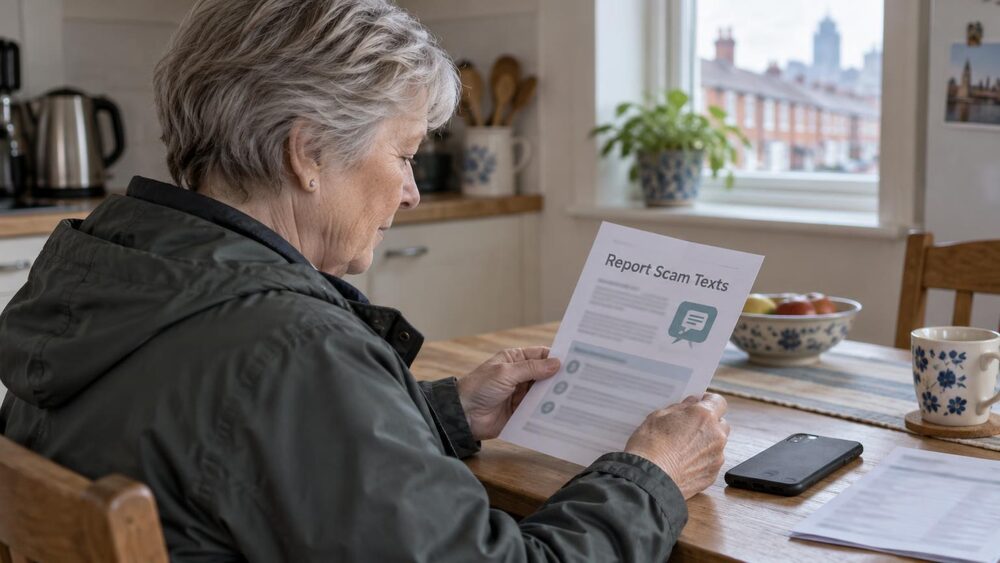
Reports of scam text messages to 7726, the free reporting service run by mobile network providers, led to more than 60,000 malicious websites being removed in March 20241. The figures were shared by Action Fraud and reported by the consumer group Which? on 2 July 20241.
The same reporting data shows that the Suspicious Email Reporting Service, which takes forwarded scam emails at report@phishing.gov.uk, reached its highest level of reporting in May since it launched in 20201. Reports made through that service have led to the removal of 329,000 scam websites by the National Cyber Security Centre1.
The 7726 service covers texts and calls received on a mobile. Which? lists it alongside other reporting routes: scam emails go to report@phishing.gov.uk, suspicious websites to the National Cyber Security Centre, and doorstep scams and companies to Citizens Advice, which can pass complaints to local Trading Standards1. Anyone who has lost money is directed to report the scam to their bank, and to Action Fraud, or to the police on 101 in Scotland1.
Which? said reporting helps investigators link separate scams run by the same criminal organisations, and helps prevent others from falling victim1. It also pointed to legislation, noting that the Online Safety Act became law after campaigning by the organisation and others, and that it will require platforms to prevent and quickly remove harmful online content, including scams1.
"Last year, we celebrated the new Online Safety Act becoming law after years of campaigning for it alongside other organisations."
Why it matters for households
Scam texts and calls arrive on the phone numbers people use every day, and the 7726 route is the one open to anyone with a mobile, at no cost, whether or not money has been lost1. The March 2024 removals figure indicates that reports made by individuals fed into the takedown of tens of thousands of websites in a single month1, which reduces the number of live pages a scam text can point to.
For households, the practical effect described is indirect: reporting is presented as a way to cut off the infrastructure behind a scam rather than as a route to recovering money already lost1. Where money has gone, the stated route is the bank, then Action Fraud, or the police on 101 in Scotland1. The email reporting service, meanwhile, recorded its highest level of reporting in May since its 2020 launch, and reports through it have been linked to 329,000 website removals by the National Cyber Security Centre1.
The figures cover reports and removals, not losses, and no breakdown by nation, age group or scam type is given1. The Online Safety Act's requirements on platforms to prevent and remove harmful content, including scams, are described as forthcoming rather than in force at the time of reporting1.
What happens next
No further dates are set out in the reporting. The Online Safety Act is described as having become law, with obligations on platforms to prevent and quickly remove harmful online content, including scams1. No timetable for those duties, and no further reporting or removal targets, have been reported1.
Consumers who want to know how the 7726 service works can read our guide to forwarding suspicious texts to 7726, and our explainer on phishing, vishing and smishing covers fake emails, calls and texts. More reporting routes are set out in our scams and fraud section.
 FCA Warning ListCheck whether a firm is authorised before you deal with it
 Financial Ombudsman ServiceFree, independent help when a complaint about a firm is not put right
 Citizens AdviceFree advice on money, consumer and legal problems in England and Wales
 MoneyHelperFree, impartial money and pensions guidance, set up by government