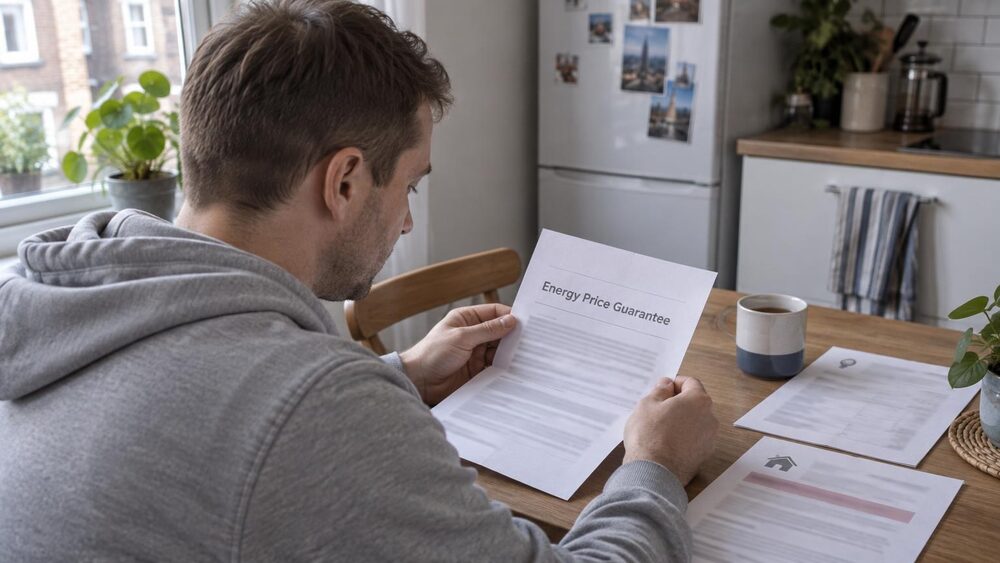
The government announced a significant intervention in the energy market in the last week of August 2022, according to the Resolution Foundation's Housing Outlook Q3 2022, published on 17 September 20221. The Resolution Foundation said the intervention "will incontrovertibly make a big difference to the inflation shock that households have to contend with this winter and beyond"1.
"The Government's significant intervention in the energy market announced last week will incontrovertibly make a big difference to the inflation shock that households have to contend with this winter and beyond"
The Energy Price Guarantee is separate from the energy price cap that Ofgem sets, and its details for 2022 to 2023 are set out in the guide to the Energy Price Guarantee. Households in Northern Ireland face a different market, where there is no energy price cap.
The Resolution Foundation's report focused on private renters in England, who numbered 4.4 million, or almost one in five households, at the time of publication1. It found that rents for new private tenancies rose by 10 to 12 per cent over the year to July 2022, based on commercial indices from HomeLet, Rightmove and Zoopla1. The Zoopla rental index rose from under 2 per cent in the year to July 2021 to over 12 per cent in the year to July 20221. The ONS Index of Private Housing Rental Prices, which covers new and existing tenancies, reached an annual change of 3.4 per cent in August 2022, after growth of between 1 and 2 per cent a year since 20181.
The report also set out longer-term pressures. Housing costs were equivalent to one-third of family income for private renters in England in 2020-21, before Housing Benefit or Universal Credit1. That figure had risen from 10 per cent in the 1960s to 33 per cent by the mid-1990s and stayed at that level1. Families in the bottom fifth of the private renter income distribution had housing costs over twice as high a proportion of income as those in the top fifth, at 51 per cent versus 23 per cent, measured before Housing Benefit or Universal Credit1.
| Measure | Figure | Period |
|---|---|---|
| Rents for new private tenancies, annual change | 10 to 12 per cent | Year to July 20221 |
| Zoopla rental index, annual change | Over 12 per cent | July 2021 to July 20221 |
| ONS Index of Private Housing Rental Prices, annual change | 3.4 per cent | August 20221 |
| Housing costs as share of family income, private renters in England | One-third | 2020-211 |
| Average floor space per person in the private rented sector | 36m², down from 43m² | 2017-19 versus 1996-20011 |
| Private rented dwellings with EPC band D to G | 67 per cent | Published September 20221 |
On quality, the report found that average floor space per person in the private rented sector fell from 43m² in 1996-2001 to 36m² in 2017-19, while average floor space across all English dwellings rose from 44m² to 47m²1. Low-income private renters lost three times more space than high-income renters, 21 per cent compared with 7 per cent1. More than two-thirds, 67 per cent, of private rented dwellings had a poor energy efficiency rating of EPC band D to G, higher than the 64 per cent of properties with mortgages1. The government estimated in August 2022 that a home in EPC band E costs on average £595 more a year to heat than one rated EPC C, and one in band F or G costs £1,339 more1.
Why it matters for households
The Energy Price Guarantee applies to household energy bills, and the Resolution Foundation's assessment is that it will make a big difference to the inflation shock households face this winter and beyond1. For private renters in England, the support on energy bills sits alongside other rising costs. Rents for new tenancies rose by 10 to 12 per cent over the year to July 2022, and the ONS measure covering all tenancies reached 3.4 per cent in August 20221. With the average private renter in England having lived in their current home for 4.2 years, the report said around one-quarter of private rented properties have new tenants each year, so increases agreed on new lets feed through to the wider index1.
The report also noted that 67 per cent of private rented dwellings had an EPC rating of D to G, meaning many renters live in homes that are harder and more expensive to heat1. The Household Costs Index tracks how inflation differs across household types, and the rates and economy section covers related cost pressures.
What happens next
The report states that it is a stated ambition for all homes in the private rented sector to reach EPC band C or better by 2028, and that the government's Private Renters White Paper commits to apply the Decent Homes Standard to the sector for the first time1. The report adds that policy makers remain silent on the question of rent levels1. No further dates for the Energy Price Guarantee beyond the 2022 to 2023 scheme are given in the report.
Sources1 cited
- Housing Outlook Q3 2022 • Resolution Foundation resolutionfoundation.org

 MoneyHelperFree, impartial money and pensions guidance, set up by government
 Citizens AdviceFree advice on money, consumer and legal problems in England and Wales
 GOV.UKOfficial information on tax, benefits and government services
 StepChangeFree debt advice and solutions from a charity
 FSCSProtects your money if a bank, insurer or investment firm fails