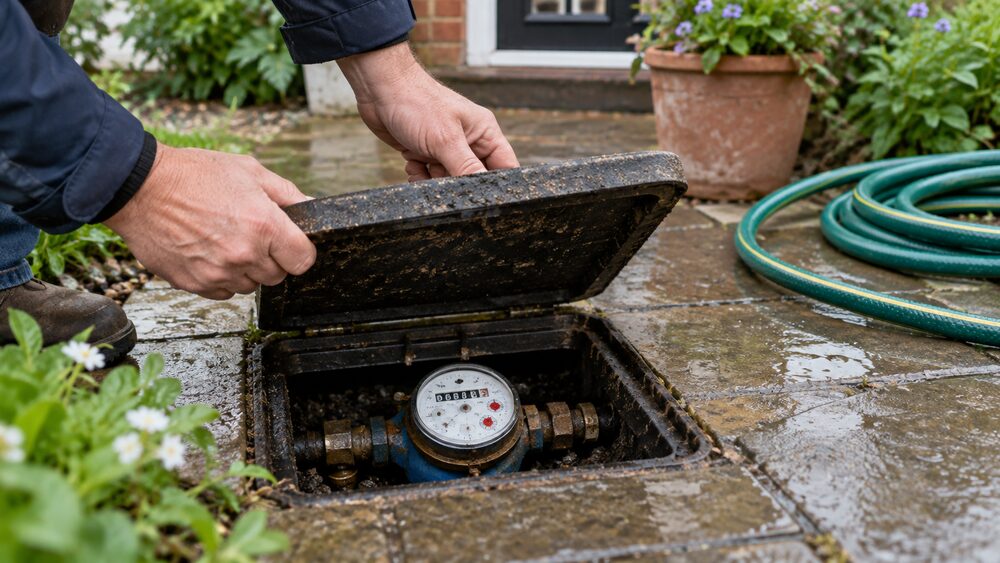
Water charges work in two completely different ways depending on which part of Great Britain you live in. In Scotland, most households pay for water and sewerage through their council tax bill, and the charge is based on their council tax band rather than how much water they use. In England and Wales, households receive a separate bill from a water company, and charges are set under the Water Industry Act 1991.
The amounts differ too. From 1 April 2026, the typical annual water bill in England and Wales is £639, after a rise of 5.4% (£33)1. In Scotland, bills rose by an average of £42 (8.7%) from 1 April 2026, bringing the typical charge to £5321. The two figures are not directly comparable, because the Scottish charge is collected with council tax and based on band, not usage.
If you are moving between the two systems, or falling behind on payments, the rules that apply to you depend entirely on where you live. This page sets out how each system works, what it costs, and what happens when water charges go unpaid.
Water charges in Scotland and in England and Wales: two separate legal systems
The legal definition of "water charges" differs by nation, and this matters because it determines who can bill you, how much you pay, and what happens if you do not pay. In England and Wales, water and sewerage charges fall under Chapter 1 of Part 5 of the Water Industry Act 19913. In Scotland, water and sewerage charges are established by Scottish Water under a charges scheme made under section 29A of the Water Industry (Scotland) Act 20023.
This split appears consistently across legislation. The Housing Benefit Regulations 2006 define water charges for England and Wales as any water and sewerage charges under Chapter 1 of Part 5 of the Water Industry Act 1991, and for Scotland as any water and sewerage charges established by Scottish Water under a charges scheme made under section 29A of the Water Industry (Scotland) Act 20025. The same two-part definition appears in the Council Tax Reduction Schemes (Prescribed Requirements) (England) Regulations 20126 and in earlier regulations going back to 19877.
In practice, this means a household in Scotland is not billed by a water company in the way a household in England or Wales is. Scottish Water provides water to all households in Scotland, but the billing arrangement depends on whether the home has a water meter8. For unmetered households, the local council bills and collects water charges on Scottish Water's behalf, and the charge appears on the council tax bill8. For metered households, Scottish Water invoices directly and offers various payment plans8.
The Scottish system also has its own annual increase mechanism. Scottish Water charge increases follow a CPI+2% basis, which is the formula it is permitted to use for annual charge increases9. This is separate from the price review process that applies to water companies in England and Wales.
In Scotland, water and sewerage charges come with council tax
Most households in Scotland pay their water and sewerage charges through their council tax bill10. The council tax bill is split into two different payments: a charge for council tax and a charge for water11. Scottish Water collects the water payments from the council, which charges you in your council tax bill11.
The charge is based on your council tax band, not on how much water you use2. This means two households in the same band pay the same water charge regardless of how many people live there or how much water they use. The charges are issued and collected by local authorities alongside council tax, so you receive one notification covering two bills2.
You must pay the water part of your council tax bill even if you are eligible for a council tax reduction12. This is a common point of confusion. A council tax reduction reduces the council tax element, but the water charge remains payable. There is a separate scheme, the Water Charges Reduction Scheme, which can reduce water charges for eligible households in Scotland13.
For 2025/26, the unmetered water and wastewater charges in Scotland by council tax band were:
| Council tax band | Annual water and wastewater charge, 2025/26 |
|---|---|
| Band A | £400.2614 |
| Band C | £533.6814 |
| Band D | £600.3914 |
| Band E | £733.8114 |
These figures cover water supply and wastewater collection for unmetered households14. The charges rose by 9.9% from April 2025, equating to £3.68 per month or £44 per year on average14. Council tax bills in Scotland increased by an average of 9.5% in April 2025, while water charges increased by 9.9%15.
If you have a water meter in Scotland, the arrangement is different. Metered charges are invoiced directly by Scottish Water, and those payments are not included in council tax payments16. Scottish Water provides a standard meter for free, but if you are the homeowner you have to pay the cost of fitting it, and once installed it cannot be removed13. In Scotland, you likely pay for water through your council tax, so switching to a meter may only be worthwhile if you could pay less17.
In England and Wales, water and sewerage charges are billed under the Water Industry Act 1991
In England and Wales, water and sewerage charges are set under Chapter 1 of Part 5 of the Water Industry Act 19913. Households receive a separate bill from their water company. The charge is usually based on a water meter, though some households remain on unmetered charges.
The amounts have risen sharply in recent years. In April 2024, the average water and sewerage bill in England and Wales was £473, a rise of £27 or 6%19. From April 2025, the average annual water bill rose by £123 in England and Wales14. From 1 April 2026, average water bills in England and Wales rose by 5.4% (£33), taking the typical annual bill to £6391.
The Water Industry Act 1991 also sets out the framework for consumer representation. The requirement for the Consumer Council for Water to publish complaints data is set out within the Water Industry Act 1991, with specific responsibilities under Sections 27F and 27G20. This gives consumers in England and Wales a formal route to compare water company performance.
Wales does not have its own separate water charging legislation. The rules that apply to a household in Wales are the England and Wales rules under the Water Industry Act 19913. This is different from council tax, where Wales has its own system, and different from Scotland, where water charging is devolved.
For households in England and Wales, the bill covers both water supply and sewerage. The charge is usually based on metered usage, which means the amount you pay reflects how much water you use. This gives households more direct control over their bill than the band-based Scottish system, but it also means bills can vary significantly from one household to another.
Scotland or England and Wales: which rules apply to your home
The rules that apply to your water charges depend on where your home is, not where you work or where you are from. If your home is in Scotland, Scottish rules apply. If your home is in England or Wales, the England and Wales rules apply.
For most households in Scotland, this means water charges are collected through council tax and based on council tax band2. The charge is not based on water use, so there is no direct financial incentive to use less water, though metered households can choose to have a meter fitted13. If you have a water meter in Scotland, you pay Scottish Water directly and your water charges are not included in your council tax payments16.
For households in England and Wales, the bill comes from a water company and is usually based on metered usage. The charge is separate from council tax and is not affected by your council tax band.
If you move from England to Scotland, the main change is how you pay. You stop receiving a separate water bill and start paying water charges through your council tax bill, based on your council tax band. If the home you move to has a water meter, you pay Scottish Water directly instead8. If you move from Scotland to England or Wales, you start receiving a separate water bill from a water company, usually based on metered usage.
There is also a difference in how increases are set. Scottish Water charge increases follow a CPI+2% basis9. In England and Wales, increases are set through the price review process. The result is that the two systems can produce different annual changes, as happened in April 2025 when average bills rose by £123 in England and Wales and by £44 in Scotland14.
Unpaid water charges in Scotland: sheriff officers, decrees and wage arrestment
If you fall behind on water charges in Scotland, the consequences follow the same path as council tax arrears. Local authorities collect unpaid water and sewerage charges using the same legislative powers as for the collection of council tax debt2. This means the enforcement process is the same as for unpaid council tax.
Water companies cannot disconnect your supply if you do not pay your bills4. However, they can make a claim in the Sheriff Court if you do not come to a repayment arrangement4. If the case is passed to external debt collection agencies or sheriff officers, recovery mechanisms may include repayment plans, summary warrants and enforcement action such as wage arrestment or home visits2.
Wage arrestment is the Scottish equivalent of an attachment of earnings order in England and Wales. In Scotland, similar deductions are made through the Sheriff Court and are called wage arrestment21. This means money can be taken directly from your wages to repay the debt.
Research by Consumer Scotland found that water debt in Scotland is driven primarily by affordability pressures rather than an unwillingness to pay2. The same research found that affordability checks are not always undertaken, with many local authorities moving quickly to enforcement action2. Recovery of water debt follows the same statutory procedure as council tax debt, even for financially vulnerable households receiving 100% council tax reduction2.
Consumer Scotland has proposed better aligning water and sewerage charges with council tax reduction, so that households receiving full council tax reduction are not still liable for water charges they cannot afford2. This is a proposed intervention, not current policy.
If you are struggling with water charges in Scotland, the Debt Arrangement Scheme is one option. It is Scotland's own debt respite scheme, administered under the Debt Arrangement Scheme (Scotland) Regulations 201122. The scheme lets you repay debts through a debt payment programme while being protected from enforcement action. Because water charges in Scotland are collected alongside council tax, arrears are treated in the same way as council tax debt and can be included in a Debt Arrangement Scheme.
The Debt Respite Scheme, which includes breathing space, is available in England and Wales. Scotland has its own Debt Arrangement Scheme, and Northern Ireland is currently not included23. Scotland already has its own debt respite scheme, the Debt Arrangement Scheme24.
If you are struggling with water charges, free and impartial help is available. MoneyHelper offers guidance on managing bills and debt. In Scotland, you can also contact your local council or Scottish Water directly to discuss repayment arrangements. The Water Charges Reduction Scheme may reduce the water element of your council tax bill if you are eligible13.
Sources24 cited
- April 2026 bill rises: what's going up and expert tips to cut costs Which?, 2026
- Interim findings: understanding the experiences of consumers in water debt Consumer Scotland, 2026
- The Housing Benefit Regulations 2006 legislation.gov.uk, 2006
- Student money and debt Business Debtline, 2026
- The Housing Benefit Regulations 2006 legislation.gov.uk, 2006
- The Council Tax Reduction Schemes (Prescribed Requirements) (England) Regulations 2012 legislation.gov.uk, 2012
- The Income Support (General) Regulations 1987 legislation.gov.uk, 1987
- Water companies in Scotland Turn2us, 2025
- Consumer outlook 2024/2025 Consumer Scotland, 2024
- Plugging the gap StepChange, 2026
- Who pays council tax Shelter Scotland, 2024
- Paying council tax bills StepChange, 2026
- Water help and costs Independent Age, 2026
- Water bill price hikes: how to save money Which?, 2025
- Insights from the 2025 energy affordability tracker Consumer Scotland, 2025
- Costs of living: making the most of your money Business Debtline, 2026
- Saving money with a water meter StepChange, 2026
- Park homes Independent Age, 2026
- April price hikes: how to save money if your costs are going up Which?, 2024
- Consumer experience: customer complaints Consumer Scotland, 2025
- Attachment of earnings orders National Debtline, 2026
- Main parties in DAS Accountant in Bankruptcy, 2024
- Collecting tax debts as we emerge from coronavirus HM Revenue & Customs, 2021
- Standard Disclosure and Repayment Plan consultation HM Government, 2022


 Citizens Advice ScotlandFree advice across Scotland
 Citizens AdviceFree advice on money, consumer and legal problems in England and Wales
 MoneyHelperFree, impartial money and pensions guidance, set up by government
 GOV.UKOfficial information on tax, benefits and government services