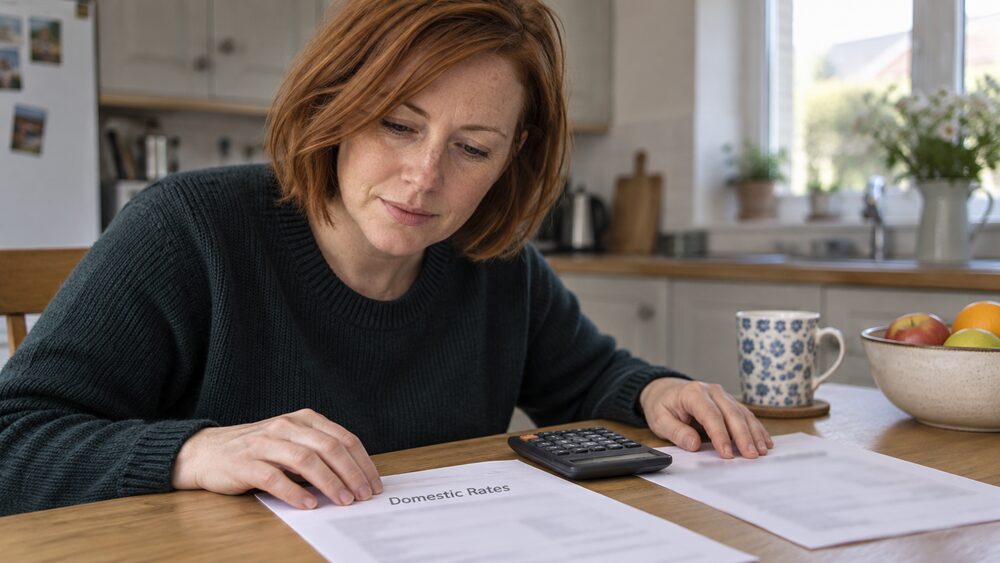
If you are moving between Northern Ireland and Great Britain, the biggest difference in your household bills is the local property tax. Northern Ireland does not have council tax. Households there pay domestic rates instead, worked out by multiplying your property's capital value by the domestic rate for your council area1. In England, Scotland and Wales, you pay council tax, which is based on the value your home would have had in April 1991 (or April 2003 in Wales) and the spending needs of your local council3.
The two systems look similar on a bill: both fund local services, both offer a 25% discount for single adults, and both can be paid in instalments. But the way the charge is calculated, the way arrears are enforced, and the help available when you cannot pay are different. Northern Ireland uses capital values, not bands. Enforcement goes through the courts, not bailiffs in the English sense. And Council Tax Reduction, the means-tested help available in Great Britain, does not exist in Northern Ireland5.
This page sets out how each system works, what discounts and exemptions apply, how to pay, and what happens if you fall behind. It covers the practical differences that matter when you move, rent, or buy across the Irish Sea.
The two systems side by side
| Council tax (England, Scotland, Wales) | Domestic rates (Northern Ireland) | |
|---|---|---|
| Basis of charge | Valuation band, based on April 1991 values (April 2003 in Wales)3 | Rateable capital value, based on 2005 values11 |
| Who sets the charge | Each local council sets its own annual charge12 | Regional rate set by the Northern Ireland Executive, district rate set by each of the eleven councils14 |
| Number of bands | Eight bands, A to H, in England and Scotland15 | No bands; a single capital value per property16 |
| Single adult discount | 25% off the bill6 | 25% off the bill17 |
| Means-tested help | Council Tax Reduction5 | Rate Rebate; Housing Benefit for rates for renters5 |
| Enforcement | Court action, then bailiffs in England and Wales18 | Magistrates' courts issue liability orders; Enforcement of Judgement Office handles judgments19 |
Northern Ireland pays domestic rates, not council tax
The first thing to understand is that council tax does not exist in Northern Ireland. Households there pay rates, a system that predates council tax and was retained when the rest of the UK moved to the banded system in 19931. The rates bill has two parts: a regional rate set by the Northern Ireland Executive and a district rate set by your local council14. The regional rate funds services delivered centrally, while the district rate funds your council's own services.
Domestic rates are payable on all residential properties in Northern Ireland21. The bill is calculated by multiplying your property's rateable capital value by the domestic rate poundage, which is the sum of the regional rate and the district rate16. Capital value is not the same as market value. It is the value the Valuation and Lands Agency assigned to your property, based on 2005 values, and it appears on your rates bill11.
One practical difference is the level of the bill. Average weekly domestic rates in Northern Ireland are nearly half the average weekly council tax bill in Great Britain, according to research from the Joseph Rowntree Foundation22. That gap reflects lower property values, lower local spending, and the different way the tax is structured. It does not mean rates are cheap in every case, particularly in areas where capital values have risen since 2005.
If you are moving to Northern Ireland, you will need to register with Land and Property Services, the body that administers rates. If you are moving to Great Britain, you will need to tell your new council and they will start charging you council tax from the day you move in, based on the new property's band23.
How council tax is worked out: bands, 1991 values and your council's charge
Council tax in England, Scotland and Wales is charged in bands based on the value of your house in 199124. There are eight bands in England and Scotland, running from A (the cheapest) to H (the most expensive)15. Wales has a similar system but uses April 2003 values instead of 19913. The band determines the proportion of your council's total charge that you pay. A Band D property is the standard reference point: other bands are expressed as fractions of Band D.
To work out your bill, you need three things:
- The valuation band for your home.
- How much your local council charges for that band.
- Whether you can get a discount, reduction or exemption12.
The council sets its own charge each year, and that charge varies widely across the country. The average Band D council tax set by local authorities in England for 2024/25 increased by 5.1% from 2023/24 levels25. The average Band D bill in England now tops more than £200 a month26.
If you think your home is in the wrong band, you can challenge your council tax band12. The Valuation Office Agency handles band challenges in England and Wales, and the Scottish Assessors handle them in Scotland. Challenges are free, but you need evidence that your property's 1991 value would put it in a different band.
How domestic rates are worked out: capital value times the district rate
Domestic rates in Northern Ireland work differently. Instead of a band, you have a capital value, and instead of a single council charge, you have two rates added together. The calculation is: rateable capital value multiplied by the domestic regional rate and domestic district rate added together16. The result is your annual rates bill.
Here is a worked example from the independent guidance: a property with a capital value of £80,000 in the Armagh City, Banbridge and Craigavon Council area would pay £80,000 x 0.010109, which equals £808.723. That figure is for illustration only. Your own bill depends on your property's capital value and the rates set by your council and the Executive for the current year.
The regional rate is set by the Northern Ireland Executive and is the same across Northern Ireland. The district rate is set by each of the eleven local councils and varies by area. Your bill shows both elements separately, so you can see how much goes to central services and how much to your council.
Domestic rates are payable on all residential properties21. If you rent, the landlord is usually responsible for paying rates on the property, but the cost may be reflected in your rent. If you own and live in the property, you are liable. If you own but rent it out, the tenant may be liable depending on the lease.
If you are struggling with your rates bill, help may be available. Rate Rebate is a means-tested reduction for people on low incomes. If you live in a property with a capital value over £150,000 and you are liable for paying the rates, Land and Property Services will credit Rate Rebate to your rate account27. There is also a Lone Pensioner Allowance for older people living alone, which reduces the rates bill.
Discounts and exemptions: the 25% single person discount and who is disregarded
Both systems offer a 25% discount for single adults. In council tax, you get 25% off your bill if you are the only person living in your home, or if all other residents are disregarded6. In domestic rates, the same principle applies: if there is only one adult in the property after discounting people who are disregarded, 25% is deducted from the bill17.
Who counts as disregarded? Full-time students are the most common example. Full-time students do not need to pay council tax, and a property occupied only by full-time students is usually exempt28. If you live with one non-student adult, that person may be treated as the only liable adult and could qualify for the single person discount. Other disregarded groups include:
- People with severe mental impairment
- Care leavers
- Some apprentices
In Wales, the rules on discounts, disregards and exemptions were amended in 2026. The Council Tax (Discounts, Disregards and Exemptions) (Wales) (Amendment) Regulations 2026 were laid to improve the operation of the 2026 exemptions framework29. If you live in Wales, check the current rules with your council.
If you live alone, you can get a 25% discount on your council tax bill30. If you live with someone who is disregarded, you may still qualify. The discount is not automatic: you need to apply to your council. If your circumstances change, for example if someone moves in or out, you must tell your council so your bill is adjusted.
Paying the bill: 10 or 12 instalments and payment methods
Most households pay council tax in 10 monthly instalments, usually from April to January, with a two-month break in February and March8. Your council will send you a bill in March showing how much you need to pay for the coming financial year, which begins in April1. The bill shows the annual amount and the instalments.
You can ask to spread your payments over 12 months instead of the usual 109. This reduces the amount of each instalment, which can help with budgeting. Some councils also accept weekly or fortnightly payments18. If you want to change your payment schedule, contact your council before the financial year starts. If your bill arrives later than April, for example because you have moved house, you will have less time to pay and may need to pay in full before the end of the financial year in March1.
In Northern Ireland, rates are also paid in instalments. You can pay monthly, and some councils accept weekly or fortnightly payments. The bill shows the annual amount and the instalments. If you are struggling to pay, contact Land and Property Services to discuss a payment plan.
Missed payments: a priority debt with different enforcement in Northern Ireland
Council tax and domestic rates are both priority debts. That means they should be paid ahead of other debts such as credit cards or personal loans, because the consequences of not paying can escalate quickly31. If you miss a payment, your council should send you a reminder notice giving you seven days to pay18. If you do not pay within seven days, you may be asked to pay the whole year's council tax at once10.
If you miss a payment for the third time, the council will send a final notice saying you must pay the whole year's council tax10. After a final notice, 10% may be added to the amount you owe33. If you still do not pay, the council can take you to court28. In England and Wales, the council can use bailiffs to take your belongings, which will be sold to cover your debt, and the cost of using bailiffs is added to the amount you owe18.
In Northern Ireland, enforcement works differently. Magistrates' courts can issue liability orders for unpaid rates19. The Enforcement of Judgement Office handles the enforcement of judgments, and the rules are different from England and Wales20. If you are struggling with rates arrears, free advice is available from organisations such as StepChange and Housing Rights.
Council tax rises and the new high-value bands in England
Council tax bills in England are likely to go up in 2026-2726. The average Band D bill already tops more than £200 a month26. The average Band D council tax set by local authorities in England for 2024/25 increased by 5.1% from 2023/24 levels25. These increases reflect pressure on local authority budgets and rising costs of services.
From April 2028, a new high-value council tax surcharge will apply in England to residential properties valued at or over £2 million34. The surcharge is a flat-rate annual charge levied on owners rather than occupiers. It starts at £2,500, rising to £7,500 for properties valued over £5 million34. The surcharge is expected to affect fewer than one per cent of households35.
Two new council tax bands will also be introduced in England from April 2028. Band I will cover properties valued between £1 million and £2 million, and Band J will cover properties valued above £2 million35. These bands are in addition to the existing bands A to H. If you own a high-value property in England, you may pay more from 2028.
Sources36 cited
- Paying council tax bills StepChange, 2026-09-25
- Unpaid council tax debt StepChange, 2026-09-25
- Council tax arrears StepChange, 2026-09-25
- Rates arrears StepChange, 2026-09-25
- Council tax bands Which?, 2026-04-17
- Domestic rates in Northern Ireland Entitledto, 2026-09-26
- How easy is it to challenge your council tax band Which?, 2026-04-19
- Council tax in Scotland to be frozen Which?, 2023-10-26
- A minimum income standard for Northern Ireland Joseph Rowntree Foundation, 2009-09-29
- Council tax rates for 2021-22 Which?, 2025-26
- Paying council tax Which?, 2026-04-17
- Review of Land and Buildings Transaction Tax Scottish Government, 2026-03
- Homeowners and tenants applying for rate rebate nidirect, 2026-06-11
- Pay your council tax bill mygov.scot, 2026-04-01
- Paying your rates bill Housing Rights, 2026
- Home economics Resolution Foundation, 2026-09-24
- Help with energy costs Carers UK, 2026-09-26
- How much deposit do you need for a mortgage Which?, 2026-04-02
- Help with council tax rates Contact, 2025-10-02
- Your priority debts Business Debtline, 2026-09-26
- Council tax GOV.UK, 2026-09-26
- Ways to reduce council tax Age UK, 2025-02-10
- Rising council tax bills and the spectre of the poll tax Resolution Foundation, 2025-02-17
- Consultation on council tax Welsh Government, 2022-07-12
- Help with your council tax Independent Age, 2026-09-26
- Budget 2025 summary House of Lords Library, 2025-11-26
- SDLT linked purchases or transfers GOV.UK, 2025-04-01
- Mansion tax: everything we know so far Which?, 2026-07-14
- Council tax discounts, disregards, exemptions and reductions Welsh Government, 2026-03-17
- Help with council tax Disability Rights UK, 2026-04-14
- Council tax discounts, disregards and exemptions Senedd Cymru, 2025-12-09
- Help with council tax reduction discount Scope, 2026-08-11
- Council Tax bill Entitledto, 2026-09-26
- Your priority debts (England and Wales) Business Debtline, 2026-09-26
- Your business and household budget Business Debtline, 2026-09-26
- Northern Ireland magistrates' court fines StepChange, 2026-09-25



 Citizens Advice ScotlandFree advice across Scotland
 Citizens AdviceFree advice on money, consumer and legal problems in England and Wales
 MoneyHelperFree, impartial money and pensions guidance, set up by government
 GOV.UKOfficial information on tax, benefits and government services