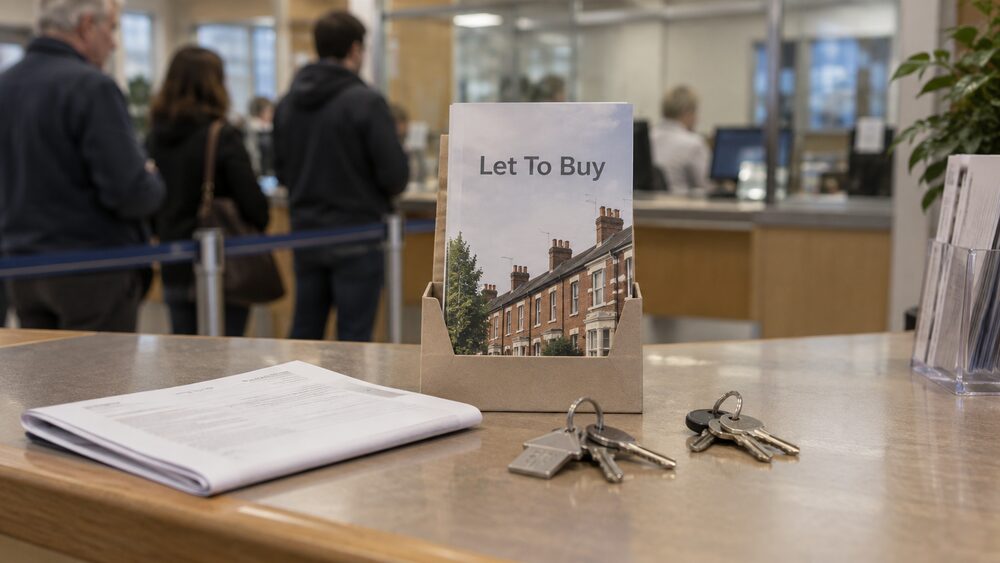
Let to buy is what happens when you keep the home you already live in, rent it out, and buy somewhere else to live at the same time. It means running two mortgages at once: a buy-to-let mortgage on the old property and a standard residential mortgage on the new one1. The remortgage and the purchase usually have to complete on the same day, because the equity released from the first home funds the deposit on the second2.
Let to buy is what happens when you keep the home you already live in, rent it out, and buy somewhere else to live at the same time. It means running two mortgages at once: a buy-to-let mortgage on the old property and a standard residential mortgage on the new one1. The remortgage and the purchase usually have to complete on the same day, because the equity released from the first home funds the deposit on the second2.
It is a different process from simply buying a property to let. With buy to let, you buy a property with the intention of renting it out3. With let to buy, you start from a home you occupy, remortgage it onto a buy-to-let loan, and use the money released to put down a deposit on your next home4. Lenders treat it as its own category, with its own criteria.
The numbers that decide whether it works are the rent and the deposit. Most lenders want the rent to cover around 145% of the monthly mortgage payment1, and the borrowing limit on your current home is typically 75% to 80% of its value1. Buy-to-let mortgages are generally interest-only rather than repayment1, so the loan balance does not fall unless you overpay.
Let to buy means two mortgages at once
The structure is the point. You are not selling your home and you are not simply letting a room; you are converting your current home into a rental property and borrowing against it to fund a move. That means two separate loans, assessed on two different sets of rules, running side by side.
The buy-to-let side is defined in law as a loan secured on a residential property that is let, or intended to be let, at the date the mortgage is granted, and marketed as being for that purpose7. The residential side is an ordinary mortgage on the home you will actually live in, and it is assessed on your income in the usual way.
Because the deposit for the new home comes out of the equity in the old one, timing matters. Accord Mortgages states that the remortgage and the purchase must be completed simultaneously2. If the sale of the new property slips, or the remortgage is delayed, the two halves can fall out of step.
Buy-to-let borrowing can be taken in your personal name or through a limited company8. That is a structural choice with tax and legal consequences, and it is worth taking advice on before you apply rather than after.
Consent to let or a buy-to-let remortgage: how each one works
There are two routes to renting out a home you already have a mortgage on, and they are not the same thing.
Consent to let is permission from your existing lender to rent the property out while keeping your current residential mortgage. Some lenders will grant it on your current deal; others may insist you switch to a buy-to-let mortgage instead9. It is usually a temporary arrangement rather than a permanent change of status.
A buy-to-let remortgage replaces your residential loan with a buy-to-let loan. This is the route let to buy normally takes, because it releases equity at the same time. Buy-to-let mortgages are generally interest-only rather than repayment1, and the amount you can borrow usually depends on how much rent the property is expected to produce rather than on your salary10.
| Consent to let | Buy-to-let remortgage | |
|---|---|---|
| What changes | Nothing on the loan itself, just permission to let | The mortgage is replaced with a buy-to-let loan |
| Equity released | No | Yes, typically used for the new deposit |
| Repayment basis | Whatever your current deal is | Generally interest-only1 |
| Who decides | Your existing lender9 | A buy-to-let lender, which may be your existing one |
If you want to move but cannot sell, a let-to-buy arrangement is one option; a bridging loan is another11. The two carry very different costs and risks, and the bridging loans page sets out how that alternative works.
Who can get a let-to-buy mortgage: rent of at least 125% of repayments
The headline test is rental cover. Most lenders require the rent to cover around 145% of the monthly repayments1. That is a stress test: the rent has to exceed the mortgage payment by a wide margin so the loan still works if rates rise or the property sits empty for a month.
Lenders apply that test at a notional interest rate rather than the rate you are actually paying. Accord Mortgages, for example, requires the anticipated monthly rent to cover the monthly mortgage payment by 145% at an interest rate of 5%12. Family Building Society applies a lower ratio in one specific case: for a remortgage with no new borrowing, on loans up to 75% of the property value or purchase price, whichever is lower, it looks for rent of at least 135% of the interest payable per month13.
You will also need proof that you are buying a new home at the same time as switching the mortgage, usually evidenced by a copy of the mortgage offer for the new property1. Accord Mortgages asks for a copy of that offer before completion, confirmation of your new correspondence address, and, where there is no mortgage on the new property, confirmation from the solicitor of its details2.
On the deposit side, landlords wanting a buy-to-let mortgage usually need at least 15% of the property's value5. Landlords can receive a tax credit of 20% of their buy-to-let mortgage interest payments14, which is a relief rather than a deduction from the rent.
Costs, deposits and conditions: up to 80% loan to value
The borrowing limit on your current home is typically 75% to 80% of its value1. That ceiling is what caps the equity you can release, and therefore the deposit you can put down on the new home.
Loan to value is simply the mortgage as a percentage of the property's value. A £200,000 property with a £180,000 mortgage and a £20,000 deposit is at 90% loan to value15. The same idea runs the other way: a £200,000 property with an £80,000 deposit is at 40% loan to value, with the deposit making up 60%6.
Different lenders set different ceilings, and they do not always agree. One lender's consumer buy-to-let product carries a maximum loan to value of 75%16, while consent to let on an existing mortgage is capped at 80% loan to value by another17. The same lender's own remortgage products are listed at both 75% and 80% in different places, and the documents do not resolve which applies18. Where a figure matters to your application, it is worth confirming it directly.
Applying for let to buy, step by step
The order of events matters more than the paperwork, because the two transactions have to land together.
- Check what your current lender will allow. Ask whether it offers consent to let on your existing deal or expects you to move to a buy-to-let mortgage9.
- Get a decision in principle on the buy-to-let remortgage, so you know how much equity you can release.
- Get a mortgage offer on the new home, since lenders will want to see it as proof you are buying1.
- Provide the supporting documents. Accord Mortgages asks for a copy of the new mortgage offer before completion, confirmation of your new correspondence address, and solicitor confirmation of the new property's details where there is no mortgage on it2.
- Line up the completions. The remortgage and the purchase must complete simultaneously2.
- Arrange landlord insurance before tenants move in, since buildings cover is the landlord's responsibility19.
If you are buying under the Right to Buy, the process runs differently and starts with a form from your landlord20. The Right to Buy mortgages page covers that route separately.
What can go wrong as a landlord
The risks are real and they do not disappear because the property used to be your home.
The rent may not cover the mortgage. Lenders stress-test at 145% of the payment1, but that is a lending test, not a guarantee. A void period, a repair bill or a rate rise can turn a comfortable margin into a shortfall.
You may not be able to sell when you want to. If the money from a sale would not pay off the mortgage, you normally need your lender's permission to sell21. That constrains your exit.
Renting without permission is a breach. Most mortgage agreements do not allow you to rent out your home without your lender's consent, and if you do, you could be breaking your mortgage agreement and your lender may be able to take you to court22.
Tenant problems become your problems. All buy-to-let mortgages should allow people claiming benefits to rent23, so a blanket ban on housing benefit tenants is not something a lender's terms can justify.
Insurance gaps. Renters only need contents insurance because the landlord arranges buildings cover19, and if the property is a leasehold flat the building may be insured by the freehold landlord instead24. Landlord policies cover different things from ordinary home insurance, and the Financial Ombudsman Service handles complaints about home insurance when a firm gets it wrong25.
If things go wrong with the mortgage itself, free and impartial help is available. Shelter Cymru advises on mortgage problems in Wales22, and the falling into arrears page sets out what to do if payments become unaffordable.
Sources25 cited
- Let to buy explained Which?, 2026-06-23
- Let to Buy criteria Accord Mortgages, 2026-09-26
- Buy to let property definition Which?, 2026-09-25
- Home buying and selling jargon Home Owners Alliance, 2026-07-31
- How much deposit do you need for a mortgage? Which?, 2026-04-02
- Loan to value (LTV) calculator Home Owners Alliance, 2026-06-30
- The Financial Services and Markets Act 2000 (Regulated Activities) Order 2001, Schedule, paragraph 7 legislation.gov.uk, 2026
- Buy to Let mortgage guide Accord Mortgages, 2026-09-17
- Becoming a landlord Which?, 2026-07-30
- Buy to let mortgage guide Leeds Building Society, 2026-09-26
- Bridging loans explained Which?, 2026-06-23
- Let to buy criteria Accord Mortgages, 2026-09-26
- Buy to Let mortgage lending criteria Family Building Society, 2026-08
- Tax reliefs Which?, 2026-04-06
- Mortgage terminology Yorkshire Building Society, 2026-09-26
- Consumer Buy to Let 70 mortgage Swansea Building Society, 2026
- Mortgage variations for existing customers The Hanley, 2026-09-26
- Buy to Let remortgage products Accord Mortgages, 2026-09-26
- Is home buyers insurance worth buying? Which?, 2025-03-03
- Buying a home Citizens Advice, 2026-09-25
- Selling your home voluntarily Shelter Cymru, 2026-08
- Cynyddu eich incwm Shelter Cymru, 2026-09-14
- How to challenge DSS discrimination Shelter England, 2026-05-01
- Shopping around for insurance Independent Age, 2026-09-26
- Home insurance complaints Financial Ombudsman Service, 2026-09-26









 MoneyHelperFree, impartial money and pensions guidance, set up by government
 StepChangeFree debt advice and solutions from a charity
 Financial Ombudsman ServiceFree, independent help when a complaint about a firm is not put right
 Citizens AdviceFree advice on money, consumer and legal problems in England and Wales
 ShelterFree housing advice from a charity