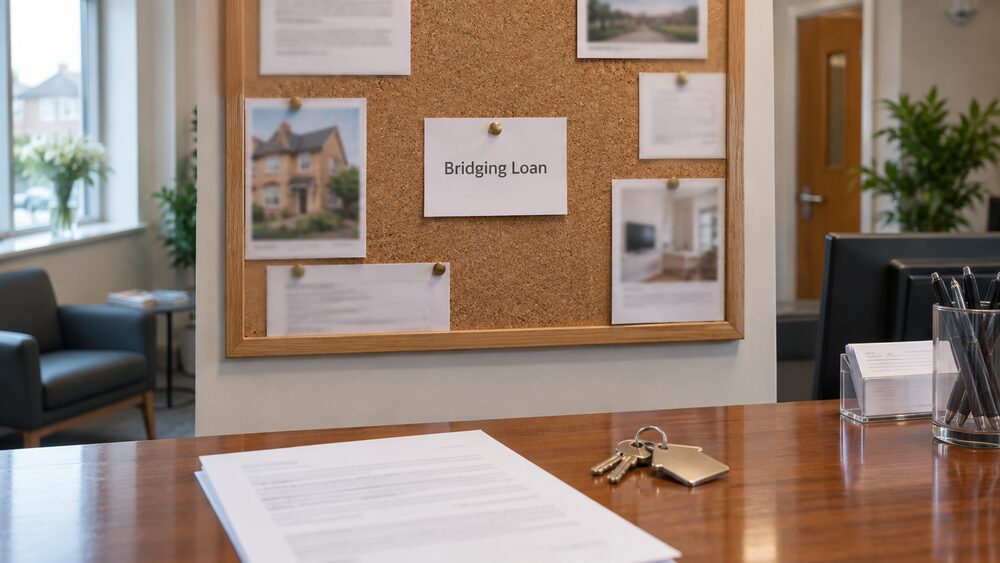
A bridging loan is a short-term secured loan, usually taken out to buy a new home before the old one has sold. It bridges the gap: the money arrives quickly, you complete the purchase, and then you clear the loan in one go when your existing property sells or a longer-term mortgage comes through. Loans typically run from around £25,000 up to £30m, and depending on the agreed deal borrowers can take up to a year or 24 months to pay the money back1.
It is expensive money compared with a normal mortgage. Interest is charged monthly, typically between 0.45% and 1.6% per month, but it is not paid monthly: it is rolled up and repaid in a single lump sum at the end, together with the original loan and any fees1. Because the loan is secured on property, your home is at risk if you cannot repay it2.
The most important thing to get right before taking one out is the exit: a clear, realistic plan for how the loan will be cleared on time. Lenders will want to see evidence of that plan before they lend1, and if it falls through, the consequences are serious.
What a bridging loan is and when people use one
A bridging loan is a secured loan, meaning there must be an asset to set it against, and that asset will usually be a property, or multiple properties1. In the FCA's rulebook, a bridging loan is defined as either an "MCD exempt bridging loan" or, otherwise, a regulated mortgage contract with a term of twelve months or less3. The exempt category is described in the Handbook as a regulated mortgage contract, or an article 3(1)(b) credit agreement, "of no fixed duration or which is due to be repaid within 12 months, used by the consumer as a temporary financing solution while transitioning to another financial arrangement for the immovable property"2.
The classic use is the chain break: you have found the house you want, but your buyer has not completed, and you risk losing the purchase if you cannot proceed. A bridging loan lets you buy first and sell later. Other uses include buying a property at auction, where funds are needed quickly, or covering a short gap while a longer-term mortgage is arranged. The defining feature in every case is that the loan is temporary by design: it exists to bridge a gap, not to fund a purchase over the long term.
Loans come in two broad shapes. With a closed loan, there is a fixed repayment date, usually tied to an agreed sale. With an open loan, there is no fixed repayment date, but you will normally be expected to pay it off within one or two years1. Open loans give flexibility but cost more the longer they run, because interest keeps rolling up.
Regulated bridging loans: when your home is the security
Whether a bridging loan is regulated depends on what secures it. Where the loan is a regulated mortgage contract secured on your home, it falls within the FCA's mortgage rules, and the firm arranging or lending must be authorised. The FCA noted when it consulted on the rules that the exemption for bridging loans is narrower than its previous Handbook definition, so some bridging loans carry the full mortgage regulatory obligations while others sit in the exempt category4. The exempt category itself is limited to loans of no fixed duration or due for repayment within 12 months, used as a temporary financing solution while transitioning to another financial arrangement for the property2.
There is also a specific legislative category for "limited payment second charge bridging loans": contracts where the number of payments to be made by the borrower is not more than four, and which are used by the borrower as a temporary financing solution while transitioning to another financial arrangement for the land subject to the mortgage5.
What regulation means for you in practice is that a lender arranging a regulated loan must follow rules on affordability, information and fair treatment. What it does not change is the fundamental risk. A bridging loan is a secured loan, and secured loans put your home on the line: guidance across Citizens Advice, Business Debtline, Shelter Cymru and National Debtline is consistent that if you cannot keep up the payments on a loan secured on your home, the property can be repossessed6. Normally the house is used as the security, although it is possible to use other assets such as an insurance policy6. If the loan is secured on your house, it could be repossessed if you do not keep up with the payments10.
How much you can borrow: usually up to 75% of the property's value
You will usually only be able to borrow a maximum loan-to-value ratio of 75% of the value of your property1. That means the lender sizes the loan against what the property is worth, not against what you paid or what you hope it will sell for, and the property will be valued as part of the application1. Our guide to loan to value explains how this ratio works.
The 75% figure is a bridging market norm, and it sits in a similar range to other secured borrowing limits. A let-to-buy arrangement, for example, typically allows borrowing of 75% to 80% of the value of your current home11. For comparison, ordinary mortgage lending can go higher on some properties, but lenders restrict new-builds: you might be restricted to 85% of the value of a new-build house, or 75% on a flat, compared with 90% or 95% on an older property12.
Two practical points follow from the 75% cap. First, the more equity you have in the property being used as security, the more you can borrow against it. Second, the valuation matters: if the property is valued lower than you expect, the amount you can borrow falls, and the gap you need to bridge has to come from elsewhere. If you are taking out a first-charge loan, you will typically be able to borrow more than with a second-charge loan1, which is the subject of the next section.
First charge or second charge: an existing mortgage changes the loan
Whether your bridging loan is a first or second charge depends on whether there is already a mortgage on the property. If you own your property outright, or you are repaying your existing mortgage in full, the bridging loan will be a first charge. This means the bridging loan would be repaid first if you fell behind with repayments and the property was sold1.
Typically, if you still have a mortgage on your property, the bridging loan will be a second charge loan, meaning that if you failed to meet repayments and your home was sold to pay off your debts, your mortgage would be paid off first1. The second charge structure is the same one used by secured loans generally: the loan sits behind the first mortgage in the queue13. The Finance and Leasing Association notes that a further advance from the existing first mortgage lender may result in the borrower losing a preferential interest rate or paying early repayment charges, which is one reason borrowers sometimes look at second charge borrowing instead13.
The charge position also affects how much you can borrow: a first-charge loan typically allows more than a second-charge loan1. And it affects the arithmetic of your exit, because when the property is sold or remortgaged, the first mortgage and then the second charge have to be cleared from the proceeds before anything comes to you. If you are weighing a second charge against other ways of raising money, our pages on second charge mortgages and remortgaging set out the alternatives.
Interest is rolled up and repaid in one lump sum
The interest structure is what makes a bridging loan feel different from a mortgage. Interest is charged monthly, but rolled up and repaid in a lump sum at the end, along with the initial loan and any fees and charges1. You do not make monthly payments that reduce the debt; the debt grows each month until you clear it.
This is the same "pay it all at the end" structure as an interest-only mortgage, where instead of paying capital and interest together each month, you pay the full amount back at the end of the term in one lump sum14. On a repayment mortgage, by contrast, you pay back the capital and the interest together over the term15. The difference with bridging is the timescale: an interest-only mortgage might run for 25 years, while a bridging loan runs for months. But the compounding effect is the same in kind. To take a worked example from the mortgage market, on a £250,000 interest-only mortgage charging 3% over 25 years, you would repay £625 a month, equating to £187,500 over the term14. Bridging rates are far higher than that per month, which is why the term is short.
Because interest compounds, every extra month costs more than the one before it in cash terms. A loan that was affordable on a six-month plan becomes materially more expensive if the sale drags on to twelve. This is why independent guidance is blunt about the product: bridging loans are expensive, and it states a borrower should only get one if they can repay it within six months16.
Fees and charges on a bridging loan
On top of the rolled-up interest, there are set-up fees to consider, usually around 2% of the loan you want to take out1. On a £200,000 loan that would be around £4,000, paid for money you may only hold for a few months.
To put that in context with other property borrowing costs, it is common for mortgage lenders to charge an arrangement fee of around £1,000, and some lenders offer low rates but charge fees of up to £3,99917. Many mortgages charge a product or arrangement fee just to get the loan, typically around £1,000, though fee-free products are available18. In later-life lending, application fees can be around £500 or £600, not all providers charge them, and the fee may be added to the amount borrowed19. Bridging's 2% arrangement fee is therefore a multiple of what a standard mortgage arrangement fee costs, on a much shorter loan.
| Cost | Typical level | Notes |
|---|---|---|
| Monthly interest | 0.45% to 1.6% per month | Charged monthly, rolled up, repaid at the end1 |
| Arrangement fee | usually around 2% of the loan | A set-up fee on top of interest1 |
| Valuation and legal costs | set by the provider | Property is valued before approval1 |
The valuation and conveyancing are real costs too: the property will be valued before a loan is approved or rejected, and solicitors will handle the conveyancing before the loan is released1. Because the interest and the arrangement fee are both percentages, the total cost of a bridging loan scales with how much you borrow and how long you hold it. Before committing, it is worth comparing the full cost against the alternatives, including simply waiting to sell, using our guide to mortgage fees and charges as a yardstick for what ordinary borrowing costs.
Who can get a bridging loan and what lenders check
Lenders check two things above all: whether you can afford the loan, and whether you have a credible way out of it. Affordability checks will be carried out and the property will be valued before a loan is either approved or rejected, and the lender will want to see evidence of a clear repayment strategy, such as using equity from a property sale or taking out a mortgage1.
Your credit history matters. Having a bad credit rating will make it more expensive and harder to borrow money, as the Bank of England puts it plainly20. If you have a poor credit rating, you may only be able to get a loan at a high interest rate or secured against your home21. Debt charities make the same point about borrowing generally: having a low credit score or a less-than-ideal credit history can make it harder to get approved, and may mean being offered higher interest rates than you pay now, or higher-risk secured loans22. Where there are marks on your credit history, you may need a specialist lender24, and the bridging market is itself a specialist market.
Where two people apply together, lenders will run a credit check on each applicant, and if one party has a poor credit score, it could impact the lender's decision24. There is no suggestion in the guidance that self-employment rules you out, but self-employed applicants should expect the affordability checks to cover their income evidence, as with any mortgage. The key eligibility question is not really your employment or your credit file in isolation: it is whether the lender believes the exit will happen on time.
Your exit strategy: how you will clear the loan
The exit strategy is the plan for clearing the loan, and it is the single most important part of the application. Lenders will want to see evidence of a clear repayment strategy, such as using equity from a property sale or taking out a mortgage1.
The FCA's rules put limits on what can count. Where a bridging loan is an interest-only mortgage, a mortgage lender accepting, as a repayment strategy, an expectation that by entering into the bridging loan the customer's credit status will be sufficiently improved to enable them to refinance to a longer-term regulated mortgage contract may be relied upon as tending to show contravention of the rules, except where the lender has evidence of a guaranteed offer for such a longer-term contract25. In plain terms: "I'll take the bridging loan and hope my credit looks better later" is not an acceptable exit plan, and a lender who accepts it is on shaky regulatory ground. A guaranteed offer of the longer-term mortgage is different.
Where no repayment date can be suggested, the FCA's affordability rules require a term of 12 months to be assumed, for example in the case of an open-ended bridging loan26. That assumption feeds into the affordability assessment.
Common exits include:
- Selling the old home: the sale proceeds clear the bridging loan, plus rolled-up interest and fees, in one payment1.
- Taking out a mortgage: a longer-term mortgage on the new property replaces the bridging loan1.
- A let-to-buy arrangement: remortgaging your current home onto a buy-to-let mortgage and using the equity released to buy the new property, which can be an alternative to bridging altogether11.
- A staged payment scheme: for self-build, an advance payment scheme releases money before each stage of construction and removes the need for bridging loans27.
Independent guidance states that these loans are expensive and that a borrower should only get one if they can repay it within six months16. The shorter and more certain the exit, the less the rolled-up interest compounds against the borrower.
How to apply through a specialist broker
Bridging loans are not available from high street banks, so you might want to consider a specialist broker who can set out your options1. Prior to the 2008 financial crash, many high street banks used to offer bridging finance, but now the loans are mainly offered by alternative lenders1. Providers named in independent guidance include LendInvest, MT Finance, Precise Mortgages, Together Mortgages and United Trust Bank1. Our page on specialist mortgage lenders explains who these firms are and how they differ from high street names.
The process, once you have found a lender or a broker has found one for you, follows a set sequence1:
- Affordability checks are carried out.
- The property is valued.
- The loan is approved or rejected.
- If approved, solicitors handle the conveyancing.
- The loan is released.
As with any mortgage, you can apply direct to a lender or use a regulated broker to help you28, and our guide to mortgage brokers and advice explains the difference, including how brokers are paid. Because bridging is a specialist market with products that differ widely in structure, a broker's role here is often to identify which lenders will accept your particular exit plan and property situation at all. Check that any firm you deal with is authorised by the FCA, which you can do on the FCA Register.
If you cannot repay at the end of the term
This is the section to read most carefully. A bridging loan is secured on property, and if you cannot repay what you owe, the lender can repossess the house20. The guidance on secured loans is unanimous: your home could be repossessed if you have used it as security and cannot keep up the payments7.
If the exit falls through, for example because the sale collapses or the replacement mortgage is refused, the rolled-up interest keeps growing. The structure of these loans leaves little room to drift: repayment terms are not flexible if you cannot afford them any more22, and if you miss payments on a secured loan the lender could ask you to repay the loan in full, including all the interest that would have been paid by the end of the agreement9.
If you find yourself unable to pay, the first step is to talk to the lender. In mortgage arrears, your lender will suggest a way to pay off the arrears gradually, alongside your usual payments29, and lenders are expected to try to make a plan with you to recover the payments you missed30. Free, independent help is available: debt charities such as StepChange and National Debtline can talk through the options, and MoneyHelper, the money guidance service, is the official free resource. If repossession becomes a live threat, charities publish guidance on the process and your rights30, and our pages on mortgage arrears and repossession set out what happens and what a lender must do before going to court.
Two further cautions from the wider borrowing guidance are worth carrying across. First, do not plug the gap with more expensive short-term credit: if you cannot repay a payday-type loan in time, it rolls over, your debt escalates and you could get into financial difficulty31, and there are limits on rolling over such balances32. Second, if the problem is a one-off expense rather than a property gap, check whether anything cheaper exists first: budgeting loans and advances exist for people on certain benefits, repaid from ongoing entitlement33, and charities and hardship funds can sometimes help with urgent or one-off expenses37. None of these will bridge a house purchase, but they are the kind of fallback people reach for when a short-term loan goes wrong, and they are cheaper than a secured loan going bad.
Sources37 cited
- Bridging loans explained Which?, 2026-06-23
- MCD exempt bridging loan, FCA Handbook glossary Financial Conduct Authority, 2026
- Bridging loan, FCA Handbook glossary Financial Conduct Authority, 2026-09-26
- CP14/20: Implementation of the Mortgage Credit Directive Financial Conduct Authority, 2014-09
- Article 61A, The Regulated Activities Order 2001 legislation.gov.uk, 2026
- Personal loans Citizens Advice, 2026-09-25
- Debt consolidation Business Debtline, 2026-09-26
- Consolidating debts Shelter Cymru, 2026-08-30
- Debt consolidation guide (England and Wales) National Debtline, 2026-09-25
- Ways to clear your debt National Debtline, 2026-09-25
- Let to buy explained Which?, 2026-06-23
- Buying a house or flat in London Which?, 2026-06-19
- Second charge mortgages Finance and Leasing Association, 2026-09-25
- How to tackle your interest-only mortgage Which?, 2026-04-02
- Repayment options Shelter Cymru, 2026-08-28
- Financial jargon checker Age UK, 2026-08-26
- The cost of selling a house Which?, 2026-01-27
- Remortgaging to release equity and cash from your home Which?, 2026-06-19
- How to switch equity release plans Which?, 2026-04-10
- What do I need to know about debt Bank of England, 2025-08-19
- Consolidating debts nidirect, 2025-09-11
- Debt consolidation and debt management StepChange, 2026-09-25
- Debt consolidation calculator StepChange, 2026-09-25
- Mortgage types explained Which?, 2026-04-02
- MCOB 11, FCA Handbook Financial Conduct Authority, 2014
- MCOB 5, FCA Handbook Financial Conduct Authority, 2026-06-26
- Raising money to build your own home nidirect, 2024-09-02
- How to get a mortgage Building Societies Association, 2023-01-19
- Mortgage arrears or payment difficulties nidirect, 2025-11-07
- House repossession StepChange, 2026-09-25
- Loans nidirect, 2025-09-30
- Dealing with payday loan debt StepChange, 2026-09-25
- Budgeting loans Shelter Cymru, 2026-08-29
- How to get help with urgent or one-off expenses Age UK, 2026-08-26
- Looking after your boiler Age UK, 2026-09-10
- Phone calls about debt StepChange, 2026-09-25
- Raising money toward funeral costs: repayment plans Quaker Social Action, 2026






 MoneyHelperFree, impartial money and pensions guidance, set up by government
 StepChangeFree debt advice and solutions from a charity
 Financial Ombudsman ServiceFree, independent help when a complaint about a firm is not put right
 Citizens AdviceFree advice on money, consumer and legal problems in England and Wales
 ShelterFree housing advice from a charity