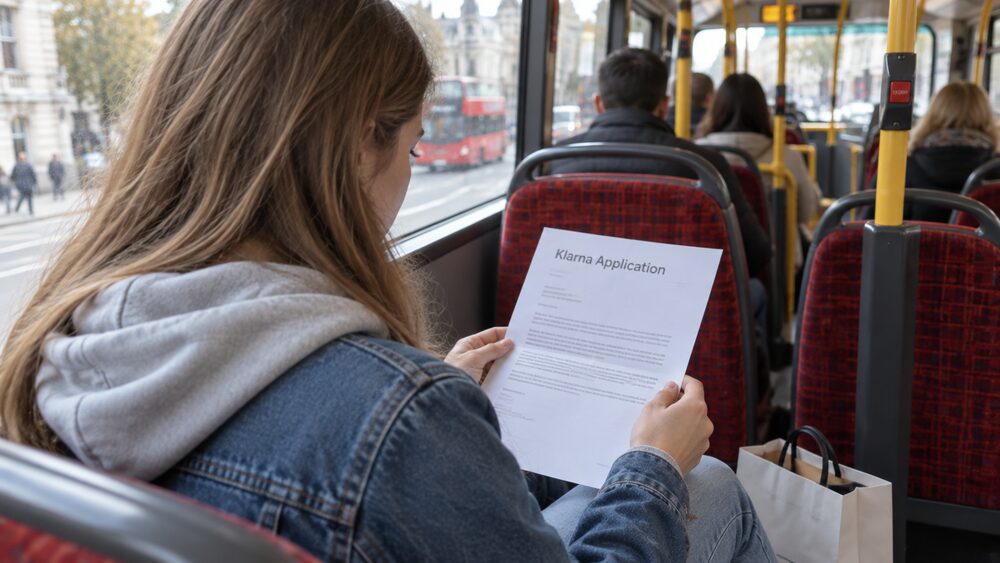
Klarna is open to people who live in the UK and are old enough to hold credit, but meeting the basic conditions does not mean every purchase will be approved. Klarna runs its own checks each time, and those checks can produce a yes, a no, or a lower spending limit than you had before. In the UK, Klarna provides regulated credit through its Klarna Financing and Klarna Credit Card, and it also offers unregulated buy now pay later products, so different purchases are governed by different rules1.
The practical answer to who can use Klarna is: UK residents, aged 18 or over, with a UK address and a payment method Klarna accepts, who pass its checks at the point of purchase. Age and residence are the fixed gates. Everything else is assessed, and can change from one order to the next.
This page sets out the conditions, what Klarna looks at, why an eligible customer can still be refused, who buy now pay later tends not to suit, and where to get free help if repayments become difficult.
Klarna eligibility: you must be a UK resident
The first condition is residence. Klarna's UK products are built around a UK address and UK payment details, and the regulated side of its business is offered to UK customers1. That is a stricter test than simply being in the country: a visitor, or someone whose main home is elsewhere, does not meet it.
Residence tests matter across UK financial services, and they are not always simple. To get most benefits, you have to be present in the UK and satisfy conditions about your residence6. The same logic runs through credit: lenders need a stable address they can verify, and a record of you at that address.
The regulatory direction of travel reinforces this. Lenders which seek to provide agreements that will be brought into regulation will be required to be based in the UK, in line with other providers of regulated consumer credit agreements2. That requirement applies to the firms, not to you, but it explains why the UK market is served by UK-based operations with UK-facing checks.
For a consumer, the practical consequences are:
- A UK address is the starting point, not a formality.
- A recently changed address can slow or block a check, because there is no history attached to it yet.
- A UK address with payment details registered abroad can fail, because the two do not match.
If you have just arrived in the UK, the honest position is that you may be eligible in principle and still be declined in practice, because the checks rely on a footprint you have not yet built.
What Klarna checks before approving a purchase
Klarna is one of several buy now pay later providers in the UK, alongside Clearpay, PayPal and Amazon7. It is also one of the larger ones: analysis of evidence provided by the UK's main three BNPL firms, Klarna, PayPal and Clearpay, treats them as the leading names in the market8.
Klarna and PayPal offer both regulated lending products and unregulated BNPL products2. That split matters to what a check involves. A regulated credit agreement sits inside the consumer credit regime, with the affordability and treatment rules that go with it. An unregulated buy now pay later instalment plan has historically sat outside it, which is why the checks behind a Pay in 3 style purchase are lighter than those behind a credit agreement.
At the point of purchase, Klarna is assessing whether to extend credit for that transaction. It looks at your history with Klarna itself, the size of the order, and the payment method you are using. The Klarna Card, for example, carries chargeback protection on purchases made using it, and the Klarna balance is a digital wallet that lets customers store e-money, add or withdraw funds, and earn cashback on certain Klarna purchases1. Those are separate products with their own terms, and using one does not automatically unlock another.
Why an eligible customer can still be declined
Eligibility and approval are two different things. You can meet every stated condition and still be turned down, because the decision is made per purchase and per customer at that moment.
Several things drive a decline:
- A thin or new credit footprint. If there is little or nothing on your file, there is little to assess.
- Recent activity elsewhere. A burst of applications in a short period is a pattern lenders notice.
- A payment method that does not match. Klarna's checks are built around UK details.
- A change in your circumstances. A limit that was fine last month may not be fine now.
It is also worth knowing that a decline is not the same as a black mark. A refused buy now pay later purchase is not, by itself, a formal credit application of the kind that leaves a footprint in the way a loan application does. But if you are declined repeatedly, that is information: it usually means something in your file or your pattern of use has changed.
If you are refused credit more broadly, National Debtline publishes guidance on refused offers that covers non-priority creditors such as credit cards, unsecured loans and overdrafts9. The same principles apply to a buy now pay later refusal: ask what changed, and check your credit file rather than applying again immediately.
Age, address and payment card requirements
The fixed requirements are age, address and a payment method Klarna accepts. Age 18 is the standard gate for consumer credit in the UK, and it is the same threshold used across the market. For comparison, a Jaja Vanta credit card requires that you must be 18 or over and have your main or only home in the UK, and any additional cardholder must be aged 18 or over and have their main or only home in the UK10. That is the shape of the requirement across UK consumer credit: adult, UK resident, verifiable address.
Address requirements are about more than postcode. A basic bank account is offered to customers who are legally resident in the United Kingdom and do not have a bank account, or who are not eligible for a standard current account11. The residency wording is deliberate: it distinguishes people who live here lawfully from those who do not, and it is the same distinction lenders apply.
Payment cards are the third gate. Klarna needs a card or account it can charge. The Klarna Card itself is a virtual card by default, with a physical card only with membership, and it charges no foreign exchange fees when spending abroad or in other currencies1. That is a feature of Klarna's own card, not a statement about which cards Klarna will accept from you.
| Requirement | What it means in practice |
|---|---|
| Age | 18 or over, the standard UK consumer credit threshold10 |
| Residence | Main or only home in the UK10 |
| Address | A UK address Klarna can verify1 |
| Payment method | A card or account Klarna accepts1 |
Who Klarna is not suitable for
Buy now pay later is a form of borrowing, and the evidence on who it harms is consistent. Those with BNPL debt are more likely to be in problem debt than UK adults, more likely to be using credit to make ends meet, and more likely to be in arrears on household bills12. That is not a moral judgment about shoppers; it is a description of where the product tends to concentrate.
Klarna's own bills sit in a particular place in a household budget. These bills from companies such as Klarna are important not to ignore13. They are not priority debts in the way rent, council tax or energy are, but ignoring them has consequences.
Buy now pay later tends not to suit:
- Anyone already behind on priority bills such as rent, council tax or energy.
- Anyone on a debt solution, where new credit can breach the terms.
- Anyone using buy now pay later to cover essentials rather than to spread a planned purchase.
- Anyone whose income is unpredictable enough that a fixed instalment is a risk.
If you are on a debt solution, the budget improvement calculator published by StepChange can be used by anyone in the UK on any debt solution5, which makes it a reasonable first stop before deciding whether to take on more.
Using Klarna when you already have other debts
Adding Klarna purchases to an existing debt load changes the arithmetic of your budget, and it changes the order in which your creditors get paid. Working out what to pay first is the starting point: StepChange publishes guidance on what debts to pay first13.
If you are on a formal debt solution, the rules differ by nation and by solution:
- A Debt Relief Order is available in England, Northern Ireland and Wales, and you must be unable to pay your debts to qualify14. The DRO guidance applies to England and Wales15.
- A Debt Management Plan is available in Scotland, England, Northern Ireland and Wales4.
- A Debt Payment Programme in Scotland may work if you live in Scotland, have money left over once you have paid your household bills, and owe money to one or more organisation or person16.
- A moratorium in Scotland is for people who have debt problems17.
Taking on new credit while on any of these can undermine the arrangement. If you are already in arrears, the escalation path is well documented. Court action in England and Wales to collect debt can only be taken after your account defaults18. Catalogue debts can be passed to a debt collection agency, and the people you owe can take court action against you19. Your debt may be collected by your original creditor, a debt collection agency acting on behalf of your creditor, a third party who has bought the debt from your creditor, or bailiffs in England and Wales or sheriff officers in Scotland20.
None of that is a reason to panic, but it is a reason to deal with Klarna bills early rather than late.
What to do if you are refused or struggling to repay
A refusal is not the end of the road, and struggling to repay is not something to manage alone. Free, impartial help exists and it does not cost anything.
If you have been refused. Check your credit file before applying anywhere else. Repeated applications in a short window do not help. National Debtline's guide to refused offers explains how to deal with non-priority creditors such as credit cards, unsecured loans and overdrafts if they refuse to accept the payment offer you have made them9.
If you are struggling to repay. Contact your creditors early. StepChange, Christians Against Poverty and Citizens Advice all provide free debt advice4. A payment holiday on debt repayments is one option some creditors offer21, and it is worth asking about before arrears build.
If you are in Scotland. The rules differ. Bankruptcy in Scotland can be applied for by a group of creditors in the UK or EU member states, other than Denmark, to whom you jointly owe at least £5,00022. There is also MAP bankruptcy for people who are on lower incomes and owe less than £3,000 in total23. Citizens Advice Scotland publishes guidance on whether your house and possessions can be sold to pay your debts24.
If someone has died. Debts after death in England and Wales follow their own rules: if the debts are joint, the surviving person will be liable for these debts, and if someone has acted as a guarantor, they may be liable for these debts or for any losses incurred by the creditor23.
If a creditor is harassing you. Citizens Advice publishes guidance on harassment by creditors20.
What protection you have, and where it stops
Buy now pay later sits in a changing regulatory landscape. Buy now pay later products, such as Clearpay, Klarna and Laybuy, will be covered by Section 75 once they become fully regulated by the Financial Conduct Authority at some point in 20263. Until then, the protection attached to a Klarna purchase depends on which Klarna product you used.
The Section 75 limit is purchases between £100 and £30,0002. That is the range within which a credit card claim can be made against the lender. Once buy now pay later products are fully regulated, the same range is expected to apply to them3.
Where protection stops:
- Chargeback is not Section 75. Chargeback protection applies to purchases made using the Klarna card1, but it is a card scheme process, not a statutory right.
- Payment platforms can sit outside cover. UK Finance, which represents banks and payment firms, states "you may not be covered" where goods or services are bought through a payment platform like PayPal, an online marketplace retailer like Amazon Marketplace or through an agent like Expedia3.
- Fraudulent claims fail. A debit card provider can refuse a refund if it can show you acted fraudulently3.
- Complaints have a route. Klarna has introduced an internal complaints adjudicator as an interim step until its customers can access the Financial Ombudsman Service1. To be an eligible complainant at the ombudsman, the complaint must arise from matters relevant to one or more listed relationships with the respondent, including being a customer, payment service user or electronic money holder25.
If you are unhappy with a purchase rather than the credit, the Consumer Rights Act 2015 gives a right to reject where a trader is in breach of the term that section 17(1) requires to be treated as included26. That is a consumer rights route, separate from any claim against Klarna.
Sources26 cited
- Klarna launches debit card: how does it work? Which?, 2025-10-30
- Buy Now Pay Later: regulatory impact assessment legislation.gov.uk, 2025
- Are credit cards still the safest way to pay? Which?, 2026
- Debt help Christians Against Poverty, 2026-09-26
- Budget improvement calculator StepChange, 2026-09-25
- Presence and residence tests Turn2us, 2025-10-09
- Buy now pay later StepChange, 2026-09-25
- BNPL market review legislation.gov.uk, 2025-11-04
- Refused offers National Debtline, 2026-09-25
- Vanta terms and conditions Jaja, 2026
- Basic bank accounts: July 2023 to June 2024 HM Treasury, 2025-11-05
- BNPL regulation consultation response StepChange, 2026-09-26
- What debts to pay first StepChange, 2026-09-25
- Debt Relief Orders Northern Ireland Executive, 2026-08-06
- Once you have a Debt Relief Order GOV.UK, 2023-12-19
- Debt Arrangement Scheme StepChange, 2026-09-25
- Sequestration StepChange, 2026-09-26
- Court action in England and Wales StepChange, 2026-09-25
- Catalogue debts StepChange, 2026-09-25
- Harassment by creditors Citizens Advice, 2026-09-25
- Payment holiday for debt repayments StepChange, 2026-09-25
- Bankruptcy and my pension StepChange, 2026-09-25
- Debts after death in England and Wales National Debtline, 2026-09-25
- Can my house and possessions be sold to pay my debts? Citizens Advice Scotland, 2026-09-26
- Eligible complainants FCA Handbook, 2026
- Consumer Rights Act 2015, section 19 legislation.gov.uk, 2026


 MoneyHelperFree, impartial money and pensions guidance, set up by government
 StepChangeFree debt advice and solutions from a charity
 National DebtlineFree debt advice by phone, webchat and online
 Financial Ombudsman ServiceFree, independent help when a complaint about a firm is not put right
 Citizens AdviceFree advice on money, consumer and legal problems in England and Wales