Valuing an estate means working out what everything the person owned was worth on the day they died, adding it up, taking off what they owed, and reporting the result. You must do this before applying for probate, if probate is needed1. The figure matters because Inheritance Tax is charged at 40% on the part of an estate above the £325,000 threshold, and because the people who inherit cannot be paid until the estate's value is settled2.
Valuing an estate means working out what everything the person owned was worth on the day they died, adding it up, taking off what they owed, and reporting the result. You must do this before applying for probate, if probate is needed1. The figure matters because Inheritance Tax is charged at 40% on the part of an estate above the £325,000 threshold, and because the people who inherit cannot be paid until the estate's value is settled2.
The valuation covers everything: cash and investments, property and belongings, and any capital gifts made in the seven years before the death3. It is not a rough estimate. The law says that for Inheritance Tax, you have to value all assets as if each item had been sold on the date the deceased died, known as open market value, rounding the value of assets down to the nearest pound and liabilities up to the nearest pound4.
The person who does the work is the executor or administrator, the person named to manage the estate after the death5. There are three main tasks in valuing an estate, and the whole exercise can take several months, longer if the estate is big or complicated, for example if it involves trusts or there is tax to pay1.
What counts in the estate: property, money, possessions and gifts from the last 7 years
A person's estate is made up of their cash, including money from insurance, and their investments, property and belongings5. The value of an estate includes all worldwide property, possessions, investments and savings, and all capital gifts made in the seven years before death3. Worldwide matters: a holiday home abroad is part of the calculation, not outside it.
Gifts are the part people most often miss. Any property or money given away up to seven years before someone passes also counts towards the inheritance valuation2. Gifts you make more than seven years before your death will not form part of your estate, regardless of their value, provided they were made without reservation, so the giver cannot benefit from them9. A gift with reservation, such as giving away your home but continuing to live in it rent-free, still counts towards the value of your estate10.
The annual exemption sits alongside the seven-year rule. You can give away up to £3,000 in a tax year without it counting towards Inheritance Tax6. Gifts out of income totalling more than £3,000 in any year must be shown in full on the Inheritance Tax forms4.
Debts come off the total. The estate is valued net of what the person owed, which is why mortgages, credit cards and loans are gathered up alongside the assets. If the estate cannot pay its debts, that is a separate problem with its own rules, and free advice is available from charities such as Citizens Advice11.
Inheritance Tax threshold: £325,000 and how it can rise to £1 million
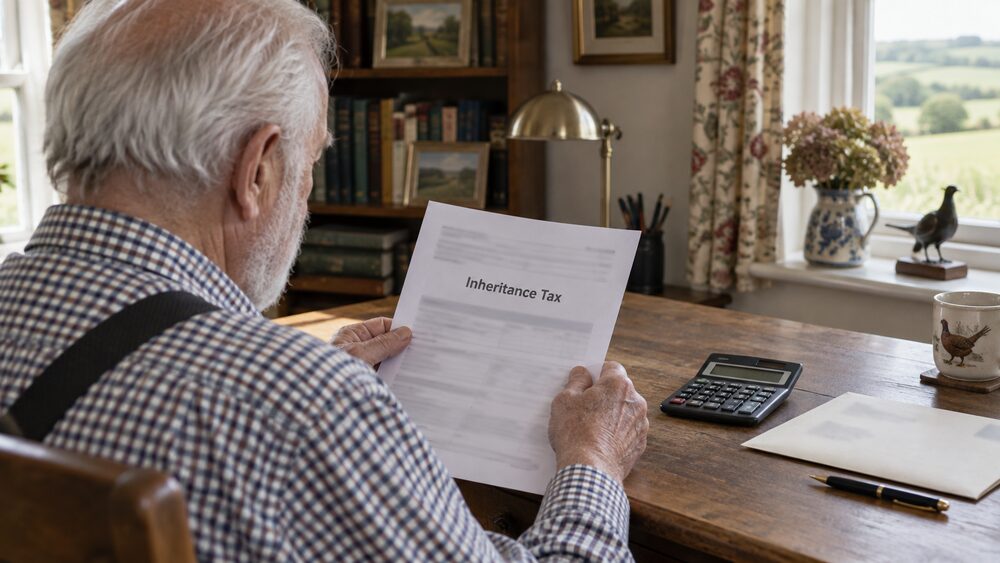
Inheritance Tax may have to be paid on the estate if it is worth more than the tax-free threshold of £325,00012. If this threshold is passed, everything above this amount will be taxed at a rate of 40%2. For married couples and civil partners the figure can be £650,000, because the allowance can pass between them6.
The route to £1 million runs through the residence nil-rate band, an additional allowance that applies where a home is passed to direct descendants. One official key document gives that additional band as £175,000, while another gives a different figure, and the conflict is not resolved. What is clear is the direction of travel: the £325,000 threshold is the base, the spouse or civil partner transfer can double it to £650,000, and the residence band can sit on top of that where a home passes to children or grandchildren.
Two practical points follow. First, the threshold is applied to the net estate, after debts, so a large mortgage reduces the taxable figure. Second, the threshold is not automatic: it has to be claimed and evidenced on the forms, and the executor needs the paperwork to show why it applies.
Spouse, civil partner and charity: what reduces the tax bill
Money and property left to a spouse or civil partner is exempt from Inheritance Tax, which is why the effective threshold for a couple is often quoted as £650,0006. The exemption is not automatic in the sense of being assumed: the executor has to show that the assets passed to the spouse or civil partner, and the exemption applies only to those assets.
Charity works differently. Donations to registered UK charities made during your lifetime would reduce the value of your estate13. And if you give 10 percent or more of your net estate to charity, your inheritance tax rate drops from 40 percent to 36 percent7. That reduced rate is a genuine saving on the whole taxable estate, not just on the charitable slice, which is why it is worth checking the arithmetic before the will is written.
There is a limit to how far exemptions can be combined. Where an estate qualifies as an excepted estate, only the Spouse or Civil Partner Exemption and the Charity Exemption can be taken into account; no other exemption or relief can be taken into account4. That matters for smaller estates where the executor is trying to avoid a full Inheritance Tax return.
Official statistics give a picture of who benefits from the spouse exemption: in general those who benefit from this exemption are likely to be aged 65 and above at the time of their death, and the estate that benefits tends to be the estate of someone who is male14. That is a description of the population, not a rule that applies to any individual estate.
Unused pensions will count towards the estate's value
From 6 April 2027, any unspent pensions will count towards the value of your estate when inheritance tax is calculated15. The government has confirmed that most unused pension funds and death benefits would be included in the value of a person's estate for Inheritance Tax from that date16. The change is significant because pensions have historically sat outside the estate, which is why they have been used as a way to pass money on.
The detail is still being settled. Legislation is not finalised, and the treatment of different kinds of beneficiary is expected to differ: pension savings left to a spouse, civil partner or charity are expected to remain exempt, while benefits paid to anyone else count towards the estate17. Death-in-service benefits are also expected to remain outside the charge.
For anyone valuing an estate today, the practical effect is a timing question. If the death occurred before 6 April 2027, the current rules apply and unused pension pots are not part of the estate for Inheritance Tax. If the death occurs on or after that date, the pension figures need to be gathered alongside everything else. HMRC has estimated that around 10,500 estates would pay Inheritance Tax for the first time as a result, with 38,500 paying more.
Paying the tax: deadlines, interest and instalments
You must pay Inheritance Tax by the end of the sixth month after the person dies to avoid paying interest1. If the estate owes Inheritance Tax, you must report its value within one year using form IHT4001. The reporting deadline is longer than the payment deadline, which catches people out: the tax falls due first, and the paperwork follows.
Some assets can be paid for in instalments rather than in one sum. The first instalment is due at the end of the sixth month after the death, with payments then due every year on that date18. On each later instalment you must pay interest on both the full outstanding tax balance and the instalment itself, from the date it is due to the date of payment if paid late18. You can pay off the full tax and interest at any time by writing to HMRC asking for a final assessment18.
For any new assets you inherit from 6 April 2026 onwards, instalments are interest-free if the asset qualifies for Agricultural Relief or Business Relief; if you pay an instalment late, you will still need to pay interest from the date it is due to the date of payment, but you will not pay any interest on the outstanding tax balance18.
There is also a route to pay from the deceased's own money. Banks and building societies can accept payment of Inheritance Tax from the person's account, and you can claim it back from the deceased's estate19. The payment is made to an account named HMRC Inheritance Tax19. Where the account was held jointly, the money that came from the deceased will still count towards their estate for Inheritance Tax purposes, so the joint name does not take it out of the calculation20.
Valuing the estate before applying for probate
You must value the estate before applying for probate, if probate is needed1. Probate is the legal process of dealing with someone's estate after they have died, and it is not always needed; each financial organisation has its own rules and policies on whether it is required21. If the estate is worth above a certain amount, the executor or administrator will need special permission, called probate or letters of administration5. If the person did make a valid will and you have been appointed as an executor, you will need to apply for a grant of probate to deal with the estate22.
The cost of applying is £300 if the estate is valued at over £5,0008. That fee is separate from any Inheritance Tax due.
Property is usually the hardest item to value. The recommended approach is to invite three local estate agents who have recently sold similar properties to value the home, and to go with the middle valuation or calculate an average23. A down valuation occurs when a surveyor decides a property is worth less than the agreed sale price, or proposed remortgage value, and it is a reminder that a date-of-death figure and a later sale price will not always match23.
If the valuations are not accurate, you may have to pay penalties8. In Northern Ireland, where a public body values a home, an independent valuer assesses the market value and a disagreement can be taken to Land & Property Services for a redetermination, whose valuation is final and can go up or down25.
In Scotland the process is called Confirmation rather than probate26. The document a bank asks to see is a grant of probate or letters of administration where total funds exceed the threshold, and in Scotland the equivalent is Confirmation27. Where the partner did not make a will, going through probate can take quite a few months28. After probate is granted, you may want to wait 10 months before distributing the estate in case any claims are made against it8.
Where to get free help
Valuing an estate is administrative work that an executor can do personally, but it carries legal responsibility and the figures go to HMRC. Free, impartial guidance is available from MoneyHelper and from Citizens Advice, and bereavement charities offer support with the paperwork as well as the practicalities11. Where the estate is large, includes a business or a trust, or the family cannot agree, paying a professional to deal with the estate is an option with its own costs.
Sources28 cited
- Valuing the estate of someone who died GOV.UK, 2026-09-26
- FAQs about Inheritance Tax Remember A Charity, 2026-09-26
- Tax efficiency checklist Bank of Scotland, 2026-09-27
- Inheritance tax planning and tax-free gifts Which?, 2026-04-06
- Debt when someone dies nidirect, 2026-06-26
- Inheritance tax planning and tax-free gifts Which?, 2026-04-06
- How can gifts in wills reduce Inheritance Tax Remember A Charity, 2026-09-26
- What is probate Age UK, 2026-09-21
- Will our gifts to our children be taxed Which?, 2025-12-15
- 6 ways to avoid inheritance tax on gifts Which?, 2026-04-06
- After death: dealing with an estate Citizens Advice Scotland, 2026-09-26
- Dealing with the estate Age UK, 2026-09-21
- Could donating to charity lower my Inheritance Tax bill Which?, 2026-02-23
- Tax relief statistics GOV.UK, 2026-01-22
- Will my pension be subject to Inheritance Tax Which?, 2026-07-23
- Inheritance Tax on pensions: summary of responses GOV.UK, 2025-07-21
- Inheriting a pension Fidelity, 2027-04
- Paying Inheritance Tax: yearly instalments GOV.UK, 2026-09-28
- Paying Inheritance Tax: bank or building society GOV.UK, 2026-09-28
- Can a joint bank account help me manage a loved one's finances Which?, 2026-01-19
- Bereavement support Aviva, 2026-09-26
- FAQs about estates Quaker Social Action, 2026
- Mortgage valuations explained Which?, 2025-12-18
- How much is your house worth Which?, 2026-06-23
- House Sales Scheme nidirect, 2026-02-18
- How to open a bank account online Which?, 2026-04-23
- IHT400 notes GOV.UK, 2026
- Dealing with paperwork Widowed and Young, 2026-09-26



 MoneyHelperFree, impartial money and pensions guidance, set up by government
 Citizens AdviceFree advice on money, consumer and legal problems in England and Wales
 Turn2usFree benefits calculator and grants search from a charity
 GOV.UKOfficial information on tax, benefits and government services