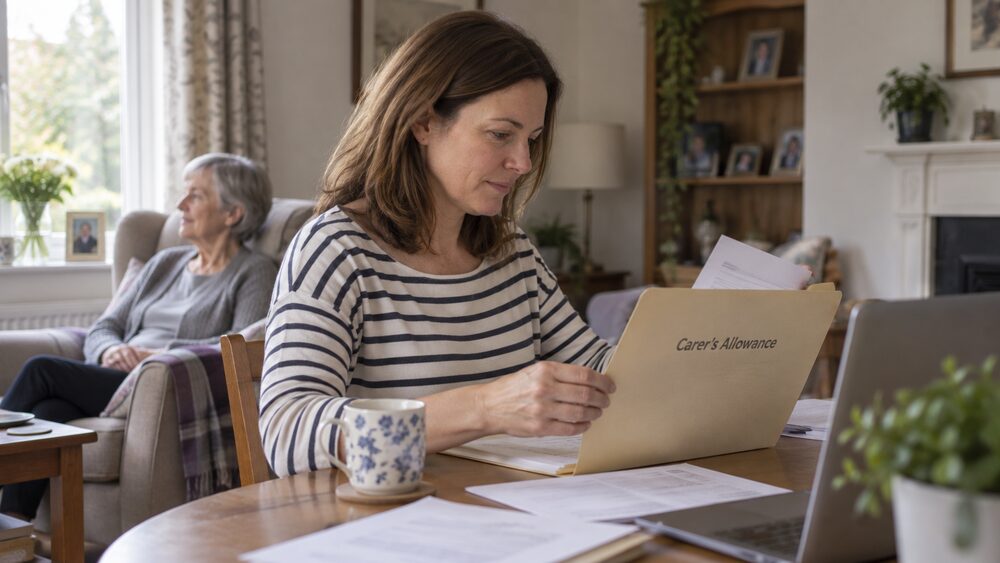
If you spend at least 35 hours a week looking after someone who gets a disability benefit, you could receive £86.45 a week in Carer's Allowance, the main payment for unpaid carers in England, Wales and Northern Ireland1. You do not have to be related to the person or live with them, and the payment is not means-tested, so your savings and your partner's income do not count against it2. What does count is your earnings: you must not earn more than £204 a week after tax, National Insurance and certain expenses2.
Caring often changes the rest of your finances too. It can affect your benefits, your tax and your State Pension record, and in Scotland the payment itself has a different name, Carer Support Payment, which has replaced Carer's Allowance for most carers there3. This page sets out what unpaid carers can claim, who qualifies, how the payments interact with Universal Credit and other support, and what happens when caring pauses, moves or ends.
Carer's Allowance: £86.45 a week for 35 hours of care
Carer's Allowance is the main benefit for unpaid carers. You could get £86.45 a week if you care for someone at least 35 hours a week and they get certain disability benefits1. The rate rose to £86.45 from 7 April 2026; before that uprating it was £83.30 a week3. The person you care for must be receiving a qualifying disability benefit, such as Personal Independence Payment, Attendance Allowance or Disability Living Allowance, for you to be paid1.
The allowance is taxable, but tax is only due if your total income is above your Personal Allowance2. It is not means-tested, so your savings and your partner's income are not relevant2. You do not get paid more if you care for more than one person: the payment is one weekly amount regardless of how many people you look after8. In Scotland, carers on Carer Support Payment may receive an additional payment, covered later on this page, in respect of a second cared-for person9.
Carer's Allowance is modest set against the hours it recognises, and it is worth understanding that it is only one part of the support available. A carer may also be entitled to the carer element of Universal Credit, National Insurance credits that protect their State Pension, and top-ups to means-tested benefits through what is called underlying entitlement, each explained below. Free, impartial guidance is available from MoneyHelper and from carers' organisations, and a care needs assessment of the person you look after is often the first step to wider support.
Who qualifies: age, caring hours, study and residence
To get Carer's Allowance you must spend at least 35 hours a week caring for someone, and that person must receive a qualifying disability benefit2. You do not have to be related to them or live with them10. There is no lower age limit for the allowance itself, but there are rules around study: you cannot usually claim if you are in full-time education or studying for 21 hours a week or more2.
In Scotland, where the equivalent payment is Carer Support Payment, carers aged 16 to 19 must not be studying certain courses; a carer of that age in non-advanced education involving more than 21 hours a week of study will not normally qualify7. You also cannot usually get Carer's Allowance if you are already receiving State Pension or certain income-replacing benefits, such as New Style Employment and Support Allowance, because these benefits overlap2. Where the allowance is not paid for that reason, underlying entitlement, explained below, may still help.
For younger carers, Scotland has a separate payment. Young Carer Grant is for 16 to 18 year olds providing at least 16 hours of unpaid care a week, though young carers who claim Carer's Allowance, or who care for someone not receiving a qualifying disability benefit, are excluded12. Young carers elsewhere in the UK have no equivalent grant, but Carer's Credit, covered below, is available from age 16 and protects a pension record while studying rules may block the allowance itself5.
The earnings limit: £204 a week after tax and expenses
You can work and still receive Carer's Allowance, but there is a ceiling on earnings. From 6 April 2026 the limit is £204 a week, up from £196 a week before the uprating13. The same £204 limit applies to Carer Support Payment in Scotland15. The limit is worked out on net earnings: after tax, National Insurance and certain expenses2.
The expenses you can deduct matter if you are self-employed or pay for care while you work. They include work-related expenses, payments for alternative care when you are at work, and 50% of your pension contributions2. The £204 limit is measured on your earnings in the immediately preceding week, so a one-off week above the limit can stop payment for that period13. Expressed as a yearly figure, the Department for Work and Pensions gives the limit as £10,608 a year for 2026/272.
If your earnings rise above the limit, payment stops for the weeks affected, and you must report the change. If they fall again, you can reclaim. Because the allowance is not means-tested, a partner's earnings do not count towards the £204: it is your own earnings alone that are measured2. If you are also receiving means-tested benefits such as Universal Credit, a rise in earnings will reduce those separately, under their own rules.
How carer payments affect other benefits
Carer's Allowance interacts with the rest of the benefit system in two directions: it affects what you receive, and in one situation it can affect what the person you care for receives.
Universal Credit. You can usually claim Universal Credit and Carer's Allowance at the same time if you meet the rules for both2. The carer element of Universal Credit and Carer's Allowance are two separate things, and a carer can receive both at once17. However, Carer's Allowance counts as income, so it is deducted from Universal Credit17. The carer element is an extra amount added to the standard allowance for someone caring for a disabled person, and the disabled person's own Universal Credit is not affected by their unpaid carer claiming it17.
State Pension and overlapping benefits. You will not get Carer's Allowance, or you will get a reduced amount, if you receive certain other benefits, including your State retirement pension8. This is the overlapping benefits rule: the state will not pay two income-replacing benefits for the same period in full.
The person you care for. Claiming Carer's Allowance will not reduce or stop the disability benefits the person you care for receives, such as Personal Independence Payment, Attendance Allowance or Disability Living Allowance18. The important exception is the severe disability premium. If the person you care for receives this extra amount with a means-tested benefit, such as income-related Employment and Support Allowance or an extra amount for severe disability paid with Pension Credit, it will stop when you claim Carer's Allowance2. Claiming for a dependent child does not affect the child's benefits7. It is worth checking this with the person you care for before you claim, because the loss of their premium can outweigh the carer's payment.
Carer premium. If you receive an income-related benefit such as Income Support, income-based Jobseeker's Allowance, income-related Employment and Support Allowance, Housing Benefit or Council Tax Reduction, an extra amount called the carer premium can be added to it because of your caring role. The rules on when this extra amount is paid, and at what rate, are set by the benefit you receive, so check with the office that pays that benefit or with MoneyHelper for how it applies in your case.
Underlying entitlement: help even when nothing is paid
Because of the overlapping benefits rule, many carers are entitled to Carer's Allowance but are paid nothing, usually because their State Pension or another benefit equals or exceeds the weekly rate. This is called having an underlying entitlement, and it is not worthless. Just being eligible might entitle you to a top-up on means-tested benefits you receive, such as Pension Credit, Universal Credit or Housing Benefit2.
The scale is significant. Official statistics show that of Carer's Allowance claimants, 26.7% (380,000 people) were entitled to the benefit but did not receive payments because another benefit equalled or exceeded their weekly rate19. A separate official analysis put the share with underlying entitlement only at 28.6% of claimants in the most recent year of data available20. In other words, more than a quarter of carers with an entitlement receive no weekly payment, but many gain through higher means-tested benefits instead.
The same principle applies in Scotland. A carer whose Carer Support Payment award is calculated at £0 because of an overlapping benefit has what is called underlying entitlement to the payment component. If you are refused a payment because of your State Pension or another benefit, ask for the decision letter anyway: carers still need to apply for Carer's Allowance in order to prove they have an underlying entitlement to the benefit, which would increase their chances of being eligible for Pension Credit and the amount of Pension Credit awarded, and the letter can open doors to other support such as council tax reductions.
National Insurance credits protect your State Pension
Caring can leave gaps in your National Insurance record, and gaps mean a smaller State Pension. The state fills those gaps with credits. The government may give you credits so you can continue building up State Pension entitlement when you cannot pay National Insurance, for example because you are caring for someone21. These credits count towards your State Pension22.
If you receive Carer's Allowance or Carer Support Payment, credits are normally added automatically. If you do not qualify for either, Carer's Credit fills the gap. Carer's Credit is a National Insurance credit for people under State Pension age who are looking after someone for more than 20 hours a week5. To get it, you must be aged 16 or over, not yet getting your State Pension, not qualify for Carer's Allowance, and the person you look after must receive a benefit because of their illness or disability2.
Carer's Credit matters most for part-time carers whose hours fall short of the 35 needed for Carer's Allowance, and for carers whose earnings or study rules block the allowance itself. Someone who does not qualify for a full State Pension through their record may still be eligible for Pension Credit or other benefits and financial support in retirement23. You can check your National Insurance record and State Pension forecast through the official services, and credits can sometimes be applied for retrospectively for past periods of caring. The pensions guide explains how the State Pension is built up.
Carers in Scotland get Carer Support Payment instead
In Scotland, Carer's Allowance has been replaced by Carer Support Payment, paid by Social Security Scotland6. If you live in Scotland, you must apply for Carer Support Payment instead of Carer's Allowance2. The weekly rate of Carer Support Payment is £86.45, matching Carer's Allowance15, and the earnings limit is the same £204 a week after tax, National Insurance and expenses16.
The benefit has reached a substantial number of people. In March 2026, 95,420 individuals received Carer Support Payment payments, and at 31 March 2026, 101,080 carers were in receipt of payment while 33,305 had underlying entitlement only11. Carer's Allowance Supplement, an extra payment previously paid to Scottish carers receiving Carer's Allowance, has been replaced with Scottish Carer Supplement for carers in receipt of Carer Support Payment11.
Scotland also has extra payments that do not exist elsewhere in the UK. Carer Additional Person Payment may be paid in respect of more than one additional cared-for person for the same period9, recognising carers who look after more than one person, something Carer's Allowance does not do. Young Carer Grant, mentioned above, is also Scottish12.
Moving to or from Scotland. Anyone who moves to Scotland and was getting Carer's Allowance at the time of their move can apply for Carer Support Payment24. If you already live in Scotland and are currently receiving Carer's Allowance, you will be automatically moved onto the new benefit and do not need to apply18. Your Carer's Allowance will not automatically move to Carer Support Payment if you live outside the UK25. The rules around moves are explained in more detail in the nations guide.
Hospital stays, care homes and breaks from caring
Caring payments depend on the person you care for continuing to receive their qualifying disability benefit, and that benefit stops after long hospital stays. If someone gets Carer's Allowance or Carer Support Payment for looking after you, their benefit will stop after you have been in hospital for 28 days26. When the qualifying benefit stops, the carer's payment stops with it, and the carer will need to reclaim when the person comes out of hospital26.
There is some flexibility for temporary breaks in care. For Carer Support Payment, a temporary break in care is allowed for more than 12 weeks in any 26 weeks where the carer or the cared-for person is an in-patient in hospital, or more than 4 weeks in 26 weeks for any other reason9. Social Security Scotland describes the same rules as allowing up to 12 weeks if a hospital stay is involved, or a combination of hospital and other reasons, within any six-month period28. Carer's Allowance similarly allows breaks, and you may have up to a further eight weeks' break from caring in the last 26 weeks if the reason was that you or the person you care for were in hospital18. If you were receiving Income Support as a carer, it can continue for up to eight weeks after your Carer's Allowance stops because the person you care for went into hospital, and it should increase to the amount you were receiving from both benefits together18.
Going abroad. Carer's Allowance can continue to be paid for a temporary period while you are abroad if you go with the person you look after, they continue to receive their qualifying disability benefit, and the purpose of your trip is to look after them; this is likely to be a maximum of 26 weeks18. For Carer Support Payment, the total period of temporary absence from the common travel area that is treated as presence in the UK will not exceed 26 weeks15. Universal Credit and Income Support generally cannot be paid abroad, except for a temporary absence in special circumstances10.
Care homes. If the person you care for moves into a care home funded by NHS continuing healthcare, NHS funding for nursing care, or the local council, most of their benefits usually stop within 28 days of admission29. When their qualifying disability benefit stops, your carer payment stops too. The guides to paying for care in England, Scotland, Wales and Northern Ireland cover what the funding rules mean for the whole household.
When the person you care for dies
When the person you care for dies, your Carer's Allowance or Carer Support Payment does not stop immediately, and other help may be available. For carers receiving Carer Support Payment who get a carer premium with a reserved benefit, the carer premium continues for twelve weeks after the death of the cared-for person, for deaths on or after 15 March 2026; this was previously eight weeks6. The same extension to 12 weeks applies to carers in receipt of carer support consisting of all applicable components6.
If you were receiving Income Support as a carer, it can continue for up to eight weeks after your Carer's Allowance stops18. Bereavement Support Payment gives financial help with the more immediate costs caused by the death of a spouse or civil partner30. In Scotland, Funeral Support Payment helps with funeral costs; it is treated as a funeral cost and may need to be repaid from the estate of the person who died if they had money or assets, and once assets become available they may need to be used to repay it before any inheritance is paid31. The guides to funeral costs, the Funeral Support Payment in Scotland and what happens to benefits when someone dies cover the practical steps, and the bereavement checklist sets out what to do first.
If the person you care for is terminally rather than having died, special rules apply: you can get Carer Support Payment under Special Rules for Terminal Illness if you or the person you care for already gets a disability benefit under those special rules33. The guide to money when someone is terminally ill covers the faster claims process this opens up.
Reporting changes and avoiding overpayments
Most problems with carer payments come from changes that are not reported. Your claim might be stopped or reduced if you do not report a change straight away or you give incorrect information34. If you are overpaid, the money usually has to be repaid, which is difficult on a carer's income.
The changes you must report include starting or finishing a job or working different hours, income going up or down, moving house, people moving into or out of your home, the death of your partner or someone you live with, starting or stopping caring for someone, going into hospital, a care home or sheltered accommodation, changes to your pension, savings or other money you get, changes to the benefits you or anyone in your house receives, and planning to go abroad for any length of time34. For a carer, the two that matter most often are earnings crossing the £204 limit and the caring arrangement itself changing, including the person you care for going into hospital or a care home.
Report changes as soon as they happen through the official reporting service34. If you are unsure whether a change matters, report it anyway: reporting something that turns out not to affect your claim carries no penalty, but failing to report something that does can create a debt.
How to claim, backdate and challenge a decision
Claims for Carer's Allowance are made to the Department for Work and Pensions, and claims for Carer Support Payment to Social Security Scotland1. Before claiming, check the three main conditions: at least 35 hours of caring a week, a qualifying disability benefit paid to the person you care for, and earnings within the £204 limit2.
Backdating. Carer Support Payment can be backdated, that is paid from a date up to 13 weeks before your date of claim, if you met all the qualifying rules during that time7. Claims for Carer's Allowance and Carer Support Payment can also usually be backdated to when you started receiving your disability benefit again after a break, such as a hospital stay26. Processing times for Carer Support Payment have been reported differently in official publications, with one giving a median of 48 working days and another 71 working days, so it is worth applying as early as possible rather than waiting11.
Challenging a decision. If you disagree with a decision made on your claim, you can ask for it to be looked at again. For Universal Credit, this is called a mandatory reconsideration, and you can challenge a decision this way if you disagree with one made during a review of your claim37. The same principle of asking for reconsideration, and then appealing to an independent tribunal if you still disagree, applies to carer benefit decisions. If you are refused payment because of an overlapping benefit, remember that the decision letter itself may still be useful as proof of underlying entitlement when you apply for other support.
Free, impartial help with claims is available from MoneyHelper and from carers' organisations, and the benefits guide explains how the wider system fits together.
Sources37 cited
- Carer's Allowance GOV.UK, 2026
- Benefits and tax credits you can claim as a carer MoneyHelper, 2026-09-25
- Carer's Allowance Disability Rights UK, 2026-04-07
- Carer's Allowance Carers UK, 2026
- Dementia and managing money nidirect, 2026-09-03
- The Carer Support Payment Regulations 2026 legislation.gov.uk, 2026-03-03
- Carer Support Payment Contact, 2026-04-28
- Carer benefits Sense, 2026-03
- The Carer's Assistance (Carer Support Payment) Amendment Regulations 2025 legislation.gov.uk, 2026-03-15
- Guidance on social security abroad NI38 GOV.UK, 2026-07-07
- Carer Support Payment statistics to 31 March 2026 Social Security Scotland, 2026-05
- Take-up rates of Scottish benefits 2024 Scottish Government, 2024-11
- The Carer's Allowance (Earnings Limit) Order 2026, explanatory memorandum legislation.gov.uk, 2026
- The Carer's Allowance (Earnings Limit) Order 2026 legislation.gov.uk, 2026-03-04
- The Carer's Assistance (Carer Support Payment) (Scotland) Regulations 2023 legislation.gov.uk, 2023-10-25
- Spread the word this Carers Week Social Security Scotland, 2026-06-08
- Change of circumstances: Universal Credit Scope, 2026-07-14
- Carer's Allowance and breaks in care Carers UK Scotland, 2026-09-26
- Annual DWP benefits statistics compendium 2026 Department for Work and Pensions, 2026-09-15
- Fraud and error in the benefit system, financial year 2024 to 2025 Department for Work and Pensions, 2025-06-12
- Getting credits towards your State Pension nidirect, 2026-06-25
- National Insurance: help if you're not working GOV.UK, 2026-09-28
- State Pension GOV.UK, 2026-09-25
- Supporting clients moving to Scotland from the rest of the UK Social Security Scotland, 2025-11-06
- What will happen with your benefit mygov.scot, 2025-11-06
- Hospital and benefits: carers Turn2us, 2025-11-06
- Carer's Allowance Age UK, 2026-04-06
- Support during breaks in care Social Security Scotland, 2026-07-22
- Going into a care home: benefits GOV.UK, 2026-09-27
- Financial help for bereaved people nidirect, 2026-04-03
- Recovery of funeral costs from a person's estate Social Security Scotland, 2026-09-26
- Funeral Support Payment: telephone application Social Security Scotland, 2026-09-26
- Assistance under special rules for terminal illness mygov.scot, 2025-03-24
- Report a change in your circumstances GOV.UK, 2026-09-26
- Carer Support Payment decision making guide: rates and form of payment Social Security Scotland, 2025
- Carer's Allowance Scope, 2026-04-22
- Universal Credit reviews GOV.UK, 2026-09-27




 MoneyHelperFree, impartial money and pensions guidance, set up by government
 Citizens AdviceFree advice on money, consumer and legal problems in England and Wales
 Turn2usFree benefits calculator and grants search from a charity
 GOV.UKOfficial information on tax, benefits and government services