
Commission-free trading means exactly what it says about one charge: no dealing commission when you buy or sell. It does not mean the investment costs nothing. Freetrade states plainly that it does not charge commission to buy or sell stocks and ETFs, and that there are no fund holding fees1. Its mutual funds page lists dealing commission of £0 per fund trade2.
Commission-free trading means exactly what it says about one charge: no dealing commission when you buy or sell. It does not mean the investment costs nothing. Freetrade states plainly that it does not charge commission to buy or sell stocks and ETFs, and that there are no fund holding fees1. Its mutual funds page lists dealing commission of £0 per fund trade2.
What remains is a set of charges that sit outside the dealing commission. Foreign exchange fees apply when you trade overseas shares, fund managers still take their ongoing charge out of the fund each year, stamp duty still applies to UK share purchases, and some platforms charge a subscription or platform fee. Which? describes how no-fee platforms make their money: through foreign exchange fees or keeping cash interest, or by upgrading customers to paid products such as managed portfolios or premium tiers3.
The practical question is not whether dealing is free, but what the total cost of holding and trading an investment comes to. That total is made up of the platform's own charges, the charges inside the fund or investment trust, and the taxes that apply to the transaction. Each of those is set by a different party and disclosed in a different document.
Commission-free is not cost-free: the charges that remain
The dealing commission is one line in a longer bill. Freetrade's own stocks and shares page carries the caveat that other charges may apply, such as FX fees7. That is the pattern across the market: the headline charge is removed, and the remaining charges carry the cost.
Foreign exchange is the most common of these. Halifax Share Dealing advertises commission-free international trading while stating that FX charges of 1.25% still apply8. Its Stocks and Shares ISA page repeats the point: no dealing commission is charged for international online trades, but FX rates still apply9. A reader comparing a UK trade with a US trade is therefore comparing two different cost structures, even on the same platform.
Fund charges are the second layer, and they are charged by the fund manager rather than the platform. Which? lists the costs a fund can carry: the ongoing charge figure, performance fees, trading fees and stamp duty reserve tax, exit fees, and platform fees10. The ongoing charge is an annual percentage of your investment, so it applies for as long as you hold the fund, whether or not you ever deal again.
Taxes are the third layer. Stamp duty is charged on buying UK shares and UK-based investment trust shares, and it is not a platform charge, so no platform can waive it. The Association of Investment Companies gives the worked example that when you buy £100 of shares you pay 50p stamp duty4.
Buying and selling funds at Freetrade: no dealing commission
Freetrade is one of the platforms that has removed the dealing charge outright. Its guidance states that it is free to buy and sell funds on Freetrade, and that you will not be charged a dealing commission, unlike other platforms5. The same page confirms that Freetrade will not charge you to hold mutual funds, meaning more of your money stays invested5. Its mutual funds product page lists dealing commission of £0 per fund trade2.
The same approach runs across the rest of the account. Freetrade states that it does not charge commission to buy or sell stocks and ETFs, and that there are no fund holding fees1. Its ETF page offers over 1,100 exchange-traded funds to invest in commission-free11, and its stocks and shares page describes trading 6,700+ global stocks and ETFs with no commissions7. Fractional shares can also be bought and sold commission-free through the app12.
On the account itself, the flexible stocks and shares ISA is described as commission-free trading with no ongoing account fee, with the qualification that other charges may apply13. The Junior ISA carries no account fees and no commissions, with unlimited free trades and low FX fees14. The Standard plan offers unlimited commission-free trades15.
Moving in and out is also free at Freetrade's end. The platform states it will not charge you for transferring your holdings into or away from its platform5, and that there is no fee to transfer away and close your Freetrade account16.
Which? has recognised this model, noting that Freetrade, another no-fee platform, received its Great Value endorsement3.
Fund charges and platform fees: what you still pay
The charges that survive a commission-free deal fall into two groups: what the platform charges you for holding an account, and what the fund charges you for managing the money.
On the platform side, Which? sets out the shape of the market. You might be charged each time you buy and sell a share, investment trust or exchange-traded fund, and less commonly for buying and selling traditional funds3. You might also be charged if you transfer investments from one platform to another, though many platforms have scrapped these fees, while others will offer to cover switching fees as an incentive to join them3.
On the fund side, the ongoing charge figure is the annual percentage paid to the fund manager. The Association of Investment Companies notes that the ongoing charge does not include transaction costs, which are the costs paid when a fund manager buys or sells assets4. That matters because transaction costs are real money leaving the fund, and they sit outside the figure most often quoted.
Investment trusts behave differently from funds on many platforms. Which? explains that investment trusts are treated by investment platforms in a similar way to shares, so you will likely have to pay one-off fees when you buy and sell trusts, even if fund trading is free17. A platform that charges nothing to deal a fund may still charge to deal a trust.
Exchange-traded funds sit somewhere between the two. Which? notes that they generally tend to have cheaper on-going charges, though they may incur extra trading fees from investment platforms10.
There is also a cost to moving investments between accounts. Bed and ISA arrangements, where you sell holdings in a general account and rebuy them inside an ISA, carry the broker's trading fees or commissions if the broker charges them19.
How to compare the total cost of trading
Comparing two platforms on dealing commission alone will mislead. The dealing charge is one input, and on some platforms it is zero while other charges are higher.
Start with the dealing charge itself. The Association of Investment Companies puts a typical dealing commission at approximately £10 per deal, while noting that this varies considerably4. That is the figure a commission-free platform is removing. Hargreaves Lansdown illustrates how the scope of a dealing charge can differ by investment type: its own guidance states that its dealing charge covers shares, exchange traded funds and investment trusts, with no dealing fee on fund dealing20.
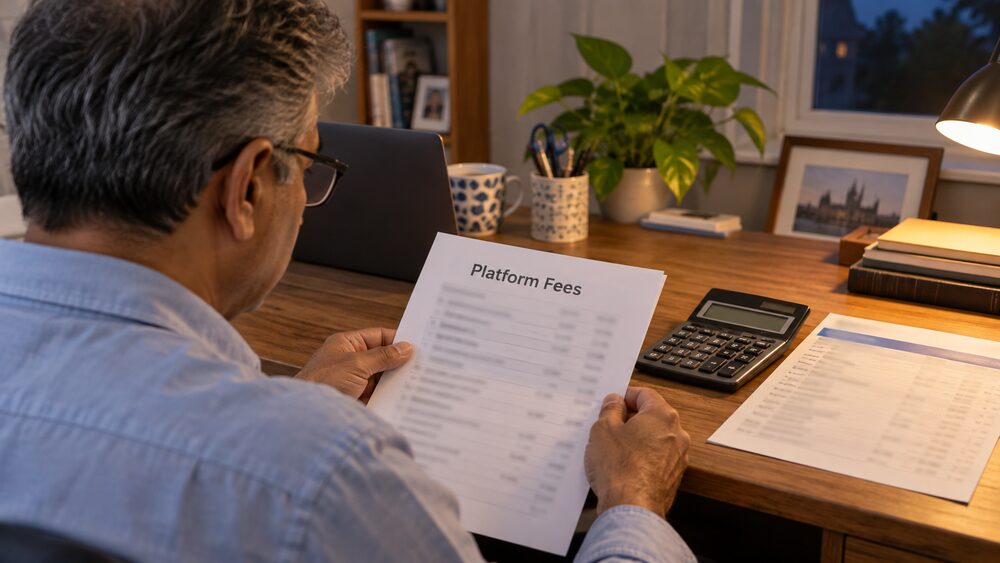
Then add the platform charge. Which? describes the two models: a charge each time you buy and sell, or an ongoing platform fee. Freetrade's own fund platform fee is described as ranging from 0% to 0.45% of holdings, capped, with no charge on Freetrade itself5.
Then add the fund's own costs, using the ongoing charge figure and remembering that transaction costs sit outside it4. Then add tax: stamp duty at 50p per £100 on UK share purchases4.
Finally, check the exit. A platform with free dealing but a transfer-out charge can cost more over a long holding period than one with a small dealing fee and free transfers. Freetrade states there is no fee to transfer away and close your account16.
Where to check a provider and get help
Before opening an account, the platform's own charges page and the key features document for the specific account type set out what it charges. For a SIPP, the key features document is where the platform's own fee terms sit23.
If a charge appears that was not disclosed, or a fee is taken that you did not authorise, the Financial Ombudsman Service is free and independent, and it costs nothing to complain24. Where it finds instances of unfair or unauthorised fees, it will usually tell the firm to refund the fee, sometimes with interest, refund additional costs incurred, and pay compensation for distress or inconvenience26. Freetrade SIPP complaints may be referred free of charge to the Pensions Ombudsman or alternatively to the Financial Ombudsman Service23.
For guidance rather than a complaint, MoneyHelper is a free, independent service27, and its support and guidance are free28. Free debt advice services are also available if investment losses have created wider financial pressure30.
Investment protection is separate from charging. The Financial Services Compensation Scheme covers investments, and its guide to investment protection sets out the limits and what counts28. That protection applies to the firm's failure, not to poor performance or to charges you agreed to.
Sources30 cited
- Keeping you safe Freetrade, 2026
- Mutual funds Freetrade, 2026
- How investment platforms work Which?, 2026-03-16
- Choosing an investment company Association of Investment Companies, 2026
- Mutual funds explained Freetrade, 2026
- Pension calculator Freetrade, 2026-03-24
- Stocks and shares Freetrade, 2026
- Share dealing charges Halifax, 2026-09-25
- Share dealing services Halifax, 2026-09-27
- Investment funds explained Which?, 2026-07-23
- ETFs Freetrade, 2026
- Fractional shares Freetrade, 2026
- ISA calculator Freetrade, 2026
- Junior ISA transfer Freetrade, 2026
- Standard plan Freetrade, 2026
- Transferring to other providers Freetrade, 2026
- Investment trusts explained Which?, 2025-05-14
- Investment trusts explained Which?, 2025-05-14
- Bed and ISA Freetrade, 2026
- How to buy shares Hargreaves Lansdown, 2026-09-26
- Choosing an investment company Association of Investment Companies, 2026
- Investment company performance figures and what they mean Association of Investment Companies, 2026
- SIPP terms and conditions Freetrade, 2026-01
- Complaining about PPI Financial Ombudsman Service, 2026-09-26
- Complaining about your lender Business Debtline, 2026-09-26
- Complaints about credit broking Financial Ombudsman Service, 2026-09-26
- MoneyHelper Citizens Advice Scotland, 2026-09-26
- Guide to investment protection Financial Services Compensation Scheme, 2026
- Guide to investment protection Financial Services Compensation Scheme, 2026
- Debt advice Shelter Scotland, 2026-01-16






 MoneyHelperFree, impartial money and pensions guidance, set up by government
 FSCSProtects your money if a bank, insurer or investment firm fails
 FCA Warning ListCheck whether a firm is authorised before you deal with it
 Financial Ombudsman ServiceFree, independent help when a complaint about a firm is not put right
 Citizens AdviceFree advice on money, consumer and legal problems in England and Wales