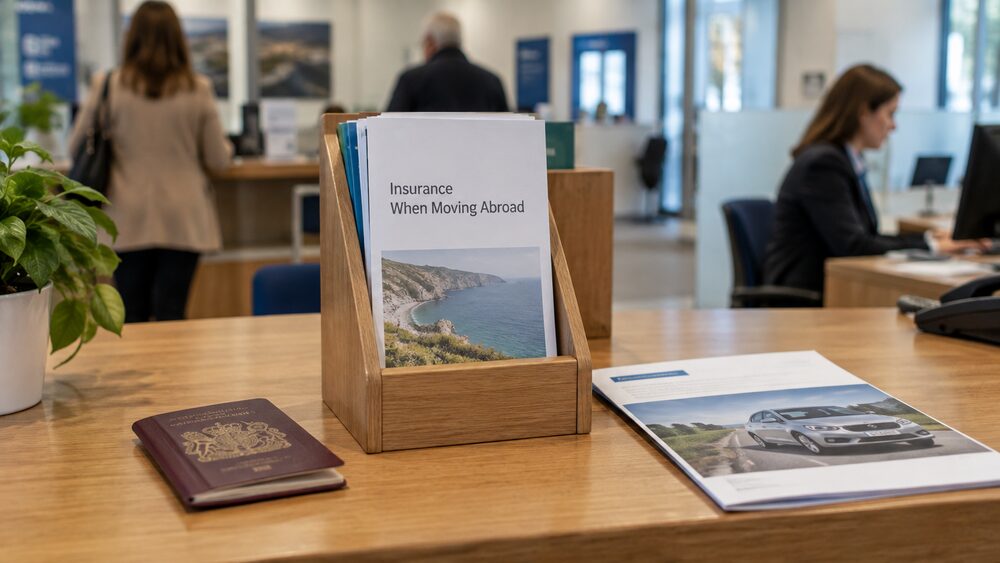
Moving abroad does not just change where you live, it changes what your UK insurance is worth. The government's guidance is blunt on the central point: foreign travel insurance "is not intended to cover you if you live abroad permanently"1. Most UK policies are priced and written on the assumption that you are a UK resident, and once that stops being true, cover can lapse, be restricted or be invalidated at the moment you most need it.
The good news is that not everything ends. Some policies carry on with conditions, some can be replaced with cover arranged in your new country, and some, like your National Insurance record, can be actively protected while you are away. This page explains, policy by policy, what happens to UK car, home, travel, life and income cover when your residence moves overseas, what you are required to tell insurers and the tax authorities, and where to get free help when things go wrong.
Which UK insurance policies stop or change when you move abroad
Insurance is a contract built on facts: where you live, what you do and how healthy you are. When one of those facts changes, the insurer's side of the bargain changes too. Residence is one of the most important facts of all, because it determines which country's laws apply to a claim, how risky the insurer considers you and, in many cases, whether the policy is valid at all.
The duty to disclose runs in both directions and it does not end when the policy starts. Scope's guidance on insurance states that once you buy travel insurance, "you must tell the insurer if there are any changes in your health or condition"7. The British Insurance Brokers' Association (BIBA) makes the same point about timing: insurers need to be told both at the quote stage and during the policy period if your health status changes8. A move abroad belongs in the same category of change. Which? warns that if your insurer is not informed of changes after you buy, including new medical conditions, changes to medication, amended travel dates, different accommodation or extra travellers, "a claim could be rejected even if the issue seems unrelated"9.
Beyond insurers, there are official notifications to make. You must tell HM Revenue and Customs (HMRC) if you are "leaving the UK to live abroad permanently or you're going to work abroad full-time for at least one full tax year"4. You also need to tell the benefits offices that deal with your benefits that you are moving abroad, and give your local council a forwarding address10. Independent Age warns that failing to tell benefit offices could amount to benefit fraud11.
In practice, the pattern across policy types is this: travel insurance stops being suitable the moment you become resident abroad; car insurance covers trips but not relocation; home insurance can continue for a UK property you keep, with conditions; life insurance often continues but needs checking; and health cover moves from the NHS and GHIC to whatever system your new country operates. The sections below take each in turn.
Health cover: the GHIC replaced the EHIC after Brexit
When the UK left the EU, the European Health Insurance Card (EHIC) was replaced for most people by the UK Global Health Insurance Card (GHIC). If you already hold an EHIC, it remains valid until it expires12. The GHIC is free and "lets you get state healthcare in Europe at a reduced cost or sometimes for free"7, giving you access to "necessary healthcare" in EU countries at the same price as citizens of that country2.
What counts as necessary healthcare is broader than many people assume. It includes "healthcare that can't wait for you to return to the UK, such as emergency treatment, routine medical care for pre-existing conditions, routine maternity care (unless you're going to a country to give birth) and oxygen and kidney dialysis"2. Both the GHIC and EHIC also cover treatment of a chronic or pre-existing condition if symptoms flare up while you are away2.
The card's limits matter just as much. It cannot be used for treatment at a private hospital or clinic, repatriation to the UK, rescue services, cancelling or cutting short a holiday, or lost or stolen luggage, and it gives no access to state healthcare in non-EU countries such as the US and Australia2. Even where state care is free, in some countries such as France you might have to pay upfront for certain services and claim the money back once you return home2. ABTA puts it plainly: the GHIC "is not a replacement for travel insurance, as it won't cover all of the medical bills you could incur if you fall ill or are injured abroad, for example, if you need an air ambulance, treatment in a private facility, ski or mountain rescue, or being flown back to the UK"12.
Crucially for anyone emigrating, the GHIC is a residents' card. You can apply only if you are "resident in the UK and don't have healthcare cover provided by an EEA country or Switzerland"2. Once you become resident elsewhere, the card is not your route to healthcare. You will need to register with your new country's state system, if it allows it, or arrange private cover, which is covered on the page about expat health insurance. The government also warns that "you may not be entitled to free medical treatment in the UK if you move abroad permanently"1, a point explained on the page about NHS treatment abroad.
Taking a UK car abroad: what your motor insurance covers
If you drive on UK roads, you must have at least third-party motor insurance by law13. When you take that car abroad, the starting position is set by law rather than by your insurer's goodwill: "all UK policies provide the minimum cover required by law in other European Union (EU) countries or the minimum cover required by UK law if that is greater"3. In other words, your comprehensive policy may temporarily behave like a bare-bones third-party policy the moment you cross into the EU.
The catch is that this legal minimum "doesn't automatically include theft or damage to your car"3. BIBA confirms the same gap: basic cover abroad "will not cover you for theft or damage to your car"14. If your car is stolen in France or damaged in Spain, a policy that is comprehensive at home may pay nothing unless the cover has been extended.
Whether it has been extended is a question for the insurer or broker before travel begins. BIBA's guidance for UK residents is to "ask your broker if you have the option for cover while driving in the EU/EEA and if it is necessary to tell insurers about journeys to Europe of less than 30 days"14. Some insurers include extended European cover at no cost, while others charge for it14. Which?'s research on breakdown cover found that only a minority of brands, among them NFU Mutual, offer a complete comprehensive package including cover if you drive into Europe15. Breakdown cover is separate from motor insurance and worth checking separately, since a UK breakdown policy may not reach the continent at all.
Two limits to keep in mind. First, this is cover for trips, not for relocation: a UK policy is arranged on the basis that you live in the UK, and taking up residence abroad with a UK-registered car is a change your insurer must know about. Second, the territorial reach of UK policies is generally the EEA and certain other European countries14, so the same rules do not follow you further afield. For the money side of driving and travelling, see the guides to using a debit card abroad and cash machines abroad.
Travel insurance is for trips, not for living abroad
Travel insurance is built around a journey: you leave home, you come back, and the policy covers the risks in between. It typically covers medical costs, cancellation, baggage and personal belongings, personal liability and delays16. It is not usually compulsory, although some countries may require it as a condition of entry17.
It is not, and was never meant to be, a way of insuring yourself while living overseas. The government's guidance for people moving, living or retiring abroad states that foreign travel insurance "is not intended to cover you if you live abroad permanently"1. ABTA adds the residence point from the other direction: most providers require you to be in the UK when you buy the policy, and buying it while already overseas will invalidate it12.
Even for genuine trips, the exclusions are extensive and worth knowing before you rely on a policy. Common exclusions include incidents after drinking too much or taking drugs, theft of unattended possessions, sports and some leisure activities, undeclared medical conditions, medical costs if you stay abroad after being fit to return, strikes known when you booked, rescheduled flights, and travel to destinations the Foreign Office advises against all but essential travel12. The Financial Ombudsman Service, which handles disputes between consumers and insurers, adds that cover is usually provided only if a cancellation or missed flight is caused by a specific event: "if you change your mind about travelling or miss your flight, your insurance may not cover you"18. BIBA notes that "deciding that you no longer want to travel (called disinclination to travel) is not covered under travel insurance"8.
Medical disclosure is where most claims come unstuck. The ombudsman advises checking "what your insurer needs to know about past or current health issues, even if you have recovered"18. Everything relevant needs to be declared, at purchase and afterwards, because a claim can be rejected even if the undeclared issue seems unrelated to the claim9.
One point that surprises people: travel insurance can cover trips within the UK. Which? reports that UK trips longer than a couple of nights and further than 25 miles are covered by most travel insurance policies, provided the disruption was caused by an event outside your control that you were not aware of when booking19. If you keep a UK base and travel back and forth after emigrating, that is worth remembering, though a UK travel policy will still assume you are a UK resident.
Home and contents insurance for a property you leave in the UK
Keeping a home in the UK while you live abroad is common, whether it is a place you intend to return to or a property you rent out. The insurance does not simply carry on unchanged, because most home and contents policies assume the property is occupied by you.
Two things change. First, insurers generally distinguish between a property that is empty and one that is let, and each carries different conditions: unoccupied properties usually attract restrictions or a time limit after which cover reduces, and a tenanted property needs landlord cover rather than ordinary home insurance. The property's new status is a change the insurer needs to be told about, like any other material change. Second, if you let the property, the arrangement itself has tax and practical consequences, covered on the page about renting out your UK home while you live abroad.
Contents insurance has a small travelling benefit worth knowing about. Which? notes that you might be protected by "contents outside the home" cover for personal possessions left in a vehicle, as part of your contents insurance policy19. That is cover for your belongings, not for you: ABTA is clear that home insurance "will not cover you for medical care and cancellations" while travelling12. In other words, a home policy is not any kind of substitute for travel or health cover.
If you are moving money abroad to support a property, or buying somewhere overseas, the pages on buying property abroad and banking while abroad cover the mechanics.
Life insurance and income protection after you emigrate
Life insurance and income protection are the policies people most often assume will simply carry on, and sometimes they do, but the position varies by insurer and by policy, so this is one to check in writing before you leave.
The two products do different jobs. Life insurance "only pays out when you die, as a lump sum"20, which is why it is not an alternative to mortgage payment protection insurance. Income protection is designed to replace earnings if you cannot work, and "some income protection policies pay out for a longer period than mortgage insurance, for example, until you can go back to work or reach retirement"20. If you are moving abroad to work, an income protection policy written around a UK job and UK state benefits may not behave as expected when your job, currency and healthcare system all change.
The practical questions to put to your insurer are whether the policy remains valid if you are no longer a UK resident, whether premiums can still be collected from an overseas bank account, and in what currency and country a claim would be paid. Where a UK policy cannot continue, the alternative is cover arranged internationally or in your new country, which the page on keeping a UK life policy or buying expat cover compares.
Pensions deserve a separate word of caution, because they are often moved at the same time as life cover. Transferring your pension savings overseas "can have tax implications depending on your circumstances and the type of scheme you transfer to"21. The Financial Conduct Authority also warns that a transfer can affect when you can access your money: some schemes have "a protected normal minimum pension age (NMPA) under age 55, which could mean waiting longer to access your pension if you transfer"22. The FCA's guidance sets out what a transfer can cost in access terms, and the pensions section covers how UK pensions work in general.
National Insurance and State Pension: protecting your qualifying years
Your UK insurance policies may end when you emigrate, but your National Insurance record does not. Years spent abroad can leave gaps, and gaps can reduce your State Pension, so this is the one part of your UK financial position you can actively protect while away.
The basics first. You usually need at least 10 qualifying years on your National Insurance record to get any new State Pension5, and a qualifying year is "a tax year in which you have enough earnings on which you have paid National Insurance contributions (NICs)"23. You might need more than 35 years of qualifying contributions to get the full State Pension if you were contracted out of the Additional State Pension before April 201624. You can add qualifying years by working and paying National Insurance until State Pension age, by getting National Insurance credits, or by making voluntary contributions to fill gaps25.
Working abroad splits into two cases. If you normally live in the UK and work abroad for a UK employer, you will normally still pay UK National Insurance26. If you work abroad for a foreign employer, you will not normally pay UK National Insurance, but you may have to pay contributions in the foreign country26. The official NI38 guidance adds that if you move abroad to work before State Pension age, "you might not gain qualifying years towards your State Pension" depending on your circumstances, such as whether you work for a UK or a foreign company27.
Voluntary contributions are the main tool for filling gaps, and you may be able to pay them for the current tax year and the previous 6 tax years27. But the rules changed on 6 April 2026. From that date, "workers living abroad will no longer be able to pay Class 2 voluntary National Insurance contributions to build their UK state pension"28, a measure the government describes as abolishing voluntary Class 2 contributions "for periods working or living outside of the UK"6. The government estimated that approximately 46,000 individuals would no longer be entitled to pay voluntary Class 2 contributions abroad29. The qualifying conditions for paying Class 3 contributions abroad were also tightened, from three years' residence in the UK or three years' contributions, to a higher threshold29. Paying voluntary contributions does not buy you healthcare: the NI38 guidance states that paying voluntary Class 2 contributions "will not give you cover for healthcare abroad, in any circumstances"27, and Which? makes the same point, that voluntary contributions "don't cover your health insurance in the country where you live"30.
The application route depends on whether you are applying for the first time or replacing an ended Class 2 arrangement.
The application process now runs on paper forms. If you are applying for the first time or after a break, use form CF8331. There is a separate form for voluntary Class 3 contributions for periods abroad, but you may use it only if HMRC has written to tell you to do so, for example a letter saying your voluntary Class 2 arrangement for time abroad has ended31. You fill the form in online, but you cannot save your progress; you then print it, sign the declaration and post it to HMRC or your employer depending on your answers31. If you were paying and are due a refund of contributions, you can apply online by signing in, or use the form on the back of HMRC's letter32. People who pay Class 2 in the UK need to register with HMRC if they do not pay through Self Assessment, and the National Insurance helpline is the contact point if an expected payment request does not arrive by the end of November33.
On the State Pension itself, you can claim it abroad if you have paid enough UK National Insurance contributions to qualify34, and you must be within 4 months of your State Pension age to claim34. You must choose which country your pension is paid in: "you cannot be paid in one country for part of the year and another for the rest"34. You might be able to increase the amount by delaying your pension or paying voluntary contributions to fill gaps34.
Where you live makes a large difference to what the pension is worth. Yearly increases are paid only if you move to EEA countries, Gibraltar or Switzerland, or a country with a social security agreement with the UK, but not Canada or New Zealand35. Which? reports that if you live elsewhere, "your pension may be frozen at the rate when you first start claiming or when you left the UK"28. Deferral rules also follow geography: the same deferral rules as the UK apply if you move to the EU, EEA, Switzerland or a country with a UK social security agreement, except Canada or New Zealand; elsewhere, your extra payment is based on the State Pension owed at whichever is later of the date you reach State Pension age or the date you move abroad36.
Time lived in certain countries has its own rules. If you move to live in the EU, EEA or Switzerland on or after 1 January 2022, you can no longer count periods living in Australia (before 1 March 2001), Canada or New Zealand towards your State Pension; people not affected by the change, who continue to live in the same country, can still count that time37. Paying into another country's social security system may help you get a UK State Pension or increase the amount, and you may be able to get a pension from that country too38. If you did not pay National Insurance while abroad, you can check your National Insurance record to see how your State Pension might be affected39.
A few related points complete the picture. Home Responsibilities Protection for full tax years before 6 April 2010 was automatically converted into National Insurance credits, up to a maximum of 22 qualifying years, for people who reached State Pension age on or after 6 April 201040. Once you reach State Pension age and keep working, you stop paying National Insurance25. And if someone paying voluntary or self-employed National Insurance dies, the NI Contributions Office should be contacted to cancel their payments41. The page on National Insurance after you move abroad covers the contributions rules in more depth.
Where cover does not follow you, and where to get help
The clearest way to summarise the page is by what does not travel. UK travel insurance does not cover permanent residence abroad1. The GHIC does not cover private treatment, repatriation or non-EU countries, and it is not available once you are resident elsewhere2. UK motor insurance abroad gives at least the legal minimum in the EU but not automatic theft or damage cover3. Home insurance covers your property and possessions, not your health or your travel plans12. And voluntary National Insurance contributions protect your pension record, never your healthcare abroad27.
Geography catches people out even on short trips. ABTA warns that popular holiday destinations like Turkey, Dubai, Egypt, Morocco and Tunisia "will not be covered by a European policy"12, so a policy or GHIC built around Europe leaves gaps elsewhere. The pages on emergency help abroad and lost or stolen cards abroad cover what to do when things go wrong on a trip.
If a claim is rejected or an insurer treats you unfairly, the Financial Ombudsman Service deals with complaints about insurance and can order redress; its guidance on travel insurance problems sets out what it expects insurers to do about disclosure and cancellations18. The ombudsman looks at a complaint only after the insurer's own complaints process has been used. For free, impartial help with the money side of emigrating, the government's guidance on moving, living or retiring abroad is the reference point for notifications and entitlements1, and MoneyHelper and the pages in the money abroad section cover the rest of the journey: Form P85 for claiming tax back when you leave, foreign income and UK tax, and double taxation when income is taxed in two countries.
Sources41 cited
- Moving, living or retiring abroad GOV.UK, 2025-08-20
- The EHIC explained Which?, 2026-05-21
- Motor insurance explained nidirect, 2026-05-27
- Tax and allowances in retirement nidirect, 2026-03-30
- New State Pension GOV.UK, 2026-09-25
- Voluntary National Insurance contributions for periods abroad from 6 April 2026 GOV.UK, 2026-04-06
- Insurance Scope, 2025-10-14
- Travel insurance for people with mental health conditions British Insurance Brokers' Association, 2026-09-26
- 7 costly travel insurance mistakes and how to avoid them Which?, 2025-12-07
- Moving or retiring abroad GOV.UK, 2026-09-26
- Benefits abroad Independent Age, 2026-09-26
- Travel insurance ABTA, 2026
- Vehicle insurance GOV.UK, 2026-09-26
- Driving abroad British Insurance Brokers' Association, 2023-02-13
- Should you buy breakdown cover with your car insurance? Which?, 2025
- Shopping around for insurance Independent Age, 2026-09-26
- Is self-insurance ever a good idea? Which?, 2026-02-25
- Problems with travel insurance Financial Ombudsman Service, 2025-03-14
- Does your insurance cover damage caused by bad weather? Which?, 2025-12-08
- What is mortgage protection insurance? Which?, 2026-05-11
- Transferring your pension nidirect, 2026-09-25
- Pension transfer: defined contribution Financial Conduct Authority, 2026-09-25
- Early retirement and the effect on your pension nidirect, 2025-07-31
- State Pension Pension Wise, 2026-09-28
- Increase your retirement income GOV.UK, 2026-09-28
- Working while you study: paying tax nidirect, 2025-09-10
- Guidance on social security abroad (NI38) GOV.UK, 2026-07-07
- How new rules could affect your State Pension if you live abroad Which?, 2026-04-06
- Voluntary National Insurance contributions abroad from 6 April 2026 GOV.UK, 2026-03-16
- Can I top up my State Pension? Which?, 2026-04-09
- Apply to pay voluntary Class 3 National Insurance contributions for periods abroad GOV.UK, 2026-07-14
- Apply for a refund of National Insurance contributions GOV.UK, 2026-06-22
- Pay Class 2 National Insurance GOV.UK, 2026-09-26
- State Pension if you retire abroad GOV.UK, 2026-09-26
- Deferring your State Pension and what you will get nidirect, 2026-06-26
- Easy read: how to claim your State Pension if you live outside the UK GOV.UK, 2026-02-05
- State Pension if you've lived in Australia, Canada or New Zealand GOV.UK, 2021-08-09
- State Pension abroad: easy read GOV.UK, 2026
- Tax return if you're a UK resident GOV.UK, 2026-09-27
- Home Responsibilities Protection GOV.UK, 2026-09-26
- Report a death without Tell Us Once GOV.UK, 2026-09-28





 MoneyHelperFree, impartial money and pensions guidance, set up by government
 FSCSProtects your money if a bank, insurer or investment firm fails
 Financial Ombudsman ServiceFree, independent help when a complaint about a firm is not put right
 FCA Warning ListCheck whether a firm is authorised before you deal with it
 Citizens AdviceFree advice on money, consumer and legal problems in England and Wales