
Earning money in one country while living in another is one of the surest ways to be taxed twice on the same income. The UK deals with this through double taxation agreements with many countries, so that you do not pay tax on the same income twice, and through foreign tax credit relief, which lets you deduct tax already paid abroad from your UK bill1. If you live abroad and have UK income, you can claim tax relief in the UK under an agreement to avoid being taxed twice2.
The system works in both directions. A UK resident with foreign income normally pays UK tax on it, but can usually claim relief for the foreign tax already charged3. A non-resident with UK income can claim relief here if the UK has an agreement with their country, and in some cases does not need to report that income to HMRC at all once relief has been claimed2. This page explains when double taxation arises, how each form of relief works, who can claim, and how to go about it, including form R43 for non-residents and the certificate of residence you may need to show to an overseas tax authority.
How double taxation arises: residence in one country, income in another
Double taxation happens because countries tax on different grounds. The UK taxes people who are resident here on their worldwide income and gains when they are taxed on the arising basis, meaning everything they receive, wherever it comes from4. Other countries tax income that arises within their borders, whoever receives it. When a UK resident receives income from abroad, both rules can point at the same money: the source country taxes it because it arose there, and the UK taxes it because the recipient lives here.
Whether you are UK resident is decided by the statutory residence test. Part of that test looks at your ties to the UK, and the ties that count depend on your history: if you were not UK resident in any of the three tax years before the one you are considering, you check whether you have a family tie, an accommodation tie, a work tie or a 90 day tie, and if you were resident in one or more of those three years, a country tie is added to the list6. Residence is not a matter of choice or of where you feel you belong; it is worked out from days spent in the UK and these ties.
Time abroad does not always break UK residence. If you were abroad for less than a full tax year, running from 6 April to 5 April the following year, you stayed UK resident, and that means you usually pay UK tax on your foreign income for the entire time you were away7. Students are a common example in the opposite direction: if you normally live and study in the UK but work abroad during the holidays, you still count as a UK resident for that tax year and are liable for UK tax on anything you earn abroad above the personal allowance8.
For people who are UK resident but whose permanent home is abroad, the position changed in April 2025. Before 6 April 2025, people whose permanent home, known as their domicile, was abroad might not have had to pay UK tax on foreign income under the remittance basis, an alternative tax treatment available to individuals who are resident but do not live permanently in the UK9. From that date the rules moved to a residence-based system, and the Foreign Income and Gains regime now applies instead3. If you are affected by that change, the page on the remittance basis and the rules that replaced it explains the detail.
Double taxation agreements stop the same income being taxed twice
A double taxation agreement is a treaty between two countries that decides which of them gets to tax each type of income, and how much. The UK has agreements with many countries, so that you do not pay tax on the same income twice1. Without one, you may be taxed twice on the same income or gains10. The agreements do not usually exempt income from tax altogether; more often they give the primary right to tax to one country and require the other to give relief.
The legal machinery sits in the Taxation (International and Other Provisions) Act 2010, which consolidated the older rules: the previous statutory provision on double taxation relief, section 57, was repealed by that Act with effect in accordance with its section 381(1)11. In practice, what matters to a reader is the outcome: if the country you have come from has an agreement with the UK, you can claim relief rather than paying twice10.
Relief under an agreement can take more than one form. In some cases the income is exempt in one of the countries. UK legislation mirrors this for certain benefits: no liability to UK income tax arises on a benefit payable under the law of a country or territory outside the UK that is similar to the benefits listed in the UK provisions12. In other cases the income stays taxable in both countries, but the country of residence gives credit for the tax charged by the other, which is the foreign tax credit relief described in the next section.
For non-residents with UK income, the agreement can remove the need to report at all: you do not need to report your income to HMRC if you have already claimed tax relief under a double taxation agreement2. If you live abroad and are employed in the UK, your tax is calculated automatically on the days you work in the UK2, which is how the agreement rules are applied to employment income in practice.
Foreign tax credit relief: deducting overseas tax from your UK bill
Foreign tax credit relief is the mechanism that stops a UK tax bill doubling up on tax already paid abroad. If you are UK resident, you normally pay tax on your foreign income, and you usually report that income in a Self Assessment tax return3. When you do, you can claim relief for the foreign tax paid on it, and HMRC publishes guidance on how to claim relief for tax paid on foreign income when a double taxation agreement is in place5.
The relief is capped. If the foreign tax you have paid is more than that payable as UK tax, you only get relief up to the amount of UK tax payable, and you need documentary evidence of the foreign tax paid4. So the foreign tax cannot be used to reduce the UK tax on your other income, and if the foreign rate is higher than the UK rate, the excess is simply lost. If the foreign rate is lower, you pay the balance to HMRC.
Foreign tax credit relief deducts overseas tax from the UK bill, but only up to the UK tax due on that income.
The claim is made in the return itself. Under the Foreign Income and Gains regime, the Self Assessment helpsheet directs claimants to specific boxes: box 28 to claim relief on foreign income, box 29 for foreign gains and box 30 for UK income or gains treated as foreign under the rules for qualifying recognised overseas pension schemes13. If you can claim Foreign Income and Gains relief, you may not have to pay tax on your foreign income at all, and where a claim is made you will not pay tax on the qualifying foreign income and gains you have claimed relief for, nor on them when brought to the UK13.
Tax reliefs generally reduce the tax you pay if you qualify for them14, and double taxation relief is one of several that can apply to a return with foreign income. The practical point is that relief is not automatic: it has to be claimed, in the right place, with evidence.
Who can claim double taxation relief
The relief is available in both directions, and eligibility follows residence rather than nationality.
- UK residents with foreign income. If you are UK resident, you normally pay tax on your foreign income and claim relief for foreign tax paid on it3. This includes people who were abroad for less than a full tax year and so never stopped being UK resident7.
- Non-residents with UK income. If the UK has a double taxation agreement with your country, you can claim tax relief in the UK to avoid being taxed twice, and once relief is claimed you may not need to report the income to HMRC2.
- People coming to the UK. You may be taxed twice on the same income or gains unless the country you have come from has a double taxation agreement with the UK10. If you have lived in the UK before, you may also have to pay tax on UK income or gains made while you were living abroad10.
- Short-term workers. You can claim tax relief or a tax refund if you are only working in the UK for a short time and plan to leave10.
- Students. UK students working abroad in the holidays remain UK residents and pay UK tax on earnings above the personal allowance8, while foreign students working in the UK while studying normally pay UK tax and National Insurance8.
One group should check their position carefully. From the 2025/26 tax year, UK residents claiming tax relief under the foreign income and gains regime may not be eligible for UK tax allowances, which changes the arithmetic of whether claiming suits them13. The old remittance basis, described in HMRC's helpsheet as available to individuals who are resident but do not live permanently in the UK, has been replaced by this regime9.
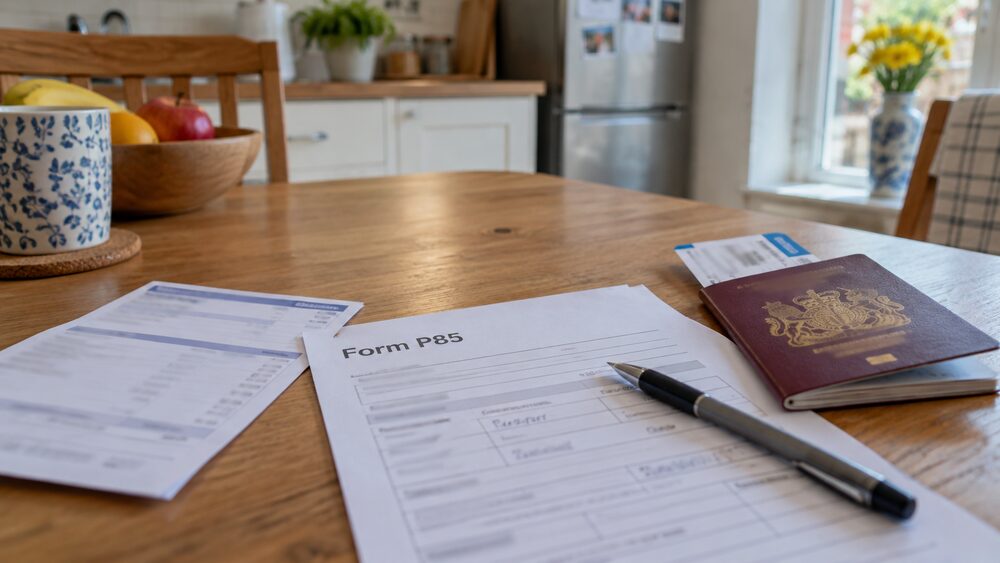
If you are leaving the UK, you must tell HMRC if you are going to live abroad permanently, going to work abroad full-time, including for a UK-based employer, for at least one full tax year, or you are a foreign national leaving the UK15. Telling HMRC is what puts the right residence status on record before any double taxation question arises. The page on form P85 covers the leaving process, and foreign income and UK tax covers what has to be declared.
Certificate of residence: proving you qualify before tax is paid
Relief under an agreement usually has to be shown before tax is deducted, not argued back afterwards. If you have not yet paid tax on the foreign income, you may need to apply for a certificate of residence to prove you are eligible for relief3. The certificate is a document from HMRC confirming your UK residence status, which the overseas tax authority or payer uses to apply the agreement's reduced rate or exemption at source.
The timing matters because relief applied at source avoids the money being deducted in the first place. Without it, the foreign payer may withhold tax at the full domestic rate, and you are then left claiming the excess back from the overseas authority, which is usually slower and more involved than presenting a certificate in advance.
There is a practical restriction on how non-residents deal with HMRC: you cannot use HMRC's online services to tell them about your income if you are non-resident2. So a non-resident applying for a certificate or claiming relief will generally be doing so on paper rather than through an online account. Identity checks still apply where online services are used: when you sign in you may be told you need to prove your identity, usually with photo ID like a passport or driving licence16.
Your residence position, which the certificate confirms, is worked out under the statutory residence test described earlier, including the family, accommodation, work, 90 day and country ties6. If your position is borderline, it is worth settling it before applying, because a certificate states a fact about your residence and that fact has to be right.
Claiming a refund as a non-resident with form R43
If you live abroad and UK tax has been taken from your income when it should not have been, form R43 is the usual route to a refund. You send form R43 to HMRC, or claim the refund in your Self Assessment tax return if you are already doing one2. A common scenario is where tax is deducted automatically, for example by your bank, but your total UK income is below your personal allowance2. In that situation nothing is owed, so what was deducted is repayable.
Non-residents usually have to send a Self Assessment tax return if they live abroad and rent out property in the UK, have taxable savings interest from UK banks or building societies, have a pension outside the UK and were UK resident in one of the five previous tax years, or have any other untaxed UK income2. Where a return is already being filed, the refund claim goes in the return rather than on a separate R43.
Other refund forms exist for other situations, and several of them turn on residence. Overpaid tax on savings can be reclaimed using form R40, or by contacting HMRC17. The forms for reclaiming overpaid tax on pension lump sums, P53Z and its variants, state that if you are not a UK resident for tax purposes you do not need to complete them, because non-residents are handled through the non-resident routes instead2. The message is consistent: identify your residence status first, because it determines which form and which claim route applies.
HMRC will usually send refunds by cheque. If you want HMRC to send a refund straight to your bank account, include your bank account number and sort code on your tax return, and you need to include this information each time you complete a return2.
Pension income and double taxation
Pensions are a frequent source of double taxation because they are often paid from one country to a retiree living in another. The general rules apply: a UK resident receiving a pension from abroad normally pays UK tax on it and reports it in Self Assessment, claiming relief for any foreign tax charged on it3. A non-resident receiving a UK pension can claim relief under an agreement if there is one2.
The reporting trigger for pensions is specific. If you live abroad and have a pension outside the UK, and you were UK resident in one of the five previous tax years, you usually have to send a Self Assessment tax return2. That five-year look-back is what catches many people who retire abroad and assume they have left the UK system behind.
UK pension contributions themselves carry tax relief of up to 100 per cent of your earnings, as long as you are under 7518, and HMRC publishes guidance on understanding tax and your pension15. None of that changes the double taxation position of the pension once it is being paid, but it explains why a pension can have tax attached in more than one country: relief was given on the way in, and the source country may still want to tax it on the way out.
Where the protection stops: countries without an agreement
The protection is not universal. You may be taxed twice on the same income or gains unless the country involved has a double taxation agreement with the UK10. Where there is no agreement, each country applies its own domestic rules, and the UK's unilateral relief, the foreign tax credit relief described above, may still give credit for foreign tax paid, but the treaty protections, such as agreed reduced rates and the allocation of taxing rights, are absent.
Some protections exist outside the treaty network. UK legislation exempts from income tax certain benefits payable under the law of a country outside the UK that correspond to benefits listed in the UK provisions12. The UK and Ireland have a social security agreement allowing existing reciprocal social security rights, and the two governments have a bilateral agreement in place to make sure those rights continue to be protected19; the arrangements between the UK and Ireland are unchanged19.
Residence evidence becomes critical where there is no agreement. HMRC's guidance on the COVID-19 concession for non-residents who were stuck in the UK illustrates the point: you may have to pay tax in the UK if you cannot prove you were unable to leave the UK and did not leave as soon as you could2. The same evidential logic applies generally, which is one reason the record-keeping rules in the next section matter.
A related rule worth knowing concerns selling a UK home from abroad. In most cases you do not pay any tax for any tax year in which you, your spouse or civil partner spent at least 90 days in your UK home, but to qualify you must nominate the home as your only or main home when you tell HMRC you have sold it, and you may still owe tax if you used part of it for business only20.
Getting the refund: timing and checking HMRC messages
HMRC does not publish a guaranteed turnaround for double taxation refunds, but there are signals to watch. If you request a Self Assessment tax refund, HMRC may send you a text message saying the refund is being processed and when you can expect to get it21. HMRC may also send a text saying you are due a tax refund, known as a P800 refund, if they have sent a letter and had no response21. Because refund texts are a known scam pattern, HMRC publishes guidance on checking whether a text message claiming to be from HMRC is genuine21.
Refunds can arrive in several ways. You can check and claim for a refund online on GOV.UK, on the HMRC app, or by asking HMRC to send a cheque, and HMRC may also reduce tax collected from future wages instead22. To use the online checking service for last year's tax, you need a tax calculation letter, known as a P800, that says you can do this online16. Simple Assessment letters, which HMRC issues where, for example, a second income has not been taxed, are another route by which HMRC settles underpayments and overpayments without a full return23.
Bank details speed things up. HMRC usually sends refunds by cheque, but including your bank account number and sort code on the tax return routes the refund straight to your account2. Other tax systems show the same pattern: a Stamp Duty Land Tax refund claimed by post requires the bank name, account number, sort code and name of the account holder24, and repayments of overpaid import duty and VAT can only be made to a UK bank account25. If you live abroad, whether you have a UK account capable of receiving the refund is worth settling before you claim.
Records to keep
Claims for double taxation relief rest on evidence: proof of the foreign tax paid, proof of residence and proof of what was received. HMRC's guidance on claiming double taxation relief covers what records to keep5. The general rule is that records must be kept for at least five years from the 31 January following the relevant tax year; the guidance also gives a worked example that for the 2025-26 tax year records must be kept until 31 January 20325.
For a relief claim, the documents that matter most are those showing the foreign tax deducted, such as withholding certificates or statements from the overseas payer, since relief is only given up to the UK tax payable and requires documentary evidence of the foreign tax4. Keeping them for the full five-year window matters because HMRC can open checks into a return well after it is filed, and a relief claim without evidence may be withdrawn, leaving the tax payable in both countries after all.
Where to get help
Double taxation is one of the more technical corners of personal tax, and the official guidance is the place to start. HMRC publishes help with foreign income on your Self Assessment tax return, including how to claim relief when a double taxation agreement is in place and what records to keep5, alongside the guidance on tax on foreign income3 and on tax on UK income if you live abroad2. HMRC's guidance on moving, living or retiring abroad brings together the residence and reporting rules in one place1.
Free, impartial help is available. HMRC's own guidance pages are free, and for wider questions about tax and pensions HMRC's guidance on understanding tax and your pension is a starting point15. For general money questions while abroad, the money abroad section of this site covers banking, sending funds and healthcare, and the personal tax section covers the UK rules these claims sit inside. If your position involves significant sums or an unclear residence status, the cost of a professional adviser is often small against the tax at stake, though the choice is yours.
Sources25 cited
- Moving, living or retiring abroad HM Revenue and Customs, 2025-08-20
- Tax on UK income if you live abroad HM Revenue and Customs, 2026-09-26
- Tax on foreign income HM Revenue and Customs, 2026-09-26
- Residence, domicile and the remittance basis: RDR1 guidance note HM Revenue and Customs, 2025-05-16
- Help with foreign income on your Self Assessment tax return HM Revenue and Customs, 2025-04-22
- Statutory residence test: RDR3 guidance note HM Revenue and Customs, 2026-06-11
- UK tax returns HM Revenue and Customs, 2026-09-27
- Working while you study: paying tax nidirect, 2025-09-10
- Remittance basis: helpsheet HS264 HM Revenue and Customs, 2014-07-04
- Tax when you come to the UK HM Revenue and Customs, 2026-09-26
- Income Tax Act 2007 legislation.gov.uk, 2008-07-21
- Income Tax (Earnings and Pensions) Act 2003, Part 10 legislation.gov.uk, 2026
- Foreign income and gains regime: helpsheet HS266 HM Revenue and Customs, 2026-05-18
- Income Tax HM Revenue and Customs, 2026-09-26
- Understanding tax and your pension HM Revenue and Customs, 2025-03-27
- Check how much Income Tax you paid last year HM Revenue and Customs, 2026-09-26
- Tax and allowances in retirement nidirect, 2026-03-30
- Workplace pensions and tax relief nidirect, 2026-07-07
- Common Travel Area and social security benefits nidirect, 2026-07-27
- Tax if you live abroad and sell your UK home HM Revenue and Customs, 2026-09-27
- Check if a text message you have received from HMRC is genuine HM Revenue and Customs, 2026-09-18
- Tax code changes HM Revenue and Customs, 2026-08-05
- HMRC urges customers not to ignore Simple Assessment letters HM Revenue and Customs, 2026-07-28
- Apply for a refund of Stamp Duty Land Tax HM Revenue and Customs, 2026-06-26
- Claim a repayment of import duty and VAT if you have overpaid HM Revenue and Customs, 2026-02-20





 MoneyHelperFree, impartial money and pensions guidance, set up by government
 FSCSProtects your money if a bank, insurer or investment firm fails
 Financial Ombudsman ServiceFree, independent help when a complaint about a firm is not put right
 FCA Warning ListCheck whether a firm is authorised before you deal with it
 Citizens AdviceFree advice on money, consumer and legal problems in England and Wales