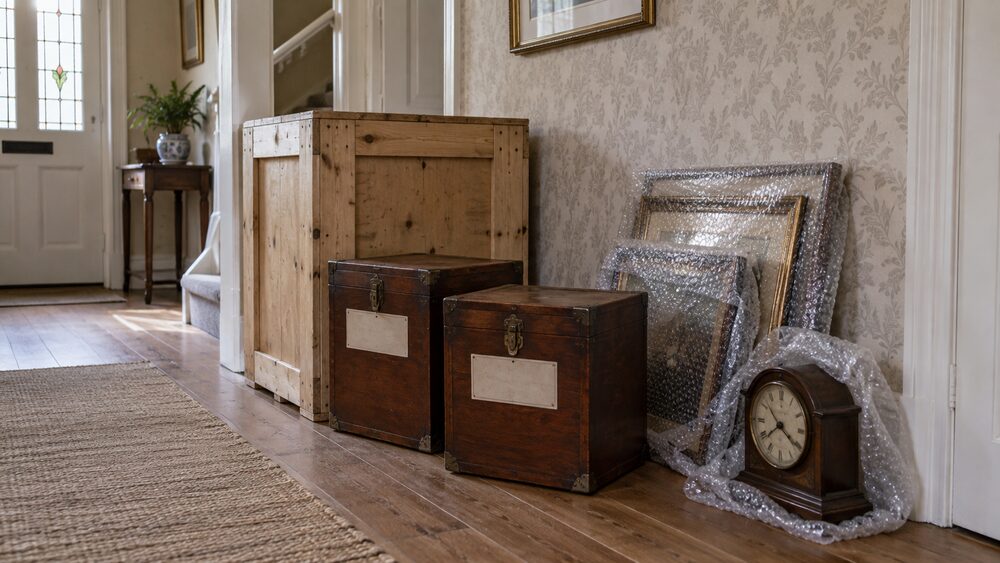
When someone dies abroad and leaves you their belongings, bringing those possessions into the UK normally attracts import duty and VAT in the same way as any other goods crossing the border. Inherited goods relief exists so that a genuine inheritance does not create a tax bill on top of a bereavement. If you qualify, the goods can be brought in without paying those charges, whether they arrive as freight, by post or in your own luggage.
The relief is narrow and condition-heavy. It covers goods inherited from a deceased person, it is available to UK residents and to UK-established non-profit making companies, and it normally cannot be claimed until the owner has died1. The goods should be imported within two years of the estate being finally settled, and you must keep records for at least four years after claiming1. Several categories are excluded outright, including alcoholic drinks, tobacco and commercial vehicles1.
What inherited goods relief covers
Inherited goods relief removes the import charges that would otherwise apply when belongings left to you in a will, or under a country's intestacy rules, are brought into the UK from outside the UK. The charges it relieves are import duty and VAT, the two charges that most commonly catch people out when goods cross a border. Without the relief, a shipment of furniture, jewellery, paintings or household effects sent from abroad would be assessed for duty and VAT in the ordinary way, and the bill can be substantial on high-value or bulky consignments.
The relief sits alongside the wider tax rules that apply when someone dies. Importing the goods is only one part of the picture: the estate itself may owe Inheritance Tax, and you may face Capital Gains Tax when you later sell anything you inherited3. Inherited goods relief deals only with the border charges. It does not reduce or remove any Inheritance Tax due on the estate, and it does not affect what happens when you dispose of the items later.
The guidance covering this relief was first published in June 2020, and its wording on inherited personal goods was updated in May 2025, so the rules described here reflect the current published position1. The relief applies to goods that formed part of the deceased person's estate and were inherited by you. That is the core test: the items must be yours by inheritance, not bought, gifted by a living person or acquired in some other way.
Who can claim: UK residents and non-profit bodies
There are two groups who can claim the relief. The first is a person who inherits goods from a deceased person and is a UK resident. The second is a non-profit making company established in the UK1. If you inherit belongings from a relative abroad and you live in the UK, you fall within the first group, and residence is the key condition rather than nationality.
The residence condition matters because the relief is designed for people whose belongings are coming home to the UK, not for goods that will simply pass through or stay with someone abroad. If your circumstances are unusual, for example if you have recently moved to the UK or split your time between countries, the question of whether you count as a UK resident for this purpose is worth settling before the goods ship, because a freight consignment that arrives without a valid claim will be assessed for duty and VAT at the border.
The second group, non-profit making companies established in the UK, is narrower than it may sound. A charity or similar body that inherits goods, perhaps because it was named as a beneficiary in a will, can claim under the same relief. Commercial businesses cannot, and neither can people who are not UK residents. If several beneficiaries inherit different items from the same estate, each person claims in their own right, and each must meet the conditions individually.
Relief normally starts only after the owner's death
The relief is tied to death. In nearly all cases, you cannot claim relief before the death of a current owner1. This rule exists because the relief is for inherited goods, and goods are only inherited once the person who owned them has died. A gift from a living relative, however generous, is not an inheritance and does not qualify.
There is one narrow exception. Relief may be available before death where the goods were left to the current owner by a deceased person's will which stipulates that they pass to the claimant, the current owner has renounced ownership or been judged too ill or infirm, and a certificate under the laws of the country concerned is provided1. All three conditions must be met, and the certificate must come from the country whose law governs the situation. In practice this exception is rare, and anyone considering it would need to satisfy HMRC on each element.
For most people the position is straightforward: the claim begins after the death, once the goods have passed to you under the will or under the intestacy rules of the country where the person died. The date of death is not the same as the date you can import, however, because the estate has to be administered first, and the two-year import window runs from a later point in the process.
Goods that do not qualify for relief
The exclusions are set out plainly in HMRC's guidance, and they are worth checking before arranging any shipment, because an excluded item will be charged however genuine the inheritance is. You cannot claim relief for alcoholic drinks, tobacco and tobacco products; stocks of raw materials and finished or semi-finished products; tools of trade other than portable items; commercial vehicles; livestock and agricultural stocks beyond a family's normal needs; goods bought from the executor of the estate; and goods bought or received as a gift from the person who legally inherited them1.
| Excluded category | What it means in practice |
|---|---|
| Alcoholic drinks, tobacco and tobacco products | Wine, spirits and cigarettes left in a cellar or house do not qualify, whatever their value1 |
| Stocks of raw materials, finished or semi-finished products | Business stock and production materials are excluded1 |
| Tools of trade other than portable items | Portable tools may qualify, but larger trade equipment does not1 |
| Commercial vehicles | A van or lorry left to you cannot claim the relief1 |
| Livestock and agricultural stocks beyond a family's normal needs | Animals and produce beyond ordinary family use are excluded1 |
| Goods bought from the executor | Items you purchase from the estate, rather than inherit, do not qualify1 |
| Goods bought or received as a gift from the legal beneficiary | If the named beneficiary passes items on to you, that is a gift, not an inheritance1 |
The last two exclusions catch people out most often. Buying items at an estate sale, even from the executor of a family member's estate, is a purchase, not an inheritance, and the relief does not apply. Equally, if the will left everything to one person and that person then gave items to you, you received a gift from a living beneficiary rather than an inheritance from the deceased, and the relief is not available on those items. The relief follows the line of inheritance, not the chain of family generosity around it.
Proving the inheritance: will, intestacy papers and executor certification
A claim stands on its evidence. Because the relief exists only for genuine inheritances, you need documents that show the goods were left to you by the deceased person. A will naming you as a beneficiary is the clearest proof. Where there is no will, the intestacy papers of the country concerned, showing who inherits under its rules, serve the same purpose. A certificate from the executor or administrator of the estate confirming that the goods form part of the estate and have passed to you is central to the claim1.
Keep copies of everything, and keep more than one copy. If the goods arrive in several consignments, each shipment must be supported by proof of the inheritance1, so a single set of documents locked in a solicitor's file will not serve repeated arrivals. Practical documents worth assembling include the will or intestacy confirmation, the executor's certificate, the estate's inventory listing the items, and freight or shipping paperwork that ties the consignment to the goods described in the estate.
The standard of evidence echoes the wider practice around estates. When dealing with Inheritance Tax accounts, HMRC requires that you keep all documents used to complete the forms and any supplementary pages, because they may be asked for later4. The same discipline applies here: the person claiming the relief should be able to produce, on request, a paper trail running from the death, through the estate administration, to the arrival of the goods.
When proof is not yet available
Estates take time to administer, and shipping arrangements do not always wait for paperwork. Where the proof of inheritance is not yet available when the goods arrive, the guidance provides a route: a cash deposit or a banker's guarantee can be used instead1. In effect, the charges are covered by the deposit or the guarantee until the proper documents can be produced, at which point the relief can be confirmed and the security released.
This matters most with freight consignments, where a shipping company may hold goods until charges are paid or secured. Rather than paying duty and VAT outright and trying to recover them later, a deposit or guarantee keeps the position open while the estate's paperwork is completed. A banker's guarantee is a commitment from a bank to pay the charges if the claim fails, and arranging one usually involves the bank you hold an account with, on the terms it sets.
If you do end up paying charges that should have been relieved, the recovery route is a repayment claim rather than a blocked import. HMRC's guidance on reclaiming overpaid import duty and VAT sets a limit of three years for overpayments2, so a payment made in error does not have to be written off, but it should not be left indefinitely either.
Import within 2 years of the estate being settled
The timing rule gives the claim its shape: the goods should be imported within 2 years from the date the estate is finally settled1. The goods need not arrive at the same time, but proof of the inheritance is required each time a shipment comes in1. That means the two-year window is about when the goods physically enter the UK, and it is generous enough to cover slow freight and phased shipments, provided each falls inside the period.
The starting point is not the death but the settlement of the estate. The period of administration starts on the day following the date of death of the deceased person and ends when the personal representatives have taken all the steps necessary to complete the administration of the estate5. That endpoint, when the executors or administrators have finished their work, is the date the estate is finally settled, and the two years run from there.
The settlement date can be later than people expect, because administering an estate involves valuing assets, paying debts and tax, and distributing what remains. Some parts of the tax system impose their own deadlines on that process: Inheritance Tax must normally be paid by the end of the sixth month after the person dies to avoid interest6, and you will normally have to start paying Inheritance Tax before probate is granted6. Where the estate includes assets that take time to sell, the tax on them can be paid in equal annual instalments over 10 years, with the first instalment due at the end of the sixth month after the death7. None of these dates changes the import window, but together they explain why an estate may not be settled for some time after the death, and why the two-year clock starts later than many assume.
How to claim at import, and claiming late
The claim should be made at the time of import1. In practice this means telling the shipping agent, freight company or postal service that you are claiming inherited goods relief, and providing the proof of inheritance so the relief is entered on the import declaration. For freight, the goods are declared to HMRC's systems when they arrive, and the relief is applied at that point rather than being negotiated afterwards.
If the claim is not made at import, the position is not necessarily lost. HMRC states that if you do not claim relief at the time of import, it may accept a late claim and repay the appropriate charges, subject to conditions1. A late claim therefore involves paying the duty and VAT first, or having paid them, and then seeking repayment with evidence that the goods qualified. The general repayment route for overpaid import duty and VAT carries a three-year limit for overpayments2, and claims are made through HMRC's repayment process, with the route depending on how the original declaration was lodged, for example in Customs Handling of Import and Export Freight where the claimant has an EORI number2.
The conditions on a late claim are not published as a fixed list, so the practical step is to approach the National Import Reliefs Unit with the proof of inheritance, the import paperwork and evidence of the charges paid, as soon as the omission is noticed. Waiting is the enemy of a late claim: the three-year overpayment limit2 and the conditionality of HMRC's discretion both argue for acting promptly.
Selling or giving away inherited goods: what you must tell HMRC
The relief comes with continuing obligations. If you sell or give away the goods after importing them under the relief, you must tell HMRC1. The reason is that the relief is given on the understanding that the goods are your inherited belongings; disposing of them changes the picture, and HMRC needs to know so it can decide whether any charges now apply.
Selling inherited goods can also have tax consequences beyond import charges. Capital Gains Tax applies when you sell anything you inherited3, calculated on the increase in value from the date you inherited it, under the normal rules for chargeable gains. Separately, if Inheritance Tax is due from you as a beneficiary, HMRC will contact you3. These are distinct from the import relief, but they share the same underlying event, and the records you kept for the relief claim, the will, the executor's certificate and the estate inventory, are the same records that make these later questions straightforward to answer.
Giving items away also triggers the duty to tell HMRC1. This catches the situation where goods are imported free of duty and VAT and then passed on to family members or others. The obligation is to inform HMRC of the disposal, not necessarily to pay a charge, and the outcome depends on the circumstances. The safe course is to report and let HMRC assess, rather than to assume the relief is unaffected.
Records to keep and what happens if you break the conditions
The record-keeping rule is explicit: you must keep all records for a minimum of 4 years1. The records specified include acknowledgement letters, receipts, bills, invoices and insurance documents, plus transfer, re-export or incident documentation where relevant1. In practice this means the full file relating to the inheritance and the import: the will or intestacy papers, the executor's certificate, the shipping documents, correspondence about the claim, and anything showing what happened to the goods afterwards.
Four years is a minimum, not a target. The obligation echoes HMRC's general practice on estate paperwork, where you must keep all documents used to complete the forms and any supplementary pages, as they may be asked for later4. If you break the conditions of the relief, for example by selling the goods without telling HMRC, or by importing outside the two-year window without agreement, the relief can be withdrawn and the charges become payable. A repayment obtained that was not due must be paid back along with any interest due, under the principles HMRC applies to repayments generally8.
The practical risk is not a fine for missing paperwork but the unwinding of the relief itself. Duty and VAT that were never paid at the border can be called in once a condition is broken, and the absence of records makes it harder to show the claim was valid in the first place. Keeping the file intact for at least four years, and longer if the goods are retained, is the cheapest protection available.
Inheritance Tax and the estate: the separate questions
Inherited goods relief answers only the border question. The estate question is separate, and it is governed by Inheritance Tax rules that apply before the goods ever move. The tax itself is normally due by the end of the sixth month after the person dies to avoid interest6, which is why families often find themselves dealing with the estate's tax bill while the belongings are still abroad.
Where the estate includes assets that may take time to sell, the tax on those can be spread over equal annual instalments over 10 years7, and once the first instalment has been paid, personal representatives can proceed to apply for probate9. These instalment and payment rules shape when the estate can be finally settled, which in turn sets the start of your two-year import window.
One point of possible confusion is worth clearing up. Some heritage items, such as pictures, books, manuscripts, works of art and antiques, can qualify for a conditional exemption from Inheritance Tax, but that exemption must be claimed within 2 years after the deceased's death, except in exceptional circumstances10. That two-year period runs from the death and is a different relief with different conditions from the import relief, whose two years run from the settlement of the estate. An heir dealing with valuable antiques abroad may face both clocks, and they do not start at the same time.
There is also an active policy conversation about the pressures on personal representatives. A House of Lords committee has recommended introducing safe-harbour periods from late interest payments for personal representatives not at fault for missing deadlines, in the context of recent Inheritance Tax measures11. Nothing in that changes the current rules, but it reflects recognition that estate administration deadlines are demanding, which is relevant background for anyone juggling an estate abroad with an import claim at home.
Where to get help
The first port of call for questions about the relief itself is HMRC's National Import Reliefs Unit, which handles these claims, including late claims and eligibility questions. The guidance page on paying no import duties or VAT on inherited goods carries the current contact details and is the authoritative statement of the conditions1. For the estate side, the executor or administrator, and where relevant a solicitor handling the estate, will hold the documents the claim depends on.
For problems with traders or services in another country, for example a freight company or shipping agent based abroad, the UK International Consumer Centre provides free advice and assistance to consumers who have bought goods or services from non-UK traders and need help to resolve complaints12. It does not deal with tax questions, but it can help where the difficulty is with the firm moving your goods rather than with the relief itself.
For the wider money questions that come with a death abroad, the site's guides to money abroad, foreign income and UK tax and double taxation cover the neighbouring ground, and the personal tax section explains the UK taxes that can arise on an inheritance.
Sources12 cited
- Pay no import duties or VAT on inherited goods HM Revenue and Customs, 2020-06-04
- How to claim a repayment of import duty and VAT if you've overpaid HM Revenue and Customs, 2019-10-31
- Tax on property, money and shares you inherit HM Revenue and Customs, 2026-09-26
- Tell HMRC that Inheritance Tax is due on a gift or trust (IHT100) HM Revenue and Customs, 2024-08-12
- ADS rules for particular transactions and buyers Revenue Scotland, 2026-09-26
- Valuing the estate of someone who died HM Revenue and Customs, 2026-09-26
- Inheritance Tax yearly instalments HM Revenue and Customs, 2026-09-28
- Apply for a refund of Stamp Duty Land Tax HM Revenue and Customs, 2026-06-26
- Inheritance Tax on pensions: liability reporting and payment, summary of responses HM Treasury and HM Revenue and Customs, 2025-07-21
- Inheritance Tax account (IHT400) notes HM Revenue and Customs, 2021
- Lords committee publishes report on Finance Bill 2025-26 House of Lords Economic Affairs Committee, 2026-01-28
- Consumer advice: other problems Anglesey County Council, 2025-03






 MoneyHelperFree, impartial money and pensions guidance, set up by government
 FSCSProtects your money if a bank, insurer or investment firm fails
 Financial Ombudsman ServiceFree, independent help when a complaint about a firm is not put right
 FCA Warning ListCheck whether a firm is authorised before you deal with it
 Citizens AdviceFree advice on money, consumer and legal problems in England and Wales