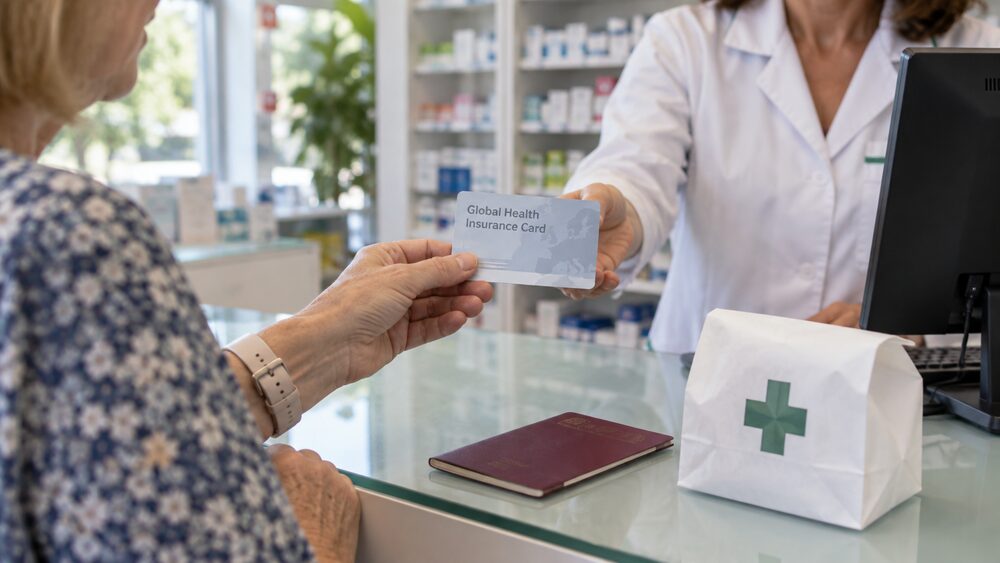
The Global Health Insurance Card, or GHIC, is a free card that lets UK residents get medically necessary state healthcare when travelling in Europe, either at a reduced cost or sometimes for free1. It replaced the European Health Insurance Card, or EHIC, when Britain left the EU in January 2021, but if you already hold an EHIC it remains valid until the expiry date on the card1. Neither card costs anything to apply for, and both are obtained through the official NHS application route rather than any paid service2.
What the card gives you is treatment on the same terms as a local person. A GHIC provides access to what the rules call "necessary healthcare" in EU countries at the same price as citizens of that country2. That covers more than emergencies: it includes routine medical care for pre-existing conditions that need monitoring, routine maternity care, and services like oxygen therapy and kidney dialysis that cannot wait until you are home2. What it does not do is pay for private treatment, get you flown home, or replace travel insurance in any of those situations1.
What the GHIC covers: necessary state healthcare at local prices
The core promise of the GHIC is simple: when you need healthcare while abroad that cannot wait until you return to the UK, the card lets you use the country's state system on the same footing as someone who lives there. If residents of the country you are visiting pay nothing for a particular treatment, you pay nothing either; if they pay a standard charge, you pay that same charge4. The card is not a discount voucher and not an insurance policy, it is access to a state system on local terms.
"Necessary healthcare" is broader than many people assume. It includes emergency treatment, but it also covers the treatment of a chronic or pre-existing condition if symptoms flare up during your holiday, and routine medical care for people with pre-existing conditions that need monitoring while they are away2. Routine maternity care is included, unless you are travelling to a country specifically to give birth, and so are oxygen and kidney dialysis, which matter to travellers who could not otherwise leave the UK for more than a few days2. The Financial Ombudsman Service, which handles disputes about travel insurance, describes the EHIC as entitling the cardholder to state healthcare in other EEA countries and Switzerland at a reduced cost or for free, and the same principle of state care at local prices underpins the GHIC5.
Two limits shape everything else on this page. First, you can use the GHIC or EHIC only for state-run medical treatment, so the moment you walk into a private clinic the card stops applying2. Second, the card covers healthcare only: it has nothing to do with the other costs a serious incident abroad can create, from a cancelled holiday to a flight home. Those gaps are where travel insurance comes in, and they are covered in detail later in this page.
Where the GHIC stops: private care, rescue and the flight home
The list of what the GHIC does not pay for is longer than the list of what it does, and every item on it can produce a bill running to thousands of pounds. The card cannot be used for any medical treatment at a private hospital or clinic, for repatriation to the UK, for rescue, for cancelling or cutting short your holiday, or for luggage going missing or being stolen2. It also does not provide state-provided healthcare in non-EU countries such as the US and Australia2.
The rescue exclusion deserves particular attention from anyone heading to the mountains. Guidance on skiing and winter sports points out that the GHIC applies to state-provided medical care only, and that many injury clinics on the slopes are private, so a skiing accident can leave you with costs the card was never designed to meet6. ABTA makes the same point in general terms: the GHIC is not a replacement for travel insurance because it will not cover medical bills such as an air ambulance, treatment in a private facility, ski or mountain rescue, or being flown back to the UK1.
Repatriation is often the single biggest number. Being brought home after a serious illness or injury can require a medical flight, and neither card contributes anything towards it2. Travel insurance policies typically include emergency medical expenses and repatriation cover, and the Financial Ombudsman Service deals with complaints where insurers have disputed or refused such claims, which shows both how large these costs can be and how important it is to read what a policy actually promises5.
Charges you may still pay with a GHIC
Even when treatment is within the card's scope, you may still open your wallet. Because the card gives you the same terms as a local resident, you inherit whatever charges locals face. In France, for example, you might have to pay upfront for certain services and claim the money back once you return home, even if the state-provided care itself is ultimately free2. Guidance for travellers notes that few EU countries pay for the full cost of treatment, so a part-payment is the norm in many places rather than the exception7.
This is worth planning for in practical terms. Keep receipts and paperwork for anything you pay towards, because a claim-back after returning home depends on them. And because the amounts involved are usually modest compared with private bills, the card still does its job even when it reduces a bill rather than wiping it out: the alternative, paying a private rate with no card at all, is nearly always worse.
The part-payment rule also explains why the card and insurance work well together. A travel insurance policy with a waiver or excess may expect you to use your GHIC or EHIC first where state treatment is available, and the insurer then deals with what is left. ABTA notes that travelling with an EHIC can reduce insurance premiums within the EU precisely because the insurer knows state care is available to you first1, and that interaction is explained in the premiums section below.
Where the card works: EU, Iceland, Norway, Switzerland and Liechtenstein
The GHIC is accepted in all 27 EU countries, and the same source also lists Switzerland, Montenegro, the Channel Islands and Australia among the places where the card is accepted1. However, the documents in this area disagree about Switzerland and its neighbours. Guidance on travelling to Europe after Brexit states that for most people, UK-issued EHICs or GHICs are not valid in Norway, Iceland, Liechtenstein and Switzerland, though it adds that you can use your passport to get necessary treatment in Norway8.
Because of that conflict, the sensible position is to treat the EU as the card's reliable heartland and to check the current official position on the NHS application page before relying on it in Switzerland, Norway, Iceland or Liechtenstein. Do not assume the card will be accepted there, and make sure your travel insurance is strong enough to stand alone if it is not. The same guidance notes that the GHIC came in after Brexit so you are still protected if you travel to the EU, which is the card's core purpose4.
A few neighbouring points matter for the same trips. If you are driving abroad, guidance on taking a car to Europe confirms that a still-valid EHIC remains valid, so the card side of your preparation is unchanged even when the trip involves your own vehicle9. And while sorting your healthcare cover, it is worth remembering the practical side of staying connected and paying for things: UK mobile users have a guarantee of free roaming in 47 destinations in the EU including Norway, Iceland and Liechtenstein10, and the everyday decisions about travel money and using cards abroad are covered elsewhere on the site.
Who can get a GHIC
The eligibility rules are broad but not universal. You can apply for a GHIC if you are resident in the UK and do not have healthcare cover provided by an EEA country or Switzerland2. Family members or dependants of entitled individuals can also be covered, so a household can generally be dealt with in one go rather than card by card2.
The second condition is the one that catches people out. If you have moved abroad and now have healthcare cover from another EEA country or Switzerland, a UK GHIC is not for you, and the same applies to family members whose cover comes from elsewhere. People living overseas long term have a different set of needs altogether, and private medical cover for that situation is covered on the expat health insurance page, while the wider question of which UK policies survive a move abroad is on the insurance when moving abroad page.
Note that the GHIC is designed for temporary stays, not for planned treatment tourism. The maternity care rule is the clearest example: routine maternity care is covered unless you are going to a country to give birth2. The card exists so that illness, flare-ups and routine needs do not ruin a trip, not to fund care you have arranged in advance.
How to apply for a GHIC: free on the NHS website
You apply for a GHIC for free on the NHS website1. The application is an online process, and both the GHIC and the EHIC it replaced are free, with no fee for renewal either2. Once issued, a GHIC is valid for five years, so it is worth keeping an eye on the expiry date in the same way you would a passport1. You can apply for a new card up to six months before your current card expires, which means there is no need to let a card lapse and travel unprotected while a replacement is processed2.
From application to renewal, the GHIC process is free at every stage.
If your card is lost or forgotten while you are abroad, there is a safety net. You might be able to get a Provisional Replacement Certificate, which is a temporary GHIC or EHIC replacement, if you do not have your card with you2. That is arranged through the official channels rather than paid third-party sites, and it is another reason never to pay anyone for card services.
GHIC or EHIC: which card you need and when an old EHIC stays valid
If you already have an EHIC, you do not need to do anything: it will remain valid until it expires1. Scope confirms the same rule in slightly different words, that a UK EHIC is valid until the expiry date on the card3, and you can continue to get free or discounted healthcare until that date2. When it expires, the replacement is a GHIC rather than a new EHIC, because the GHIC came in after Brexit4.
So for most people the position is straightforward. Hold an EHIC with years left on it, and you keep using it. Hold an expired one or no card at all, and you apply for a GHIC. The two cards do the same job in the EU: both give you state-run treatment at local prices, both exclude private care and repatriation, and both are free2. The difference is essentially about when the card was issued and, in a few cases, about which countries recognise it, which is why the Switzerland and Norway question in the section above matters more to EHIC holders checking old assumptions than to anyone else.
One group should take particular care: people whose circumstances have changed since their EHIC was issued. The card's usefulness depends on still being UK resident and not having healthcare cover from elsewhere in the EEA or Switzerland2. Someone who has moved abroad since their card was issued may find it no longer applies to them, even though the date has not passed, and the emergency help abroad page covers what consular support can and cannot do when things go wrong.
Why the card and travel insurance do different jobs
The clearest statement on this subject is also the shortest: GHIC and EHIC do not replace travel insurance3. Marie Curie's guidance puts it just as plainly, that the cards are not a replacement for travel insurance and that travel insurance is still needed before travelling4, and BIBA's guidance for the industry says the same8. The reason is the list of exclusions already covered: private hospitals, medical repatriation back to the UK, and all the non-medical costs of a holiday going wrong, such as cancellations and lost or stolen belongings12.
The card covers state treatment; insurance covers everything the card leaves out.
The practical division of labour looks like this. With a card and no insurance, you are covered for state treatment that cannot wait, and for nothing else: no private care, no rescue, no flight home, no cancellation costs, no lost luggage2. With insurance and no card, your policy may pay for medical treatment abroad, but many insurers price and settle claims on the assumption that you will use state care where it exists, and some reduce what they pay if you did not1. With both, each covers what the other cannot.
Common mistakes make the point from the other direction. Guidance on travel insurance mistakes warns against assuming a GHIC is enough on its own, since it will not cover private hospitals, medical repatriation, or non-medical issues such as cancellations12. A travel insurance checklist similarly treats the card as one item among several, not a substitute for the policy itself7. If a claim does go wrong, the Financial Ombudsman Service can look at complaints about travel insurance, including disputes over medical expenses and repatriation, which is the protection of last resort when an insurer refuses to pay5.
How the card affects travel insurance premiums
Holding a card can make insurance cheaper, though only in one direction and only in one place. Travelling with an EHIC can reduce premiums when travelling within the EU, but that is because the insurer knows state healthcare is available to you first and expects claims to be smaller as a result1. The reduction does not apply outside the EU, and it does not remove the need for the policy, it just lowers its price.
The other forces on a premium usually matter far more than the card. Travel insurance can become more expensive as you get older, especially if you have a medical condition or disability13, and declaring those conditions honestly is essential, because an undisclosed condition can void the medical cover that is the whole point of the policy. For older travellers and people with long-term conditions, the premium is driven by the medical risk, and the card's contribution is a modest discount rather than a transformation.
It is also worth knowing that travel insurance sometimes arrives attached to something else. Some packaged bank accounts include travel insurance as a benefit: one account reviewed by Which? offers travel insurance for customers under the age of 70, covering a partner and dependent children under 18, or under 23 if they are in full-time education14. Age limits like that mean the cover can quietly disappear exactly when it becomes most expensive to buy separately, so anyone relying on a packaged account's insurance should check its age cap and whether it suits their health situation before travelling with only a GHIC in their pocket.
Where to get more help
The official application route, the current country-by-country position and the Provisional Replacement Certificate scheme are all reached through the NHS website, which is the only free and authoritative place to apply2. For the insurance side, the insurance section explains how policies work and what to check before buying, and the wider money abroad section covers the rest of a trip's finances, from buying foreign currency to withdrawing cash from machines abroad and mobile roaming charges.
If a dispute arises with a travel insurer over medical expenses or repatriation, complain to the insurer first and then to the Financial Ombudsman Service, which handles travel insurance complaints and can order redress5. For the everyday mechanics of paying for things while away, guidance on spending abroad sets out the dos and don'ts that keep costs down15, and ABTA's travel money advice covers the same ground from the traveller's perspective16. None of these replace the card or the policy, but between them they cover most of what can go wrong financially on a European trip.
Sources16 cited
- Travel insurance ABTA, 2026
- The EHIC explained Which?, 2026-05-21
- Insurance Scope, 2025-10-14
- Travel insurance Marie Curie, 2022-07-12
- Medical expenses and repatriation Financial Ombudsman Service, 2023-07-03
- Skiing and winter sports British Insurance Brokers' Association, 2023-02-13
- Travel insurance checklist British Insurance Brokers' Association, 2022-11-10
- Travelling to Europe after Brexit British Insurance Brokers' Association, 2022-12-05
- Driving abroad British Insurance Brokers' Association, 2023-02-13
- EU exit and mobile roaming Consumer Council, 2026
- EHIC guide Post Office, 2026-04-28
- 7 costly travel insurance mistakes and how to avoid them Which?, 2025-12-07
- Shopping around for insurance Independent Age, 2026-09-26
- Should you ever open a premium bank account? Which?, 2018-04-26
- Spending abroad: the 4 dos and 5 don'ts Which?, 2024-07-26
- Travel money ABTA, 2026




 MoneyHelperFree, impartial money and pensions guidance, set up by government
 FSCSProtects your money if a bank, insurer or investment firm fails
 Financial Ombudsman ServiceFree, independent help when a complaint about a firm is not put right
 FCA Warning ListCheck whether a firm is authorised before you deal with it
 Citizens AdviceFree advice on money, consumer and legal problems in England and Wales