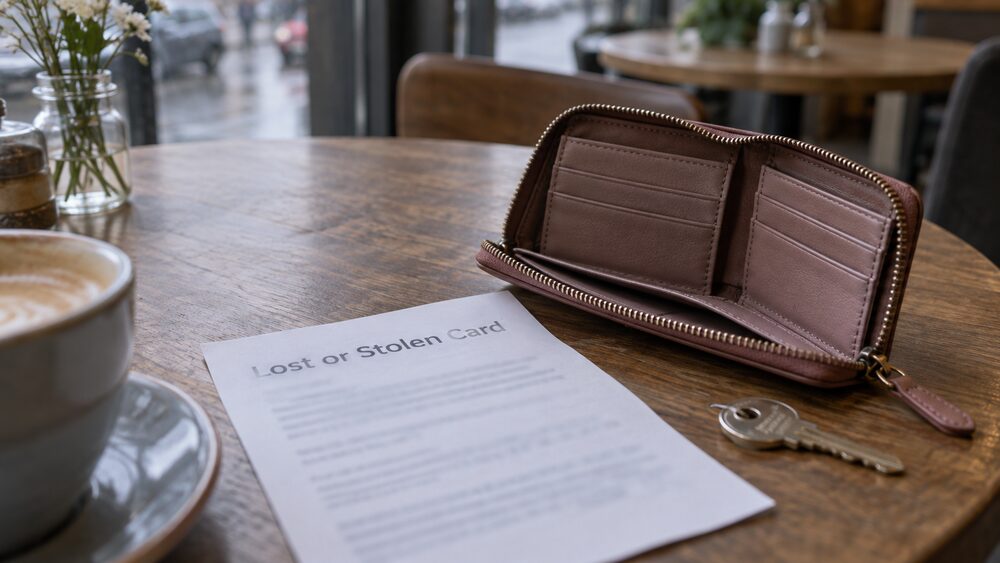
If your card goes missing, the single most important step is to tell your bank immediately. Take Five, the national campaign against fraud, puts it plainly: "If your card is lost or stolen, report it to your bank immediately."1 The reason is liability. Once you have told your bank that your card has been stolen, or that someone else has got hold of your security details, you are not liable for any unauthorised payments taken after that point2. The sooner the card is blocked, the smaller the window in which a criminal can spend on it.
This is not a rare problem. Lost and stolen card fraud accounted for 449,189 confirmed cases in 2025, with a value of £109.8 million, according to UK Finance's Annual Fraud Report 20263. Most of that loss falls on banks rather than customers, because the rules protect a cardholder who reports promptly. But the protection works through reporting, and this page explains exactly how to do that: in your app, through online banking, by phone, and when to bring in the police.
Report a lost or stolen card to your bank straight away
The first call or tap matters more than anything else on this page. Which?'s scams reporting guidance is consistent with every official source: if you have lost money or spotted an unauthorised transaction, contact your bank immediately using the phone number on the back of your card6. Northern Ireland's official consumer guidance says the same thing in slightly wider terms: speak to your bank or building society straight away if you think your card, online bank account or cheque book have been stolen or hacked7.
There are two situations where the urgency steps up a level. The first is when your phone is stolen along with, or instead of, your card. Take Five advises reporting the phone as stolen and freezing your card immediately, and if you cannot do either, using a friend's or family member's phone to call your bank8. The second is when you are abroad or cannot find your bank's number: reporting services run around the clock, and Zempler Bank, for instance, states that lost and stolen cards can be reported to its customer service team 24 hours a day, 7 days a week5.
Each bank publishes its own route. first direct asks customers to report a lost or stolen card in the Cards section of its app or by calling 03 456 100 1009. Lloyds Bank blocks the card straight away when you report it and posts a replacement10. Virgin Money's advice to its customers is simply to report a lost or stolen card straight away so it can be blocked11. The principle is the same everywhere: the bank cancels the old card, which stops any further spending, and starts the process of sending you a new one.
If money has already gone out of your account, the reporting call is also the start of getting it back. Resolver's guidance on credit card disputes says to report the issue to your card company immediately, and if the card was stolen, to consider reporting it to the police so you have a crime reference number12. Take Five's identity theft advice adds that any lost card, driving licence or passport should be reported as lost immediately to the organisation that issued it13. For a fuller picture of how fraud attempts work and how to spot them, see the guide to scams and fraud.
Reporting in your banking app
For most people the app is now the fastest route, and it is worth knowing how yours works before you ever need it. Take Five suggests checking in advance how you can report a phone as lost or stolen on your banking app or website, so you know what to do if it happens8. The same preparation applies to a card.
Most large banks support both a temporary freeze and a full report. Barclays lets you freeze a card or report it as lost or stolen in its app if the card goes missing or you cannot find it14. Santander describes its app as the easiest way to report a card as lost, stolen or damaged: log on, choose the card, and tap Report card15. Barclays' reporting path runs from the home page: select Manage your cards or Your cards, then Report damaged, lost or stolen16. Nationwide says a card can be reported lost or stolen in its app, over the phone, or at a branch17. TSB lists report lost or stolen card as a feature of its mobile banking app18, and RBS lets you report a debit card as lost or damaged and order a new one in its app19.
The distinction between freezing and reporting matters. A freeze is a pause: it suits a card you think is somewhere in the house. A report is permanent: the card is cancelled, and a replacement is ordered. Freezing first costs nothing and buys thinking time, but if there is any chance the card has been taken, reporting is the safer option, because it is the report that fixes your liability position for later payments2.
Two further points are worth knowing. Setting up alerts in your banking app, so you know when your card has been used, is one of the protections Take Five recommends against digital wallet fraud20. And not every bank offers an in-app freeze: Which? notes that the Co-operative Bank is a notable exception, so a Co-operative Bank customer who loses a card needs to report it rather than simply pause it21. Some app-based banks go further still: Which? reports that Chase customers can generate new card details within the app and carry on spending as usual if they think a fraudster has the old ones22.
Reporting through online banking
If you do not have the app, or your phone is the thing that has gone missing, online banking from any browser does the same job. Lloyds Bank lets customers registered for Internet Banking or its mobile app report a card lost or stolen online, and the existing card is cancelled straight away23. Its reporting route is either a search for lost or stolen and a quick form, or logging in and selecting help and support from the account overview, then choosing lost or stolen card10.
Online banking is also the natural place to do the follow-up checks that a lost card calls for. The Information Commissioner's Office (ICO), the data protection regulator, advises anyone whose documents have been lost or stolen to report them to the organisation that issued them, and then to check bank statements and their credit report, watch out for phishing, use strong passwords and multifactor authentication, and consider applying for Cifas protective registration24. The ICO's identity theft guidance makes the same point about reporting lost or stolen documents such as passports, driving licences, credit cards and cheque books to the issuer25, and its Northern Ireland guidance repeats it26.
The reason for checking statements and a credit file is that a missing card can be a symptom rather than the whole problem. If a wallet or bag was taken, the thief may hold documents that allow wider identity fraud, not just card spending. The steps in the ICO's data breach guidance, including Cifas protective registration, which adds a warning flag to your credit file, are designed for exactly that situation24. If you want to see what is on your credit file in full, the guide to requesting your statutory credit report explains how to get it free from each agency.
Lost or stolen credit cards: card company first, then the police
A credit card is reported in much the same way as a debit card, and the card company comes first. The Finance and Leasing Association states that identity fraud involving plastic cards, online banking or cheques should be reported directly to the financial institution concerned27. Resolver's guidance is the same: report the issue to your credit card company immediately, and if the card was stolen, consider reporting it to the police for a crime reference number12.
The police step is about the theft, not the card. Which?'s identity theft guidance advises contacting your bank, credit card company and the local police on the non-emergency number 101 as soon as possible, and reporting the incident to Action Fraud, the national fraud reporting service28. Which? has also reported on the rise of ID fraud and gives the same sequence: bank first, then police on 101, then Action Fraud29. In Scotland there is a difference: the reporting route is the police on 101 rather than Action Fraud, which covers England, Wales and Northern Ireland.
Once the card is reported, the clock starts on your replacement, and for debit cards that clock is regulated. The Financial Conduct Authority's Banking Conduct of Business Sourcebook (BCOBS 7.4.1R) requires firms to publish information about the time it takes to replace a debit card that has been lost, stolen or stopped4. The rule also fixes when the count begins: the time is measured from the earlier of the day the card is reported lost or stolen and the day the firm stopped the card for any other reason4. The published figure appears in the FCA handbook's table of required disclosures, covering the time taken to replace a lost, stolen or stopped debit card32. Lloyds Bank, for example, states that a new card arrives in five working days, depending on the type of card ordered10.
For credit cards the same practical steps apply even though the publishing rule is written for debit cards. Lloyds says customers can view new debit card details in the app the next day and credit card details within five days of reporting10, which means online and contactless spending can resume before the physical card arrives. One thing to plan for: recurring payments tied to the old card will usually fail until they are updated with the new details, and the guide to recurring payments when you get a new card covers what to expect.
When a stolen card points to wider fraud
Sometimes a missing card is an isolated nuisance. Sometimes it is the first sign that someone has your personal information, and the response needs to be bigger than one phone call.
Take Five defines two fraud types that sit behind a lost or stolen card. Card ID theft is when a criminal uses a fraudulently obtained card or card details, along with stolen personal information, to open or take over a card account held in someone else's name1. Card-not-received fraud is when a card is stolen in transit, after the issuer sends it out and before the genuine cardholder receives it1. Both are reasons to treat a missing card, or an expected card that never arrives, as potentially more than a delivery problem. UK Finance recorded 103,171 cases of card ID theft in 2025, a fall of 11% on the previous year33.
The scale of lost and stolen card fraud itself is substantial: those 449,189 cases in 2025 were worth £109.8 million, a 2% fall in value on 20243. Within that, contactless spending on stolen cards is a real but limited part of the picture: Consumer Scotland notes that contactless fraudulent payments resulting from a stolen card make up a very small part of card frauds, around 8% of overall card fraud losses34. In other words, most of the loss does not come from a thief tapping a stolen card in a shop, which is why cancelling the card matters more than worrying about the contactless limit.
If the theft involved documents as well as the card, the ICO's checklist is the practical response: report each lost or stolen document to its issuer, check statements and your credit report, watch for phishing approaches, strengthen passwords and use multifactor authentication, and consider Cifas protective registration24. Which?'s guide to identity theft sets out the same sequence for victims, starting with the bank and card company and the police on 10128. If a dispute with the bank about unauthorised payments stalls, the guide to writing an effective complaint and the page on free consumer advice explain the next steps.
If the card turns up, or is only damaged
A card that reappears after you have reported it cannot be brought back to life. Reporting a card as lost or stolen cancels it permanently, and the replacement is already on its way, so the old card should be cut up and disposed of rather than used. Take Five's advice to report a lost card immediately to the organisation that issued it13 accepts that some reports will turn out to be false alarms, and the industry treats that as the price of catching the real losses quickly. If the card turns up before you have reported it, a freeze in the app can be reversed instead, which is why freezing first suits a card that is merely mislaid14.
A damaged card follows the same reporting route as a lost one. Santander handles lost, stolen and damaged cards through the same Report card option in its app15, and RBS lets customers report a debit or credit card as lost or damaged and order a new one in a single step19. Barclays' app path covers damaged, lost and stolen cards together16. The outcome is the same in each case: the old card stops working and a replacement is posted to the address the bank holds, so it is worth checking the bank has your current address before you report.
While you wait, the details may be available before the plastic arrives. Lloyds lets customers view new debit card details in the app the next day and credit card details within five days10, and app-based banks such as Chase can generate new details instantly22. Adding the new card to a digital wallet can restore contactless payments in the meantime, and Take Five recommends app alerts so you know whenever a card of yours is used20. Once the replacement arrives, remember the recurring payments: subscriptions and other regular card payments will need the new details, and the guide to recurring payments when you get a new card explains what happens to them.
Sources34 cited
- Card fraud: how to protect yourself Take Five to Stop Fraud, 2026
- Dealing with fraud Business Debtline, 2026
- Annual Fraud Report 2026 UK Finance, June 2026
- BCOBS 7.4.1R: card replacement information Financial Conduct Authority, 2018
- Report a lost or stolen card Zempler Bank, 2026
- I'm a scams expert: my tips for reporting scams Which?, 2026
- Protect your identity nidirect, 2025
- Stolen mobile phone: what to do Take Five to Stop Fraud, 2026
- Contactless and card security first direct, 2026
- Lost or stolen cards Lloyds Bank, 2026
- Card fraud Virgin Money, 2026
- Credit cards: no payment taken complaints Resolver, 2026
- Identity theft: how to protect yourself Take Five to Stop Fraud, 2026
- Trusted person fraud Barclays, 2026
- Cancelling your credit card Santander, 2026
- Lost or stolen card Barclays, 2026
- Managing your current account Nationwide, 2026
- Mobile banking features TSB, 2026
- Travel and everyday banking RBS, 2026
- Digital wallet fraud Take Five to Stop Fraud, 2026
- The 5 biggest banking security threats and how to avoid them Which?, 2025
- What are numberless cards and could they help stop fraud? Which?, 2022
- Using a credit card abroad Lloyds Bank, 2026
- Steps to take if you have been affected by a personal data breach Information Commissioner's Office, 2026
- Identity theft Information Commissioner's Office, 2026
- Identity theft (Northern Ireland) Information Commissioner's Office, 2026
- Identity theft: consumer information Finance and Leasing Association, 2026
- What is identity theft? Which?, 2026
- ID fraud is on the rise: how to stay safe Which?, 2024
- Credit card complaints: no passcode provided Resolver, 2026-09-26
- Fraudulent emails Bank of Ireland UK, 2026-09-25
- BCOBS 7 Annex 1: required disclosures Financial Conduct Authority, 2025
- Fraud Report 2026 UK Finance, June 2026
- Response to FCA engagement paper on contactless payment limits Consumer Scotland, 2025



 Citizens AdviceFree advice on money, consumer and legal problems in England and Wales
 MoneyHelperFree, impartial money and pensions guidance, set up by government
 Financial Ombudsman ServiceFree, independent help when a complaint about a firm is not put right
 GOV.UKOfficial information on tax, benefits and government services
 StepChangeFree debt advice and solutions from a charity