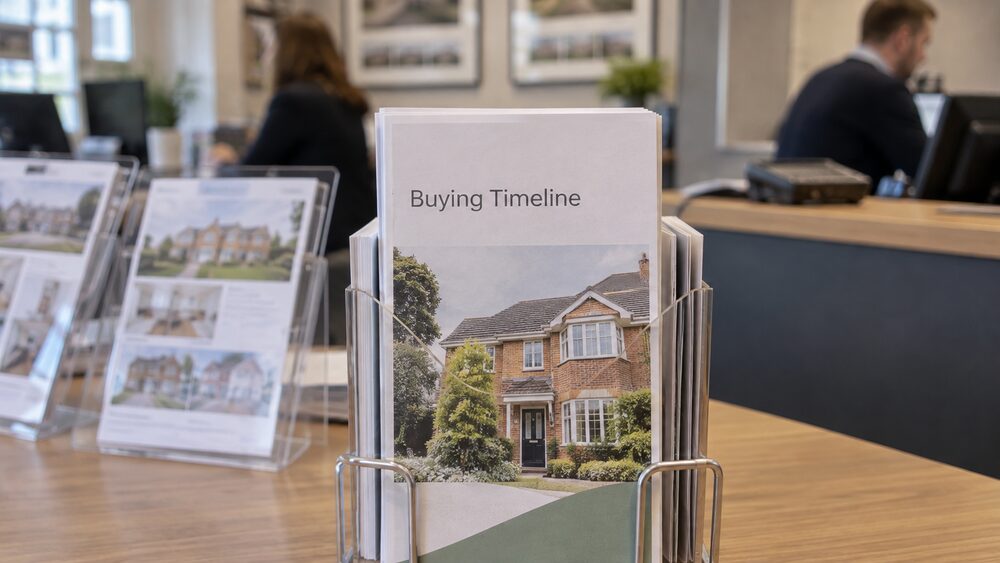
Once a seller accepts your offer, the clock starts. For a standard purchase, buying a home usually takes around two to three months from start to finish1, and buying a home in England and Wales takes about 5 months on average across the whole process2. The gap between those two figures is the point: the offer is not the beginning of the purchase, and the legal work, the survey and your mortgage all sit between the accepted offer and the day you get the keys.
Once a seller accepts your offer, the clock starts. For a standard purchase, buying a home usually takes around two to three months from start to finish1, and buying a home in England and Wales takes about 5 months on average across the whole process2. The gap between those two figures is the point: the offer is not the beginning of the purchase, and the legal work, the survey and your mortgage all sit between the accepted offer and the day you get the keys.
From having an offer accepted to exchange of contracts can take up to seven weeks, and from exchange of contracts to completion can take up to four weeks2. Completion often takes place around two weeks after exchange, but this is flexible and you can agree a convenient date with the seller3. So a realistic answer to "how long after an offer is accepted?" is roughly one to three months for the legal stages, with the whole purchase, including finding the property and agreeing a price, running longer.
The route you are buying through changes the timetable. A home purchase plan, Co-Ownership in Northern Ireland, Right to Buy and the House Sales Scheme each have their own stages and, in some cases, their own deadlines that can end your application if you miss them.
From accepted offer to completion: the usual stages
The purchase runs through a recognisable sequence. You agree a price, your mortgage lender issues an offer, a survey is carried out, your solicitor or conveyancer drafts and agrees the contract with the seller's, you exchange contracts, and then you complete. Each stage has its own typical duration, and they overlap.
Agreeing a price is not instant. It may take several weeks to agree a price at all7. Once you have, an agreement in principle from a lender can take as little as 15 minutes or up to 24 hours7. The legal work then runs from offer accepted to exchange of contracts, which can take up to seven weeks2, and from exchange to completion, which can take up to four weeks2. Completion often takes place around two weeks after exchange, but this is flexible and you can agree a convenient date with the seller3.
For new purchases, from mortgage offer to completion usually takes between one and three months, or three and six weeks for some cases8. After you receive your mortgage offer, it can take around 12 weeks to complete on your property9. The variation between these figures reflects how much depends on the individual chain, the lender and the solicitor.
The government has been consulting on reforms to home buying and selling. The government hopes these changes will cut the time it takes to buy a home, which is currently around 120 days, and aims to cut buying times by around four weeks10. Those changes are not yet in force, so the current timescales above still apply.
Surveys and contract drafting: a week to a month
After your offer is accepted and your mortgage is agreed, the survey and the drafting of the contract can take anywhere from a week to a month4. This is the stage where the property is checked and the legal paperwork is prepared, and it is often where delays appear, because it depends on the surveyor's availability, the seller's solicitor responding, and any issues the survey turns up.
The legal work as a whole runs from offer accepted to exchange of contracts, which can take up to seven weeks2. If the survey reveals a problem, or the lender's valuation comes in lower than the price you agreed, the timetable can stretch while that is resolved. The seller's own legal work has to keep pace with yours, and in a chain, the slowest link sets the speed.
Once contracts are exchanged, the remaining legal work runs to completion, which can take up to four weeks2. Completion often takes place around two weeks after exchange, but this is flexible and you can agree a convenient date with the seller3. It is often a week or so after you have exchanged contracts7.
Home purchase plans: 2 to 4 weeks to an offer of finance, then 12 to 16 weeks
A home purchase plan is a Sharia-compliant alternative to a mortgage, offered in the UK by Gatehouse Bank. The provider states the process usually takes 2 to 4 weeks from the initial application to an Offer of finance being issued, as long as you send the documents requested11. Then it is usually another 12 to 16 weeks from receiving a signed Offer of finance to legal completion, subject to satisfactory legal reports12.
The same two-stage pattern appears across the provider's own guidance: 2 to 4 weeks from initial application to an Offer of finance, then usually another 12 to 16 weeks from a signed Offer to legal completion13. The provider repeats this timescale for its buy-to-let purchase plans and for international resident buy-to-let purchase plans14.
For comparison, with a standard mortgage the mortgage offer is typically received within four weeks of applying15, and after the mortgage offer is received, completion can take around 12 weeks9. So the offer stage is broadly similar, and the legal completion stage is where the home purchase plan's stated 12 to 16 weeks sits alongside the mortgage route's roughly 12 weeks.
Co-Ownership purchases: 8 to 12 weeks from accepted offer
Co-Ownership is the Northern Ireland scheme that lets you buy a share of a home and pay rent on the rest. Its own guidance says the time from accepted offer to completion typically takes 8 to 12 weeks, similar to any house purchase6. The same figure is given for finding a property: the time from accepted offer to completion typically takes 8 to 12 weeks, similar to any house purchase16.
Across the whole process, most Co-Ownership applications take between three and six months from application to completion, although this can vary17. The mortgage side has its own timescale: the time it takes to process a mortgage application varies by lender, but typically it takes between two and six weeks18.
If you later sell a Co-Ownership home, a separate deadline applies. The sale must be completed within 12 weeks of the valuation completing19. That is a deadline on the sale, not on the original purchase, but it is worth knowing if you plan to move on.
Right to Buy and other schemes with their own deadlines
Right to Buy, the House Sales Scheme in Northern Ireland and Right to Acquire each run to their own timetable, and some of the deadlines are strict.
Under Right to Buy, you have up to 12 weeks to accept your landlord's offer5. If you disagree with the offer, you must write to your landlord within three months of getting it and ask for an independent valuation20. Your landlord must send the offer, known as a Section 125 Notice, within a further 8 weeks after you have received your RTB2 form if your home is a house and you are buying the freehold, or within 12 weeks if it is a flat or a leasehold house5. Your landlord's initial response to your application comes within 4 weeks of receiving your RTB1 form if you have been a tenant for 3 years or more, or within 8 weeks if you have been a tenant for less than 3 years5.
If you do not reply to a reminder within 28 days, your landlord will think you do not want to buy, and your application will not be dealt with5. Once you have the offer, a warning notice will ask you either to complete the purchase within 8 weeks or to write and tell your landlord that you disagree with it5. Your landlord is not bound to complete the sale if you have not paid all the rent or any other payment within 4 weeks from the date you were asked to pay it5.
In Northern Ireland, the House Sales Scheme works differently. You must make your decision about going ahead to buy your home within six weeks of receiving the offer21. If you sell within ten years, you must give the Housing Executive the option to buy back the property, and you cannot sell your property until the Housing Executive confirms that it does not wish to buy the property21.
Right to Acquire, for housing association tenants in England, requires that you have lived in a council or housing association home for 3 years and that the home was built or bought by a housing association after 31 March 199720. Under Right to Buy, if you have been a tenant for 3 or more years, it does not have to be 3 years in a row, you could qualify to buy the home5. If you purchase under Right to Buy and wish to resell or dispose of it within 10 years, your landlord may require you to offer your home to them5.
What can slow a purchase down
The figures above are typical, not guaranteed. Several things push a purchase past the usual timescales.
A chain is the most common cause. If the seller is buying another home, their purchase has to complete before yours can, and the slowest transaction in the chain sets the pace. A survey that reveals a problem, or a lender's valuation that comes in lower than the price you agreed, can also add weeks while it is resolved.
The mortgage stage has its own variability. An agreement in principle can take as little as 15 minutes or up to 24 hours7, but the full application and offer take longer. The mortgage offer is typically received within four weeks of applying15. For new purchases, from mortgage offer to completion usually takes between one and three months8.
If you are on a fixed rate that is ending, the Mortgage Charter sets out how lenders handle switching. Rates must be finalised two weeks before the new term starts, and six months is the maximum time lenders may offer for customers to sign up to a new deal under the Mortgage Charter22. That is a separate deadline from the purchase itself, but it can affect the timing of a remortgage alongside a move.
Where to get help
If a purchase goes wrong, or you need to understand your options, free and impartial help is available. Citizens Advice covers buying and selling a home, including what to do if something goes wrong2. The government's own guidance on buying a home sets out the process in England and Wales1. For Northern Ireland, nidirect's step-by-step guide covers the process there3.
If you are buying through a scheme, the scheme's own guidance is the place to check deadlines: Right to Buy5, the House Sales Scheme21, and Co-Ownership6. For a home purchase plan, the provider's own guidance sets out the timescales11.
Sources22 cited
- Buying a home GOV.UK, 2026-09-26
- Buying a home Citizens Advice, 2026-09-25
- How to buy a house Which?, 2026-05-29
- Making an offer on a house Lloyds Bank, 2026-09-27
- Your Right to Buy your home: a guide GOV.UK, 2026-04-08
- Starting the process Co-Ownership, 2026-09-26
- How long does it take to buy a house? Experian, 2026
- Applying for a mortgage Cambridge Building Society, 2026-09-26
- Timeline for buying a home HSBC UK, 2026
- Home buying and selling changes: what you need to know Which?, 2026-06-18
- Home finance Gatehouse Bank, 2026-09-26
- Home finance FAQs Gatehouse Bank, 2026-09-26
- Home purchase plan FAQs Gatehouse Bank, 2026-09-26
- Buy-to-let Gatehouse Bank, 2026-09-26
- Applying for a mortgage Which?, 2026-05-20
- Finding a property Co-Ownership, 2026-09-26
- Step-by-step process Co-Ownership, 2026-09-26
- Getting a mortgage Co-Ownership, 2026-09-26
- Selling your home and buying us out Co-Ownership, 2026-09-26
- Right to Buy and Right to Acquire Scope, 2026-04-01
- House Sales Scheme nidirect, 2026-02-18
- Mortgage Charter HM Treasury, 2023-06







 MoneyHelperFree, impartial money and pensions guidance, set up by government
 Citizens AdviceFree advice on money, consumer and legal problems in England and Wales
 ShelterFree housing advice from a charity
 GOV.UKOfficial information on tax, benefits and government services
 Financial Ombudsman ServiceFree, independent help when a complaint about a firm is not put right