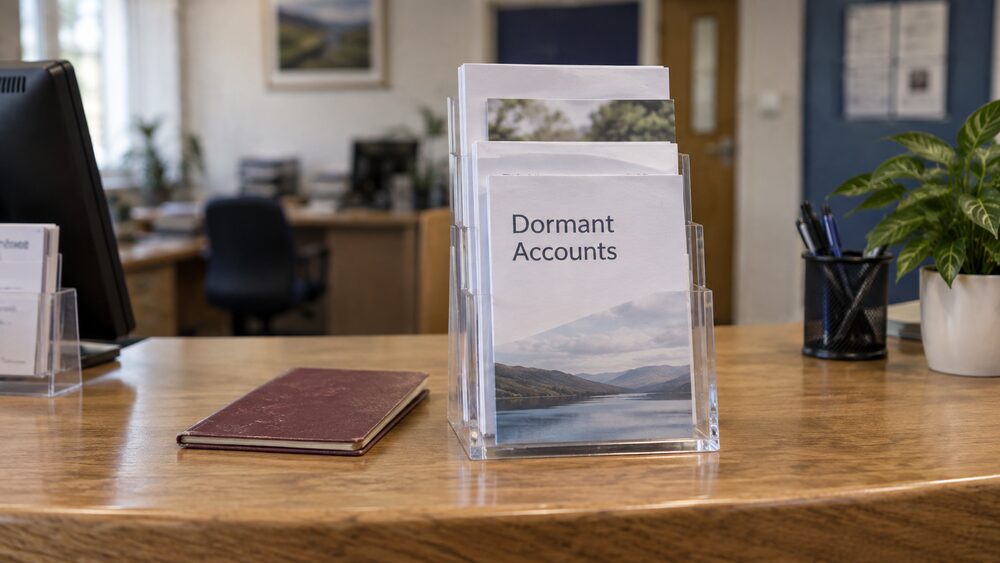
Money left in a credit union account does not disappear when you stop using it. It stays yours, but the account can be marked dormant, and dormancy has consequences: several credit unions state that a dormant account stops attracting the annual dividend, and one adds that a dormant member also loses the right to vote at general meetings1.
Money left in a credit union account does not disappear when you stop using it. It stays yours, but the account can be marked dormant, and dormancy has consequences: several credit unions state that a dormant account stops attracting the annual dividend, and one adds that a dormant member also loses the right to vote at general meetings1.
The trigger varies by credit union. One declares an account dormant after 36 months with no transactions and no reply to its letters, and moves it into a suspense account3. Others act sooner: two accounts at the same credit union say the credit union may declare an account dormant if no deposits are made for six months or more, with no dividend paid on dormant accounts4. A third says an account inactive for three years, with no contact in that period, may become dormant6.
Getting the money back is usually a matter of proving who you are and asking. A member with no loan account can normally withdraw part or all of their savings during normal office hours, and many credit unions pay out by bank transfer7.
What stays in a credit union account you stopped using
Your savings stay in the account, and so does your membership, but the account stops working for you in two ways. The first is the dividend. A credit union is a not-for-profit community lender, and any surplus it makes is paid back to members as a dividend12. That dividend is not guaranteed: one credit union states plainly that a dividend may be payable but cannot be guaranteed, and that if one is paid it is added after the annual general meeting13. Another states that a dormant member's account will not attract the annual dividend and that the member forfeits their right to vote at general meetings2.
The second is access. A dormant account is often moved into a suspense account, which means routine transactions stop until the member gets in touch3. The savings themselves are not lost, and they are not taken by the credit union. Members' savings are used to fund loans to other credit-worthy members, so your balance has been working in the meantime, but the balance remains yours14.
The dormancy clock differs sharply between credit unions, and the terms are the place to check. Six months without a deposit is enough for one credit union to declare an account dormant4; three years without a transaction or a reply to correspondence is the trigger at another3. If you have moved house and not told the credit union, correspondence will have gone astray, which is often what starts the process.
Finding the credit union that holds your savings
The first step is working out which credit union it was. Credit unions work through a common bond: members share a link such as living, working, studying or volunteering in a certain area, working in the same industry or for certain employers, or belonging to the same trade union15. Most local areas have a credit union, so the area where you lived or worked at the time is a useful starting point16.
If the name has gone, the Association of British Credit Unions can help: you can search its website for your local credit union or call 0800 015 306011. Credit unions also operate through online and phone banking, payroll partnerships with employers, and local branches or service points, so an employer's payroll team may be able to say which credit union ran a deduction from your pay17.
For forgotten savings more generally, the My Lost Account service searches forgotten savings pots from banks and building societies, including NS&I18. It is not a credit union tracing service, but it is the standard route for money you cannot place. Checking your credit report through Experian, Credit Karma or Equifax can also surface accounts you had forgotten, and after a data breach it is worth checking your report with the three main credit agencies, TransUnion, Experian and Equifax, to make sure credit has not been taken out in your name19.
If you are starting from scratch rather than tracing an old account, the credit union directory lists providers, and finding a credit union you can join explains how the common bond decides who qualifies.
The ID you need to reclaim your account
Reactivating a dormant account is an identity check. One credit union sets it out precisely: the account may be reactivated by conducting transactions and supporting it with photographic ID such as a passport, driving licence or birth certificate for children, plus confirmation of address not more than three months old, such as a utility bill or revenue documentation6.
That pattern is standard. MoneyHelper says you will usually need to provide two recent documents to prove your identity and address, for example a passport, driving licence, student or work ID card, bus pass, birth certificate, bank statement or energy bill15. The same guidance applies to opening a credit union current account, where you will usually need ID such as a driving licence, passport, recent bills or official documents22.
Two practical points trip people up. The address document must be recent, so a bill from two years ago will not do. And if you have moved since the account was opened, the credit union needs the new address before it can match you to the old record, which is often the whole reason the account went dormant in the first place.
Ways to take your money out
Once the account is active, the withdrawal options depend on what the credit union offers. A member with no loan account may withdraw part or all of their savings at any time during normal office hours at one credit union7. Another pays out by bank transfer or cash withdrawal at its office8. A credit union current account lets you withdraw cash in branch or at an ATM23.
Across the sector, the routes are: cashing a cheque at a local Post Office, taking cash from the local credit union office, having the money paid directly into a bank account, or using a debit card at a cash machine if the credit union runs a current account24. Credit union bank accounts commonly let you pay in or take out cash at the credit union, have wages, benefits and pensions paid in, and use online, mobile or telephone banking, all for free15.
If you are simply moving money to a bank account, the withdrawals page covers notice periods and how shares are released, and getting your money out is the same process whether the account is active or being reactivated.
Where savings can be kept back to repay a loan
If you borrowed from the credit union and still owe money, your savings are not simply yours to withdraw. One credit union's terms state that it may use any balances held in a member's savings account to reduce or repay any loan that falls into default, with notification and an opportunity to make repayments26. That is the key condition: savings can be held against a loan, and the credit union will normally tell you before it acts.
The flip side is that many credit unions build savings while you repay. One splits repayments between the loan and savings, so that when the loan is cleared you have a savings pot to use as you wish27. Another lets you put a small amount aside each time you make a repayment28, and a third simply says "Build savings as you repay your loan"29. One credit union lets you use those savings to pay off the loan early once you reach 50% repaid, or leave them as a savings pot30.
Repayment methods vary too: standing order, payroll deduction, cash, cheque, card payment or a collection point for most loans, and direct deductions from the benefit or wage paid into the account for a family loan and savings plan31. If you are tracing an old account and find a loan attached, the save as you borrow page explains how the two sides work together, and withdrawing shares while repaying a loan covers what you can and cannot take out.
FSCS protection: up to £85,000 or £120,000 per person
Credit union savings are protected by the Financial Services Compensation Scheme, and the figures in circulation differ, so it is worth being precise. The FSCS states that it protects up to £120,000 in total across all accounts you hold with the credit union, and that it can pay back any money you hold with a failed credit union up to its compensation limit of £120,000 per person10. MoneyHelper gives the same figure: just like most banks, up to £120,000 per person is protected in a credit union account15. The FSCS's own leaflet describes automatic protection up to £120,000 if your bank, building society or credit union fails32.
Some credit union material still quotes £85,000 per individual, and FSCS material for debt management claims quotes £85,000 per person per firm33. The £120,000 figure is the current deposit protection limit and the one the FSCS and MoneyHelper both give for credit union deposits10.
Two limits matter in practice. The £120,000 is per person, per authorised firm, so money held in two credit unions that share one authorisation counts together, while joint accounts are treated separately. And protection covers deposits, not everything: loans and savings are protected by the FSCS, but the protection applies to the money you hold, not to the terms of a loan35.
Fees, complaints and where to get help
Some credit unions charge for dormant accounts. One sets a £20 annual fee for dormant accounts1; another charges an annual administration fee of £5 on each dormant account9. The fee is deducted from the account rather than billed separately, so a small balance can shrink over time. There is no general rule that you must pay to reclaim your own savings, and the fee is a term of the account rather than a charge for tracing.
If something goes wrong, a credit union's own complaints process comes first. One sets out the route: phone 0141 222 2259, email info@keepcreditunion.co.uk, or write to Keep Credit Union, 5th Floor, 52 St. Enoch Square, Glasgow G1 4AA, and if the matter is unresolved within eight weeks or you are not satisfied with the final response, you can refer it to the Financial Ombudsman Service1.
Free, impartial help is available. MoneyHelper covers credit union current accounts and how to choose the right bank account15. StepChange, a debt advice charity, explains how credit unions work and how to make budgeting easier16. In Northern Ireland, credit union law is largely devolved, and its credit unions are counted separately, adding well over half a million members; the Irish League of Credit Unions is the trade and representative body for 92 credit unions there, which makes it the natural starting point for tracing an account in the province37.
Credit unions are not-for-profit community lenders providing affordable loans and savings, and they always consider affordability when assessing loan applications35. If you are thinking about rejoining rather than reclaiming, how to join a credit union sets out ID, fees and minimum balances, and the common bond explains who qualifies.
Sources39 cited
- Keep Credit Union membership terms and conditions Keep Credit Union, 2026-09-03
- Metro Moneywise membership terms and conditions The Money Coop, 2026-06-17
- Orchard Credit Union membership general terms and conditions Orchard Credit Union, 2026-09-26
- Share account SaveEasy Credit Union, 2026-09-26
- Christmas saver SaveEasy Credit Union, 2026-09-26
- Savings Beragh Credit Union, 2026-09-26
- Savings Mourne Derg Credit Union, 2026-04-20
- Savings Stevenage Credit Union, 2026-09-26
- Membership and savings terms and conditions creditunion.co.uk, 2025
- Deposit protection for credit unions Financial Services Compensation Scheme, 2026-09-25
- Considering a payday loan StepChange, 2026-09-25
- What is a credit union? Capital Credit Union, 2026
- Savings Falkirk District Credit Union, 2026-02-26
- About credit unions UFCU, 2026-09-26
- Credit union current accounts MoneyHelper, 2026-09-25
- Credit unions StepChange, 2026-09-25
- About credit unions Association of British Credit Unions, 2026-04-01
- Are you sitting on a windfall? How to track down forgotten money Which?, 2026-07-11
- Ways to make budgeting easier StepChange, 2026-09-25
- My personal data has been lost after a breach: what are my rights? Which?, 2026-08-14
- Loans Beragh Credit Union, 2026-09-26
- Choosing a bank account for your Universal Credit payment MoneyHelper, 2026-09-25
- Current account Darlington Credit Union, 2026-09-26
- Ways to bank Consumer Council for Northern Ireland, 2026-09-15
- How to choose the right bank account MoneyHelper, 2026-09-25
- Payroll member loan terms Just Credit Union, 2025-10-28
- Top up loans Darlington Credit Union, 2026-09-26
- Booster loan creditunion.co.uk, 2026-08-13
- Personal loans creditunion.co.uk, 2026-08-21
- Personal loan Darlington Credit Union, 2026-09-26
- Loan frequently asked questions SaveEasy Credit Union, 2026-09-26
- FSCS protected leaflet Financial Services Compensation Scheme, 2026-02
- What is a credit union? SCVO Credit Union, 2026-09-26
- FSCS protected badge leaflet Financial Services Compensation Scheme, 2025-11-27
- Save, bank or borrow: credit union Welsh Government, 2026
- Credit unions Building Societies Association, 2026-09-15
- Credit union law in Northern Ireland House of Commons Library, 2026-07-08
- Help and advice on illegal lending Consumer Council for Northern Ireland, 2026
- Savings Dromore (Tyrone) Credit Union, 2026-09-26











 MoneyHelperFree, impartial money and pensions guidance, set up by government
 FSCSProtects your money if a bank, insurer or investment firm fails
 Financial Ombudsman ServiceFree, independent help when a complaint about a firm is not put right
 StepChangeFree debt advice and solutions from a charity
 Citizens AdviceFree advice on money, consumer and legal problems in England and Wales