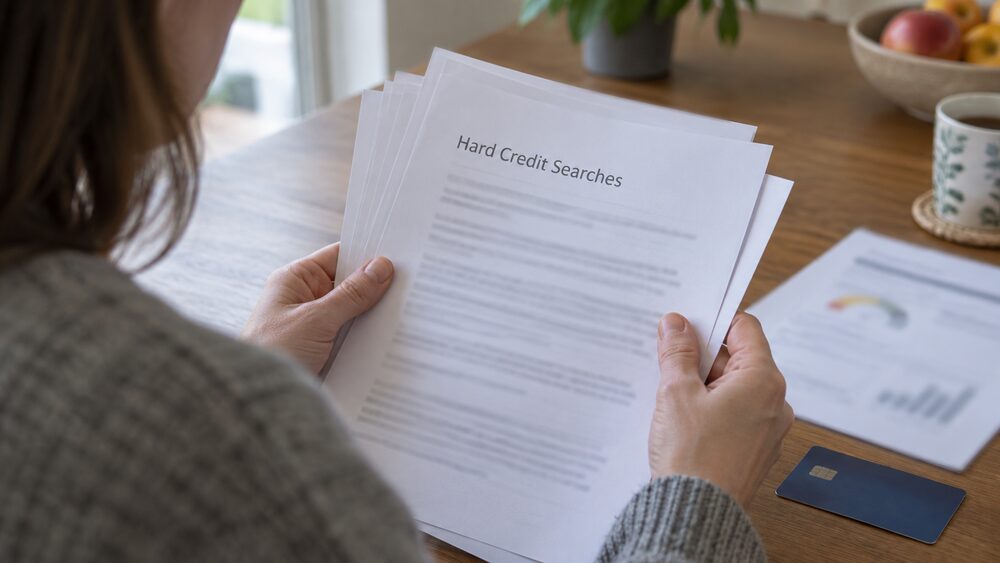
There is no fixed number of credit applications that is safe for everyone. What matters is the pattern a lender sees: several applications close together leave a trail of hard searches on your credit file, and that trail can lower your score and your chances of approval. One source describes a footprint visible to other lenders for at least 12 months, while an industry policy statement says hard searches normally stay on the respective credit files for two years1.
There is no fixed number of credit applications that is safe for everyone. What matters is the pattern a lender sees: several applications close together leave a trail of hard searches on your credit file, and that trail can lower your score and your chances of approval. One source describes a footprint visible to other lenders for at least 12 months, while an industry policy statement says hard searches normally stay on the respective credit files for two years1.
The practical answer is to apply only where you have a realistic chance. Eligibility checkers let you see the odds without leaving a hard search, and you can check your own credit score as often as you like without doing any harm3. Where a full application is needed, guidance points to spacing them by months rather than days5.
This page explains what lenders can actually see, how a burst of applications affects your score, why no single number is safe, how to test your chances first, and what to do after a refusal.
Hard searches and soft searches: what lenders can see
There are two types of search on your credit file: a soft search, which won't be seen by other lenders, and a hard search, which will be visible to them7. The distinction matters because only one of them follows you around.
A hard search happens when you make a full application for credit. It is recorded on your file and can be seen by other lenders deciding whether to lend to you. A soft search happens for background checks, quotes and eligibility checks, and it is not shown to other lenders in the same way.
Some checks that people worry about are soft by rule. Landlords and letting agents can only do a soft search of your credit record, and what they see is limited to information that is already public, such as county court judgments, an IVA or bankruptcy8. That means a tenant reference check does not add a hard search to your file.
Not every credit product is clear-cut. One credit union's Flexi Credit loan states that in some cases the check will be a soft credit search, visible only to you and not affecting your score, but that some loan applications require a hard credit search, which is recorded on your file and may be visible to other lenders10. The lesson is that the same provider can run either kind of check depending on the product and the stage of the application.
How several applications in a short time affect your score
Multiple applications in a short period can negatively impact your credit score, which may further discourage lenders from accepting you11. That is the core of the problem: the searches themselves are a signal, and the signal compounds if you keep applying.
The evidence for this is consistent across sources. Applying for too many cards, or regularly switching cards, can affect your credit rating12. If you apply to lots of lenders, this leaves a trail on your credit reference file, and lenders may think you already have lots of borrowing or have been refused by other creditors13. Making several mortgage applications very close together could significantly damage your credit score14. Applying too often in a short space of time can lower your credit score, meaning you may find it harder to get credit15.
The effect is not limited to one product type. Successive current account applications in a short space of time could negatively affect your score, particularly where accounts with overdrafts appear on your credit report16. Every application for credit, such as a loan or a phone contract, affects your credit score, and making too many at once can be a red flag17. Unsuccessful applications can bring your score down too, so a run of refusals is worse than a single application that succeeds18.
Lenders are also reading intent, not just volume. Applying for finance multiple times in a short period may signal to lenders that you are struggling financially, which could impact their decision19. That is why the pattern matters more than the count: three applications in a fortnight reads very differently from three spread across a year.
Why there is no fixed safe number of applications
No source sets a number of applications that is safe, because the answer depends on what else is on your file and on each lender's own criteria. What the sources describe instead is a pattern that lenders dislike: several hard searches close together, or repeated applications after refusals.
A lot of checks in a short amount of time can reduce your score, and multiple hard searches, particularly within a short period, can lower it4. The wording is about clustering, not about a threshold. Two applications a week apart may look worse than four spread over two years.
The type of credit matters as well. A mortgage application is a heavier decision than a credit card application, and lenders will run a credit check on each applicant before granting a mortgage; if one party has a poor credit score, it could affect the lender's decision21. On a joint application, the lender looks at information on your credit report, information on the application form, and information held if you have been a customer before, plus the same information about the other applicant22. That means a joint application can surface two people's recent search history at once.
Because there is no safe number, the useful question is not "how many can I get away with" but "how likely am I to be accepted". That is what eligibility checkers are for.
Eligibility checkers: checking your chances without a hard search
An eligibility checker runs a soft search, so it won't leave a record on your credit file23. That lets you see whether a provider is likely to accept you before you commit to a full application and the hard search that comes with it.
Providers describe these tools in similar terms. One credit card eligibility checker usually gives a more accurate and personalised offer in about 5 minutes, without affecting your credit score24. Another offers a soft search eligibility check that does not impact your credit score, and notes that if you do not qualify, a different card with its own terms may be offered25. The result is a realistic picture of your options without a trail of searches.
Checking your own credit file is separate from applying, and it is free of risk. You can check your own credit score without hurting it, and you can check it as often as you like without doing any harm4. Checking your own credit score and credit report as many times as you like will never have a negative impact on it26. If you want to see what a lender will see, start there.
Spacing out applications and what to do after a refusal
The guidance on timing is directional rather than precise. One source suggests spreading loan and credit card applications by at least three, if not 12, months5. A lender suggests aiming for a maximum of one credit application every three months6. Another suggests minimising the number of credit card applications and spacing them out over several months or more27. None of these is a rule that makes a particular gap safe, but they point the same way.
If you have been refused, the priority is to stop applying. Do not apply for a lot of credit cards in a short space of time, because getting a lot of rejections in a short period can hurt your score28. Repeated applications after a refusal is the pattern that does the most damage.
It also helps to understand why the refusal happened. Lenders decide on their own criteria, and a refusal is not always about your score. If you think a lender has treated you unfairly, the Financial Ombudsman Service handles complaints about consumer credit, and its 2025/26 data recorded 8,800 cases about perceived irresponsible or unaffordable lending29. Free, impartial help is available from Citizens Advice and from debt advice charities if the underlying issue is affordability rather than a single application.
Where the rules differ across the UK
Credit reference agencies operate across the UK, and the search footprint rules described here apply throughout England, Scotland, Wales and Northern Ireland. What differs is the wider context: the registers that hold public information, such as decrees in Scotland and judgments in Northern Ireland, sit alongside the credit file rather than on it, and the debt advice and insolvency routes differ by nation. If you are dealing with a refusal because of a public record rather than a search, the relevant register and its timescales are the place to look.
Sources30 cited
- How to check your credit score for free Which?, 2025-10-24
- From Control to Financial Freedom report UK Finance, 2024-05
- How to check your credit score for free Which?, 2025-10-24
- Credit score guidance StepChange, 2026-09-25
- How to improve your credit score Which?, 2025-10-24
- Refused credit Experian, 2026
- Universal Credit and credit searches Experian, 2026
- Credit checks when renting Shelter, 2026-05-01
- How landlords and letting agents check tenants Shelter, 2026-05-01
- Flexi Credit loan The Money Coop, 2026-06-17
- How to apply for a credit card Lloyds Bank, 2026-09-27
- Choosing and applying for a credit card Citizens Advice, 2026-09-25
- How lenders decide whether to give you credit Citizens Advice, 2026-09-25
- Applying for a mortgage Which?, 2026-05-20
- Home improvement loans Experian, 2026
- How to open a bank account online Which?, 2026-04-23
- What is a credit score? Metro Bank, 2026-09-25
- Bad credit mortgages Which?, 2025-10-08
- Hard vs soft credit checks HSBC, 2026
- How to check your credit score for free Which?, 2025-10-24
- Mortgage types explained Which?, 2026-04-02
- Joint mortgages Experian, 2026
- Credit card terms explained Santander, 2026
- What is APR? Lloyds Bank, 2026-09-27
- Credit cards for fair credit Zable, 2026-09-25
- Credit myths Experian, 2026
- Using credit cards Experian, 2026
- Credit cards and bad credit scores StepChange, 2026-09-25
- Annual complaints data and insight 2025-26 Financial Ombudsman Service, 2025
- Mortgages HomeOwners Alliance, 2026-07-31












 MoneyHelperFree, impartial money and pensions guidance, set up by government
 Financial Ombudsman ServiceFree, independent help when a complaint about a firm is not put right
 Citizens AdviceFree advice on money, consumer and legal problems in England and Wales
 StepChangeFree debt advice and solutions from a charity
 GOV.UKOfficial information on tax, benefits and government services