
An account status code is the short marker a lender puts against each account on your credit report to show how you have been paying it. It tells anyone reading your file whether the account is up to date, whether a payment was late, and by how many months, or whether the account has gone into default. Lenders assessing a late payment will see a small number next to it to advise them how many months late the payment was1.
An account status code is the short marker a lender puts against each account on your credit report to show how you have been paying it. It tells anyone reading your file whether the account is up to date, whether a payment was late, and by how many months, or whether the account has gone into default. Lenders assessing a late payment will see a small number next to it to advise them how many months late the payment was1.
The codes matter because they are the running record of your borrowing behaviour. A single late payment stays on your credit history for six years, as do missed payments and defaults1. That does not mean six years of refusal, but it does mean the mark is visible to lenders, landlords and anyone else with a legitimate reason to check, and its impact tends to lessen over time2.
This page explains what each kind of status shows, how the codes change as you pay, how long they last, how to read them for free, and how to challenge one that is wrong.
What an account status code shows: up to date, late or in default
Every account on your credit report carries a status that reflects your most recent payments. At its simplest, the status says the account is up to date. When a payment is late, the code changes to show how far behind you are, and lenders see a small number next to each late payment telling them how many months late it was1.
If arrears build up, the account can move to a default. For most types of consumer credit, you get a warning letter called a default notice, and the account defaults around 14 days later6. In practice, a default is generally recorded once you have missed three or more payments3. The rules are not identical for every product. With buy now pay later, if you fall behind with your payments for 90 days or more, the account may be reported as defaulted7.
A default is a serious marker. If you have fallen behind with your mortgage, this will show as a default on your credit file and will stay there for six years8. The same six year period applies to a defaulted buy now pay later account7.
It helps to separate the two things a status code does. It records the fact of a missed or late payment, and it records how serious the position has become. A single late payment and a default are both negative, but they are not the same, and lenders weigh them differently.
How status codes change as you pay, and how long updates take
Status codes are not fixed. Each month a lender reports your position, and the code moves with it. Bring an account back up to date and the newest markers reflect that, though the older late markers remain on the record for their full six years.
The delay between paying and seeing the change is one of the most common sources of confusion. Lenders usually update the credit reference agencies once a month, so a new account may take about a month to show up9. The same monthly rhythm applies to updates on existing accounts10. Some sources put the wider picture at several weeks for updated information to appear on your credit report, and a few months before any new accounts start to help build your credit score11. One debt charity puts the outer limit at up to three months for a new bank or credit account to show on your credit file12.
How often you see your own file refresh depends on where you look. Experian's credit report updates every 30 days with a free account, or daily with CreditExpert13. Free online credit reports from ClearScore, Credit Karma and the Money Saving Expert Credit Club are updated monthly14.
The practical point is that a status code is a snapshot, not a live feed. If you clear an arrears balance today, the code may not change until the next reporting cycle, and the historic late markers stay put regardless.
Late and missed payments stay on your report for six years
The six year figure runs through almost every part of a credit file. Late payments stay on your credit history for six years, as do missed payments and defaults1. Some information stays on your credit file for six years, including missed payments, defaults and court judgments15. All missed, late or partial payments are recorded on your credit file for at least six years16.
The same period applies across the different markers. Information such as missed payments, default notices and court judgments will generally stay on your credit file for six years3. Details of court action, defaults, partial payments and missed payments are recorded on your file for six years17. A missed mortgage repayment leaves a mark on your credit report that will remain for six years18.
There is a subtlety in when the clock starts. Debts show on your credit file for six years from the date they are paid off, or from the date the account defaulted if you did not clear it19. Information about a debt is taken off your file after six years even if you still owe it19. So paying a debt does not remove the record early, but the record does eventually drop off whether or not the money was repaid.
How to see the status codes on your own credit report for free
You have a right to see your credit report, and you do not have to pay for it. To get a free copy of your credit report, you need to contact the credit reference agencies and fill in an application form, and you can usually apply in writing, by phone or online20. Making a statutory request is free of charge21.
The statutory report should reach you within seven working days, unless the agency needs you to send proof of your identity and address4. The same seven working day rule applies across the agencies22.
Alongside the statutory route, the three main agencies offer free access through apps and partner services. Experian offers its credit report and credit score free via the Experian app24. TransUnion's credit report is available free via the Money Saving Expert Credit Club25. Free online reports from ClearScore, Credit Karma and the Money Saving Expert Credit Club are updated monthly14.
You can also check your credit score for free online before you look for a property to rent, which is a useful moment to review the status codes on your file5. Checking your own report is a soft check and does not affect your score5.
Why Experian, Equifax and TransUnion show different codes for the same account
The three biggest organisations for checking your credit report are TransUnion, Equifax and Experian26. Each holds its own record, and each lender decides what it reports and when. That is why the same account can look slightly different depending on which agency you check.
The differences usually come down to timing and coverage rather than the underlying facts. A lender may report to one agency and not another, or update them on different days, so a status code can appear at one agency before it appears at another. Each of the credit reference agencies provides lenders with the facilities to make their own changes to the information you see on your credit file21.
If you are checking after a data breach, the advice is to check your credit report with the three main credit agencies, TransUnion, Experian and Equifax, to ensure credit is not being taken out in your name27. The same three agency check is recommended if you suspect a county court judgment has been made against you28.
It is worth knowing that the agencies also change how they present information over time. TransUnion changed its consumer credit score scale in autumn 2026, and its new score rolls out across credit monitoring partners from late September 2026 until June 2027, during which some consumers may temporarily see two different TransUnion scores29. That affects the score, not the status codes, but it explains why the same file can look unfamiliar from one month to the next.
Will a status code disappear once I pay off a debt?
Paying off a debt does not erase its history. The status codes that recorded late or missed payments stay on your file for their six year period, and clearing the balance does not shorten that. What changes is the account's current status: it moves to settled or closed.
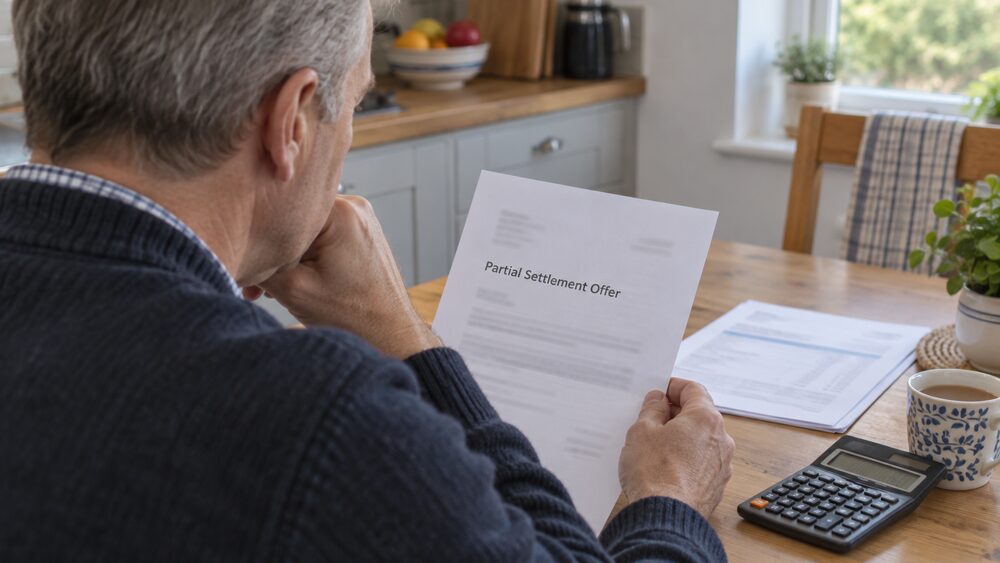
When an account is settled, you can expect to see it showing as having been closed, with your balance changed to zero to show there is nothing outstanding30. If you settled for less than the full amount, the file may also carry a partial settlement flag31. An account can only show as settled on your credit file if it was closed within the original terms and conditions of the agreement3. That is why a defaulted account you later clear may still show the default rather than a clean settled marker.
The distinction between a default and a partial settlement matters for how lenders read the file, and it is worth understanding before you agree a settlement. There is a separate comparison of how each is treated on your file at default vs partial settlement.
Wrong status code? Correcting mistakes with Experian, Equifax and TransUnion
If a status code is wrong, you can challenge it. The first step is to check your report through Experian, Credit Karma or Equifax so you can see exactly what is recorded33. If you suspect a county court judgment has been made against you, check your credit report with Experian, Equifax or TransUnion28. If you think you have been a victim of identity theft, check your credit report with Experian, Equifax and TransUnion and ask for help removing any fraudulent information34.
A wrong status code can be a sign of something more serious. One of the signs of identity theft is that your credit rating goes down even though you have not missed any payments or do not have an account in arrears35. If that happens, it is worth checking the account rows carefully for anything you do not recognise.
You can also add your own explanation. You can add a note to say why you did not pay a debt, or that you are in dispute with a creditor about a debt36. This is a Notice of Correction, and it sits alongside the entry so a lender reading your file sees your side of the story. It does not remove the marker, but it gives context. There is more on how this works, and how it differs from raising a dispute, at Notice of Correction vs raising a dispute.
If you need free, impartial help understanding your file or dealing with the debts behind the codes, StepChange Debt Charity and National Debtline both provide it, and the MoneyHelper service offers free guidance. Correcting your report is covered in more detail at how to correct wrong information on your credit report.
Sources36 cited
- Getting a mortgage with late payments and defaults Which?, 2025-08-20
- How to improve your credit score Which?, 2025-10-24
- Getting credit card debt written off: your rights and options National Debtline, 2026-09-25
- Credit reference agencies (England and Wales) National Debtline, 2026-09-25
- Credit checks when renting Shelter England, 2026-05-01
- Default notices and missed payments StepChange Debt Charity, 2026-09-25
- Buy now pay later (England and Wales) National Debtline, 2026-09-25
- Mortgage shortfalls (England and Wales) National Debtline, 2026-09-25
- Understanding your credit information Equifax, 2026
- Understanding credit information Experian, 2026
- How to improve your credit score HSBC UK, 2026
- Credit score StepChange Debt Charity, 2026-09-25
- Credit report disputes Experian, 2026
- Credit reports and credit reference agencies Advice NI, 2026-09-26
- How does debt affect a credit file? StepChange Debt Charity, 2026-09-25
- Mortgage arrears StepChange Debt Charity, 2026-09-25
- How do mortgage payments work? Which?, 2026-06-19
- Credit reports and credit reference agencies Advice NI, 2026
- Identity theft Information Commissioner's Office, 2026-09-25
- Your non-priority debts (England and Wales) Business Debtline, 2026-09-26
- Credit Information Commissioner's Office, 2026-09-25
- Credit reference agencies (Scotland) Business Debtline, 2026-09-26
- Irresponsible lending and affordability checks StepChange Debt Charity, 2026-09-25
- How to check your credit score for free Which?, 2025-10-24
- How to check your credit score for free Which?, 2025-10-24
- Finding who I owe money to StepChange Debt Charity, 2026-09-25
- Bad credit mortgages Which?, 2025-10-08
- County court judgments (England and Wales) National Debtline, 2026-09-25
- TransUnion credit score shake-up: what the changes mean for you Which?, 2026-09-06
- Full and final settlement offers (Scotland) Business Debtline, 2026-09-26
- Renting with a poor credit history Shelter England, 2026-05-01
- Credit reference agencies (England and Wales) Business Debtline, 2026-09-26
- Ways to make budgeting easier StepChange Debt Charity, 2026-09-25
- Types of fraud Experian, 2026
- Full and final settlement offers (Scotland) National Debtline, 2026-09-25
- Consumer credit sourcebook (CONC) Financial Conduct Authority, 2026











 MoneyHelperFree, impartial money and pensions guidance, set up by government
 Financial Ombudsman ServiceFree, independent help when a complaint about a firm is not put right
 Citizens AdviceFree advice on money, consumer and legal problems in England and Wales
 StepChangeFree debt advice and solutions from a charity
 GOV.UKOfficial information on tax, benefits and government services