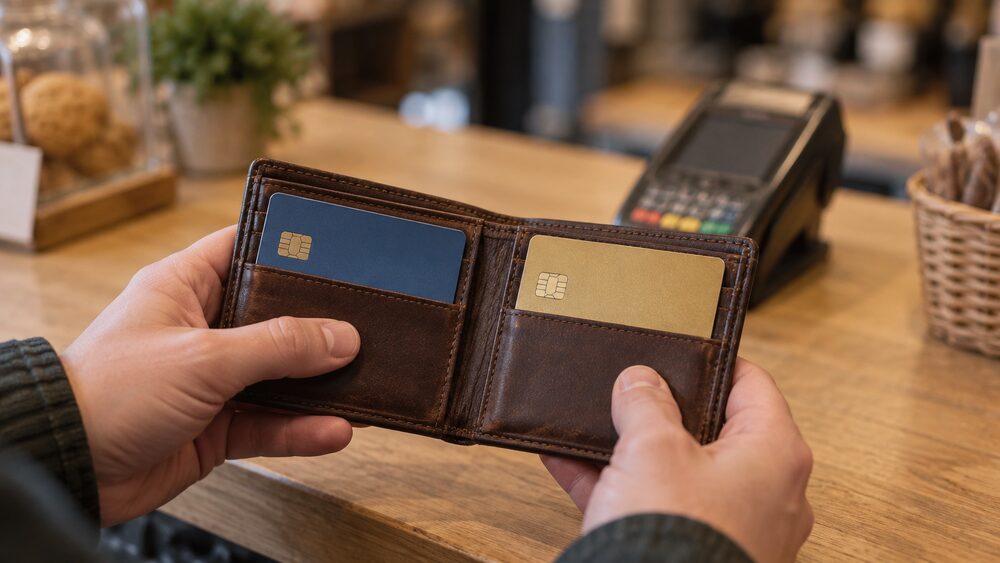
A debit card spends money that is already in your bank account. A credit card spends money the card company has lent you, which you repay later, usually with interest if you do not clear the balance. That single difference drives everything else: what a purchase costs, what happens when something goes wrong, and what shows up on your credit file.
Both are payment cards, and both can be used to pay for goods and services or to withdraw money1. Debit cards overtook cash as the main way people in the UK pay by 2017, and spending has kept shifting: growth in spending was again stronger on credit cards compared with debit cards in the first quarter of 20262.
The practical choice is not which card is better. It is which one suits a particular payment. A debit card is the everyday tool attached to your current account. A credit card is a borrowing product you apply for, and it carries protections a debit card does not, along with costs a debit card does not.
A debit card spends your money, a credit card spends borrowed money
When you buy something on a debit card, you are using money which is already in your bank account or loaded onto the card9. The payment clears from your own balance, so there is no bill to come and no interest to pay on the purchase itself. A basic bank account, which comes with a debit card, lets you pay in wages, salary, benefits, cheques and cash, pay bills by direct debit, and withdraw from cash machines, but it does not include a cheque book or an overdraft10.
A credit card works the other way round. The card company pays the retailer and you owe the company. Credit cards can be used to buy goods anywhere, including over the phone, online or by post9. If you clear the balance in full by the payment date, the borrowing costs nothing. If you do not, interest applies, and the amount of interest varies between providers9.
Credit cards do not have one interest rate but several, and which one applies depends on what you did with the card. There is a purchase rate for buying things, a balance transfer rate for moving what you owe on one card to another, and a cash transaction rate for taking money out of a cash machine or getting cashback at a till11. A debit card has none of these, because it is not lending you anything.
What each card costs to use
Neither card carries a surcharge at the till. You cannot be charged extra for using a credit or debit card12. The costs sit elsewhere.
For a debit card, the account itself is usually the cost. Current accounts can carry a spending or cash machine charge abroad, typically between £1 and £3 each time you use your card, except for euros in the EU8. Some accounts charge a monthly fee; basic bank accounts generally do not, and in exchange they come without an overdraft10.
For a credit card, the costs depend on how you use it. Interest on purchases applies if you do not clear the balance. Cash withdrawals are charged at the cash transaction rate, which is separate from the purchase rate11. Going over your credit limit can trigger a charge: some credit cards have a credit limit, meaning you will be charged if you go over it13. Missing or making only the minimum payment has its own consequences, covered below.
There is a cost to the payment system too, though it is paid by retailers rather than by you directly. Mastercard and Visa account for 99% of debit and credit card payments in the UK14. The average cost of processing a debit card payment was 0.27% of the value of the transaction in 202415. Debit cards, which accounted for the majority of transactions, saw scheme fees rise by 28% compared to 2020, which translated into an additional £141 million in costs imposed by card firms onto retailers just to process debit card transactions in 202116.
Protection when a purchase goes wrong
This is where the two cards diverge most sharply, and it is the reason many people keep a credit card at all.
Section 75 of the Consumer Credit Act makes the credit card company equally responsible with the seller if there are any problems with the items you have bought17. It applies to credit card purchases over £100 and under £30,000, and not to charge cards or debit cards4. The protection only applies to credit card purchases, not debit card purchases18.
Debit cards have a different route. If you paid by debit card, you may be able to make a chargeback claim, which enables you to dispute a card transaction and request your money back for something you have paid for19. Chargeback exists for both credit and debit card purchases, and it applies to all debit card transactions including goods costing less than £100, although exact rules may vary between the American Express, Maestro and Visa networks20. Card providers sign up voluntarily and exact rules may vary between Visa and American Express, so it is not as strong as credit card protection21.
The gap matters most for large or risky purchases. Paying by credit card rather than cash gives extra protection when paying for work, and you may be able to get your money back if something goes wrong23. Booking travel and holidays with a credit card gives some protection if your travel firm goes bust24. For scams, paying by credit card over £100, debit card or PayPal gives more protection than a bank transfer25. Your money is not protected unless you pay by credit card or Direct Debit26.
How each card affects your credit record
A debit card does not build or damage your credit file, because it is not credit. A credit card does, and how you run it is reported.
Applying for a credit card leaves a mark. The credit card provider will check your credit record with a credit reference agency, to see if you are creditworthy6. Applying for too many cards or regularly switching cards can affect your credit rating6. That is a reason to space out applications rather than apply to several lenders at once.
Once you have a card, the record reflects your repayments. Missing payments, going over your limit and carrying a large balance all show up. Minimum payments usually only cover the interest and charges on a debt, so a balance can sit almost unchanged for years while the account stays up to date27. Minimum repayments are typically around 3% of the balance or £5, whichever is higher6.
Your credit card company should contact you to warn you of what might happen if you only make minimum payments12. If the balance is not falling and you cannot afford to pay more, free help is available from debt advice charities, and the debt help section sets out the options.
Using each card abroad
Both cards work overseas, but they are priced differently.
Most credit card companies will charge you a commission charge when you use your card abroad12. Non-sterling transaction fees on credit cards are typically up to 2.99% each time you use one7. Some student credit cards charge 2.75% per transaction, while HSBC charges 2.99%28. Those figures are from 2020 and rates change, so the fee on any particular card is worth checking before travel.
Debit cards carry their own charges. A current account can apply a spending or cash machine charge abroad, typically between £1 and £3 each time you use your card, except for euros in the EU8. Prepaid cards, which are loaded with funds in advance, can be used abroad like a debit card29.
The fees behind the scenes have also moved. Shortly after EU withdrawal, Mastercard and Visa increased interchange fees for card-not-present transactions using consumer debit and credit cards, from 0.2% to 1.15%30. That is a charge between banks, not one added to your statement, but it feeds into the cost of paying by card across borders.
Telling your cards apart
The two cards look similar and are often the same colour and shape, which is why they get mixed up. A few differences are worth knowing.
A debit card is treated as replaced only when both the card and, where relevant, personal identification number have been issued to the banking customer31. That matters if a card is lost: a replacement is not complete until the PIN arrives too.
Credit cards can be used to buy goods anywhere, including over the phone, online or by post, and debit cards work the same way9. Both can be used to withdraw money or pay for goods and services1. The difference is whose money moves.
If you are returning something bought in a shop, take the card you paid with. If you paid for an item on a debit or credit card, take it with you when you return the item32. Refunds go back to the card that paid, which is one practical reason not to mix cards up.
Choosing between them for everyday spending
The two cards are not rivals so much as tools for different jobs, and the choice comes down to what a particular payment needs.
A debit card suits routine spending: groceries, bills, direct debits and cash machine withdrawals, all drawn from money you already have. It cannot leave you with a bill, and it does not touch your credit file. Its weakness is protection: chargeback is voluntary and varies by network, and there is no Section 7521.
A credit card suits purchases where protection matters, where you will clear the balance before interest applies, or where the card carries a benefit you value. Its weakness is cost: interest on purchases, a separate cash transaction rate, charges for going over your limit, and the risk that minimum payments keep a balance alive11.
Some practical points sit across both. Leaving debit and credit cards at home and only taking a small amount of cash is one suggested approach to day-to-day spending33. Several banks let you create virtual debit cards in your mobile banking app, so you do not share your primary physical debit card details with the retailer, and some let you set spending limits or ringfence them by linking them to separate pots34. If you are shopping online, paying by credit card over £100, debit card or PayPal gives more protection than a bank transfer25.
Where the rules differ across the UK
Consumer credit law applies across England, Scotland, Wales and Northern Ireland, so Section 75 and chargeback work the same way wherever you live. Debt advice and the routes into it differ, though. Scotland has its own insolvency and debt solutions, covered in credit card debt in Scotland, and Northern Ireland has its own arrangements, covered in credit card debt in Northern Ireland.
Sources34 cited
- Card payments Payment Systems Regulator, 2026-09-26
- The UK's spending on credit and debit cards House of Commons Library, 2017
- Card expenditure statistics dashboard UK Finance, 2026
- Consumer Credit Act Which?, 2025-10
- Advance loan fee fraud and scams Which?, 2026-09-27
- Choosing and applying for a credit card Citizens Advice, 2026-09-25
- Travel money ABTA, 2026
- How to open, switch or close your bank account MoneyHelper, 2026-09-25
- Plastic cards Citizens Advice, 2026-09-25
- Basic bank accounts MoneyHelper, 2026-09-26
- Credit card debt StepChange, 2026-09-25
- The costs and charges of credit cards Citizens Advice Scotland, 2026-09-25
- Making the most of your bank account Independent Age, 2026-09-26
- Market review into cross-border interchange fees Payment Systems Regulator, 2025-10
- Treasury Committee report on card fees House of Commons Treasury Committee, 2024
- Future of Payments Review 2023: Which? response Which?, 2022-12
- Buying used disability equipment Scope, 2025-11-19
- Consumer Credit Act Which?, 2025-06-18
- How to complain about a takeaway and get your money back Which?, 2026-06-30
- How to get your money back after a scam Which?, 2026
- Safer ways to pay Consumer Council, 2026
- Shop safely online MoneyHelper, 2026-09-25
- Maintaining your home Independent Age, 2026-09-26
- Student credit cards: are they ever a good idea Which?, 2020-03-08
- Buy now pay later Financial Conduct Authority, 2026-02-11
- How to spot, avoid and report scams StepChange, 2026-09-25
- Ombudsman approach to redress for PPI policy mis-sold Financial Ombudsman Service, 2026-09-27
- Best air mile credit cards Which?, 2026-09-02
- Passenger consumer rights when travelling to the EU GOV.UK, 2020-12-31
- Final terms of reference for cross-border interchange fees market review Payment Systems Regulator, 2026-09-26
- BCOBS 7.4 Financial Conduct Authority, 2018-08-15
- I want to return my goods: what are my rights Which?, 2026-09-15
- Tips for managing money and mental health Mental Health and Money Advice, 2018-10-19
- Paying off credit card debt StepChange, 2026-09-25


 MoneyHelperFree, impartial money and pensions guidance, set up by government
 StepChangeFree debt advice and solutions from a charity
 National DebtlineFree debt advice by phone, webchat and online
 Financial Ombudsman ServiceFree, independent help when a complaint about a firm is not put right
 Citizens AdviceFree advice on money, consumer and legal problems in England and Wales