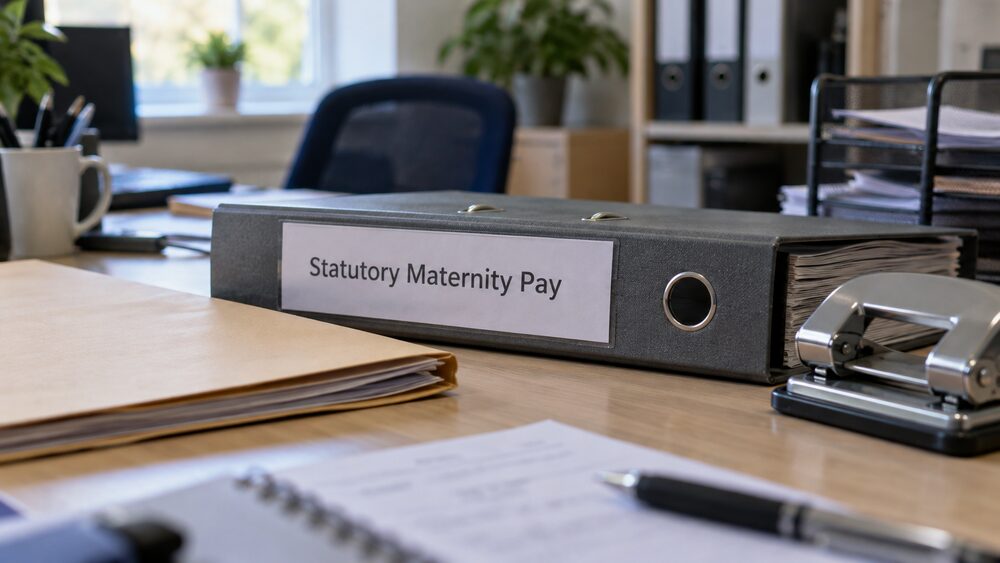
Statutory Maternity Pay (SMP) is the statutory payment your employer makes to you around the birth of your baby. It is a weekly payment, payable for up to 39 weeks1. For the first six weeks you get 90% of your average gross weekly earnings, with no upper limit, and for the remaining 33 weeks you get the lower of a flat rate of £194.32 a week or 90% of your average gross weekly earnings2. Statutory Paternity Pay works on the same flat rate: one or two consecutive weeks at £194.32, or 90% of average weekly earnings if that is less3.
Both payments come from your employer, not from a benefits office, and both are treated like normal pay for tax and National Insurance. To qualify for Statutory Maternity Pay you generally need to have worked for the same employer continuously for at least 26 weeks into the 15th week before your baby is due, and to earn at least £129 a week on average before tax (April 2026 to April 2027)4. If you do not qualify, or you are self-employed, Maternity Allowance from the Department for Work and Pumps is the equivalent payment, at £194.32 a week or 90% of your average pay if lower, for up to 39 weeks5.
Statutory Maternity Pay: up to 39 weeks of weekly pay
Statutory Maternity Pay is a weekly payment from your employer, payable for a period of up to 39 weeks1. The stretch of time over which it is paid is called the Maternity Pay Period, and it runs for a maximum of 39 weeks from the date your pay starts8. You cannot choose to have it spread more thinly over a longer period: the 39 weeks are what the rules provide, and any weeks of maternity leave beyond that are unpaid unless your employer offers contractual maternity pay on top.
SMP is not a benefit in the everyday sense. Your employer works out whether you qualify, pays you through the normal payroll, and recovers most or all of the cost from the National Insurance contributions it collects. That is why claims and disputes about SMP go to HMRC rather than to the Department for Work and Punds: HMRC oversees the statutory payment system that employers operate.
Two payments cannot be combined. You cannot get Statutory Maternity Pay and Maternity Allowance at the same time, and both are paid for a maximum of 39 weeks9. If you qualify for SMP, that is the one you receive; Maternity Allowance exists for people who cannot get SMP from an employer, including the self-employed. The comparison page on Maternity Allowance vs Statutory Maternity Pay sets the two side by side.
SMP is also distinct from Shared Parental Pay. If you and your partner want to divide leave and pay after the birth, Statutory Shared Parental Pay can replace some of your SMP, but only if you qualify for SMP or your partner qualifies for SMP or Maternity Allowance10. The rules for sharing are separate and require notice to both employers.
How much you get: 90% for six weeks, then £194.32 a week
The payment splits into two phases. For the first six weeks, SMP is paid at 90% of your average gross weekly earnings with no upper limit4. For the remaining 33 weeks, it is paid at the lowest of either the standard rate of £194.32 (for the year 2026 to 2027) or 90% of your average gross weekly earnings4. If your average earnings are below £194.32 a week, you simply get 90% of them for the whole 39 weeks, so low earners are not short-changed by the flat rate.
The flat rate rises most Aprils. The uprating order for 2026 increased the weekly rate of statutory maternity pay, along with statutory paternity pay, statutory adoption pay, statutory shared parental pay, statutory parental bereavement pay and statutory neonatal care pay12, and the Government Actuary's report on the 2026 uprating confirms the standard rate of £194.3213. Some advice pages still quote £184.03 a week for the later 33 weeks14; that was the rate for an earlier year, and the figure for the April 2026 to April 2027 rate year is £194.324. If you are reading older guidance, check which rate year it describes.
Your average earnings are worked out from a set reference period: the eight weeks (if you are paid weekly) or two months (if you are paid monthly) up to the last pay day before the end of the 15th week before your baby is due15. A pay rise that takes effect during that reference period changes the average, and your employer must recalculate. A rise that takes effect afterwards does not increase payments already fixed.
Who qualifies: 26 weeks with your employer and £129 a week in earnings
There are two main conditions. First, you must have been employed by the same employer continuously for at least 26 weeks into the 15th week before the week your baby is due, a point known as the qualifying week2. Full-time and part-time work both count. Second, you must earn at least £129 per week on average before tax (April 2026 to April 2027), measured in the eight weeks or two months before the end of the qualifying week6.
On the earnings figure, the guidance is not consistent. Several sources state the threshold as £129 a week for April 2026 to April 20276, while others state £123 for the same rate year17. The £129 figure appears in the more recent and more detailed guidance, but if your earnings sit between the two, do not assume you fail the test: ask your employer to work out your entitlement, and if refused, take the dispute route described later on this page.
A few situations can affect the calculation:
- Share incentive plans: if you take part in a share incentive plan and your average weekly earnings, calculated for SMP purposes, fall below the lower earnings limit, you may lose entitlement18.
- More than one job: you can get SMP from more than one employer, provided you satisfy the qualifying conditions for each job separately19.
- Not qualifying: if you do not qualify, your employer must give you form SMP1 explaining why, and you can then apply for Maternity Allowance20.
Visa holders are not excluded. If you have a visa that allows you to live and work in the United Kingdom you may be able to get SMP, including in some cases where the visa carries a "no recourse to public funds" condition, provided you satisfy the qualifying conditions2.
Statutory Paternity Pay: one or two weeks at £194.32
Statutory Paternity Pay is paid for one or two consecutive weeks at £194.32, or 90% of average weekly earnings if this is less3. You cannot take odd days: it is one week or two consecutive weeks3. The same £194.32 weekly rate is set in legislation for 202621.
The qualifying conditions mirror SMP. You must have continued to work for the same employer without a break for at least 26 weeks by the 15th week before the baby is due, and you must be earning an average of at least £129 a week before tax3. For adoption, the 26 week test runs up to and including the week your wife, partner or civil partner was matched with a child3.
Timing rules apply to the leave itself. Paternity leave starts on or following the child's birth, but must be completed within 56 days of the actual date of birth, or within 56 days after the expected date of birth if the baby is born early3. For adoption, it starts from the date of placement and must be completed within 56 days of that date3.
The claim process is straightforward but has deadlines:
- Tell your employer when you plan to take leave by the 15th week before your baby is due, or within seven days of being told of an adoption match3.
- Your employer may ask for self-certificate form SC3 (becoming a parent), which confirms you are entitled to the pay3.
- If you change your mind, you must give 28 days' notice3.
If you have more than one job, you may be able to get Statutory Paternity Pay from each employer3. Your employer pays it in the same way and at the same time as your normal wages, and it is treated as normal pay, so tax and National Insurance come off as usual3. If your employer decides you cannot have it, they must complete and give you form SPP1 telling you why it has not been paid3.
How to claim from your employer
There is no benefits form for SMP: you claim from your employer. You must tell your employer when you want your SMP to start, and provide medical evidence of the date your baby is due2. In practice the medical evidence is usually the MATB1 maternity certificate, which your midwife or doctor signs from about 20 weeks of pregnancy15.
The notice requirement is 28 days. You must tell your employer that you are pregnant and will be off work because of the birth, 28 days before you decide to start maternity leave, and your employer may need this in writing22. The same 28 day notice applies to the date you want your pay to start17. Tell your employer exactly when you want your Statutory Maternity Pay to start, at least 28 days before you want it to begin14.
For Statutory Paternity Pay, give your employer form SC3; some employers have their own version of the form20. If you are adopting a child, you need to ask your employer at least 28 days before you want the pay to start and fill in form SC4 on gov.uk14.
Once you have given notice, your employer works out whether you qualify and tells you. If you qualify, payment follows through the payroll in the same way as your wages. If your employer says you do not qualify, they must give you form SMP1 explaining why, and that form is what you use to claim Maternity Allowance instead20.
When your pay can start and what moves the date
You choose the start date, within limits. The earliest your Statutory Maternity Pay can start is from the 11th week before the week your baby is due8. The latest you can start your maternity leave, and therefore your SMP, is the week after the week the baby is born22.
Several events can move the date automatically:
- The baby arrives early. If you give birth before the start of your maternity leave, your SMP period starts on the day following the actual date of birth23.
- Pregnancy-related illness. If you are sick with a pregnancy-related illness in the six weeks before your baby is due, your SMP starts the week following the week you become sick22.
- Your job ends. If you are made redundant or leave your employment after the start of the 15th week but before the start of the 11th week before the baby is due, your SMP starts from the beginning of the 11th week before the expected week of childbirth8.
- You leave later. If you leave at any time after the start of the 11th week before the week the baby is due and before the start of your Maternity Pay Period, your SMP starts from the day after you left your employment8.
For premature births, the rules protect your entitlement: SMP is still paid, and the 39 week period runs from the date the payments start24. If your baby is stillborn after the start of the 25th week of pregnancy, or dies shortly after birth, your entitlement to SMP is not lost; claims connected to a baby's death must be made within 28 days of the death25.
Working, changing jobs or leaving during maternity pay
Once you qualify, you are entitled to SMP for the full 39 weeks, and it is not repayable if you decide not to return to work19. But what you do during the pay period changes what happens next.
Starting a new job. Your SMP must stop if you start work with a new employer after your baby is born who did not employ you in the 15th week before the week your baby was due26. Guidance also states that you may need to repay SMP you owe if you start working in a new job before the end of your 39 week maternity pay period15. The two statements point the same way: taking new employment during the pay period can end the payments, and sums already paid for weeks you were not entitled to can be recoverable. SMP itself, for weeks you were entitled to, is not repayable merely because you do not return23.
Self-employment. If your new work is self-employment, it does not affect your SMP23. You can build up a self-employed venture during the pay period without losing the statutory payments.
Keeping in touch with your employer. Once you have given notice of your return, your employer must write to you within 28 days and state the date you are expected to return23.
Redundancy. If you are made redundant while on maternity leave, your statutory redundancy pay should be calculated using your normal week's pay or average week's pay received before your statutory leave period started, not based on SMP or contractual maternity pay17. SMP cannot be offset against statutory redundancy pay: the two are separate and you keep both15.
Payment after employment ends. Your employer can pay your SMP in a lump sum, although you and your employer may pay more National Insurance that way, or continue paying it through the weekly or monthly payroll even if your employment has ended15.
Working abroad and visa holders
Going abroad does not end an entitlement that has begun. If you qualify for Statutory Maternity Pay and go abroad, it will still be payable to you9. Once you become entitled to SMP, or if you are already getting it and then go abroad, your employer must continue paying it26.
Working outside the UK for a UK employer can still qualify. You may be able to get SMP if your employer pays National Insurance contributions for you, or would pay if your earnings were high enough26. If you worked for a UK employer both in the European Economic Area (EEA) and the UK, and actually worked in the UK in the 15th week before your expected week of childbirth, you may get SMP even if your employer has not paid National Insurance contributions for you26. The continuity test can also be satisfied by employment with a UK employer in the EEA: 26 continuous weeks into the 15th week before the baby is due27.
Visa holders, including those with a "no recourse to public funds" condition, may be able to get SMP provided they satisfy the qualifying conditions2. The position on other benefits is different and is covered on the page about the no recourse to public funds condition.
Tax, National Insurance and Universal Credit
SMP is subject to tax and National Insurance like your normal pay15. Your employer can continue to make authorised deductions from it, such as pension contributions and trade union membership, and deductions for an overpayment of wages15. Statutory Paternity Pay is treated the same way: tax and National Insurance come off as usual3.
If your SMP is not high enough for you to pay National Insurance, or to be treated as paying a Class 1 contribution, you can apply for Class 1 NI credits to protect your state pension record15.
Universal Credit. Statutory Maternity Pay, Statutory Paternity Pay, Statutory Shared Parental Pay, Statutory Parental Bereavement Pay, Statutory Adoption Pay and Statutory Sick Pay are all counted as earnings for Universal Credit28. SMP is treated as earnings, and it is partly disregarded under the work allowance if you have a child or limited capability for work6. Claimants receiving these statutory payments are treated as being in paid work for the purposes of the work condition29. The practical effect is that SMP reduces your Universal Credit as earnings do, through the taper, rather than pound for pound. How earnings reduce a Universal Credit award is explained on the page about the work allowance and taper.
Tax credits. For tax credits, the income from Statutory Maternity, Paternity or Adoption pay or Maternity Allowance is included under earnings before tax and National Insurance, and up to £100 a week is deducted before calculating earnings30.
Other help. If you or your partner or civil partner are claiming benefits, you may be able to get a Sure Start Maternity Grant26. Statutory payments also count as income when other benefits are worked out: for example, statutory notice pay claims deduct SMP and Maternity Allowance from what is paid31.
If your employer refuses to pay or goes bust
If your employer refuses to pay SMP, or dismisses you to avoid paying it, you can ask HMRC to step in. The HMRC Statutory Payments Disputes Team handles disputes about Statutory Maternity Pay, Adoption Pay, Paternity Pay, Shared Parental Pay, Parental Bereavement Pay and Statutory Sick Pay, and can be contacted on 0300 322 94227. You can also contact the HMRC employees statutory pay helpline on 0300 200 35007. If your employer is going into liquidation, you can claim your SMP directly from the Statutory Payments Disputes Team on 0300 322 942215. For Statutory Paternity Pay, if you think your employer's decision is wrong, contact the HMRC employees enquiry line3.
Insolvency. If your employer does not pay you SMP because they are insolvent, payment will be made by HMRC from and including the week of insolvency, once the employer has been formally declared insolvent26. Any payments before that date must still be paid by your employer26. Where a job has ended, claims connected to insolvency can be made by written application to the employer or to an Industrial Tribunal within six months of the job ending32.
A struggling employer. Insolvency is not the only route to trouble: your employer can also apply to HMRC for advance funding if they do not have enough money to pay your SMP15. If payments are simply late rather than refused, raising it with the employer first, then with the disputes team, is the sequence the rules support.
If you do not qualify. Your employer must give you form SMP1 explaining why you do not qualify, and you can then apply for Maternity Allowance20. Maternity Allowance covers people who are employed but cannot get SMP, the self-employed, people who have recently stopped working, and those who take part in unpaid work for the business of their spouse or civil partner5. It is paid at £194.32 a week, or 90% of your average weekly earnings if that is less, for up to 39 weeks33. The claim is made on form MA1 with the MATB1 maternity certificate, and you do not need proof of earnings because the Department for Work and Pumps checks your National Insurance record15.
For wider help, free calculators and advisers can check what else you may be entitled to, and the benefits section covers the payments that often follow a birth, including Child Benefit and help with rent.
Sources33 cited
- SMP eligibility nidirect, 2026-04-06
- SMP introduction nidirect, 2026-04-06
- Statutory Paternity Pay nidirect, 2026-04-06
- SMP how it is worked out nidirect, 2026-04-15
- Maternity Allowance GOV.UK, 2026-09-26
- Money for parents and babies Maternity Action, 2026-03
- Miscarriage, stillbirth and neonatal death rights Maternity Action, 2026-03
- SMP when do your payments start nidirect, 2025-06-12
- Guidance on social security abroad NI38 GOV.UK, 2026-07-07
- Shared parental leave and pay nidirect, 2026-04-03
- Maternity leave and pay for parents of twins and triplets Twins Trust, 2026-06-16
- The Social Security Benefits Up-rating Order 2026 legislation.gov.uk, 2026-03-02
- Report by the Government Actuary on the draft Social Security Benefits Up-rating Order 2026 GOV.UK, 2026-01-13
- Time off for a new baby Gingerbread, 2026-06-08
- Maternity pay questions Maternity Action, 2026-03
- Rights for parents with more than one job Maternity Action, 2026-02
- Redundancy during pregnancy and maternity leave Maternity Action, 2026-03
- Share incentive plans and your entitlement to benefits GOV.UK, 2025-10-20
- Pregnant during maternity leave Maternity Action, 2026-03
- Maternity and paternity leave Which?, 2026-04-09
- The Social Security Benefits Up-rating Order 2026 (PDF) legislation.gov.uk, 2026-03-02
- How do I claim Statutory Maternity Pay Turn2us, 2026-05-14
- Resigning from your job during pregnancy and maternity leave Maternity Action, 2026-03
- Premature births: rights to maternity leave and pay Maternity Action, 2026-02
- Bereavement benefits mygov.scot, 2022-10-19
- SMP circumstances that may affect your payments nidirect, 2026-02-19
- Claiming benefits in Europe (EEA countries) nidirect, 2026-09-09
- What will affect your Universal Credit payments nidirect, 2026-06-30
- Universal Credit Regulations 2013 as amended legislation.gov.uk, 2025-04-06
- Maternity, paternity and adoption pay entitledto, 2026-09-26
- How to apply for statutory notice pay GOV.UK, 2024-08-29
- Insolvency payment claims nidirect, 2025-12-22
- Maternity Allowance nidirect, 2026-07-15






 Turn2usFree benefits calculator and grants search from a charity
 Citizens AdviceFree advice on money, consumer and legal problems in England and Wales
 GOV.UKOfficial information on tax, benefits and government services
 MoneyHelperFree, impartial money and pensions guidance, set up by government