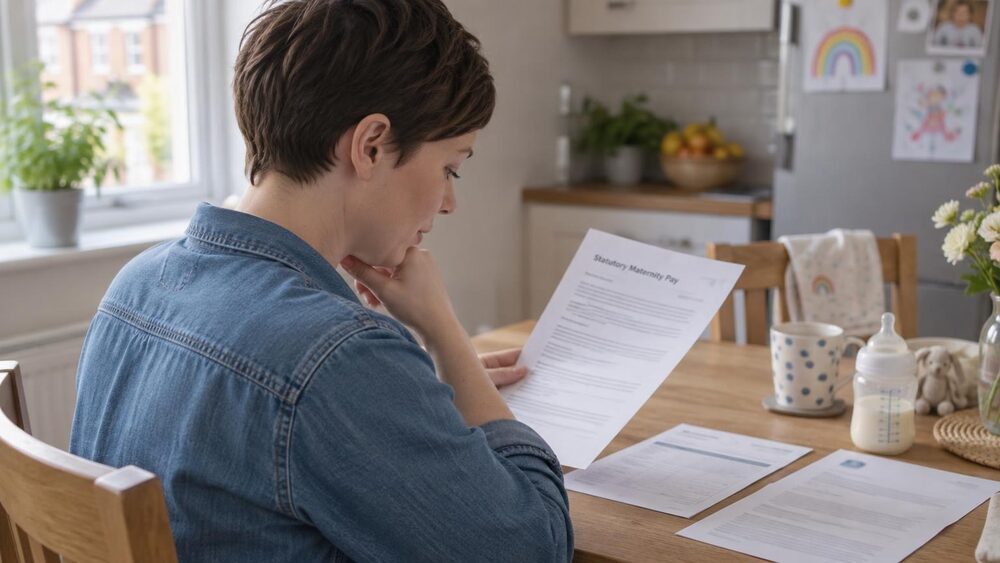
If you are pregnant and about to stop work, the question is usually simple: will you be paid by your employer or by the government? Statutory Maternity Pay (SMP) comes through your employer's payroll. Maternity Allowance (MA) is paid by the government. You cannot get both at the same time, and both are paid for a maximum of 39 weeks1.
For April 2026 to April 2027 the flat rate of SMP and the standard rate of MA are both £194.32 a week3. SMP pays more than that for the first six weeks: 90% of your average weekly earnings, then £194.32 a week or 90% of your pay, whichever is lower, for the rest of the 39 weeks5. MA is paid at a flat rate throughout, without that initial six weeks at 90% of income6.
Which one you get is decided by your employment and earnings, not by choice. If you have worked for your employer long enough and earn enough, you get SMP. If you are self-employed, recently stopped working, or employed but not eligible for SMP, you claim MA instead1.
Statutory Maternity Pay or Maternity Allowance: which one applies to you
The two payments are alternatives, not stages. SMP is your minimum entitlement from the government, paid through your employer while you are on maternity leave12. MA is the version for people who do not qualify for SMP: the government pays it directly9.
You can get MA if you are employed but cannot get SMP, are self-employed, have recently stopped working, or take part in unpaid work for the business of your spouse or civil partner1. You have to have been employed or self-employed at some point to qualify8. If you are pregnant and do not qualify for SMP from your employer, or you are self-employed, MA is the route13.
SMP is paid in the same way and at the same time as your wages are normally paid, so it arrives through payroll like ordinary pay5. MA is paid by the government instead9. Both are based on length of employment and earnings rather than on a means test, and neither is classed as public funds11.
One practical difference is timing. If you are entitled to SMP or MA and you are unemployed, payment starts when you are 29 weeks pregnant, or from the date you stop work if that is later14.
| Statutory Maternity Pay | Maternity Allowance | |
|---|---|---|
| Who pays it | Your employer, through payroll3 | The government9 |
| First six weeks | 90% of average weekly earnings5 | Flat rate throughout6 |
| Remaining weeks | £194.32 a week or 90% of pay, whichever is lower5 | £194.32 a week4 |
| Maximum period | 39 weeks1 | 39 weeks2 |
| Main qualifying test | Average weekly earnings at least equal to the lower earnings limit6 | Employed or self-employed, and not entitled to SMP for the same pregnancy1 |
Who pays each one: your employer or the government
SMP is administered by your employer and paid as a weekly payment3. Your employer pays it in the same way and at the same time as your normal wages, for example monthly if that is how you are paid5. It must be paid in full in cash and cannot be sacrificed or offset against other benefits, and all non-pay contractual benefits must continue during statutory maternity leave16.
MA is paid by the government, which is the main structural difference between the two9. If your employer is going into liquidation, you can claim your SMP directly from HMRC's Statutory Payments Disputes Team on 0300 322 942218. Any payments before the week of insolvency must be paid by your employer; from the week the employer first becomes insolvent until the end of the maternity pay period, liability transfers to the Secretary of State19.
If your employer runs its own occupational maternity scheme and pays more than the statutory amount, that extra sits on top of the statutory entitlement. You can receive occupational maternity pay and MA together if you qualify for both, and if nothing in the scheme says otherwise you are entitled to both the occupational pay and the MA paid by the Department for Work and Pensions18. Where an employer pays more than the statutory amount as part of the employment contract, the extra above the statutory amount is entered as employment income21.
Eligibility depends on your employment and earnings
For SMP, your average weekly earnings must be at least equal to the lower earnings limit that applies on the Saturday at the end of your qualifying week6. That is the earnings test, and it is measured over a set period rather than week by week.
For MA, the test is different. You need to have been employed or self-employed, and you must not be entitled to SMP from a current or former employer for the same pregnancy1. If you are getting or going to get SMP from a current or former employer for the same pregnancy, you cannot get MA15.
There are rules that keep entitlement alive in specific situations:
- If you leave your employment after the beginning of the week immediately preceding the 14th week before the expected week of confinement, the usual notice requirement does not apply to you22.
- If you leave your employment with the person who will be liable to pay your SMP after the beginning of the 15th week before the expected week of confinement for a reason wholly unconnected with your pregnancy, the notice rule in section 164(4) of the Contributions and Benefits Act does not apply23.
- If you are sent to prison or arrested, SMP ends but you can then claim MA20.
- If you are detained in legal custody or sentenced to imprisonment, no liability to pay SMP arises for any week within the maternity pay period for any part of which that applies, unless the sentence is suspended19.
You cannot get both at the same time
The rule is absolute: you cannot get SMP and MA at the same time, and both are paid for a maximum of 39 weeks1. That means the 39 weeks is one period of paid leave, not two entitlements that can be stacked.
The exclusion runs in both directions. You cannot get MA if you are getting or going to get SMP from a current or former employer for the same pregnancy15. If you are receiving statutory maternity, paternity, adoption or additional paternity pay, you are not eligible for Statutory Sick Pay either24.
There is one narrow overlap rule. Where a woman is in receipt of MA within the maternity pay period and is also entitled to SMP following a pay increase or retrospective earnings, the employer is not liable to pay SMP for a week unless, and only to the extent that, the rate of SMP exceeds the rate of MA received in that week19. In practice this means the two are reconciled rather than paid twice.
Shared parental pay interacts with both. To qualify for Shared Parental Pay you must qualify for SMP, or your partner must qualify for SMP or MA25. If you get MA on the basis of your employment or self-employment and you reduce the length of time over which MA is paid, you cannot qualify for Statutory Shared Parental Pay, though your child's father or your partner may qualify26. Statutory shared parental pay is not payable to the mother before the end of her maternity pay period27.
How each payment is treated: earnings, repayment and other benefits
SMP is taxable and is treated as earnings21. Tax and National Insurance are taken off in the usual way, and it counts in full as earnings when your entitlement to means-tested benefits is calculated5. It is not included in the Benefit Cap5. For tax credits, being on statutory maternity leave and receiving SMP counts as remunerative work29.
MA is treated differently. It is taken into account in full as income for all benefits17. That difference matters if you are on Universal Credit: MA is paid at a flat rate without the initial six weeks at 90% of income that SMP provides, and a Maternity Action survey published in August 2022 found that this left women on MA up to £5,000 worse off than women in similar circumstances in receipt of SMP6.
Neither payment has to be paid back. SMP is not repayable, so not returning to work does not create a debt30. If you are made redundant, SMP continues for 39 weeks unless a new job is started31. SMP cannot be offset against statutory redundancy pay, and redundancy pay is based on normal pay, not maternity pay18.
Statutory payments are treated as remuneration from employment in the legislation that governs National Insurance and tax32. The amounts paid out are funded from money provided by Parliament, equal to the aggregate recovered by employers, as estimated by the Government Actuary33. Statutory sick pay, statutory maternity pay, statutory paternity pay, statutory adoption pay, statutory shared parental pay, statutory parental bereavement pay and statutory neonatal care pay are all treated as employed earnings34.
Where Statutory Sick Pay fits in
Statutory Sick Pay and maternity pay do not run together. You are not eligible for Statutory Sick Pay if you are receiving statutory maternity, paternity, adoption or additional paternity pay24. If you become sick during the SMP pay period, your employer does not pay Statutory Sick Pay and continues to pay SMP as normal16.
The reverse situation is different. If you are sick at the end of your SMP, you may claim Statutory Sick Pay from your employer, with the normal eligibility rules applying20. For MA, if you are getting Statutory Sick Pay from your employer, that sick pay must stop when your MA starts, and any Statutory Sick Pay, New Style Employment and Support Allowance or Incapacity Benefit in the four week period will also stop15.
Statutory Sick Pay is treated as earnings21. It also counts as earnings for the purposes of the statutory payment rules: earnings include sums payable by way of statutory sick pay, statutory maternity pay, ordinary and additional statutory paternity pay and statutory adoption pay, among others35. Statutory shared parental pay and statutory neonatal care pay are excluded for any week in which the claimant is entitled to statutory sick pay28.
How to claim and where to get help
For SMP, you claim from your employer37. Your employer administers the payment and pays it through payroll3. Regulations amended in April 2026 mean claimants no longer need to provide the original MAT B1 maternity certificate, so a copy is accepted18.
For MA, the process runs in this order:
- Download a claim form or request one to be posted out38.
- Phone Jobcentre Plus on 0800 169 0283 if you are in England, Scotland or Wales38.
- Complete the MA1 form using the notes and test period table, published on 29 June 202615.
If your employer is going into liquidation, you can claim your SMP directly from HMRC's Statutory Payments Disputes Team on 0300 322 942218.
If you are on a low income or your circumstances change, free and impartial help is available. Checking what you are entitled to covers free calculators and advisers, and Challenging a decision explains mandatory reconsideration if a claim is refused. Maternity Allowance and Statutory Maternity and Paternity Pay set out each payment in full, and Sure Start Maternity Grant covers the one-off grant for a first child. In Scotland, the Best Start Grant has different rules on who qualifies39.
Sources39 cited
- Maternity Allowance GOV.UK
- Guidance on social security abroad (NI38) GOV.UK, 2026-07-07
- Statutory Maternity Pay Turn2us, 2026-05-14
- Maternity Allowance Turn2us, 2026-01-06
- How much Statutory Maternity Pay will I get Turn2us, 2026-05-14
- Cost of living survey Maternity Action, 2022-08
- SMP introduction nidirect, 2026-04-06
- Help during pregnancy Entitledto, 2026-09-26
- What is Maternity Allowance Turn2us, 2026-01-06
- Public funds: accessible version GOV.UK, 2025-04-09
- No recourse to public funds: money for parents and babies Maternity Action, 2026-03
- Occupational Maternity Pay Entitledto, 2026-09-26
- Expecting a child Turn2us, 2026-09-26
- Redundancy during pregnancy and maternity leave Maternity Action, 2026-03
- Maternity Allowance MA1 claim form notes and test period table nidirect, 2026-06-29
- Statutory Maternity Pay: employee circumstances that affect payment GOV.UK, 2014-03-18
- Maternity and paternity pay and allowance Entitledto, 2026-09-26
- Maternity pay questions Maternity Action, 2026-04
- The Statutory Maternity Pay (General) Regulations 1986 legislation.gov.uk, 1986-11-17
- SMP: circumstances that may affect your payments nidirect, 2026-02-19
- Other payments from employment and Universal Credit Entitledto, 2026-09-26
- The Social Security (Jobseeker's Allowance) (Amendment) Regulations 2002 legislation.gov.uk, 2002-10-30
- The Social Security Maternity Benefits and Statutory Sick Pay (Amendment) Regulations 1994 legislation.gov.uk, 1994-06-11
- Statutory Sick Pay explained Which?, 2026-04-14
- Shared parental leave and pay nidirect, 2026-04-03
- Statutory Shared Parental Pay: who does it help Turn2us, 2026-05-14
- The Statutory Shared Parental Pay (General) Regulations 2014 legislation.gov.uk, 2014-11-18
- The Statutory Shared Parental Pay (General) Regulations (Northern Ireland) 2015 legislation.gov.uk, 2015-03-02
- Work definition Entitledto, 2026-09-26
- Resigning from your job during pregnancy and maternity leave Maternity Action, 2026-03
- How to calculate your redundancy pay Which?, 2026-04-06
- Social Security Contributions and Benefits Act 1992 legislation.gov.uk, 1992-02-13
- Social Security Contributions and Benefits Act 1992 legislation.gov.uk, 1992-02-13
- The Universal Credit Regulations 2013, Part 6 legislation.gov.uk, 2013
- The Additional Statutory Paternity Pay (General) Regulations 2010 legislation.gov.uk, 2010-03-25
- The Statutory Neonatal Care Pay (General) Regulations 2025 legislation.gov.uk, 2025-03-20
- How do I claim Statutory Maternity Pay Turn2us, 2026-05-14
- How do I claim Maternity Allowance Turn2us, 2026-01-06
- Best Start Grants Scotland Turn2us, 2026-09-26





 Turn2usFree benefits calculator and grants search from a charity
 Citizens AdviceFree advice on money, consumer and legal problems in England and Wales
 GOV.UKOfficial information on tax, benefits and government services
 MoneyHelperFree, impartial money and pensions guidance, set up by government