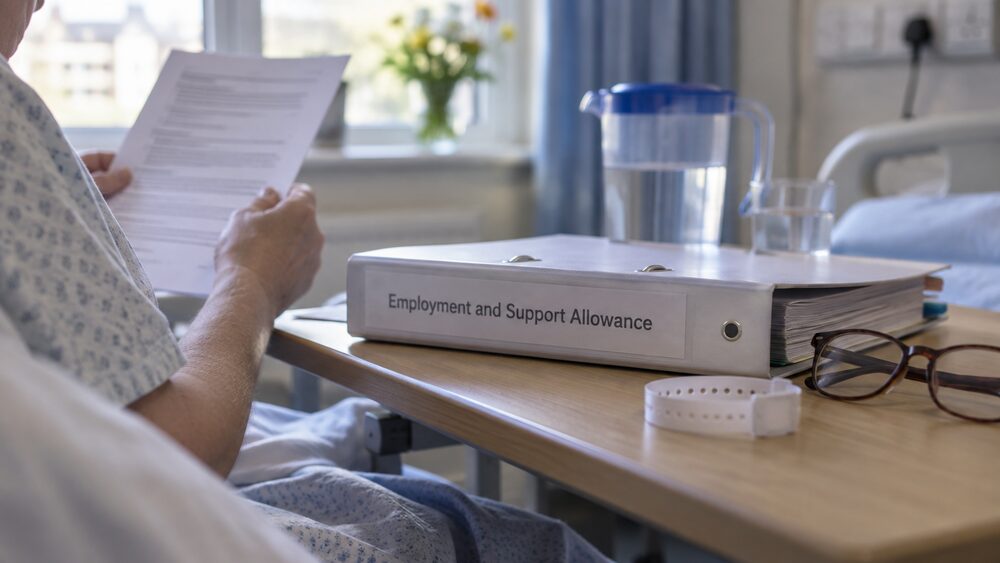
Employment and Support Allowance (ESA) is money to help with living costs if an illness or disability means you cannot work, or cannot work as much as you used to1. You can apply whether you are employed, self-employed or unemployed, as long as you are under State Pension age and your condition affects how much you can work1. New claims today are for "New Style" ESA, a benefit based on your National Insurance record rather than your savings or household income, and it can be claimed on top of Universal Credit.
The amounts are fixed by law. During the assessment phase you are paid a basic allowance of £95.55 a week if you are 25 or over, or £75.65 if you are under 252. After the Work Capability Assessment, people in the support group receive a support component of £50.35 a week on top of the basic allowance3. Payments usually arrive every two weeks into your bank account4.
ESA has been changing for several years. Income-related ESA has been replaced by Universal Credit for new claims, and the government plans to merge New Style ESA and Jobseeker's Allowance into a single contributory "unemployment insurance" benefit in 2028/295. This page explains what ESA is now, what it pays, how the assessment works and what your options are at each stage.
What ESA is and who it is for
ESA exists to support people with an illness or disability that affects their ability to work10. It replaced Incapacity Benefit and Income Support paid on grounds of incapacity for new claims from 30 October 200811. The benefit has two purposes rolled into one: it replaces some of your lost income while you are unable to work, and it offers support to get back into work if you are able to1.
There are two types of ESA: contribution-based (now called New Style ESA) and income-related12. The two work very differently. New Style ESA depends purely on your National Insurance record and pays a flat rate regardless of your savings. Income-related ESA was means-tested and topped up low income, but it has been replaced by Universal Credit and there are no new claims to it13. Anyone who would once have claimed income-related ESA is now directed to claim Universal Credit instead, which has its own health element for people with limited capability for work.
The scale of the benefit has shrunk considerably. Official statistics show ESA fell by 39.0% to 810,000 claimants, a decrease of 520,000 since February 202514. In Northern Ireland there were 55,700 claimants at May 2026, with an average weekly payment of £138.6715. Across the UK as a whole, the average weekly ESA payment was £172.10 as at August 202516. These falls reflect both the move to Universal Credit and changes to who qualifies.
Who ESA tends to suit is narrow now. It is for people under State Pension age with a health condition that limits work, who have a recent National Insurance record17. It can be claimed by part-time students unable to work due to illness or disability, provided they have previously worked and paid contributions18. Existing claimants may also be able to carry on getting ESA as a student10. People over State Pension age look instead to benefits such as Attendance Allowance and Pension Credit.
New Style ESA is based on National Insurance, not savings
New Style ESA is a contributory benefit: what matters is your National Insurance contributions in the last two to three years, not what you own or earn now19. This is the key difference from Universal Credit, which is means-tested and falls as household income rises. Eligibility depends on contributions from two to three years ago rather than the most recent year, which protects people whose recent earnings dropped because of their illness20.
Because it is not means-tested, neither your savings nor any partner's income and savings affect how much New Style ESA you get9. Scope confirms the same point plainly: "It is not means-tested"21. A partner's income and work will not affect your entitlement to contributory New Style ESA at all22. This makes New Style ESA one of the few working-age benefits someone with savings or a working partner can still receive in full.
There is one main exception: an occupational or personal pension paying more than £85 a week can reduce your ESA9. The reduction is applied to the pension income above that threshold, not to the whole pension. If you have a private or workplace pension, it is worth checking how it interacts with your claim before you take the pension.
The National Insurance conditions are strict. You must have paid enough contributions or credits in the last two to three years, which usually means you were working or receiving credits for a period before your illness17. People who have been out of the workforce for longer, or who arrived in the UK recently, may not qualify and may need to rely on Universal Credit instead. If you are unsure of your record, you can check it through HMRC and use a free benefits calculator to see which route is open to you.
How much ESA pays: up to £95.55 a week plus £50.35 in the support group
ESA is paid in two phases, and the amount depends on your age, your group and whether you have a partner. The rates below apply from 7 April 20262.
| Situation | Weekly rate |
|---|---|
| Assessment phase, aged 25 or over | £95.552 |
| Assessment phase, aged under 25 | £75.652 |
| Work-related activity group, single | up to £92.0523 |
| Work-related activity group, with partner | up to £144.6523 |
| Support group, single | up to £140.5523 |
| Support group, with partner | up to £193.1523 |
The support component itself is set in legislation at £50.35 a week for a contributory allowance3, and the personal allowance for a single claimant in the work-related activity group is set at £95.55 weekly24. The legislation and the guidance charities publish agree on these figures for 2026/272.
One independent source gives a different assessment phase figure: £97.75 a week for a single person aged 25 and over for 2026/2725. 552. If your award letter shows a different figure, the letter governs your actual payment.
The support group rates are made up of the basic allowance plus the £50.35 support component2. The couple rates apply where both of you qualify or where your partner's own entitlement is aggregated. ESA is taxable, so these amounts count towards your taxable income for the year26.
The Work Capability Assessment and the 13-week assessment phase
Every ESA claim begins with an assessment phase of around 13 weeks, during which you are paid the basic allowance while your claim is assessed6. Disability Rights UK describes it plainly: "For the first 13 weeks of your claim, the 'assessment phase', you are paid the basic allowance"2. The phase should last up to 13 weeks, but it can be longer27.
During this period you go through the Work Capability Assessment, which decides whether you have limited capability for work. The official detailed guide to New Style ESA sets the assessment phase rate at up to £95.55 a week for those aged 25 and over28. If you are assessed as having limited capability for work, you move on to "main phase" ESA after around 13 weeks of the claim25. If you are not, ESA stops and you may be directed towards Jobseeker's Allowance or Universal Credit instead.
The assessment itself looks at both physical and mental health functions, and the DWP's technical guide to the Work Capability Assessment, aimed mainly at professionals and contractors, sets out how points are scored29. The outcome is not just a yes or no: it also determines which group you are placed in, which in turn sets how much you are paid and for how long. The dedicated guide to the Work Capability Assessment covers the assessment in detail, including what to bring and how descriptors are scored.
The assessment phase can feel precarious because the rate is lower and the outcome is uncertain. Payments during this period are provisional in the sense that they depend on the final decision. If the decision goes against you, there are challenge routes, covered later on this page, and payments can be reinstated while an appeal is prepared.
Support group or work-related activity group: how each one affects you
After your claim is assessed, you are placed in one of two groups: a work-related group if you can prepare to work in the future, or a support group if your condition means you are not expected to work7. The group you land in changes three things: how much you are paid, how long you are paid, and what the DWP requires of you.
The differences are stark:
| Work-related activity group | Support group | |
|---|---|---|
| Weekly rate (single) | up to £92.0523 | up to £140.5523 |
| Time limit | 12 months7 | none, while you meet the rules7 |
| Requirements | prepare for work, attend interviews | no work-related requirements |
| Share of claimants | 2% | 91%13 |
The 12-month limit in the work-related activity group applies to New Style and contribution-based ESA7. Disability Rights UK states: "If you are getting ESA, the award of this will be limited to just 12 months"5. In the support group, by contrast, "it can be paid indefinitely (as long as you continue to meet the qualifying rules and you remain" in the group5. Income-related ESA had no time limit in either group, but it no longer accepts new claims13.
The support group component has a complicated history. The work-related activity component, worth £36.55 a week for income-related claims and £37.95 for New Style claims made before 3 April 2017, was abolished for new claims from that date25. Claimants in the support group continue to get the support group component30. Claims backdated up to three months to a date before 3 April 2017 were not affected by the abolition30.
In practice, most claimants end up in the support group: official statistics show 91% of ESA claimants were in the support group and only 2% in the work-related activity group, with the rest in the assessment phase or receiving credits only13. People in the work-related activity group must comply with conditions for ESA to keep being paid, and could be sanctioned if they do not23. Universal Credit has its own set of work-related requirements, with four groups that determine what you must do31.
Working while on ESA: permitted work and earnings limits
The general rule is that you cannot work while claiming ESA32. But there is an important exception called permitted work, which lets you try some work, keep your skills fresh or ease back towards employment without losing your benefit32.
Permitted work comes in two tiers, and the rules differ between them:
- The lower limit: any work, for an unlimited period, as long as you do not earn more than £20 a week8.
- The higher limit: work for less than 16 hours a week on average, as long as you do not earn more than £203.50 a week8. Scope gives the same £203.50 figure measured after tax and National Insurance21.
The £203.50 limit applies to work under the permitted work higher limit, work as part of a treatment programme under medical supervision, and supported work8. The Office for Budget Responsibility's welfare trends report gives a slightly different figure of £183.50 per week alongside the same 16-hour rule33, while the more recent charity guidance supports £203.508.
Some kinds of work are allowed outside the permitted work rules altogether. These include work as a councillor, work as a member of a First Tier Tribunal (up to one full day or two half days a week), caring for a relative or another person living with you, certain self-employment where you receive assistance, voluntary work not for a relative, and unpaid work experience approved by the DWP8.
Permitted work has to be declared. If you start work and your earnings rise above the limit, ESA stops, so it is worth telling the ESA office before you begin rather than after. The rules on working while claiming cover permitted work across benefits, including how it interacts with Universal Credit if you claim both.
ESA alongside Universal Credit, Statutory Sick Pay and pensions
New Style ESA is designed to sit alongside Universal Credit rather than instead of it. Many people claim both: New Style ESA because their National Insurance record earns it, and Universal Credit because their income and savings are low. The two are treated differently, and Universal Credit usually reduces by the amount of New Style ESA received, but the combination can still leave you better off because New Style ESA is taxable while Universal Credit is not.
You cannot get ESA at the same time as Statutory Sick Pay, Statutory Maternity Pay or Jobseeker's Allowance9. Mencap confirms the same: "You cannot get New Style ESA if you get Jobseeker's Allowance (JSA) or Statutory Sick Pay (SSP)"17. The practical route for most people coming off Statutory Sick Pay is to claim ESA shortly before the sick pay ends, so there is no gap. Macmillan notes that in most cases you cannot claim ESA if you are working, with exceptions for permitted work, supported permitted work and unpaid voluntary work or work experience34.
Pensions are the one income that reduces New Style ESA: an occupational or personal pension paying more than £85 a week can reduce it9. Other income, and your partner's income, do not affect it22.
If you also have a disability benefit such as Personal Independence Payment, that is paid separately and on top. Universal Credit's health element may be available if you have limited capability for work and work-related activity35, and if you move from ESA to Universal Credit having already had a Work Capability Assessment, that assessment will be used for your Universal Credit claim36.
Income-related ESA still matters for people who receive it, because it acts as a passporting benefit. A person in receipt of an income-related ESA is within the core group for certain schemes if any of Conditions A to D is satisfied37. Income-related ESA also counts as a qualifying benefit for the Warm Home Discount core group in England and Wales38, and for the Scottish Child Payment in Scotland39. These passported links are explained in the guide to passported help.
How to claim New Style ESA
Claims for New Style ESA are made online through gov.uk40. You can also claim by phone: in Great Britain, call 0800 055 6688, or use the textphone number 0800 023 4888 if you have a speech or hearing impediment12. British Sign Language users may claim via a video relay service, and in Northern Ireland you can claim online through nidirect or call 0800 085 63185.
Before you start, gather what you need:
- Your National Insurance number and proof of identity.
- A fit note from your GP or hospital doctor covering your illness.
- Details of your income, savings and any pension.
- Your bank, building society or credit union account details, since ESA is usually paid every two weeks into your account4.
Answer every applicable question and send all requested documents straight away. The claim form warns: "If you do not, you may only get benefit from the date you give us all the information we need"40. That is the backdating rule in practice: claims are generally paid from when the DWP has everything, not from when you first fell ill.
Entitlement to New Style ESA is dependent on your National Insurance record40, so if your record has gaps, expect questions. If you go into hospital or a care home, call Jobcentre Plus, as a stay in care can change what you are paid41. Changes of circumstances generally must be reported promptly, and the guide to reporting a change explains what counts and when.
Challenging an ESA decision: mandatory reconsideration and appeal
If you disagree with a decision about your ESA, whether it is a refusal, a finding that you are fit for work, or which group you have been placed in, there is a set process. Start by asking for a mandatory reconsideration. This means the decision maker has to look again at the decision they made7. Only if you still disagree after that can you make an appeal, first to the DWP and then to an independent tribunal9.
The DWP publishes accredited official statistics on the outcomes of Work Capability Assessments, including mandatory reconsiderations and appeals, most recently on 15 September 202644. These show how often decisions are changed at each stage, which is worth knowing if you are deciding whether a challenge is worthwhile. The statistics have been published in this series for years, with an earlier edition in September 201945.
The guides to challenging a decision, mandatory reconsideration versus appeal and appealing to a tribunal cover the deadlines, the paperwork and what happens to your payments while you wait. If you miss the deadline, late appeals explains when they can still be accepted.
ESA and the move to Universal Credit
The ESA system is being wound down in stages. Income-related ESA has been replaced by Universal Credit34, and there are no new claims to income-based ESA, with claimants instead being directed to claim Universal Credit13. New Style ESA continues, and you will not move to Universal Credit if you are only getting New Style ESA46.
For people still on ESA, the move to Universal Credit is coming. The DWP plans for ESA claimants to be the last group to migrate, with the final group due to move in 202847. When you do move, your existing Work Capability Assessment carries over: if you move from ESA to Universal Credit and have already had a Work Capability Assessment, this will be used for your Universal Credit claim36. That means most people will not be reassessed as part of the move itself.
Looking further ahead, the government plans to merge ESA and Jobseeker's Allowance into a single contributory "unemployment insurance" benefit in 2028/29, paid at the same rate as ESA including the support component but time limited5. A time-limited "unemployment" insurance-style benefit is expected to launch in 2028/295. What this means for people in the support group, who currently have no time limit, is not yet settled, and anyone on ESA should watch for a migration notice, which tells you when your own move is due and what to do about it.
The guide to moving to Universal Credit explains transitional protection, which can keep your payments at the same level after the move, and the comparison of New Style ESA versus the Universal Credit health element sets the two side by side.
Where to get free help
ESA claims and assessments are complicated, and free independent help is available from several charities. Disability Rights UK publishes detailed factsheets on ESA, including the rates, the groups and the time limits5. Scope offers guidance on New Style ESA and how it fits with Universal Credit21. Turn2us runs a free benefits calculator and explains permitted work, the claimant commitment and how much ESA pays23. Age UK covers ESA for people approaching later working life26, Carers UK explains ESA for carers in England, Wales and Scotland9, and Macmillan supports people with cancer claiming ESA34. Entitledto and similar calculators, covered in the guide to checking entitlement, show whether New Style ESA, Universal Credit or both is the better route in your circumstances. For anything to do with a decision you disagree with, the guides to mandatory reconsideration and appeals set out the process step by step.
Sources47 cited
- Employment and Support Allowance, gov.uk GOV.UK, 2026-09-25
- Employment and Support Allowance overview, Disability Rights UK Disability Rights UK, 2026-04-07
- The Social Security (Rates of Benefits) Order 2026, legislation.gov.uk legislation.gov.uk, 2026-03-02
- How to have your benefits paid, gov.uk GOV.UK, 2026-09-26
- Employment and Support Allowance resource, Disability Rights UK Disability Rights UK, 2026-04-05
- ESA assessment phase, entitledto entitledto, 2026-09-26
- ESA: how long it lasts, Carers UK Scotland Carers UK Scotland, 2026-09-26
- ESA permitted work, Turn2us Turn2us, 2026-09-26
- ESA and your income, Carers UK Carers UK, 2026-09-26
- Benefits and higher education students, nidirect nidirect, 2026-06-30
- Family Resources Survey quality and methodology report, NISRA NISRA, 2026-05-28
- ESA eligibility, entitledto entitledto, 2026-09-26
- Benefits statistics summary November 2025, NISRA NISRA, 2025-11-30
- Annual DWP benefits statistics compendium 2026, gov.uk Department for Work and Pensions, 2026-03
- Benefits statistics summary May 2026, NISRA NISRA, 2026
- Benefits statistics summary August 2025, NISRA NISRA, 2025-08-31
- New Style ESA, Mencap Mencap, 2026
- Part-time students and disability benefits, Turn2us Turn2us, 2026-04-28
- Universal Credit, Scope Scope, 2026-04-08
- Childbirth injuries, rights at work and benefits, Maternity Action Maternity Action, 2026-03
- Employment and Support Allowance, Scope Scope, 2026-04-22
- Redundancy during pregnancy and maternity leave, Maternity Action Maternity Action, 2026-03
- How much ESA will I get, Turn2us Turn2us, 2025-12-01
- The Social Security (Rates of Benefits) Order 2026 schedules, legislation.gov.uk legislation.gov.uk, 2026
- ESA phases and components, entitledto entitledto, 2026-09-26
- Employment and Support Allowance, Age UK Age UK, 2026-03-23
- ESA assessment and main phase, entitledto entitledto, 2026-09-26
- New Style ESA detailed guide, gov.uk GOV.UK, 2026
- ESA214: a guide to the Work Capability Assessment, gov.uk GOV.UK, 2013-01-01
- Abolition of the work-related activity component, entitledto entitledto, 2026-09-26
- Your claimant commitment, Turn2us Turn2us, 2026-02-25
- How are benefits affected by hours worked, Turn2us Turn2us, 2025-12-16
- Welfare trends report October 2024, OBR Office for Budget Responsibility, 2024-10
- Employment and Support Allowance, Macmillan Macmillan Cancer Support, 2025-06-01
- Health conditions and disability and Universal Credit, gov.uk GOV.UK, 2026-09-26
- Universal Credit if you have a health condition or disability, nidirect nidirect, 2026-08-25
- Universal Credit and ESA (Amendments) Regulations 2026, legislation.gov.uk legislation.gov.uk, 2026-04-30
- Warm Home Discount eligibility, Ofgem Ofgem, 2026
- Scottish Child Payment: who should apply, mygov.scot mygov.scot, 2022-11-14
- ESA claim form consultation, nidirect nidirect, 2026-07
- Going into a care home: benefits, gov.uk GOV.UK, 2026-09-27
- Introduction to ESA Mental Health and Money Advice, 2025-06-19
- Benefits during mandatory reconsideration Mental Health and Money Advice, 2025-03-10
- ESA outcomes of Work Capability Assessments September 2026, gov.uk Department for Work and Pensions, 2026-09-15
- ESA outcomes of Work Capability Assessments September 2019, gov.uk Department for Work and Pensions, 2019-09-12
- What moves you to Universal Credit, nidirect nidirect, 2026-02-24
- Managed migration blog, entitledto entitledto, 2024-01-19






 Turn2usFree benefits calculator and grants search from a charity
 Citizens AdviceFree advice on money, consumer and legal problems in England and Wales
 GOV.UKOfficial information on tax, benefits and government services
 MoneyHelperFree, impartial money and pensions guidance, set up by government