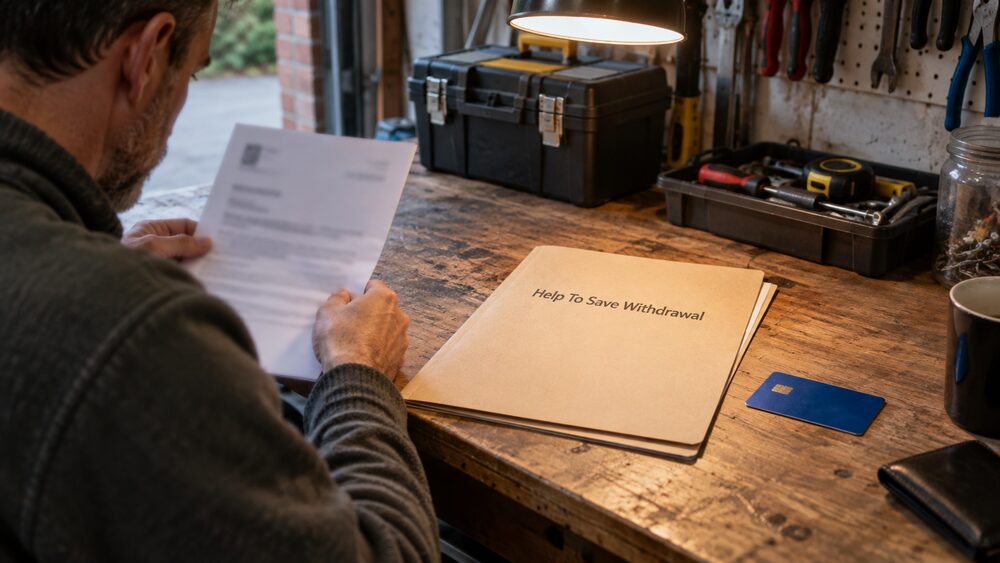
You can take money out of a Help to Save account at any time, and it is paid into your bank account. There is no notice period, no withdrawal limit and no penalty for taking money out. The scheme lets you save up to £50 a month for up to four years and pays a bonus of 50p for every £1 saved1.
You can take money out of a Help to Save account at any time, and it is paid into your bank account. There is no notice period, no withdrawal limit and no penalty for taking money out. The scheme lets you save up to £50 a month for up to four years and pays a bonus of 50p for every £1 saved1.
The catch is not access, it is the bonus. Help to Save pays its 50% bonus at the end of the second and fourth years, based on the highest balance you reach over that period, not on what is in the account when the bonus is worked out2. So a withdrawal does not cost you a fee, but it can cost you bonus, because it can pull down the highest balance your next payment is measured against.
You keep any bonus you have already earned, even if you withdraw money3. What a withdrawal can affect is the bonus still to come. This page sets out how withdrawals work, how long the money takes to arrive, when taking money out reduces a bonus, and what happens if you close the account.
How withdrawals from Help to Save work
Help to Save is a savings account with a government bonus attached, and the withdrawal rules are deliberately simple. You can withdraw the money from your savings at any time and it will be paid into your bank account4. There is no notice period to serve, no fixed term to wait out, and no charge for taking money out. In that respect it behaves like an easy access account rather than a fixed-rate bond, where early access usually costs something.
The account is held by National Savings & Investments (NS&I), and bonuses are paid into your nominated bank account5. That matters for withdrawals too: the money does not sit in a separate NS&I pot you draw from, it is sent to the bank account you nominated when you opened the account. If those details are out of date, the payment goes to the wrong place.
The scheme is open to people on certain benefits, and you open it online at gov.uk/helptosave or through the HMRC app, using your National Insurance number, bank account details and a Government Gateway account. If you cannot get online, you can call 0300 322 70934.
Take-up of the account has been low. At the time of the official evaluation research, take up of the Help to Save account was low1. That is worth knowing if you are weighing it up: it is a small scheme, and the withdrawal process is handled through your HMRC account rather than through a high street banking app.
Bonuses depend on your highest balance, not your current one
This is the single rule that decides whether a withdrawal costs you money. The first bonus is based on the highest balance achieved during the first 2 years1. The second bonus payment is based on the difference between the highest balance saved in the first 2 years and the highest balance saved in the last 2 years1.
In plain terms, the scheme remembers the most you have ever had in the account. Withdrawing does not erase that memory. If you build up to £1,000, take £400 out, and then save back up to £1,000, your highest balance is still £1,000, and the bonus is worked out on that figure. You have not lost anything by withdrawing, but you have not gained anything either, because the money you paid back in only restored a level you had already reached.
Where it bites is the final bonus. If your highest balance does not increase, you will not earn a final bonus3. So if you withdraw everything after two years and carry on saving, you do not get a bonus in year 4, because your highest balance does not go over £1,2004. The money you pay back in rebuilds your savings, but it does not create a new high, so there is nothing for the second bonus to be calculated on.
The official example makes the arithmetic clear. If your highest balance grows from £600 to £800 across years three and four, your final bonus is £100, which is 50% of £2003. The bonus is charged on the £200 of new ground you broke, not on the £800 total.
How to take money out through your HMRC account
Withdrawals are handled through your Help to Save account, which you reach through your HMRC account rather than through a bank's app. The practical steps are:
- Sign in to your HMRC account, using your Government Gateway details.
- Open your Help to Save account and check your current balance and your highest balance so far.
- Check the bank account your withdrawals are paid into is still correct.
- Request the withdrawal and note the date you asked for it.
- Watch for the payment arriving in your nominated bank account.
If you cannot get online, the scheme is reachable by phone on 0300 322 70934. The same number is the route for opening an account, so it is the main point of contact for the scheme.
One thing to check before you withdraw is whether the money is better left where it is. Help to Save savings are treated favourably in the benefits system: to ensure policy consistency, savings in Help to Save accounts should be disregarded from the capital rules6. That is a recommendation from independent research rather than a statement of current benefit rules, so if you are on means-tested benefits it is worth checking how a withdrawal affects your award before you take money out. Our page on how savings affect Universal Credit and other benefits covers the wider picture.
How long a withdrawal takes to reach your bank
Help to Save is run by NS&I, so the timescales that apply to NS&I accounts are the best guide to what to expect. NS&I's published timescales for its savings products are three to five days for a withdrawal to reach your bank account7.
For larger or phone-instructed withdrawals, NS&I gives a slightly different rule. When it gets your instruction on a banking day before 20:00, it processes it that day, and the payment will normally reach your account between two and four banking days after that11. That applies to instructions given by phone, and to multiple withdrawals totalling more than £50,000 in one day11. Where the instruction is given online for a total above £50,000, the payment will normally reach your account two banking days after that11.
| Withdrawal route | When it reaches your bank |
|---|---|
| NS&I savings products generally | 3 to 5 days7 |
| Phone instruction before 20:00 on a banking day | 2 to 4 banking days after processing11 |
| Online instruction above £50,000 in a day | 2 banking days after processing11 |
These are NS&I's own published timescales for its accounts, and Help to Save is administered by NS&I, so they are the closest published guide. Treat them as an indication rather than a promise for Help to Save specifically, and allow a few working days before chasing a payment.
Where withdrawing can cost you bonus
A withdrawal from Help to Save never triggers a charge, but it can reduce a bonus in three ways.
- It can stop a final bonus entirely. If your highest balance does not increase, you will not earn a final bonus3. Withdrawing a large amount late in the four years, when there is little time to build a new high, is the clearest way to lose out.
- It can leave you with nothing to earn a bonus on. Withdraw everything after two years and carry on saving, and you do not get a bonus in year 4, because your highest balance does not go over £1,2004.
- It can interact with time out of the UK. An individual who is absent from the UK, bar temporary absences, is not able to pay any amount into an account, and no bonus will accrue on any amount paid in during such a period12.
The reassuring part is what a withdrawal cannot do. You will get any bonuses you have earned even if you withdraw money3. Once a bonus has been paid, taking money out afterwards does not claw it back. And you can withdraw money at any time, though this may reduce the amount of bonus payment you receive13.
It helps to see the bonus as a reward for breaking new ground, not for holding a balance. Every pound you save above your previous high point is a pound that can earn 50p. Every pound you save below it is a pound that has already done its work.
"Withdrawing money could mean you are not able to earn a final bonus - depending on how much you withdraw and when."
Closing your account and getting help
Closing the account is different from withdrawing from it, and the consequences are firmer. If you close the account early, you also won't be eligible for the next bonus that's due4. An individual's Help to Save account will close 4 years after they open it, and they will not be able to reopen it or open another Help to Save account1. After four years, your account will close14.
So there are two ways the account ends: you close it early and give up the next bonus, or it runs its four years and closes automatically. Either way, there is no reopening it and no second Help to Save account. Our page on when a Help to Save account ends goes through the end of the term in more detail.
If you are thinking about closing early, it is worth checking what it does to your benefits and to any bonus in progress first. Free, impartial help is available from MoneyHelper, and debt advice charities can look at the whole picture if you are weighing up savings against debts. Our guides on paying off debt or building savings first and overpaying the mortgage or keeping money in savings cover those trade-offs.
If a withdrawal does not arrive, contact HMRC, which runs the scheme. Check the nominated account details first, since a payment sent to an old account is the most common cause of a delay. Keep a note of the date you requested the withdrawal. If HMRC cannot resolve the problem, you can take the complaint to the Financial Ombudsman Service, which looks at disputes between consumers and financial firms free of charge.
For comparison, other schemes set their own chase-up points. DVLA asks you to contact it if you have not got your refund cheque after 8 weeks15, and the Scottish Welfare Fund withdraws an award if it is not collected or there is no contact from the applicant within 28 days of grant notification being issued16. Help to Save does not publish an equivalent deadline, so the sensible approach is to allow the NS&I timescales above and then get in touch.
Sources16 cited
- Evaluation of the Help to Save scheme: synthesis report GOV.UK, 2025-11-03
- Annual savings statistics 2025: background and methodology GOV.UK, 2025-09-18
- Help to Save: what you'll get GOV.UK, 2026-09-28
- Help to Save scheme StepChange, 2026-09-25
- What is Help to Save HSBC UK, 2026-07-02
- Saving penalties Resolution Foundation, 2025-04-24
- Direct Saver NS&I, 2026-09-04
- Direct ISA NS&I, 2026-09-04
- Income Bonds NS&I, 2026-09-18
- Premium Bonds NS&I, 2026-09-04
- Make a withdrawal from your savings NS&I, 2025-09-01
- Help to Save regulations: explanatory memorandum legislation.gov.uk, 2018
- How much will I get in the Help to Save scheme Turn2us, 2026-04-17
- Grants, loans and welfare schemes Contact, 2025-10-20
- Vehicle tax refund GOV.UK, 2026-09-25
- Scottish Welfare Fund statutory guidance Scottish Government, 2026-03






 MoneyHelperFree, impartial money and pensions guidance, set up by government
 FSCSProtects your money if a bank, insurer or investment firm fails
 Financial Ombudsman ServiceFree, independent help when a complaint about a firm is not put right
 Citizens AdviceFree advice on money, consumer and legal problems in England and Wales
 GOV.UKOfficial information on tax, benefits and government services