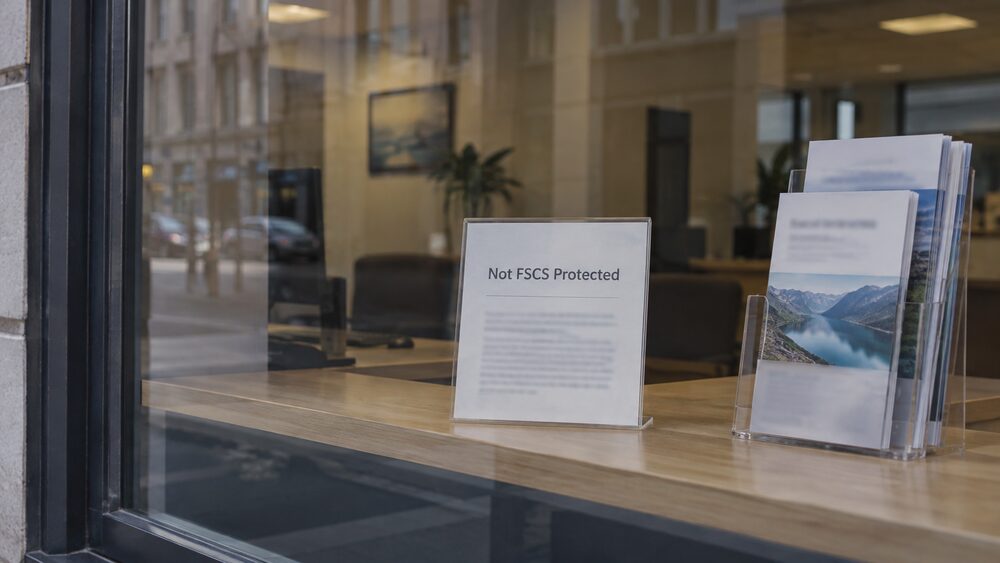
Most people with money in a UK bank, building society or credit union are covered by the Financial Services Compensation Scheme (FSCS) if the firm fails. The scheme protects up to £120,000 per person or company, per authorised firm1. That limit applies across all your accounts with that firm, not to each account separately2.
Most people with money in a UK bank, building society or credit union are covered by the Financial Services Compensation Scheme (FSCS) if the firm fails. The scheme protects up to £120,000 per person or company, per authorised firm1. That limit applies across all your accounts with that firm, not to each account separately2.
But not everyone is covered, and not every kind of money is. Authorised financial services firms are excluded, whatever their size3. Large businesses are usually excluded too, though there are some exceptions for deposits and insurance4. Money held with banks outside the UK is not covered, and neither are e-money or payment services firms5.
The exclusions matter most to people who hold money in more than one name, run a business, or save through an app or platform rather than directly with a bank. This page sets out who is left out, what still counts as protected, and how to check your own position.
Authorised financial firms are excluded, whatever their size
The clearest exclusion is also the one most people never encounter. Authorised financial services firms are not protected by FSCS deposit protection, and there is no size test: a small authorised firm is excluded just as a large one is3. Most businesses are protected, but authorised financial services firms are not3.
The exclusion list is long and specific. Deposits held by credit institutions, financial institutions, investment firms, insurance undertakings, reinsurance undertakings, collective investment undertakings, pension or retirement funds, and public authorities other than small local authorities are all excluded6. Cater Allen, a bank owned by Santander, sets out the same list in its own FSCS information sheet7. Deutsche Bank's terms state that FSCS coverage for deposit protection does not apply to certain types of claimants, including authorised persons8.
There is one notable exception that has widened over time. Deposits from large companies and small local authorities have been covered by FSCS deposit protection since 30 January 2017, up to the £120,000 limit9. So a large company is not automatically excluded, and a small local authority is not either.
For a consumer, the practical point is this: if you hold money through a firm that is itself authorised to carry on financial services, that money may sit outside the scheme. That is most relevant to people running limited companies, partnerships or trusts, and to anyone whose savings are held by a financial business rather than in their own name.
Deposits held for someone else: when the underlying beneficiaries are still covered
Money held on behalf of someone else is not automatically excluded. Deposits held on behalf of underlying beneficiaries who are eligible for FSCS protection are not excluded10. The same wording appears in the FSCS information sheets of BLME, Chase, Atom bank and Accord Mortgages11.
That matters for anyone whose savings are held in a nominee arrangement, a trust, or a platform that pools customer money. The test is whether the underlying beneficiary would be eligible in their own right. If they would, the deposit is not excluded just because someone else holds the legal title.
Pension schemes get a similar carve-out. Personal, stakeholder and occupational pension schemes for micro, small and medium sized companies are not excluded15. So a small company pension scheme's deposits are not shut out of protection simply because a scheme, rather than an individual, is the account holder.
Joint accounts are also eligible for FSCS protection up to the same limit of £120,000 per eligible person5. Two people with a joint account therefore have £240,000 of cover between them, not £120,000 shared.
Where FSCS protection does not apply: banks outside the scheme
FSCS can only protect money held by UK branches of authorised banks, building societies and credit unions5. Banks located outside the UK are not covered by the FSCS16. A deposit is also excluded if it is not held at a UK establishment, or a Gibraltar establishment of a UK-incorporated firm17.
This is the exclusion that catches people who bank with an overseas provider that offers sterling accounts, or who move money to a bank that operates in the UK without a UK banking licence. The FSCS protection checker will not list a firm that is outside the scheme5.
There is a separate rule for firms that share a banking licence. If you have money in multiple accounts with multiple banks that are part of the same banking group and share a banking licence, they are treated as one bank, with the £120,000 limit applying across all accounts6. Protection is across all accounts held within the bank or banking group, not per account3. The Bank of England's explainer makes the same point: anyone who has accounts under different brands owned by the same firm is still only protected up to £120,00018.
So the number of brands on your statements is not the number of limits you get. Two accounts with two brands under one licence share one £120,000 limit.
Is a small business covered by FSCS deposit protection?
Most businesses are protected, but the limit depends on how the business is structured. If your business is a separate legal entity, such as a limited company or an LLP, you could claim up to £120,000 for each account6. A sole trader is different: your company is not treated as a separate entity, so FSCS can protect up to £120,000 in total across all personal and business accounts with the same bank3.
Partnerships have their own rule. Where joint account holders act as business partners, the business partnership is only entitled to a single claim of £120,000, not one claim per business partner6.
Large businesses are usually excluded, although there are some exceptions for deposits and insurance4. The 2017 change that brought large companies and small local authorities into deposit protection is the main exception9.
For a small business owner, the practical questions are whether the business is a separate legal entity, and whether personal and business money sit with the same bank. A limited company with its own account gets its own £120,000 limit. A sole trader with a personal account and a business account at the same bank does not.
Can I lose FSCS protection if my bank never verified my identity?
Yes. A deposit is excluded from protection if the holder and any beneficial owner have never been identified in accordance with money laundering requirements17. Deposits linked to a criminal conviction for money laundering are also excluded17.
This is not a rule most savers will trip over, because banks are required to verify identity before opening an account. But it is a reminder that the protection depends on the bank knowing who you are. Your bank, building society or credit union will confirm eligible deposits on your statement of account and inform you of any exclusions from protection which may apply19.
If you are unsure whether your money is covered, the FSCS website has a checker where you can look up a firm5. Mutual insurers do not appear in the checker, except credit unions that can take deposits5. Your provider's own FSCS information sheet should also set out the exclusions that apply to your account20.
Insurance claims that are not protected, from credit to marine
FSCS also covers insurance, but some kinds of cover are outside the scheme. Goods in transit, marine, aviation and credit insurance are not eligible for FSCS protection, and neither are contracts of reinsurance for insurance firms or brokers or financial advisers21. The FSCS website lists marine, aviation, credit insurance and contracts of reinsurance as ineligible22.
Credit insurance is the one most consumers are likely to meet, because it is often sold alongside a loan or a credit card. It is not covered22. Payment protection insurance, which is a form of credit protection, sits in the same category.
Payment services are outside the scheme too. FSCS only applies to certain types of activity and does not cover payment services23. When Premier Payment Solutions Ltd entered liquidation, the FCA confirmed that the FSCS does not cover payment services23. FSCS cannot protect e-money or payment services firms5.
There are also claimant rules for insurance distribution claims. Bodies corporate, partnerships, mutual associations and unincorporated associations which are not small businesses are excluded where the claim relates to protected non-investment insurance distribution24.
Where insurance claims are covered, the payment rate varies. Employers' liability claims are paid at 100%, while health claims are paid at 90%21. So even inside the scheme, not every claim is met in full.
How do I check whether my bank is part of the FSCS scheme?
The FSCS website has a protection checker that lists firms in the scheme5. You can search by the brand name you know, and the checker will tell you whether the firm is covered. Mutual insurers do not appear in the checker, except credit unions that can take deposits5.
Your provider should also tell you directly. Banks, building societies and credit unions confirm eligible deposits on statements of account and inform customers of any exclusions from protection that may apply19. Virgin Money, for example, points customers to the FSCS website for details on the protection of eligible deposits and deposits excluded from the scheme26.
If a firm is not in the checker, that does not always mean your money is unprotected. It may mean the firm is not a deposit taker, or that it holds your money in a way that puts protection elsewhere. If an aggregator deposited your money with a regulated bank that then fails, it is likely that FSCS will protect it5.
What is covered, and what is not
| Situation | Covered? | Limit or rule |
|---|---|---|
| Personal current or savings account with a UK bank | Yes | £120,000 per person, per authorised firm1 |
| Joint account, two eligible people | Yes | £120,000 per eligible person5 |
| Two brands sharing one banking licence | Yes, as one firm | One £120,000 limit across both6 |
| Limited company or LLP account | Yes | £120,000 for each account6 |
| Sole trader, personal and business money at one bank | Yes, combined | £120,000 in total3 |
| Authorised financial services firm | No | No size test applies3 |
| Large business | Usually no | Some exceptions for deposits and insurance4 |
| E-money or payment services firm | No | FSCS cannot protect these firms5 |
| Bank located outside the UK | No | UK branches of authorised firms only5 |
| Credit, marine, aviation or goods in transit insurance | No | Not eligible for FSCS protection21 |
Where to get help
If you are unsure whether your money is protected, the FSCS website is the starting point: it has a protection checker and information sheets setting out eligible and excluded deposits5. Your own bank, building society or credit union should confirm eligible deposits on your statement and tell you about any exclusions19.
If a firm you saved with has failed, FSCS handles claims directly. The claims process involves the firm's insolvency practitioner and FSCS working together, and FSCS publishes guidance on who is involved and the eligibility rules30.
For free, impartial help with savings questions more generally, MoneyHelper is the government-backed service. For debt problems, StepChange and other debt advice charities offer free advice. If you have a complaint about a financial firm that you cannot resolve, the Financial Ombudsman Service can look at it.
Sources30 cited
- FSCS deposit protection: what is covered FSCS, November 2025
- Check your money is protected FSCS, 25 September 2026
- Deposit protection for banks FSCS, 25 September 2026
- FSCS eligibility rules FSCS, 4 June 2026
- What is the Financial Services Compensation Scheme? Bank of England, 1 December 2025
- Banks, building societies and credit unions FSCS, 25 September 2026
- FSCS information sheet and exclusions list Cater Allen, 2026
- Investor compensation and depositor guarantee schemes Deutsche Bank, 26 September 2026
- Ethical Easy Access Account Charity Bank, 30 January 2017
- FSCS eligibility sheet BLME, November 2025
- FSCS protection Chase, 26 September 2026
- FSCS information Atom bank, 2026
- FSCS information sheet Accord Mortgages, 2026
- FSCS information sheet Accord Mortgages, 2026
- FSCS information sheet Oxbury, 17 August 2026
- Customer terms and conditions Insignis Cash, 11 August 2025
- FSCS information sheet and exclusion lists FidBank UK, 2026
- FSCS information BLME, 25 September 2026
- FSCS information South Herts Credit Union, 2026
- Savings terms HSBC, 2026
- Insurance protection FSCS, 25 September 2026
- Flood insurance FSCS, 25 September 2026
- Premier Payment Solutions Ltd enters liquidation FCA, 14 September 2026
- COMP 4.2: Eligible claimants FCA Handbook, 17 March 2026
- COMP 4.2: Eligible claimants FCA Handbook, 2026
- Help to Buy ISA key features Virgin Money, 2026
- Individual savings accounts Virgin Money, 2026
- M Saver summary box Virgin Money, April 2026
- Property scam investments FSCS, 25 September 2026
- Who's involved in a claim FSCS, 25 September 2026











 MoneyHelperFree, impartial money and pensions guidance, set up by government
 FSCSProtects your money if a bank, insurer or investment firm fails
 Financial Ombudsman ServiceFree, independent help when a complaint about a firm is not put right
 Citizens AdviceFree advice on money, consumer and legal problems in England and Wales
 GOV.UKOfficial information on tax, benefits and government services