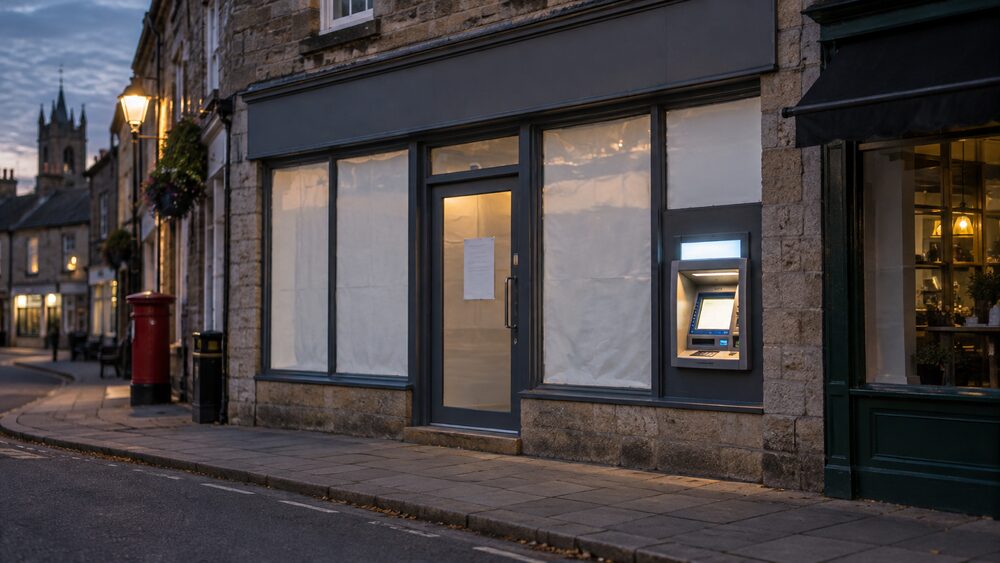
When a bank or building society wants to close a branch, a cash machine or a counter service, it cannot simply switch it off. Since 18 September 2024, rules from the Financial Conduct Authority require designated firms to assess the effect on local cash access before the closure takes effect, and to fill any significant gap the assessment finds1. The Government has chosen 14 banks and building societies, plus one coordination body, to deliver these reviews2. The standard behind the rules is that the vast majority of people should be able to reach a way to deposit and withdraw cash within one mile in urban areas, or three miles in rural areas3.
The assessments themselves are carried out by LINK, the ATM network run by banks, which the Treasury designated as the cash access coordination body in May 20244. If LINK finds a planned closure would leave an unacceptably low level of access to cash, it can recommend new services, from replacement cash machines to shared banking hubs5. This page explains what the rules require, what they cover, how a closure is assessed, how to ask for a review of your own area, and where the rules stop.
What the access to cash rules require from banks and building societies
The legal foundation is Part 8B of FSMA 2000, inserted by the Financial Services and Markets Act 2023, which set out Parliament's intention to protect access to cash and gave the FCA powers to oversee and ensure the continued provision of cash deposit and withdrawal facilities to individuals and businesses4. The regime applies to banks and building societies designated by the Government: in practice, the 14 largest banks and building societies in the UK must conduct cash access assessments when trigger events occur6. The Treasury also designated two LINK entities as the operator of cash access coordination arrangements, which is why LINK rather than the banks themselves runs the assessments4.
The duty has two halves. First, designated firms must review how easy it is for people to get cash in their local area, including paying in and taking out both notes and coins, and fill significant gaps2. Second, they must publish information about the cash access services available to their customers. The FCA's Handbook rule on access to cash puts this in terms:
A designated firm must publish information about the availability of cash access services with respect to its relevant current accounts7. The information covers the range of cash access services available to customers, including facility type, address or location, services, opening hours, accessibility information, the mix of coins and banknotes, charges, assisted cash services and ancillary services8.
The consultation that led to the final rules set out what that published information should include: facility type, address or location, services, opening hours, accessibility information, the mix of coins and banknotes, charges, assisted cash services and ancillary services8. So a designated bank has to tell you not just where its cash points are, but when they are open, whether they are accessible, and what they charge.
The regime formalises work that was already under way. Before the rules, an Access to Cash Action Group had been set up by 8 banks and building societies, chaired by Natalie Ceeney, to work on maintaining access9. The statutory rules replaced that voluntary approach with enforceable obligations.
Which cash services are covered, and which are not
The rules cover cash deposit and withdrawal services for relevant personal and business current accounts across the UK10. For consumers with personal current accounts, the access the rules protect has two features the FCA states plainly: it includes access to both notes and coins, and it is free of charge1. The reviews also aim to make sure businesses can access cash deposit facilities and change2.
Several things sit outside the regime. Cashback with a purchase, pay-to-use services for personal current accounts, and cash delivery or collection services are excluded from the assessment triggers4. Services that are expected to close are not counted when working out what an area has. The arrangements are limited to deposit and withdrawal facilities: they do not extend to wider banking services6.
The rules also have a cut-off at their start. Closures of cash access services that firms had already announced, taking place before the rules came into force, are not subject to the new regime1. A branch whose closure was announced in early 2024 and completed before 18 September 2024 was never assessed under these rules.
Beyond the designated banks, the regime reaches some other providers for information only. The FCA can request information from non-designated personal current account providers with 10 or more branches, the Post Office, and operators of payment systems through which cashback is provided1. That means the Post Office network, which many people rely on for basic banking, is drawn into the picture even though it is not itself designated to fill gaps.
For people who cannot use a mainstream bank account, credit unions offer another route. MoneyHelper notes that with a credit union bank account you can usually, for free, pay in or take out cash at the credit union, have money paid in such as wages, benefits and pensions, use online, mobile or telephone banking, and get budgeting advice and support11.
When a closure triggers an assessment
Two things trigger a cash access assessment. The first is a closure of, or a material reduction or change to, the provision of cash access services at an existing facility, including facilities of non-designated entities. The second is receipt of a cash access request from a local resident, business or representative4. Changes to services, such as a branch, cash machine or Post Office closing or changing its opening hours, count as triggers2.
Not every change counts. The rules define a "relevant closure" as a full closure, or material reduction or change in services, which is reasonably anticipated to last, or has lasted, for at least 6 months4. A temporary closure for building works would not trigger an assessment on its own.
What counts as a material change is spelled out. The FCA considers the removal of a counter at a bank branch or Post Office to be a material change to a cash access service which should trigger an assessment4. And where a service was free to use for personal customers, changing it to pay-to-use qualifies as a material reduction and triggers an assessment4. So a bank converting a free cash machine to a charging one is caught by the rules just as much as a branch closure.
There are exemptions, and they matter in practice:
- No new assessment is required where one is ongoing, or has been completed within the preceding 12 months, for substantially the same local area and issues4
- No assessment is needed where the person who made a request withdraws it in writing, or where the closure is no longer happening4
- Where an ATM closes but one or more ATMs offering the same services remain at the same site, no assessment is required4
The ATM exemption was tightened in the final rules. The FCA amended it so that it only applies where the remaining ATM or ATMs are, between them, accessible 24 hours a day4. A machine locked inside a shopping centre overnight does not keep the exemption on its own.
The Treasury's Cash Access Policy Statement adds a rule about timing: any proposed alternative service identified for maintaining reasonable access must be put in place no later than when the significant closure or change takes place12. The FCA built on this with a 3-step assessment framework that designated entities must follow when an assessment is triggered4. A cost exception exists, where providing new services would not be reasonable, but the FCA expects it to apply in only very exceptional cases given the variety of cash access solutions available8.
How LINK assesses a closure: the 12-week notice and the review
Before the statutory rules, the FCA's guidance FG22/6 already set expectations for branch and ATM closures: firms should communicate closures to customers at least 12 weeks before they take effect, and branches should not be fully or partially closed until reasonable, fit-for-purpose alternatives are in place13. The statutory regime carried the 12-week notice into rules1 and added the assessment machinery around it.
Once a trigger occurs, the designated firm has 12 weeks to carry out the review and publish the outcome2. The assessment itself is conducted by LINK, the ATM network operator run by banks6. LINK looks at a range of factors: where people live and businesses are based, travel time and cost to get cash, ease of taking out and paying in cash after the closure or change, and what services are needed where there are significant gaps2.
Under the industry's previous voluntary scheme for branch closures, LINK used data on low financial resilience, digital exclusion and the numbers in the population aged over 65 to judge an area's needs8. Those measures point the assessment at the people most likely to depend on cash: those on low incomes, those without internet access or the skills to use it, and older people.
The FCA's consumer page states the rule that ties the whole process together: firms planning to close facilities affecting cash access must keep them open until the necessary cash services are available2. That is the protection a reader most needs to know about. The old branch does not shut on the day the notice expires if the replacement has not arrived.
Banking hubs, deposit services and new ATMs: what LINK can recommend
If LINK finds a planned closure would cause an unacceptably low level of access to cash, it can recommend new services be put in place6. Those services range from new ATMs to banking hubs. LINK runs access to cash reviews when banks plan closures or when local residents ask for a review, and the reviews can result in new ATMs or banking hubs6.
Banking hubs are shared facilities on the high street where participating banks each provide counter services on a rota, alongside ATMs. By July 2025, LINK had recommended 77 banking hubs14. The Treasury Committee report that recorded that figure also noted that 80% of businesses had used their local hub since it opened14. Because the rules require access to both notes and coins, free of charge for consumers with personal current accounts1, a hub's counter services sit within the protected scope for personal customers.
LINK also runs other schemes that feed the same machinery: its ATM Community Request scheme and its Retail Centre policy15. Its financial inclusion programme aims to ensure free-to-use ATMs are maintained across the UK and that all communities retain free access to cash16, with over 100 million LINK-enabled cards in circulation16. Support for new free ATMs is available to deprived areas that do not have a free ATM within a kilometre of the nearest free-to-use machine17.
LINK is itself the network that connects UK card issuers and ATM providers, enabling cardholders to obtain cash from their bank accounts from almost anywhere in the UK18. The Payment Systems Regulator oversees LINK as a designated payment system and works with the FCA in its oversight of LINK as the designated cash access coordination body3. The PSR's stated aim is to support cash access, including widespread geographic access, which meets the needs of UK consumers who need or want to use cash19, and it has monitored LINK's commitment to maintain the broad geographical spread of free-to-use ATMs20.
How quickly new services arrive, and how long they must stay
The timetable is fixed at each stage. Firms must deliver the services an assessment identified within 3 months of the review, unless there are exceptional circumstances2. The FCA kept a 3-month backstop for delivery but amended its rules to allow firms longer in exceptional circumstances4. For services required following a community request, the consultation proposed delivery within 3 months of the publication of the assessment outcome or the conclusion of any review, whichever occurs later8.
Once a new service is in place, it cannot be withdrawn quickly. Firms may stop providing a service required by an assessment only a minimum of 2 years after it has been delivered, and then only subject to a new assessment4. So a banking hub or replacement ATM installed after a closure has to stay for at least two years, and taking it away later means going through the assessment process again.
The practical effect of these timings is that a community facing a branch closure should expect a replacement within roughly six months of the closure notice: 12 weeks of notice, up to 12 weeks of assessment, and up to 3 months of delivery, with the old facility staying open in the meantime1.
Asking for a review of cash access in your area
You do not have to wait for a bank to close something. A cash access request from local residents, businesses or their representatives is itself a trigger for an assessment4. You can ask LINK to review your community's access to cash on its Request Access to Cash Review webpage21. The dedicated guide to requesting a cash access assessment walks through how to do this.
There is a limit on repeat requests. Designated entities do not have to act on a cash access request where an assessment is ongoing, or has been completed within the preceding 12 months, for substantially the same local area and issues4. A second request for the same town, raising the same points, within a year of the last review will not restart the process.
The scope of what a review can lead to may widen. The FCA consulted on rules to make cash access reviews a legal requirement and could widen the number of areas eligible for new services6. The PSR's research work, including its call for views on cash access, use and acceptance, examined how use of cash may evolve, the network of cash outlets, alternatives to ATMs for accessing cash, and barriers to using those alternatives22, with a full research report published alongside it23.
How much of the country is covered gives a sense of what a request can achieve. The FCA's coverage data for the second half of 2025 shows 99.6% of the UK urban population within 1 mile of a free-to-use cash access point offering withdrawals24. The rules were built on a baseline of 95% of people in urban areas being within 1 mile, and people in rural areas within 3 miles, of a cash access point4, matching the Treasury's policy statement that at least 95% of people in predominantly urban areas had access to cash deposit and withdrawal services within a mile25. The coverage data counts 48,532 free-to-use cash access points excluding cashback, and 597,417 entries when cashback locations are included24, which shows how much of the raw count comes from shops rather than dedicated cash facilities.
Where the rules stop: what the FCA cannot do for you
The rules protect one thing: getting cash in and out. The reviews only look at whether you can pay in and take out cash2. They will not look at whether local businesses accept cash as payment, because the FCA's powers do not extend to cash acceptance, and businesses can choose whether to accept cash2.
The powers do not extend to wider banking services such as card and PIN management or fraud and scam support, and they do not extend to maintaining branch networks or preventing bank branch closures generally4. The Financial Services and Markets Act 2023 gave the FCA powers to protect access to cash, though not wider banking services6. A branch that no longer offers anything the rules cover, in an area with adequate cash access, can still close.
The FCA also cannot pay compensation. Even where a consumer has received poor service, the FCA cannot pay compensation or order a firm to compensate them26. What the FCA can do is set expectations: firms should consider the likely impact on customers, communicate changes clearly and in good time, and take appropriate steps to ensure customers can continue to have appropriate access to banking and cash services when implementing closures27. The Financial Ombudsman Service, in its response to HM Treasury's Access to Banking review, noted these expectations and the limits of a regime built around access rather than around branches27.
Complaints and help if you cannot get cash
If a bank closes a facility without following the rules, or you cannot get cash because a promised service has not arrived, the first step is to complain to the bank itself. If the bank does not resolve the complaint, the Financial Ombudsman Service can look at it; the Ombudsman sets out how to complain on its website, starting with giving the firm the chance to respond first28.
For matters about the cash network itself, the Payment Systems Regulator provides consumer information on how it helps, including its oversight of LINK and the ATM network to make sure people and businesses have access to cash across the UK29. Its access to cash FAQ pages answer common questions about the network and who to contact21.
Free, impartial help is available from MoneyHelper, which explains everyday banking options including credit union accounts with free cash services11. If you want to check whether a firm is legitimate or report a possible scam, the FCA is the contact30. And if your concern is that your area has lost its last free cash machine or counter, the route with teeth is the one described above: ask LINK for a review, and the designated banks must assess and fill the gap the review finds4.
Sources30 cited
- PS24/8: Access to cash Financial Conduct Authority, 2024
- Access to cash Financial Conduct Authority, 2024
- Access to cash Payment Systems Regulator
- PS24/8 Access to cash policy statement Financial Conduct Authority, 2024
- Access to cash reviews and banking hubs House of Commons Library
- Access to banking services and cash House of Commons Library
- ATCS 10 Access to Cash Rules FCA Handbook, 2024
- CP23/29 Access to cash consultation Financial Conduct Authority, 2023
- UK's cash infrastructure consumer research Financial Conduct Authority, 2021
- Cash access policy statement HM Treasury, 2023
- Credit union current accounts MoneyHelper
- HM Treasury Access to Cash Policy Statement permissions HM Treasury, 2023
- FG22/6 Branch and ATM closures or conversions guidance Financial Conduct Authority, 2022
- Treasury Committee report on access to cash House of Commons Treasury Committee, 2025
- Call for views: second annual review of Specific Direction 8, LINK Payment Systems Regulator
- CP182 Draft Specific Direction 8 protected ATMs Payment Systems Regulator
- The UK's ATM network Payment Systems Regulator
- When you make a payment Payment Systems Regulator
- First annual review of Specific Direction 8, 2020 Payment Systems Regulator, 2020
- Second annual review of Specific Direction 8, 2021 Payment Systems Regulator, 2021
- Access to cash frequently asked questions Payment Systems Regulator
- CP19/6 Call for views: the PSR's research into cash access, use and acceptance Payment Systems Regulator
- CP19/6 Full research report into cash access, use and acceptance Payment Systems Regulator
- Access to cash coverage UK 2025 H2 Financial Conduct Authority, 2025
- Closure of high street banks: impact on local communities House of Lords Library
- Complain about a claims management company GOV.UK
- FOS response to HMT's call for evidence for the Access to Banking Review Financial Ombudsman Service
- How to complain Financial Ombudsman Service
- How we help you Payment Systems Regulator
- What is the Prudential Regulation Authority (PRA)? Bank of England



 Financial Ombudsman ServiceFree, independent help when a complaint about a firm is not put right
 FSCSProtects your money if a bank, insurer or investment firm fails
 FCA Warning ListCheck whether a firm is authorised before you deal with it
 MoneyHelperFree, impartial money and pensions guidance, set up by government
 Citizens AdviceFree advice on money, consumer and legal problems in England and Wales