
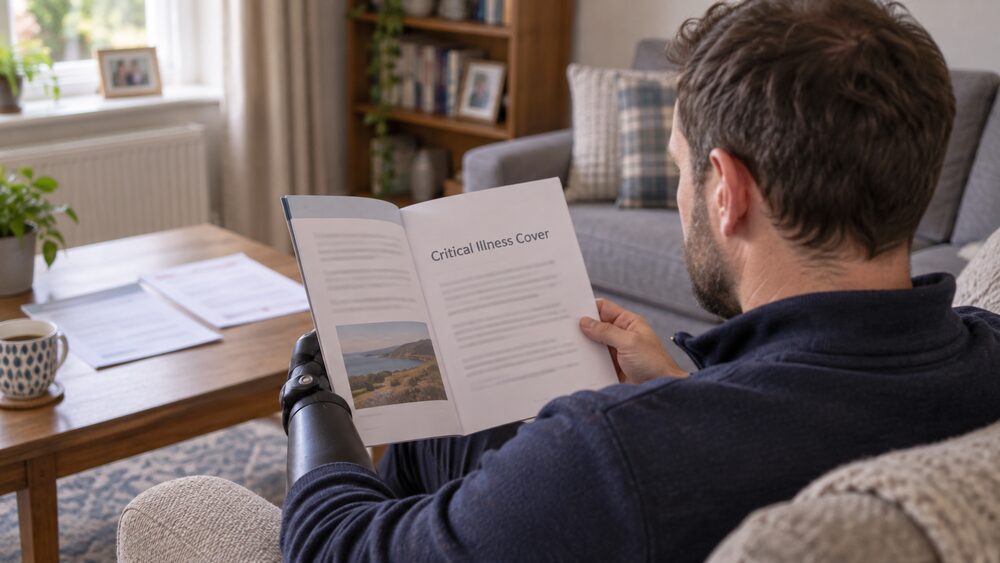
Children's critical illness cover is cover for a child that is built into, or added to, a parent's critical illness policy. Independent guidance explains the underlying product: Which? notes that critical illness cover "pays you a lump sum if you're diagnosed with a serious illness, including many types of cancer"1, and Macmillan's guidance on types of insurance describes critical illness cover as a policy that pays out on diagnosis of a serious illness2. The children's version pays that lump sum if a child is diagnosed with one of the illnesses the policy lists, and in most cases it costs nothing extra: TSB includes children's critical illness cover automatically with its adult cover3, Aviva includes its children's critical illness benefit as standard at no extra cost4, and Legal & General automatically includes Children's Critical Illness Cover when you add its critical illness cover, subject to terms and conditions5.
The money is not compensation for the illness itself. It is designed to help a family cope when a child becomes seriously ill: taking time off work, travelling to hospital, or paying for care and treatment. Nationwide describes its critical illness cover as paying out a lump sum if you or your child become ill with a condition covered by the policy6. Protection policies pay in different ways, and Which?'s guide to family income benefit explains that some life insurance pays a regular income to the family rather than a lump sum7; children's critical illness cover pays a single lump sum on diagnosis. The typical payment is the lower of £25,000 or 50% of the adult's cover amount, though some insurers pay more and some offer paid-for options that go higher.
Children's cover usually comes free with adult critical illness cover
The most common form of children's critical illness cover is not a separate policy at all. It is a benefit inside a parent's critical illness policy, and across the major UK insurers it is usually included without an extra premium. TSB states that children's critical illness cover is automatically included with its critical illness cover3. Aviva says its children's critical illness benefit "comes as standard with our critical illness cover at no extra cost"4. Legal & General will automatically include Children's Critical Illness Cover when Critical Illness Cover is added to one of its life insurance policies, with terms and conditions applying5, and the same benefit is included with its Critical Illness Extra product12.
The reason this matters is that many families who buy critical illness cover for a parent may not realise their children are already covered. Nationwide's guide to life insurance notes that a policy with critical illness cover "also provides cover for your children"13, and its life insurance page makes the same point14. Phoenix's guide to term assurance adds that in some cases cover also provides for children up to the age of 18, or up to 21 if they are in full-time education15.
Not everything is free, though. The Post Office's guide to life insurance is clear that "adding critical illness cover and children's cover to your policy will cost extra" in the sense that the critical illness element itself raises the premium, and that children's cover protects your child if they are diagnosed with a serious illness16. The distinction is between the children's benefit being free once you have adult critical illness cover, and the adult critical illness cover being an optional, paid-for addition to a life insurance policy. Some insurers also sell a paid-for, standalone children's benefit, covered later on this page.
Which children qualify: age limits and family relationships
Insurers define which children count, and the definitions are broader than "your own children living at home". TSB's policy summary defines a relevant child as "a natural child, legally adopted child, or stepchild of the person covered, who is between 30 days old, up to" and including their 18th birthday, or their 21st birthday if in full-time education9. Legal & General's adviser material extends this to children who are under the legal guardianship of the adult covered17.
The age limits are the part that catches families out. Cover does not start at birth: the 30-day minimum in TSB's definition is typical, and it exists because serious conditions detected in the first weeks of life are treated differently. At the other end, cover ends at the child's 18th birthday under many policies, or their 21st if they are still in full-time education9. Scottish Widows goes further, advertising cover for children up to 22 years old18. The age that applies is the age when the claim event occurs, not when the policy was taken out, so a child who turns 19 while a parent's policy is still running may no longer qualify under some policies but still qualify under others.
In practice, the family relationship matters less than people expect. Stepchildren and adopted children are covered under the standard definitions9, and there is no requirement in the definitions quoted here that the child lives with the policyholder. What does matter is that the child meets the policy's definition when the claim happens, and that the policy was in force. If your family circumstances change, for example a new stepchild joins the family, they are typically covered automatically under the same definition, but it is worth confirming with your insurer.
How much it pays: often £25,000 or 50% of your cover, whichever is lower
The most common payment structure across the market is a fixed cap or a percentage of the adult's cover, whichever is lower. Legal & General's consumer page gives the headline: "we could pay out £25,000 or 50% of your cover amount, whichever is lowest"8. Its dedicated children's cover page states the amount payable would be the lower of 50% of the amount of cover at the time the definition is met, or £25,00010, and its FAQs add that with decreasing cover the original amount of cover is used for the calculation19. Nationwide pays up to £25,000 or 50% of the amount of cover, whichever is lower6, and Santander pays the lower of £25,000 or 50% of the cover amount11.
Guardian's Critical Illness Essentials has children's critical illness cover built in, paying £25,000 or 50% of the cover amount, whichever is lower20, and the same applies to its Combined Life and Critical Illness Essentials product21. Guardian's Immediate Cover option applies the children's benefit at 50% of the amount applied for, up to a maximum of £25,000, with funeral cover paying £5,00022.
Some insurers pay more. LV= pays the lower of 50% of the amount of cover, up to £35,000, for a claim on one child's full payment condition, and the lower of 25% of the amount of cover, up to £15,000, for its less serious children's conditions23. Its product page describes children's critical illness cover as an option covering up to £35,00024. Vitality's Serious Illness Cover takes a different approach again, allowing up to £100,000 of standalone child cover to be added to any adult plan25.
| Insurer | Typical children's payment | Basis |
|---|---|---|
| Legal & General | lower of £25,000 or 50% of cover | automatic benefit8 |
| Nationwide | up to £25,000 or 50% of cover | automatic benefit6 |
| Santander | lower of £25,000 or 50% of cover | automatic benefit11 |
| Guardian Essentials | £25,000 or 50% of cover | built in20 |
| LV= | lower of 50% of cover up to £35,000 | full payment conditions23 |
| Zurich | up to £25,000 | added to a life and critical illness policy26 |
The percentage basis means the payment scales with the adult's cover, but only up to the cap. A parent with £20,000 of critical illness cover would receive 50% of that, £10,000, for a child's claim, not £25,000. A parent with £200,000 of cover would receive the £25,000 cap, not £100,000. Families buying cover mainly to protect children should be aware that a larger adult policy does not buy a proportionally larger children's payment beyond the cap.
Conditions covered, including cancer
Children's critical illness cover pays for the conditions listed in the policy, and those lists are set by each insurer. Legal & General covers children for all the conditions listed under its Critical Illness Cover except Total and Permanent Disability27. Zurich's approach is to pay up to £25,000 if your child is diagnosed with one of the same 41 conditions the adult is covered for, where children's cover is added to a life and critical illness policy26. Guardian's Children's Critical Illness Protection pays the full cover amount for specified critical illnesses, including 6 child specific conditions28.
Cancer is the condition most families ask about. The Financial Ombudsman Service describes critical illness cover generally as paying "a lump-sum cash payment if you develop a critical illness like cancer, heart failure or stroke"29. Which? notes that critical illness cover "pays you a lump sum if you're diagnosed with a serious illness, including many types of cancer"1. Macmillan's guidance adds that whether a diagnosis qualifies can depend on the stage or grade of the cancer30. For children's cover specifically, MetLife's child cover products state they include a benefit if your child is diagnosed with cancer31, and Guardian's children's cover pays out if your child becomes critically ill33.
The definitions matter as much as the list. A policy that covers "cancer" will define what counts, and early-stage or low-grade cancers may fall outside the definition under some policies while qualifying under others. The same applies to child-specific conditions: Guardian's six child-specific conditions28 are conditions that occur mainly or only in children, and a policy without them may not pay for those illnesses at all. When comparing policies for a family, the number of conditions and the wording of the definitions matter more than the headline payment.
When children's cover does not pay
The exclusions in children's cover are consistent across insurers, and they mostly relate to what the insurer knew when the cover started. Santander states that children's critical illness "won't pay out if the critical illness was present at birth or the child had symptoms of critical illness before the cover was taken out"11. Legal & General's technical terms add that no payment is made if the child dies within 14 days of meeting a definition, or if the child is under 30 days or over 18 years of age when the claim event occurs34.
The 14-day rule is a survival period, not a waiting period. Legal & General pays a children's claim if the child is diagnosed with one of its specified critical illnesses during the term and survives for 14 days after the diagnosis10. This mirrors the survival periods in adult critical illness cover, and it exists so the policy pays for the financial impact of a child's serious illness rather than acting as a small life insurance policy.
One point worth separating: children's critical illness cover is not the same as state support for a disabled child. In Scotland, Child Disability Payment requires disability tests to have been met for 13 weeks before the claim and to be likely to continue for at least 26 weeks, with terminally ill children exempt35. That is a means-tested state benefit, paid regularly, whereas children's critical illness cover is an insurance lump sum paid on diagnosis of a listed condition. A family can be entitled to both, and neither affects the other's rules.
One claim per child, and caps across policies
Children's cover has claim limits that are easy to miss. Legal & General's technical document states: "We will pay one claim per relevant child (to a maximum of two relevant children) covered under the policy"34. Its consumer pages confirm that only one claim can be made per child and that claims are paid for a maximum of two children10, with cover ending once two claims in total have been made9. Royal London's historic Personal Protection Policy conditions allowed the children's benefit to be paid on one occasion per child, or no more than two occasions where both parents were each the Life Assured under separate single life benefits under the policy36.
The caps also apply across policies with the same insurer. Legal & General pays a maximum of £50,000 for a child covered by more than one of its policies34, or £80,000 for a child covered by more than one policy under its Children's Critical Illness Extra benefit34. LV= states that if the child is covered by more than one policy, the maximum it will pay across all its policies is £140,00023, and it will only pay for one full payment condition for each child23.
Aviva describes how a claim affects the rest of the family's cover: "You can only use this benefit once for each child you have, but after a successful claim for one child, the cover will continue for your other children"4. This is the practical shape of the limit: a claim for one child does not end the policy or the adult cover, and the other children remain covered until the policy's own claim limits are reached.
For a family with more than two children, the two-claim limit is the number to look at. A policy that has already paid two children's claims will not pay a third, however many children are covered. Families who want cover for more than two children's claims would need to look at policies with different limits or at standalone child cover, and to check how caps apply across policies with the same insurer.
Optional and standalone child cover
Alongside the free built-in benefit, some insurers sell child cover as a paid-for option or a standalone product. Guardian's Children's Critical Illness Protection is an optional extra on its Protection range or Life Essentials covers, paying the full cover amount for specified critical illnesses, including 6 child specific conditions28. You can choose any cover amount from £10,000 to £100,000, limited to your own cover amount20, and the same range applies to its Combined Life and Critical Illness Protection21. Vitality offers a standalone option allowing up to £100,000 of child cover to be added to any adult plan25.
MetLife takes a different approach with its Child Cover, sold in units. Its EverydayProtect summary of benefits shows hospital admission cover of £20 to £100 per 24-hour period depending on the number of units chosen, from 1 to 5 units37, and its brochure products state the cover includes a benefit if your child is diagnosed with cancer31. MetLife reported paying 6,282 claims for child accidents and illnesses under its protection portfolio between 1 January and 31 December 202338. MetLife's Child Cover can be added at any time as long as you have at least one eligible child aged under 18 when you add it, and can be removed at any time37.
The choice between a free built-in benefit and a paid-for option comes down to the amount and the conditions. The built-in benefit is capped, typically at £25,000, and pays for the insurer's own list of conditions. A paid-for option can insure a larger amount, up to £100,000 with Guardian or Vitality20, and may cover a different set of conditions, including child-specific illnesses. The cost of the paid-for options is set by each insurer based on your circumstances, so the figures to compare are the cover amount, the conditions and the claim limits rather than a headline price.
Who provides children's cover in the UK
Children's critical illness cover is provided by the UK's protection insurers, usually as part of their adult critical illness products. Legal & General includes Children's Critical Illness Cover automatically with its Critical Illness Cover and Critical Illness Extra12. Aviva includes its children's critical illness benefit as standard4 and paid over £7.6 million in children's critical illness claims in 2024, across 361 claims with an average payout of £21,3214. TSB includes children's critical illness cover automatically3, and Nationwide's critical illness cover pays up to £25,000 or 50% of the amount of cover for a child6.
Other insurers offering children's cover within or alongside their adult policies include Santander11, LV=23, Scottish Widows18, Zurich26, Guardian28, Vitality25, Royal London36 and MetLife37. The differences between them are in the payment amounts, the ages covered, the conditions listed and the claim limits, rather than in the basic idea, which is the same across the market: a lump sum paid if a child is diagnosed with a listed condition while the policy is in force.
Getting advice and where to get help
Because the differences between policies are in the detail, several insurers themselves recommend getting advice before choosing. Royal London says "the next step is to speak to a financial adviser"39, and Guardian says to talk to your financial adviser before deciding which children's critical illness cover is right for your needs and budget28. An adviser can compare the definitions, ages and claim limits across insurers, which vary more than the headline amounts do. The site's guide to buying protection insurance explains the options for getting advice, and how critical illness cover works covers the adult cover these benefits sit inside.
Free, impartial help is available. MoneyHelper, the government-backed money guidance service, offers free information on protection insurance, and a financial adviser regulated by the Financial Conduct Authority can give personal advice on which policy suits your family. If a claim is refused and you believe it was handled wrongly, the Financial Ombudsman Service can look at complaints about insurance claims, and its guidance on personal accident and medical insurance explains how the process works29. Macmillan also publishes guidance on protection insurance for people affected by cancer, including what to check about how a diagnosis affects cover30.
Sources39 cited
- Life insurance with cancer explained Which?, 2026-06-25
- Types of insurance Macmillan Cancer Support
- TSB Life Insurance TSB, 2026
- Children's critical illness benefit Aviva, 2026-05-15
- Different types of life insurance Legal & General, 2026-06-19
- Critical illness cover Nationwide, 2026
- Family income benefit insurance explained Which?
- Critical illness cover Legal & General, 2026-09-26
- Life insurance and critical illness cover policy summary TSB, 2026-01
- Children's critical illness cover Legal & General, 2026-09-26
- Critical illness cover Santander, 2026
- Additional benefits Legal & General, 2026-09-26
- Guide to life insurance Nationwide, 2026
- Life insurance Nationwide, 2026
- Term assurance product guide Phoenix Life, 2026
- What is life insurance Post Office, 2026
- Critical illness cover, adviser product page Legal & General, 2026-09-26
- Critical illness cover Scottish Widows, 2026-09-25
- Critical illness cover FAQs Legal & General, 2026-09-26
- Critical illness cover Guardian1821, 2026-06-08
- Life and critical illness cover Guardian1821, 2026-06-08
- Immediate cover Guardian1821, 2026-06-15
- What illnesses are covered LV=, 2026-09-28
- Critical illness cover LV=, 2026-09-28
- Serious illness cover Vitality, 2026-09-28
- Life insurance Zurich, 2026-09-26
- Life insurance, adviser product page Legal & General, 2026-09-26
- Children's critical illness Guardian1821, 2026-06-08
- Personal accident insurance Financial Ombudsman Service, 2026-09-27
- Protection insurance and cancer Macmillan Cancer Support, 2023-09-01
- MetLife MultiProtect brochure MetLife, 2026
- MetLife EverydayProtect brochure MetLife, 2026
- Our protection Guardian1821, 2026-09-26
- Children's Critical Illness Cover technical information Legal & General, 2026-07
- Child Disability Payment Scotland Disability Rights UK, 2026-04-09
- Personal Protection Policy conditions Royal London, 2026
- EverydayProtect summary of benefits MetLife, 2026
- MetLife child claims paid in 2023 MetLife, 2024-01
- Children's critical illness cover Royal London, 2026-09-26




 MoneyHelperFree, impartial money and pensions guidance, set up by government
 Financial Ombudsman ServiceFree, independent help when a complaint about a firm is not put right
 FSCSProtects your money if a bank, insurer or investment firm fails
 Citizens AdviceFree advice on money, consumer and legal problems in England and Wales
 Turn2usFree benefits calculator and grants search from a charity